
Surat has quietly become one of western India's fastest-growing business hubs. What was once known primarily for its diamond and textile trade is now home to IT parks, corporate towers, co-working hubs, and a rapidly expanding base of startups and service companies. As businesses grow, so does the need for smarter, more efficient, and more flexible office environments. But here's the challenge: most commercial buildings in Surat, especially those built ten or fifteen years ago, were never designed with today's smart office requirements in mind.
This is where RCC modification becomes essential. If you're a business owner, facility manager, or interior contractor planning to convert a traditional office into a smart, technology-driven workspace, understanding how RCC (Reinforced Cement Concrete) modification works — and why it needs to be done by trained professionals — can save you significant time, cost, and structural risk.
At Core Cutting India, we specialize in precision RCC cutting, coring, and structural modification services tailored for commercial and office renovation projects across Surat. In this guide, we'll walk you through everything you need to know.
What Is RCC Modification and Why Does It Matter?
RCC modification refers to the process of altering existing reinforced concrete structures — walls, slabs, beams, or columns — to accommodate new architectural, electrical, mechanical, or structural requirements. This can include cutting openings for doors and windows, creating channels for cabling and ductwork, coring holes for pipes and wiring, or reinforcing weakened sections of a structure.
For a smart office, RCC modification isn't just about aesthetics. It's about creating a functional backbone that supports modern technology: structured cabling for high-speed internet, sensor networks, centralized HVAC systems, automated lighting, security infrastructure, and flexible open-plan layouts. None of this can be properly installed in a rigid, decades-old concrete shell without carefully planned structural changes.
Why Smart Offices in Surat Need RCC Modification
1. Legacy Buildings Weren't Built for Smart Technology
Most commercial buildings constructed before the 2010s in Surat were designed around conventional office layouts — cabin-style rooms, limited cable routing, and basic electrical planning. Smart offices today require significantly more infrastructure: fiber optic cabling, IoT sensor wiring, centralized building management systems, and often raised flooring or false ceiling cavities for services. Retrofitting all of this into a solid RCC structure requires precise cutting and coring work that doesn't compromise the building's structural integrity.
2. Open-Plan and Flexible Layouts Are in Demand
Smart offices favor open, collaborative layouts over compartmentalized cabins. This often means removing or modifying existing RCC walls, which are frequently load-bearing in older structures. Doing this without professional assessment can be dangerous. A structural engineer combined with an experienced RCC cutting team ensures walls are modified safely, with load redistribution accounted for wherever necessary.
3. HVAC and Ventilation Upgrades
Modern smart offices rely heavily on centralized HVAC systems for climate control and air quality monitoring. Installing ducting through existing RCC slabs and walls requires accurate core cutting — often using diamond core drilling techniques — to avoid damaging embedded reinforcement bars or compromising the slab's load-bearing capacity.
4. Cabling, Wiring, and Network Infrastructure
Every smart office depends on a dense network of data cables, power lines, and often dedicated conduits for security cameras, access control systems, and automation sensors. RCC modification allows contractors to create clean, precise channels and openings for this cabling without unnecessary demolition or structural weakening.
5. Fire Safety and Compliance Upgrades
Older commercial buildings in Surat often need modification to meet updated fire safety norms — this includes creating openings for fire-rated ducting, sprinkler systems, and emergency exit pathways. RCC cutting done incorrectly can create safety hazards, which is why compliance-focused planning is critical.
The RCC Modification Process: Step by Step
Step 1: Structural Assessment
Before any cutting begins, a structural assessment identifies which walls, columns, or slabs are load-bearing and which are non-structural partitions. This step is non-negotiable. At Core Cutting India, we work closely with structural engineers and architects to ensure every modification plan is safe and compliant with building codes.
Step 2: Planning and Marking
Once the assessment is complete, precise markings are made on-site indicating where cuts, core holes, or openings will be made. This includes coordination with electrical, plumbing, and HVAC contractors to avoid conflicts with existing utility lines.
Step 3: Core Cutting and Drilling
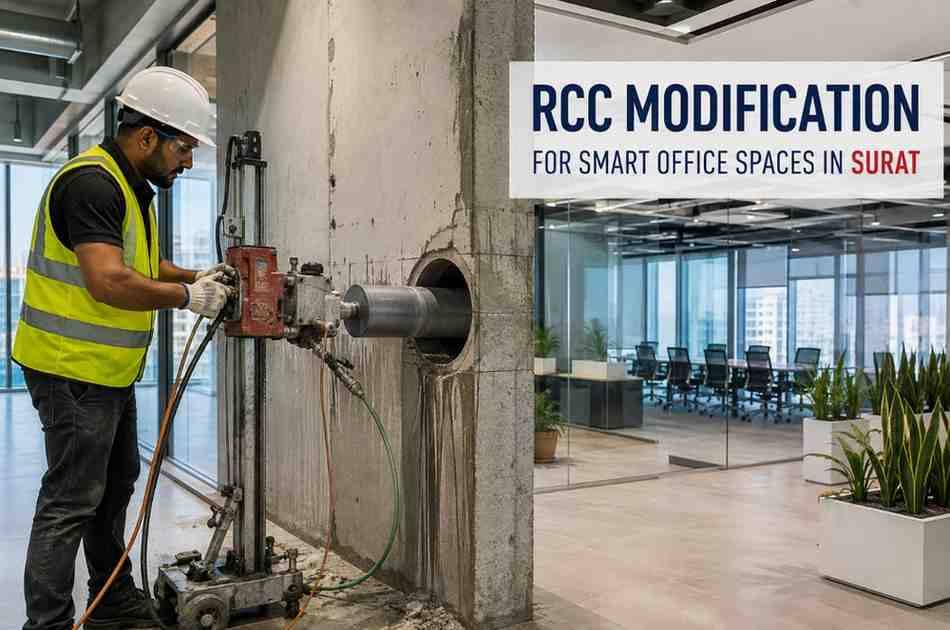
Using diamond core drilling machines and wall-cutting equipment, our team performs controlled, dust-minimized cutting. Diamond core cutting is preferred for RCC modification because it delivers clean, accurate holes and openings without the vibration and cracking associated with traditional hammer drilling — a critical factor when working near reinforcement bars or in occupied buildings.
Step 4: Debris Management and Site Cleanup
Professional RCC cutting services include systematic debris removal and dust control, especially important for offices that may still be partially operational during renovation.
Step 5: Structural Reinforcement (If Required)
In cases where a load-bearing element has been modified, reinforcement measures such as steel plating, jacketing, or additional support columns may be introduced to maintain structural stability.
Step 6: Finishing and Handover
Once modifications are complete, the site is handed over to interior contractors for finishing work — flooring, false ceilings, partitions, and smart device installation.
Benefits of Professional RCC Modification for Smart Offices
Precision Without Structural Compromise Diamond core cutting and controlled demolition techniques ensure that only the necessary concrete is removed, without weakening surrounding structural elements.
Faster Project Timelines Professional equipment and experienced teams complete cutting and coring work significantly faster than manual methods, helping keep renovation projects on schedule.
Reduced Noise and Dust Modern RCC cutting techniques, including wet cutting methods, significantly reduce dust and noise compared to traditional demolition — an important consideration for offices located in busy commercial complexes or shared buildings.
Cost-Effective Renovation Rather than demolishing and rebuilding sections of a structure, targeted RCC modification allows businesses to upgrade their space while preserving the existing building shell, reducing overall renovation costs.
Compliance and Safety Working with a professional RCC cutting contractor ensures all modifications meet local building codes and safety standards, reducing liability for building owners.
Why Surat's Commercial Sector Needs This Now
Surat's commercial real estate landscape is evolving rapidly. Areas like Ring Road, Adajan, Vesu, Pal, and the emerging business districts near Dream City are seeing a surge in demand for modern, tech-enabled office spaces. Companies relocating to Surat or expanding within the city increasingly expect infrastructure that supports hybrid work models, video conferencing, smart access control, and energy-efficient building systems.
Building owners who invest in RCC modification now — converting older commercial stock into smart-office-ready spaces — position themselves to attract higher-quality tenants and command better rental value. For business owners renovating their own offices, RCC modification is often the single most important (and most overlooked) step in creating a genuinely functional smart workspace.
Choosing the Right RCC Cutting Partner in Surat
Not all contractors are equipped to handle RCC modification safely. When selecting a partner for your smart office renovation project, consider the following:
- Experience with commercial and occupied buildings — office renovations often happen while parts of the building remain in use, requiring careful planning to minimize disruption.
- Access to diamond core cutting equipment — this ensures precision and reduces structural risk compared to conventional methods.
- Structural engineering coordination — a reliable contractor works alongside engineers rather than making unilateral cutting decisions.
- Dust and debris management protocols — especially important for indoor commercial environments.
- Track record of compliance — proper documentation and adherence to local building regulations in Surat.
How Core Cutting India Can Help
At Core Cutting India, we bring specialized expertise in RCC cutting, core drilling, and structural modification for commercial and office projects across Surat. Whether you're converting a traditional office into an open-plan smart workspace, installing new HVAC and cabling infrastructure, or reinforcing structural elements for compliance, our team combines technical precision with a strong understanding of commercial project timelines.
We work closely with architects, interior designers, and structural engineers to ensure every modification is planned, executed, and finished with minimal disruption to your business operations. From initial site assessment to final handover, our goal is to help you build a smart office space that is safe, efficient, and future-ready.
Final Thoughts
Transforming a traditional office into a smart workspace is about far more than new furniture and better Wi-Fi. It starts with the building itself — and for most existing commercial spaces in Surat, that means RCC modification. Done correctly, it lays the structural foundation for everything a modern smart office needs: clean cabling routes, efficient HVAC systems, flexible layouts, and full compliance with safety standards.
If you're planning a smart office renovation in Surat, don't leave structural modification to guesswork. Partner with a team that understands both the technical demands of RCC cutting and the practical realities of commercial renovation projects.
Get in touch with Core Cutting India today at [email protected] to discuss your RCC modification requirements and take the first step toward building a smarter, more efficient office space.