
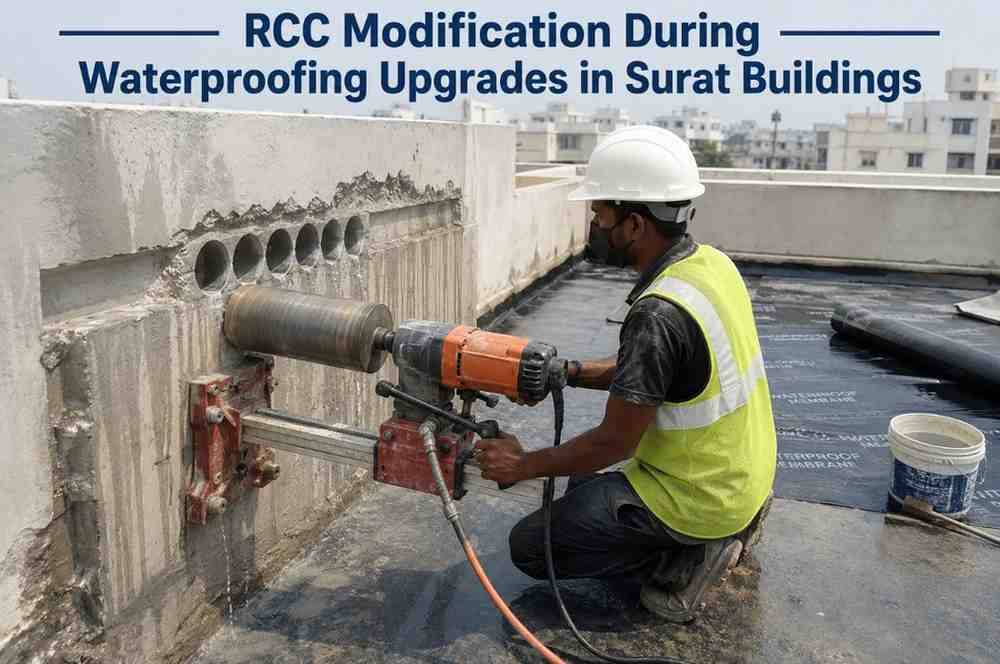
Surat's rapid vertical growth, combined with its humid coastal climate and heavy monsoon rainfall, has made waterproofing one of the most pressing concerns for property owners, builders, and facility managers across the city. From high-rise residential towers in Vesu and Adajan to industrial units in Sachin and Pandesara, water seepage through terraces, basements, and RCC (Reinforced Cement Concrete) slabs is a recurring problem that, left unaddressed, leads to steel corrosion, spalling, and long-term structural damage.
What many property owners don't realize is that effective waterproofing is rarely just a surface-level coating job. In most real-world cases — especially in older or poorly detailed RCC structures — waterproofing upgrades require RCC modification: precise cutting, drilling, chiseling, and reshaping of concrete elements to correct drainage slopes, install new outlets, expose reinforcement for repair, or create construction joints that allow waterproofing membranes to perform correctly.
This blog explains why RCC modification is so closely tied to waterproofing success, the techniques involved, and how Surat property owners can approach these upgrades safely and cost-effectively.
Understanding RCC and Why It's Vulnerable to Water Damage
RCC is the backbone of nearly every modern building in Surat — used in slabs, beams, columns, footings, and water-retaining structures like overhead tanks and basements. While concrete itself is durable, it is inherently porous at a microscopic level, and the embedded steel reinforcement is highly reactive to moisture and oxygen.
When water infiltrates through cracks, poorly sloped terraces, or failed expansion joints, it doesn't just stain ceilings — it initiates a chain reaction:
- Capillary absorption draws moisture deep into the concrete matrix.
- Carbonation and chloride ingress gradually destroy the passive protective layer around reinforcement bars.
- Steel corrosion causes the rebar to expand, generating internal pressure.
- Spalling and cracking occur as the concrete cover breaks away, exposing rusted steel.
In Surat's climate, where monsoon humidity is prolonged and temperature swings accelerate expansion-contraction cycles, this deterioration process moves faster than in drier regions. This is precisely why waterproofing here can't be treated as a cosmetic add-on — it needs to be engineered into the structure, and that engineering often starts with modifying the existing RCC.
Why RCC Modification Becomes Necessary During Waterproofing Upgrades
Waterproofing membranes, coatings, and chemical treatments only work when the underlying concrete substrate is properly prepared and structurally sound. Several situations commonly force contractors to modify the RCC before or during waterproofing:
1. Incorrect or Failed Slope Design
Many older Surat buildings have terraces and sunken slabs built with inadequate slope toward drainage outlets. Water pools instead of flowing away, defeating even premium waterproofing coatings. Correcting this requires cutting and re-profiling sections of the RCC screed or, in severe cases, chipping into the structural slab itself.
2. Damaged or Corroded Reinforcement
Where corrosion has already started, coating over the surface is a temporary fix at best. Proper repair requires breaking out the deteriorated concrete cover, cleaning and treating the exposed rebar, applying anti-corrosive primers, and then recasting the section with polymer-modified repair mortar — all before any waterproofing layer is applied.
3. New Drainage Outlets and Pipe Penetrations
Renovations often require relocating or adding rainwater outlets, plumbing lines, or exhaust penetrations through existing RCC slabs. Precision core cutting is used here instead of manual breaking, because it avoids micro-cracking and vibration damage to the surrounding structure — critical in occupied buildings.
4. Expansion and Construction Joints
Large RCC slabs need properly detailed movement joints to accommodate thermal expansion. Where these were omitted or poorly executed in original construction, contractors may need to saw-cut new joint lines into the slab so that waterproofing membranes can be installed with correct joint treatment and sealants.
5. Basement and Retaining Wall Corrections
In basements, waterproofing upgrades frequently require cutting into RCC walls to install grouting ports, repair construction joints, or expose honeycombed concrete for structural repair before applying membrane or injection-grouting waterproofing systems.
Core Cutting: The Precision Tool Behind Modern RCC Modification
Traditional concrete breaking with hammers and chisels is imprecise, noisy, and risks damaging adjacent reinforcement or finishes — a real concern in occupied residential towers and commercial complexes across Surat. This is where diamond core cutting and drilling has become the industry standard for RCC modification during waterproofing projects.
Core cutting offers several advantages:
- Vibration-free operation, reducing risk to surrounding structural elements
- Clean, accurate openings for drainage outlets, pipe sleeves, and inspection points
- Dust-controlled cutting using wet-cutting techniques, important for indoor and occupied sites
- Ability to cut through reinforced sections without compromising nearby rebar
- Speed and consistency, minimizing project downtime
At Core Cutting India, these techniques are applied specifically to support waterproofing contractors and civil engineers who need RCC openings, slab modifications, or joint cuts executed without disturbing the structural integrity of the building. For inquiries related to core cutting and RCC modification services in Surat, you can reach the team at [email protected].
Step-by-Step: How RCC Modification Fits Into a Waterproofing Upgrade
A well-executed waterproofing upgrade involving RCC modification typically follows this sequence:
Step 1: Structural and Leakage Assessment
Engineers inspect the affected slab, wall, or terrace to identify seepage sources, slope defects, cracks, and corrosion extent. This may involve moisture mapping, hammer-sounding tests to detect delamination, and rebar cover surveys.
Step 2: Marking and Planning RCC Cuts
Based on the assessment, precise locations for core cutting, chiseling, or slab re-profiling are marked. This step is coordinated closely with structural drawings to avoid cutting through primary reinforcement or load-bearing zones.
Step 3: Core Cutting and Concrete Removal
Diamond core drilling or wall/floor sawing is used to remove deteriorated concrete, create new outlets, or cut expansion joints. Debris and dust are managed using wet-cutting methods suited to occupied buildings.
Step 4: Reinforcement Treatment
Exposed steel is cleaned of rust using mechanical or chemical methods, treated with anti-corrosive coatings, and, where section loss is significant, supplemented with additional rebar.
Step 5: Structural Repair and Re-Profiling
Polymer-modified repair mortars or micro-concrete are used to restore the slab profile, correct slopes, and rebuild removed sections to design thickness.
Step 6: Surface Preparation
The repaired RCC surface is cleaned, primed, and prepared according to the specific waterproofing system being installed — whether membrane-based, cementitious, or liquid-applied polyurethane.
Step 7: Waterproofing Application
Only after the RCC has been structurally corrected is the waterproofing system applied — including detailing at joints, drains, and penetrations that were created or modified during the RCC work.
Step 8: Testing and Handover
Ponding tests, flood tests, or moisture checks confirm the waterproofing performance before final handover.
Common Waterproofing Systems Used Alongside RCC Modification in Surat
Different building elements call for different waterproofing approaches, each with its own RCC preparation requirements:
- Terrace and roof waterproofing: Often uses APP/SBS membrane, polyurethane coatings, or cementitious systems — all requiring corrected slopes and clean, sound RCC substrates.
- Basement waterproofing: Frequently combines external membrane systems with internal crystalline or injection grouting, requiring core-drilled grout ports through RCC walls.
- Water tank waterproofing: Uses food-grade cementitious coatings, requiring surface preparation and sometimes core cutting for new inlet/outlet pipe positions.
- Bathroom and wet area waterproofing: Involves chiseling around drain outlets and pipe penetrations to ensure membrane continuity, a common renovation requirement in older Surat apartments.
- Expansion joint waterproofing: Requires saw-cutting clean, straight joint lines for proper sealant and joint-filler installation.
Structural Safety: The Non-Negotiable Priority
Modifying RCC — even for a seemingly minor waterproofing fix — must never compromise structural safety. This is why professional core cutting and RCC modification work should always involve:
- A qualified structural engineer's review before cutting near load-bearing elements
- Use of rebar scanning equipment to avoid cutting primary reinforcement
- Controlled, vibration-free cutting methods instead of manual breaking
- Proper sequencing so temporary structural support is provided where large sections are modified
- Post-modification repair using materials that match or exceed original concrete strength
Cutting corners on any of these steps — quite literally — can turn a waterproofing upgrade into a structural liability. This is particularly relevant in Surat, where many buildings are densely packed and modifications in one unit can affect shared structural elements in a housing society or commercial complex.
Why Surat Buildings Need a Specialized Approach
Surat's building stock presents a few unique challenges that make generic waterproofing approaches insufficient:
- High humidity and monsoon intensity accelerate moisture ingress compared to drier Gujarat cities.
- Dense, high-rise residential development means RCC modification work must be low-vibration and low-noise to avoid disturbing occupied units.
- Older textile and diamond industry buildings in areas like Ring Road and Katargam often have RCC that wasn't originally detailed for modern waterproofing standards, requiring more extensive slab correction.
- Rapid new construction sometimes prioritizes speed over slope and joint detailing, creating latent defects that surface only after a few monsoons.
A specialized RCC modification and core cutting partner who understands both structural safety and waterproofing sequencing is essential for getting these upgrades right the first time — avoiding repeat leakage complaints and costly re-work.
Choosing the Right Contractor for RCC Modification and Waterproofing
When evaluating contractors for this kind of combined structural and waterproofing work in Surat, property owners and facility managers should look for:
- Experience with diamond core cutting and precision concrete sawing, not just manual demolition
- A track record of coordinating with structural engineers and waterproofing specialists
- Dust and vibration control practices suited to occupied buildings
- Clear documentation of rebar scanning and structural assessment before cutting
- References from similar projects — residential towers, industrial sheds, basements, or water tanks in the Surat region
Conclusion
Waterproofing upgrades in Surat buildings are rarely as simple as applying a new coat of sealant. In most cases, lasting protection against water damage depends on correcting the underlying RCC — fixing slopes, treating corroded reinforcement, creating precise drainage outlets, and detailing joints properly. This is where professional RCC modification, backed by precision core cutting techniques, becomes the foundation of a successful waterproofing project.
For property owners, builders, and facility managers in Surat looking to combine structural RCC correction with effective waterproofing, working with a specialized team ensures the job is done safely, precisely, and with long-term durability in mind.
Core Cutting India provides RCC modification, diamond core cutting, and concrete drilling services tailored to waterproofing and structural repair projects across Surat. To discuss your project requirements, reach out at [email protected].
Frequently Asked Questions
What is RCC modification in waterproofing? RCC modification refers to cutting, drilling, chiseling, or re-profiling reinforced concrete elements — such as slabs, walls, or terraces — to correct drainage slopes, expose corroded reinforcement for repair, or create new outlets and joints so that a waterproofing system can be applied effectively and perform as intended.
Why is core cutting required before waterproofing work? Core cutting allows contractors to create precise openings for drainage outlets, pipe penetrations, or joint lines without the vibration and unpredictability of manual concrete breaking. This protects surrounding reinforcement and structural elements while ensuring clean surfaces for waterproofing application.
How much does waterproofing cost in Surat? Costs vary widely depending on the area, the waterproofing system chosen, and whether RCC modification or structural repair is needed alongside it. Get an accurate estimate by having a site assessment carried out, as pricing depends heavily on the extent of slab correction, reinforcement repair, and the specific waterproofing membrane or coating selected.
Which waterproofing method is best for RCC roofs and terraces? The right method depends on factors like slab exposure, foot traffic, slope, and budget. Polyurethane liquid membranes, APP/SBS torch-applied membranes, and cementitious crystalline coatings are all common choices for Surat terraces, each suited to different conditions and maintenance expectations.
Can RCC structures be modified without weakening them? Yes, when the work is planned properly — including rebar scanning, structural engineering review, and use of precision cutting tools like diamond core cutters — RCC modification can be carried out without compromising structural safety. Problems typically arise only when cutting is done without proper assessment or by unqualified contractors.
How long does an RCC waterproofing upgrade take? Timelines depend on the extent of RCC repair required. A straightforward coating application might take a few days, while projects involving significant slab correction, reinforcement treatment, and re-profiling can take one to two weeks or more, followed by curing and testing before final handover.