
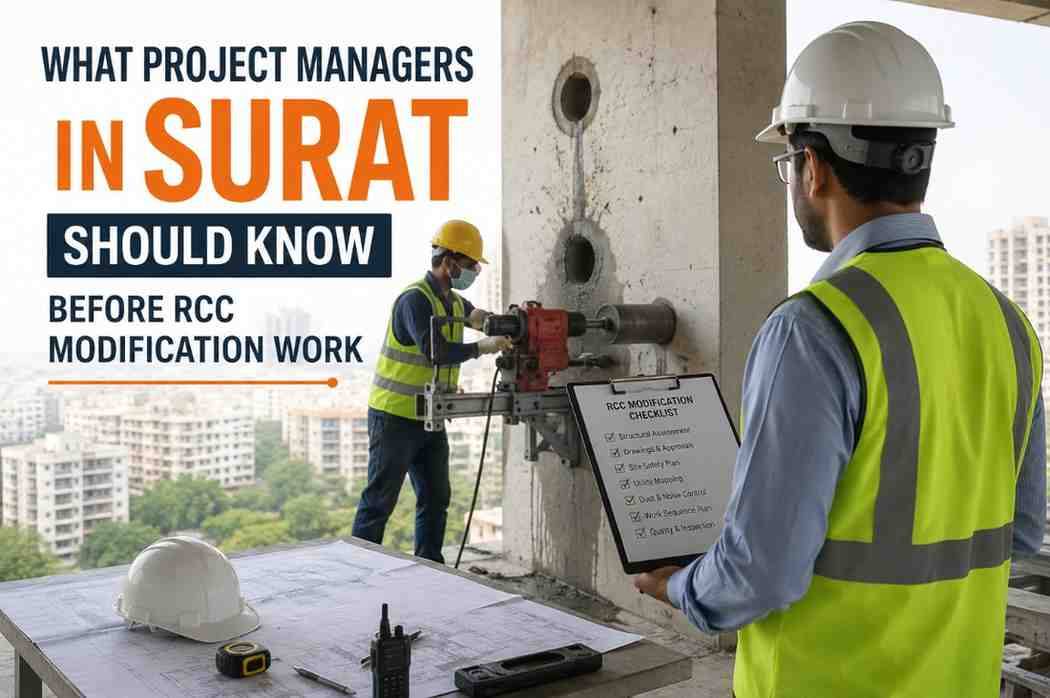
Surat's skyline is changing fast. Textile hubs, diamond markets, high-rises near the Tapi riverfront, and an ever-expanding industrial belt mean that construction and renovation activity in the city rarely slows down. With this growth comes a steady rise in RCC (Reinforced Cement Concrete) modification work — cutting, coring, demolishing, or reshaping existing concrete structures to accommodate new floors, openings, utilities, or structural changes.
For project managers, RCC modification is one of the trickiest parts of any construction or renovation timeline. Unlike fresh construction, you're working with a structure that already exists, already carries load, and already has hidden reinforcement, utilities, and stress points you can't always see. A single wrong cut can compromise structural integrity, delay a project by weeks, or put workers at risk.
At Core Cutting India, we've worked on RCC cutting, coring, and demolition projects across Surat's residential towers, commercial complexes, and industrial units. This guide brings together what we believe every project manager should know before RCC modification work begins.
What Exactly Is RCC Modification Work?
RCC modification refers to any process that alters the existing reinforced concrete structure of a building. This includes:
- Wall cutting — creating new door or window openings, or removing non-load-bearing partitions
- Slab cutting — for new staircases, lift shafts, ducts, or floor openings
- Core drilling — precise circular holes for plumbing, electrical conduits, HVAC ducts, or anchor bolts
- Column and beam modification — rare, but sometimes required for structural retrofitting
- Controlled demolition — removing sections of concrete without affecting adjoining structure
Each of these tasks demands a different approach, different equipment, and a different level of structural understanding. Treating all RCC modification as "just cutting concrete" is the most common — and costliest — mistake project managers make.
Why This Matters More in Surat Specifically
Surat presents a few local realities that project managers need to factor in:
- Rapid vertical growth — Many buildings in areas like Vesu, Adajan, Piplod, and Althan are being modified or extended even though they're relatively new, meaning original structural drawings and load calculations must be respected carefully.
- Dense urban clusters — Textile markets and commercial complexes in areas like Ring Road and Sahara Darwaja are tightly packed, so noise, dust, and vibration control during cutting work directly affects neighboring units and business continuity.
- Industrial retrofitting — Surat's textile and diamond processing units frequently modify RCC floors and walls to install heavy machinery, which requires load-bearing assessments before any cutting begins.
- Monsoon timing — Surat's monsoon season (June to September) affects curing, dust settlement, and site safety, so modification schedules often need to work around it.
A contractor unfamiliar with these local factors can misjudge both the technical and logistical side of a project.
Step 1: Get a Structural Assessment Before Anything Else
This is non-negotiable. Before any cutting, coring, or demolition begins, a structural engineer should assess:
- Which walls, columns, and beams are load-bearing
- The location and depth of existing reinforcement (rebar)
- The building's current load distribution
- Whether the proposed modification will create new stress points
Project managers sometimes skip this step to save time, especially on smaller commercial fit-outs. This is a false economy. If a load-bearing element is cut without proper assessment, the consequences range from visible cracking to catastrophic structural failure. In Surat's mixed-use and multi-storey buildings, even a "minor" wall removal on a lower floor can affect the loads carried above it.
Step 2: Understand the Cutting Method That Fits the Job
Not all RCC cutting is the same, and choosing the wrong method can cause unnecessary vibration, dust, or structural stress. The main methods used in professional RCC modification include:
- Diamond wall sawing — for precise, straight cuts on walls and slabs with minimal vibration, ideal for creating doorways or window openings without disturbing surrounding structure
- Diamond core drilling — for round holes used in plumbing, electrical routing, or HVAC penetrations, offering clean edges and no micro-cracking
- Wire sawing — for cutting thick or heavily reinforced sections, often used in bridges, large columns, or industrial slabs
- Hand-held cutting — for smaller, localized jobs where full-scale equipment isn't practical
- Controlled/hydraulic demolition — for removing larger sections without the noise and unpredictability of hammering or breaking
Diamond cutting techniques, in particular, have become the industry standard because they're dust-controlled, low-vibration, and precise — all of which matter in occupied buildings or buildings close to neighboring structures, as is common across Surat's urban core.
Project managers should ask any contractor bidding on the work: which method are you proposing, and why? A contractor who defaults to breaking concrete with hammers for a precision job is either underequipped or cutting corners.
Step 3: Factor in Permits and Compliance
RCC modification work, especially in occupied or commercial buildings, often requires clearances depending on the scope:
- Surat Municipal Corporation (SMC) approvals for structural alterations, particularly for load-bearing changes or additions
- Society or building association permissions for residential complexes
- Fire NOC if the modification affects fire escape routes, shafts, or fire-rated walls
- Utility clearances before cutting near existing electrical, plumbing, or gas lines
Skipping these steps can lead to work stoppages mid-project, fines, or disputes with tenants and neighboring property owners. A good project manager builds permit timelines into the overall schedule rather than treating them as an afterthought.
Step 4: Plan for Dust, Noise, and Vibration Control
This is often underestimated, especially in occupied buildings or dense commercial zones. RCC cutting generates concrete dust, noise, and vibration — all of which can disrupt nearby businesses, residents, or ongoing operations within the same building.
Professional RCC cutting services use:
- Wet cutting techniques to suppress dust at the source
- Vacuum dust extraction systems attached to cutting equipment
- Low-vibration diamond tools instead of impact-based breaking
- Scheduled work windows to minimize disruption during business hours
For project managers working in areas like Surat's commercial markets or IT parks, coordinating cutting schedules with tenants and neighboring units is as important as the technical execution itself.
Step 5: Account for Reinforcement and Rebar Handling
Every RCC element contains embedded steel reinforcement. When cutting through it, contractors need:
- Rebar detection scanning before cutting, to avoid unexpected obstructions or utility damage
- The right blade specification for cutting through steel-reinforced concrete without excessive wear or breakage
- A plan for whether rebar needs to be preserved (for later structural tie-ins) or fully removed
Cutting blindly into reinforced sections without scanning is a common source of project delays — broken blades, damaged embedded utilities, and unplanned rework all eat into the schedule.
Step 6: Budget Realistically
RCC modification costs vary significantly based on:
- Slab or wall thickness
- Reinforcement density
- Access constraints (upper floors, tight spaces, occupied buildings)
- Cutting method required
- Debris removal and disposal
Project managers should ask for itemized quotes rather than lump-sum estimates, so cost drivers are transparent. It's also wise to build in a contingency for unexpected findings — such as denser-than-expected reinforcement or hidden utility lines — which are common in older Surat buildings where original drawings may not perfectly match the as-built structure.
Step 7: Prioritize Safety Protocols
RCC cutting work carries inherent risks: falling debris, dust inhalation, equipment vibration injuries, and structural instability if load paths aren't respected. A professional contractor should follow:
- Proper PPE for all site workers
- Barricading and signage around active cutting zones
- Structural propping or shoring where load-bearing elements are temporarily affected
- Emergency response protocols in case of unexpected structural movement
Project managers should treat safety compliance as a selection criterion when choosing a contractor, not just a checkbox after the work begins.
Step 8: Choose a Contractor With Local Experience
Surat's building stock — from older textile market structures to newer high-rises — has its own quirks. A contractor experienced in the local context will better anticipate:
- Common reinforcement patterns in buildings from different eras
- Local monsoon-driven scheduling constraints
- Municipal approval processes specific to Surat
- Coordination expectations within busy commercial clusters
At Core Cutting India, our teams bring exactly this kind of ground-level familiarity with Surat's construction landscape, paired with modern diamond cutting and coring equipment for precision, low-vibration results.
Final Checklist Before Starting RCC Modification Work
Before breaking ground on any RCC modification project, project managers should confirm:
- Structural assessment completed by a qualified engineer
- Cutting method selected based on the specific task, not convenience
- All required municipal and society permits secured
- Dust, noise, and vibration control plan in place
- Rebar scanning completed before cutting begins
- Realistic, itemized budget with contingency
- Safety protocols and site signage arranged
- Contractor has verifiable local experience in Surat
Conclusion
RCC modification work sits at the intersection of engineering precision and project management discipline. Get it right, and you protect both the structural integrity of the building and your project timeline. Get it wrong, and the costs — financial, structural, and reputational — can be significant.
For project managers in Surat, working with an experienced, well-equipped RCC cutting and coring partner isn't a luxury; it's a safeguard. Core Cutting India has supported residential, commercial, and industrial projects across Surat with precise, low-vibration, dust-controlled cutting solutions built around structural safety.
If you're planning RCC modification work and want a team that understands both the technical and local demands of the job, reach out to Core Cutting India at [email protected].
People Also Ask
1. What is RCC modification work? RCC modification refers to altering an existing reinforced concrete structure — through cutting, coring, or controlled demolition — to create new openings, install utilities, or adjust the layout of a building.
2. Is RCC cutting safe for occupied buildings? Yes, when done using modern diamond cutting techniques with dust extraction and low-vibration equipment, RCC cutting can be carried out safely in occupied residential or commercial buildings.
3. Do I need a structural engineer before cutting concrete walls? Yes. Any wall or slab cutting should be preceded by a structural assessment to confirm whether the element is load-bearing and to avoid compromising the building's stability.
4. How much does RCC cutting cost in Surat? Costs depend on factors like slab thickness, reinforcement density, access conditions, and the cutting method used. It's best to get an itemized quote from a local contractor for an accurate estimate.
5. What permits are needed for RCC modification in Surat? Depending on the scope, you may need approvals from the Surat Municipal Corporation, your building society or association, and in some cases a Fire NOC if fire-rated walls or escape routes are affected.
6. What is the difference between core drilling and wall sawing? Core drilling creates round holes, typically for utility penetrations like plumbing or electrical conduits, while wall sawing creates straight, precise cuts for openings like doors and windows.
Target-Related Searches
- RCC cutting contractor Surat
- concrete coring services Surat
- structural modification for buildings Surat
- diamond wall cutting Surat
- RCC demolition services Surat
- core cutting company near me
- wall and slab cutting for construction
- structural retrofitting contractor Gujarat