
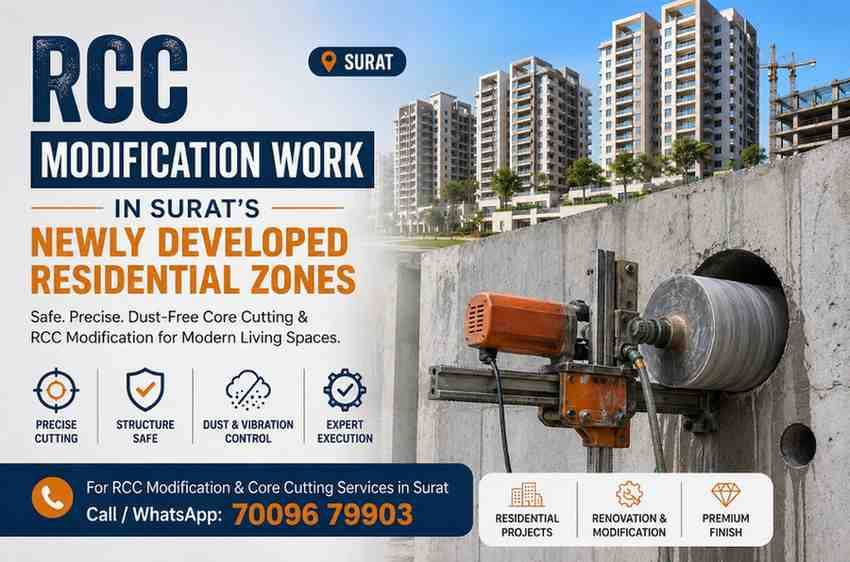
Surat has changed shape faster than almost any other city in Gujarat. Areas that were open farmland a decade ago — Vesu, Pal, Adajan, Palanpur, Dumas Road, City Light, and the stretches around VIP Road and Bhatar — are now packed with high-rise apartments, gated townships, and premium residential complexes. As families move into these newly developed zones, a very practical need keeps coming up again and again: RCC modification work.
Reinforced Cement Concrete (RCC) is the backbone of every modern residential structure in Surat. It forms the slabs, beams, columns, and walls that hold a building together. But as families settle into new homes, they often want changes that the original design didn't account for — an extra window for ventilation, a modified kitchen layout, a new bathroom opening, or a duct for plumbing and electrical lines. This is where professional RCC modification work becomes essential, and why it has to be done by trained hands, not guesswork.
This blog looks at why RCC modification is so common in Surat's new residential zones, what the process actually involves, the risks of doing it the wrong way, and how a professional agency like Core Cutting India approaches the job safely and precisely.
Why RCC Modification Work Has Become So Common in Surat
Surat's real estate boom has been driven by rapid population growth, a strong diamond and textile economy, and continuous inward migration from across Gujarat and other states. Builders have responded by constructing residential towers and townships at record speed. But speed in construction sometimes means limited flexibility in original design — floor plans are standardized to save time and cost, and buyers only get to see the exact layout of their flat after possession.
Once families move in, several common needs push them toward RCC modification:
- Layout customization – Many buyers want to merge two rooms, create an open kitchen, or reposition a wall to suit their furniture and lifestyle.
- Additional openings – A flat facing an internal courtyard may need an extra window cut into an RCC wall for light and cross-ventilation.
- Plumbing and electrical rerouting – New bathroom fittings, modular kitchens, or air-conditioning units often require core holes through RCC slabs and walls for pipes, cables, and ducts.
- Balcony and terrace conversions – Homeowners frequently want to modify balcony walls or slabs to extend usable space or install grills and glass partitions.
- Retrofitting for modern amenities – Elevators for ground-floor duplexes, solar panel wiring, or smart-home cabling often need controlled openings in existing concrete.
- Commercial-to-residential or mixed-use adjustments – In some of Surat's mixed-use developments, ground-floor units are reconfigured from shop spaces to residential use, requiring wall and slab alterations.
Because RCC is dense, reinforced, and structurally load-bearing, none of these changes can be done with a hammer and chisel. That approach damages surrounding concrete, exposes and often cuts through steel reinforcement, and can compromise the structural integrity of the entire building. This is exactly why specialized RCC cutting and modification services have grown into their own trade in Surat's construction and renovation industry.
What RCC Modification Work Actually Involves
Professional RCC modification is a precise, engineering-driven process, not a demolition job. At Core Cutting India, the typical scope of work includes:
1. Site Assessment and Structural Study
Before any cutting begins, the team studies the building's structural drawings (where available) or uses non-destructive tools like rebar detectors and scanners to map the position of steel reinforcement inside the RCC element. This step identifies load-bearing walls, columns, and beams that must never be cut, and marks the safe zones where modification can proceed.
2. Diamond Core Cutting
For circular openings — needed for plumbing pipes, electrical conduits, exhaust ducts, or AC piping — diamond core drilling machines are used. These machines cut clean, precise circular holes through concrete and brick without vibration-based cracking, which is critical in occupied residential buildings where neighboring flats are still in use.
3. Wall Sawing and Slab Cutting
For larger modifications such as new doorways, windows, or slab openings for staircases and lift shafts, wall saws and floor saws with diamond blades are used. These tools cut in straight, controlled lines, leaving smooth edges that don't require extensive rework and don't stress the surrounding structure.
4. Track-Guided and Hand-Held Cutting
In tighter residential spaces — like a compact kitchen or a bathroom wall shared with a neighboring unit — track-guided hand saws allow technicians to make precise cuts in confined areas where larger machinery can't operate.
5. Dust and Noise Control
Newly developed residential zones in Surat are densely populated, and most modification work happens in occupied buildings. Reputable RCC cutting teams use wet-cutting techniques and vacuum dust extraction to minimize dust spread and reduce noise disturbance to neighbors — an important consideration in societies with shared walls and common corridors.
6. Structural Reinforcement After Cutting
Whenever an opening is made in a load-relevant RCC element, the opening is reinforced — typically with steel lintels, angle sections, or epoxy-bonded rebar — to redistribute the load safely around the new opening. This step is what separates professional RCC modification from unsafe DIY cutting.
7. Finishing and Handover
Once the structural work is done, the opening or modification is finished with plastering, waterproofing (where needed, such as bathroom or terrace walls), and surface leveling so it's ready for tiling, painting, or fitting.
Why Newly Developed Zones Need a Different Approach
Older parts of Surat, like the walled city or established areas near Ring Road, often have independent houses or low-rise buildings where structural changes are relatively simpler to plan. Surat's newly developed residential zones are different in three important ways:
High-rise density. Complexes in Vesu, Pal, and Palanpur are often 10–25 storeys tall. Any RCC modification on a lower or mid floor has load implications for everything above it. Cutting must be planned with the full structural load path in mind, not just the local wall or slab.
Shared structural elements. In apartment buildings, many walls are shared between adjoining flats, and slabs are shared between floors. A modification in one unit can affect the neighboring one, both in terms of structural load and in terms of noise, dust, and water seepage during the work. This makes coordination with the society or builder's structural engineer essential before starting.
Modern amenities require more service penetrations. New-age flats come with centralized plumbing shafts, VRV/VRF air conditioning systems, home automation wiring, and fire safety installations — all of which need multiple, precisely located core holes through RCC slabs and walls. Getting these positions wrong means either redoing the work or compromising the finish and function of the amenity.
Because of these factors, RCC modification work in Surat's new residential zones is increasingly handled by specialized agencies rather than general contractors. It requires the right machinery, trained operators, and — most importantly — the judgment to know what can and cannot be cut safely.
Risks of Unprofessional RCC Cutting
It's worth being direct about what goes wrong when RCC modification is attempted without expertise:
- Cutting through load-bearing reinforcement can weaken a wall, column, or slab, sometimes with effects that only show up months or years later as cracks or deflection.
- Uncontrolled hammering creates micro-cracks in surrounding concrete that spread over time, especially under Surat's humid, monsoon-heavy climate, accelerating water seepage and rebar corrosion.
- Ignoring shared structural elements can damage a neighboring flat's wall or ceiling, leading to disputes within the housing society.
- Skipping post-cutting reinforcement leaves an opening structurally unsupported, which can become a serious safety issue in a multi-storey building.
- Poor dust and noise control during work can violate society bylaws and strain relationships with neighbors in tightly packed residential complexes.
These risks are precisely why RCC modification should always be treated as specialized structural work — planned with the same seriousness as the original construction, not as a quick renovation shortcut.
How Core Cutting India Approaches RCC Modification in Surat
Core Cutting India works across Surat's newly developed residential zones, offering diamond core drilling, wall and floor sawing, controlled demolition, and structural reinforcement for RCC modification projects — from individual flats to entire residential towers.
The approach followed on every project includes:
- A pre-work structural assessment to identify safe cutting zones
- Use of diamond-tipped, vibration-free cutting equipment suited to occupied buildings
- Dust suppression and noise management appropriate for residential societies
- Reinforcement of every structural opening as per engineering best practice
- Clean handover with finishing-ready surfaces
Whether it's a single core hole for a new AC pipe in a Vesu apartment, a full wall modification for an open kitchen in Pal, or coordinated multi-floor plumbing shaft cutting in a Palanpur township, the same principle applies: RCC modification should make a home better without ever putting its structure at risk.
Frequently Asked Questions
1. What is RCC modification work and why is it needed? RCC modification work refers to controlled cutting, drilling, or altering of reinforced concrete elements — walls, slabs, beams, or columns — to create new openings, reroute utilities, or change a layout. It's needed whenever a homeowner wants structural changes that weren't part of the original construction, such as a new window, door, or plumbing shaft.
2. Is it safe to cut RCC walls or slabs in an existing building? Yes, when it's done by trained professionals using diamond cutting tools and preceded by a structural assessment. The danger comes from cutting without understanding where the reinforcement and load-bearing elements are — that's why professional assessment and post-cutting reinforcement are essential.
3. How much does RCC cutting cost in Surat? Costs vary based on the type of cutting (core drilling versus wall or slab sawing), the thickness of the concrete, the number of openings, and site accessibility. It's best to get a site visit and quote for an accurate estimate.
4. Can RCC modification weaken a building's structure? If done incorrectly — without identifying reinforcement or reinforcing the new opening afterward — yes, it can weaken the structure. Done professionally, with proper planning and reinforcement, RCC modification does not compromise structural safety.
5. How long does RCC modification work take for a residential flat? A small modification, like a single core hole or a compact wall opening, can often be completed in a day. Larger changes, such as slab openings or multiple wall modifications, may take a few days depending on scope and reinforcement work required.
For professional RCC modification work in Surat's newly developed residential zones, contact Core Cutting India at [email protected] for a site assessment and quote.