
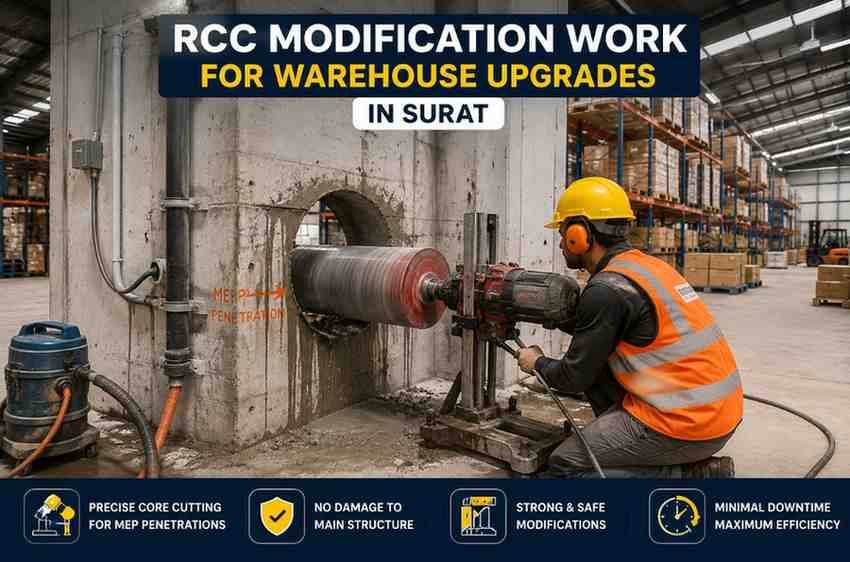
Surat has quietly become one of western India's busiest industrial and logistics hubs. Textile units, diamond processing centers, e-commerce fulfillment hubs, and manufacturing plants have all expanded rapidly across areas like Sachin, Pandesara, Palsana, and Hazira. As business needs change, the warehouses that once served these industries often need more than just a fresh coat of paint — they need real structural upgrades. That's where RCC (Reinforced Cement Concrete) modification work comes in.
Whether it's widening a loading bay, adding a mezzanine floor, cutting a new opening for heavy machinery, or reinforcing columns to support additional load, RCC modification is the backbone of any serious warehouse renovation project. In this blog, we'll walk through what RCC modification actually involves, why Surat's warehouses increasingly need it, and how professional cutting and coring contractors like Core Cutting India make these upgrades safe, precise, and efficient.
What Is RCC Modification Work?
RCC modification work refers to the process of altering, cutting, reinforcing, or partially demolishing existing reinforced concrete structures to meet new functional or structural requirements — without compromising the building's overall stability. Unlike fresh construction, modification work happens on structures that are already standing, often while the facility is partially or fully operational.
For warehouses specifically, RCC modification can include:
- Cutting new openings in walls or slabs for doors, windows, ventilation, or conveyor systems
- Core drilling for pipes, cables, HVAC ducts, or machine foundations
- Demolishing sections of old slabs to build mezzanine floors
- Strengthening columns and beams to support higher racking or heavier equipment
- Widening entry and exit points for larger trucks and forklifts
- Removing damaged or non-load-bearing concrete sections for repair
- Creating floor openings for elevators, hoists, or goods lifts
Each of these tasks requires precision. A single miscalculated cut into a load-bearing element can compromise the structural integrity of the entire building, which is why RCC modification is never a DIY job — it needs trained engineers and specialized cutting equipment.
Why Warehouses in Surat Are Increasingly Opting for RCC Modification
1. Rapid Industrial and E-Commerce Growth
Surat's warehousing sector has expanded significantly to keep up with textile exports, MSME manufacturing, and third-party logistics (3PL) demand. Many existing warehouses were built years ago for smaller-scale operations. As businesses scale up, these structures need modification to accommodate larger inventory, automated systems, and heavier machinery — all without tearing down and rebuilding from scratch.
2. Changing Storage and Automation Needs
Modern warehouses increasingly rely on automated conveyor systems, robotic pick-and-place units, and vertical storage racking. Installing this equipment often requires new floor openings, wall penetrations for cabling, or reinforced flooring — all of which fall under RCC modification.
3. Compliance and Safety Upgrades
Fire safety norms, ventilation requirements, and structural safety codes have become stricter. Many older warehouse structures in Surat's industrial belts need retrofitting to meet current building codes, which often involves RCC cutting for additional exits, ventilation shafts, or fire escape routes.
4. Cost-Effective Alternative to Rebuilding
Demolishing and reconstructing an entire warehouse is expensive and time-consuming. RCC modification allows businesses to upgrade specific sections — like adding a mezzanine, expanding a loading dock, or reinforcing a weak column — at a fraction of the cost and time of new construction.
5. Adapting to Multi-Tenant or Multi-Use Spaces
Many warehouse owners in Surat are converting single-use industrial sheds into multi-tenant facilities. This often requires internal partition walls to be cut, new access points created, and utility lines routed through existing slabs — all classic RCC modification tasks.
Common RCC Modification Techniques Used in Warehouse Upgrades
Diamond Wall Sawing
Diamond wall sawing uses a diamond-tipped circular blade to make precise, straight cuts through concrete walls and slabs. It's commonly used for creating new door openings, window openings, or removing entire wall sections in warehouses without generating excessive vibration or dust that could damage nearby structures or stored inventory.
Core Drilling
Core drilling creates clean, circular holes through concrete for pipes, electrical conduits, HVAC ducts, or bolts. In warehouse settings, this is essential when installing new plumbing lines, fire sprinkler systems, or running cables for automated machinery.
Concrete Chain Sawing
Chain sawing is used for cutting corners and tight spaces that circular saws can't reach — particularly useful in warehouse corners, near existing structural columns, or where precise right-angle cuts are required.
Wire Sawing
For thicker concrete sections, such as heavy-duty warehouse floor slabs or foundation elements, diamond wire sawing offers a controlled, low-vibration cutting method. It's often used when structural elements need to be removed without disturbing adjacent reinforced sections.
Controlled Demolition and Selective Concrete Removal
Instead of full demolition, selective removal allows contractors to break down only the specific concrete sections that need to change — such as an old, cracked floor slab or a redundant partition wall — while preserving the rest of the structure.
Structural Strengthening
After modification, especially where load-bearing elements have been altered, structural strengthening techniques like jacketing (adding new reinforced concrete or steel around existing columns) or epoxy injection for crack repair are used to restore or improve load capacity.
Step-by-Step: How Professional RCC Modification Works for a Warehouse Project
- Site Assessment and Structural Survey – Engineers inspect the existing structure, review original building drawings if available, and assess load-bearing elements before any cutting begins.
- Structural Design and Approval – A structural engineer determines whether the proposed modification (like a new opening) will affect the building's load distribution, and designs reinforcement solutions if needed.
- Method Selection – Based on the modification required — wall opening, floor coring, column reinforcement — the right cutting technique (diamond sawing, core drilling, chain sawing) is selected.
- Execution with Safety Protocols – Trained technicians carry out the cutting or coring work using dust-suppression systems, vibration control, and temporary shoring where required to keep the surrounding structure stable.
- Debris Management – Concrete debris is removed systematically to avoid disrupting warehouse operations, especially important for facilities that remain partially functional during the upgrade.
- Reinforcement and Finishing – Any newly exposed edges are reinforced, finished, or sealed, and structural strengthening is applied where the modification has altered load paths.
- Final Inspection – A post-work inspection confirms the modification meets safety standards and the structure's integrity has been maintained or improved.
Benefits of Professional RCC Modification for Warehouse Owners
- Minimal Disruption: Modern cutting techniques are precise and low-vibration, allowing warehouse operations to continue with minimal downtime.
- Structural Safety: Professional assessment ensures load-bearing elements aren't compromised, protecting both the building and the people working inside it.
- Cost Efficiency: Targeted modification is significantly cheaper than full demolition and reconstruction.
- Faster Turnaround: Specialized equipment completes cutting and coring work faster and cleaner than manual breaking methods.
- Dust and Noise Control: Diamond cutting techniques generate far less dust and noise compared to traditional hammering or jackhammer demolition, which matters in occupied industrial zones.
- Future-Ready Infrastructure: Reinforced modifications can be designed to accommodate future expansion, additional machinery, or higher storage loads.
Choosing the Right RCC Modification Contractor in Surat
Not every construction contractor is equipped to handle RCC modification safely. When selecting a partner for warehouse upgrade work in Surat, consider the following:
- Experience with industrial and warehouse structures specifically, not just residential cutting jobs
- In-house structural engineering support to assess load-bearing impact before cutting
- Modern diamond cutting equipment for precision and reduced structural stress
- Safety certifications and trained technicians who follow proper protocols
- Track record of completed projects in Surat's industrial belts
- Ability to work around active operations without forcing a full warehouse shutdown
Core Cutting India specializes in diamond concrete cutting, core drilling, wall sawing, and structural RCC modification services tailored for industrial and warehouse clients across Surat and the surrounding Gujarat region. From single core drilling jobs to full-scale structural openings for mezzanine floors, the team combines technical precision with a strong understanding of industrial safety requirements.
Conclusion
As Surat's industrial and warehousing landscape continues to grow, upgrading existing structures through professional RCC modification work has become a practical, cost-effective way for businesses to expand capacity, improve safety, and adapt to evolving operational needs. From precise wall sawing and core drilling to structural strengthening, these techniques allow warehouse owners to modernize their facilities without the time and expense of complete reconstruction.
If you're planning a warehouse upgrade in Surat and need expert RCC cutting, coring, or structural modification services, reach out to Core Cutting India at [email protected] for a consultation tailored to your facility's specific requirements.
People Also Ask
1. What is RCC modification work and why is it needed in warehouses? RCC modification work involves cutting, coring, or reinforcing existing reinforced concrete structures to meet new functional needs — such as adding openings, installing equipment, or expanding load capacity. Warehouses need it when operations scale up, new machinery is installed, or safety codes change.
2. How much does RCC cutting cost per square foot in Surat? Costs vary based on concrete thickness, reinforcement density, the cutting method used (wall sawing, core drilling, chain sawing), and site accessibility. It's best to get a site-specific quote from a professional contractor like Core Cutting India for an accurate estimate.
3. Is RCC cutting safe for load-bearing structures? Yes, when performed by trained professionals following a proper structural assessment. Engineers evaluate load paths before cutting and apply reinforcement or temporary shoring where necessary to maintain structural safety.
4. How long does warehouse RCC modification work take? Timelines depend on the scope of work — a single core drilling job might take a few hours, while a full mezzanine floor opening or multiple wall modifications could take several days to weeks, especially if reinforcement work is involved.
5. What is the difference between RCC cutting and RCC demolition? RCC cutting is a precise, controlled process used to create specific openings or remove targeted sections while preserving the rest of the structure. RCC demolition typically involves breaking down larger or entire sections of concrete, often with less precision and more debris.
6. Do warehouses need structural approval before RCC modification? In most cases, yes. Any modification affecting load-bearing walls, columns, or slabs should be reviewed and approved by a structural engineer to ensure the building's safety and compliance with local construction regulations.
For professional RCC cutting, coring, and structural modification services for warehouses and industrial facilities in Surat, contact Core Cutting India at [email protected].