
Introduction
India's textile industry is undergoing a quiet revolution. Spinning mills, weaving units, dyeing houses, and garmenting facilities are rapidly replacing manual processes with automated spinning frames, robotic material handlers, conveyor-driven fabric lines, and computerized dyeing systems. This shift toward Industry 4.0 has transformed not just how textiles are made, but also how factory buildings themselves need to function.
At the heart of this transformation lies a challenge that is often overlooked until it becomes urgent: the existing Reinforced Cement Concrete (RCC) structure of most textile units was never designed for automation. Machine foundations, cable routing, ducting, floor loading, and equipment access all demand precise, code-compliant modifications to the concrete structure. This is where specialized RCC modification services, such as those offered by Core Cutting India (info@corecuttingindia.com), become essential to a successful automation rollout.
In this blog, we explore why RCC modifications matter for automated textile manufacturing units, the techniques involved, safety considerations, and how the right cutting and drilling partner can save time, cost, and structural risk.
Why Automated Textile Units Need RCC Modifications
Traditional textile factories were built decades ago around manual looms, spinning frames, and human-operated material movement. Automation changes the physical footprint of a plant in several ways:
- Heavier and Larger Machine Foundations – Automated ring frames, air-jet looms, and robotic winding machines are heavier and generate more vibration than manual equipment. Existing floor slabs often cannot bear this load without reinforcement or newly cut foundation pits.
- Underfloor Cable and Utility Routing – Programmable Logic Controllers (PLCs), servo drives, sensors, and SCADA systems require extensive underfloor cabling, conduits, and sometimes compressed air lines. This means cutting precise trenches and openings through existing RCC floors without disturbing the surrounding structure.
- Material Handling Corridors – Automated Guided Vehicles (AGVs) and conveyor systems need level, uninterrupted floor paths. Old floor thresholds, plinths, or structural beams frequently need to be cut, leveled, or removed.
- HVAC and Humidification Ducting – Automated dyeing and spinning processes are highly sensitive to temperature and humidity. New ducting routes often need to pass through existing RCC walls, slabs, and beams.
- Equipment Access Openings – Large automated machines are frequently installed as pre-assembled units that cannot fit through standard doorways. Walls need controlled cutting to create temporary or permanent equipment access openings.
- Expansion and Isolation Joints – Vibration-sensitive automated machinery often requires isolated foundation pads separated from the main floor slab by expansion joints, which must be precisely cut into existing concrete.
Each of these needs falls squarely into the domain of professional RCC cutting, drilling, and structural modification — work that must be executed without compromising the load-bearing integrity of the building.
Common RCC Modification Techniques Used in Textile Automation Projects
1. Diamond Core Drilling
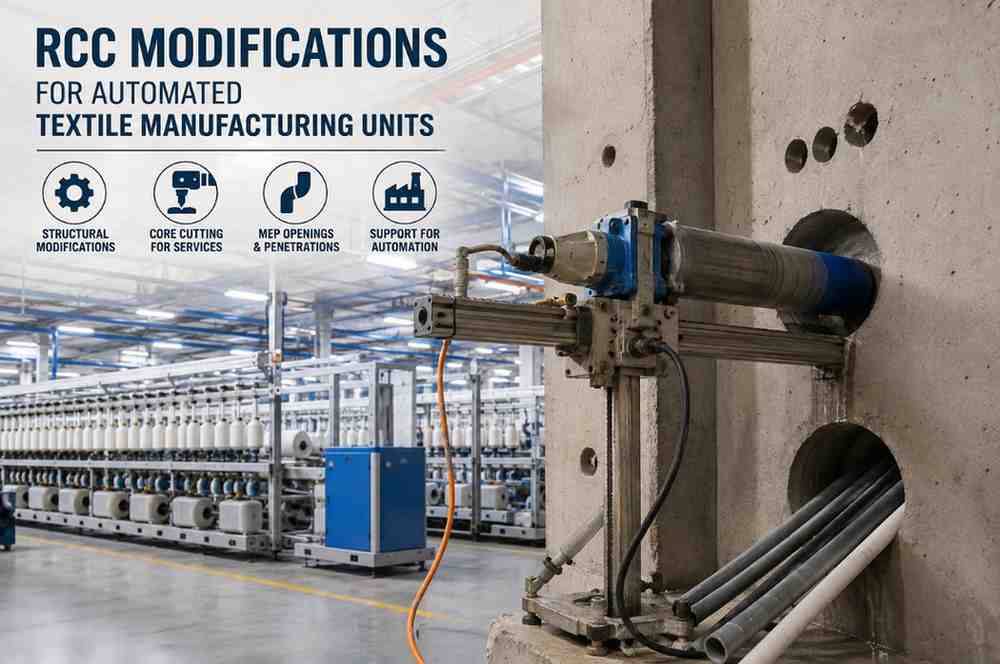
Core drilling is used to create clean, circular holes through RCC slabs and walls for cable conduits, pipe routing, exhaust ducts, and anchor bolt installations for new machine bases. Diamond core drilling is dust-controlled, vibration-free, and precise — critical in an operating textile unit where fabric contamination from dust is a major concern.
2. Wall Sawing and Cutting
When automated machinery needs a new access point, wall saws create straight, clean cuts through RCC walls with minimal disturbance to adjacent structure. This is commonly used when installing large-frame automated looms or bulk yarn storage systems that require wider openings than existing doors allow.
3. Floor Sawing for Trenches and Slots
Automated systems rely heavily on underfloor cable trays and utility trenches. Floor sawing allows contractors to cut long, straight slots into RCC flooring for routing high-voltage cables, compressed air lines, and data cables without breaking up the entire floor.
4. Wire Sawing for Thick Structural Sections
For thicker structural elements such as foundation beams or columns that must be partially removed to accommodate new machine bases or floor openings, wire sawing offers a controlled, low-vibration method that protects surrounding reinforcement and structural stability.
5. Controlled Demolition and Chiseling
In areas requiring localized removal, such as old plinths or redundant foundation blocks from decommissioned manual machines, controlled demolition ensures the surrounding RCC remains undisturbed.
6. Foundation Pit Excavation and Reinforcement
New automated machinery often needs isolated foundation pits with vibration-dampening pads. This involves cutting out sections of existing floor slab, excavating to the required depth, and casting new reinforced foundations designed to the machine manufacturer's load and vibration specifications.
Structural Safety Considerations
RCC modification in an operational textile facility is not simply a cutting job — it is a structural engineering exercise. Key considerations include:
- Load Path Analysis: Before any cutting begins, a structural engineer must assess how existing loads are transferred through the slab, beams, and columns to avoid compromising load-bearing paths.
- Rebar Detection: Ground Penetrating Radar (GPR) or rebar scanning is used to map embedded reinforcement steel and electrical conduits before cutting, preventing accidental damage to structural steel or live utilities.
- Vibration Control: Textile machinery is highly sensitive to vibration, and diamond cutting techniques are preferred over jackhammering because they minimize vibration transfer to surrounding equipment and structures.
- Dust and Contamination Control: Textile fibers are highly susceptible to dust contamination, so wet-cutting and vacuum dust extraction systems are essential during any RCC modification work carried out near active production areas.
- Temporary Shoring: When beams or load-bearing walls are modified, temporary shoring and propping systems must be installed to maintain structural stability until new reinforcement is in place.
- Compliance with IS Codes: All RCC modification work should comply with relevant Indian Standard codes (such as IS 456 for RCC design and IS 13920 for seismic considerations) to ensure the modified structure meets safety norms.
Benefits of Professional RCC Modification for Textile Automation
- Minimal Production Downtime: Precision cutting techniques allow modification work to be scheduled around production shifts, reducing disruption to ongoing manufacturing.
- Structural Integrity Preserved: Engineered cutting plans ensure that load-bearing elements remain sound even after significant modification.
- Faster Machine Commissioning: Well-planned foundation pits, cable routes, and access openings mean automated machinery can be installed and commissioned faster.
- Reduced Contamination Risk: Dust-controlled cutting protects sensitive textile fibers and yarns from debris during ongoing production.
- Cost Savings: Precision modifications avoid the higher costs and structural risks associated with unplanned or improvised concrete breaking.
- Future-Ready Infrastructure: Properly executed RCC modifications create flexible floor plans that can accommodate further automation phases down the line.
Typical Applications Across Textile Segments
Spinning Mills: Foundation pits for automated ring frames and roving machines, cable trenches for pneumatic yarn transport systems, and floor openings for automatic doffing and bobbin transport systems.
Weaving Units: Wall openings for large automated air-jet and rapier looms, vibration-isolated foundations, and floor-level conveyor pathways.
Dyeing and Processing Units: Wall and floor penetrations for automated dosing systems, effluent piping, humidification ducting, and process control cabling.
Garmenting and Finishing Units: Floor modifications for automated cutting tables, conveyor-based sewing lines, and robotic packing systems.
Why Choose Core Cutting India
Core Cutting India specializes in precision RCC modification services tailored for industrial and manufacturing environments, including textile plants transitioning to automation. With experience in diamond core drilling, wall and floor sawing, wire sawing, and structural foundation work, the team ensures every modification is planned with structural safety, minimal downtime, and dust-free execution in mind.
Whether you are installing a new automated spinning line, retrofitting a weaving shed for robotic material handling, or upgrading your dyeing unit's utility infrastructure, Core Cutting India brings the engineering precision and industrial cutting expertise needed to get the job done safely and efficiently.
For consultations on RCC modification for your automated textile manufacturing unit, reach out to Core Cutting India at info@corecuttingindia.com.
Conclusion
Automation is reshaping the Indian textile industry, but the physical infrastructure of most existing plants was never designed for it. RCC modifications — from core drilling and wall cutting to foundation pit excavation and cable trenching — form the structural backbone of any successful automation upgrade. Executed correctly, with careful engineering assessment and precision cutting techniques, these modifications allow textile manufacturers to install modern automated machinery without compromising structural safety or halting production.
Partnering with an experienced RCC modification specialist like Core Cutting India ensures that your automation investment is supported by a structurally sound, future-ready facility.
Target-Related Searches
- RCC cutting for industrial automation
- core cutting services for textile mills
- concrete floor cutting for machine foundation
- wall cutting for factory automation
- diamond core drilling industrial units
- RCC structural modification services India
- textile mill retrofitting for automation
- concrete cutting company near me
- foundation pit cutting for heavy machinery
- underfloor cable trench cutting services
People Also Ask
1. What is RCC modification in industrial construction? RCC modification refers to altering existing reinforced cement concrete structures — such as floors, walls, and foundations — through techniques like core drilling, wall sawing, and floor cutting to accommodate new equipment, utilities, or structural requirements.
2. Why is core cutting needed for automated textile machines? Automated textile machines require precise foundation pits, cable routing, and access openings that existing concrete structures don't have. Core cutting allows these modifications to be made accurately without damaging surrounding structural elements.
3. Is RCC cutting safe for occupied factory buildings? Yes, when performed by trained professionals using diamond cutting and wire sawing techniques with proper structural assessment, RCC cutting can be carried out safely in occupied and operational factory buildings with minimal vibration and dust.
4. How long does RCC modification take for a textile unit? Timelines vary based on scope, but most core drilling and wall/floor cutting tasks can be completed within a few days to a couple of weeks, depending on the extent of foundation and utility work required.
5. What techniques are used for cutting RCC floors and walls? Common techniques include diamond core drilling, wall sawing, floor sawing, wire sawing, and controlled chiseling or demolition, each suited to different thicknesses and structural requirements.
6. Does RCC modification affect the structural strength of a building? If done without engineering assessment, yes, it can weaken the structure. However, professional RCC modification services conduct load path analysis and rebar scanning beforehand to ensure structural integrity is preserved or reinforced as needed.