
Introduction
Luxury residential towers have redefined urban living across India's metropolitan skylines. From sprawling duplex penthouses to sky lounges and infinity pools perched several floors above ground, today's high-end residential projects demand structural flexibility that traditional construction methods simply cannot deliver on their own. This is where RCC (Reinforced Cement Concrete) modification services step in — enabling architects, builders, and homeowners to reshape existing concrete structures without compromising safety or structural integrity.
At Core Cutting India (info@corecuttingindia.com), we specialize in precision RCC cutting, coring, and structural modification services tailored specifically for premium residential developments. In this blog, we take an in-depth look at what RCC modification really involves, why it has become indispensable for high-end towers, the techniques used, and what property owners and developers should know before undertaking such work.
What Are RCC Modifications?
RCC modification refers to the process of altering, cutting, drilling, or reinforcing existing reinforced cement concrete structures to accommodate new design requirements, utility installations, or structural changes. Unlike modifications made during the initial construction phase, RCC modifications are typically carried out on structures that are already built — sometimes even in occupied buildings.
These modifications can include:
- Cutting openings in RCC walls and slabs for doors, windows, ducts, or staircases
- Core drilling for plumbing, electrical conduits, HVAC ducts, and elevator shafts
- Demolishing or resizing existing RCC beams and columns (under structural supervision)
- Creating floor openings for lift shafts, skylights, or double-height spaces
- Strengthening or retrofitting existing structural members
- Precision cutting for expansion joints or seismic retrofitting
For high-end residential towers, where design ambitions often evolve after the shell and core stage, RCC modification has become a critical link between architectural vision and structural reality.
Why High-End Residential Towers Require RCC Modifications
1. Evolving Design Requirements
Luxury developments frequently undergo design revisions midway through construction, or even after possession, as homeowners customize their units. A buyer may want to merge two apartments into one expansive residence, add a private elevator, or convert a utility balcony into a home theatre. All of these require careful, code-compliant RCC modification.
2. Retrofitting for Modern Amenities
Modern luxury towers are expected to offer smart home systems, centralized HVAC, high-speed elevators, home automation wiring, and advanced plumbing — many of which require core drilling through existing concrete to route new conduits, risers, and ducts without disturbing the building's aesthetics or occupants.
3. Structural Upgrades and Seismic Retrofitting
As building codes evolve and seismic zoning regulations become stricter, older RCC towers sometimes require structural strengthening. This might involve jacketing columns, adding shear walls, or modifying existing structural members to meet updated safety standards — all without demolishing the entire structure.
4. Space Optimization
In premium real estate, every square foot carries significant value. RCC modification allows for reconfiguration of internal layouts — merging units, creating duplexes, or opening up double-height living rooms — while preserving the building's load-bearing framework.
5. Renovation and Restoration Projects
Heritage buildings and older luxury towers undergoing renovation often require careful RCC cutting to preserve original structural elements while integrating modern utilities and finishes.
Key RCC Modification Techniques Used in Residential Towers
Diamond Core Drilling
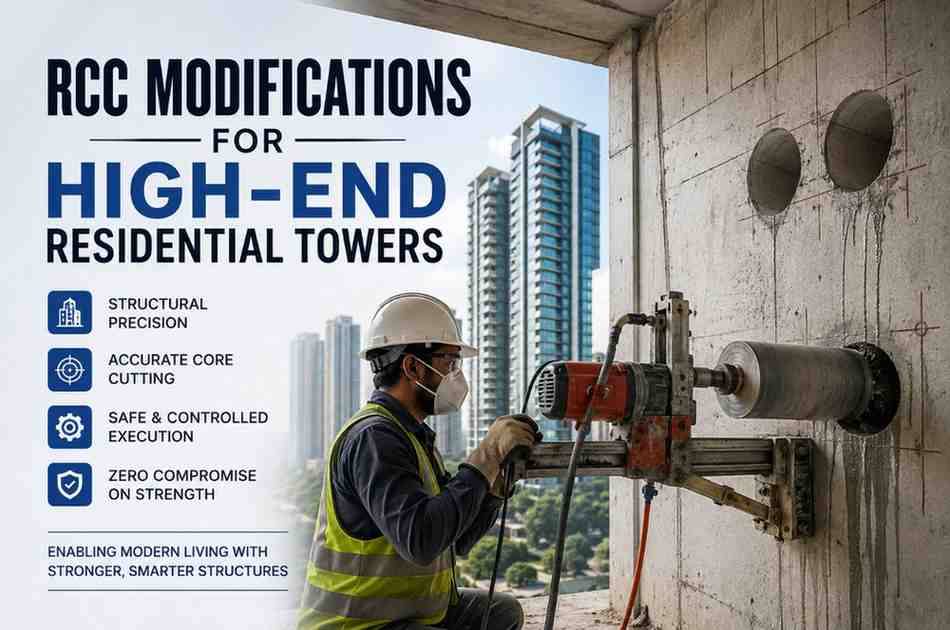
Diamond core drilling is one of the most precise and widely used techniques for creating circular openings in RCC slabs and walls. It's ideal for installing pipes, cables, HVAC ducts, and plumbing risers. Diamond-tipped drill bits cut through concrete with minimal vibration, making this method safe for use in occupied buildings without disturbing residents or compromising nearby structural elements.
Wall Sawing
Wall sawing uses diamond blade-equipped circular saws to create straight, clean cuts in RCC walls. This technique is commonly used for forming door openings, window enlargements, or entire wall sections that need to be removed for layout changes.
Slab Cutting
Slab cutting involves the controlled removal of RCC floor slabs, typically for staircases, lift shafts, skylights, or double-height spaces. This requires meticulous structural assessment to ensure load paths are redistributed correctly.
Wire Sawing
For thicker RCC sections, heavily reinforced structural members, or areas with limited access, wire sawing offers a flexible, low-vibration cutting solution. A diamond-embedded wire loop is used to slice through concrete and steel reinforcement with high precision.
Stitch Drilling
Stitch drilling — a series of closely spaced core holes — is used when a straight-line cut is required but wall or floor saws cannot access the area. It's especially useful for irregular openings or corners.
Non-Structural Demolition
Controlled demolition of non-load-bearing RCC elements, such as parapet walls or partition slabs, is carried out using a combination of cutting and breaking techniques to minimize noise, dust, and vibration in sensitive residential environments.
The Structural Safety Perspective
RCC modification in high-rise residential towers is not simply a cutting exercise — it is fundamentally a structural engineering exercise. Every modification, however minor it may appear, has the potential to affect load distribution, seismic performance, and long-term durability of the building.
Before any cutting or coring work begins, a few non-negotiable steps must be followed:
- Structural Assessment: A qualified structural engineer must evaluate the existing drawings, reinforcement layout, and load paths to determine whether the proposed modification is feasible.
- Non-Destructive Testing (NDT): Techniques such as rebar scanning and ground-penetrating radar are used to map existing reinforcement and avoid cutting through critical structural steel.
- Temporary Support Systems: In cases involving beams, columns, or load-bearing walls, temporary shoring and propping systems are installed to redistribute loads safely during the modification process.
- Method Statement and Risk Assessment: A detailed execution plan outlining cutting sequence, safety protocols, and contingency measures is prepared before work begins.
- Post-Modification Reinforcement: Where required, the modified section is reinforced with steel plates, epoxy-bonded rebars, or carbon fiber wrapping to restore or enhance structural capacity.
At Core Cutting India, every project begins with this rigorous safety-first approach, ensuring that aesthetic and functional upgrades never come at the cost of structural reliability.
Why Precision Matters in Luxury Residential Projects
High-end residential towers operate under a different set of expectations compared to standard construction. Precision, cleanliness, and minimal disruption are paramount, especially in occupied buildings where residents continue to live their daily lives during modification work.
Key considerations that set premium RCC modification projects apart include:
- Low-Noise, Low-Vibration Techniques: Diamond cutting technology significantly reduces vibration and noise compared to traditional jackhammer demolition, making it suitable for occupied luxury towers.
- Dust Control Systems: Wet-cutting methods and vacuum dust extraction systems keep work areas clean and minimize disturbance to residents and finished interiors.
- Minimal Structural Disturbance: Precision cutting avoids unnecessary damage to adjoining structural elements, finishes, and utilities.
- Time-Bound Execution: Luxury projects often operate on tight handover schedules, requiring efficient project management and skilled execution teams.
- Aesthetic Sensitivity: Cuts and openings are finished to align seamlessly with the building's premium interior and exterior finishes.
Common Applications in High-End Residential Towers
- Penthouse and Duplex Conversions: Merging floors or units often requires slab and beam modifications to create internal staircases or double-height spaces.
- Private Elevator Installation: Many luxury towers now offer private lift access, requiring precise core cutting through multiple floor slabs.
- Smart Home Wiring and Automation: Retrofitting concealed wiring for home automation systems often requires wall and slab coring.
- Swimming Pools and Sky Decks: Structural modifications and reinforcements are needed to support rooftop or terrace-level amenities.
- Basement and Parking Modifications: Expanding parking capacity or creating service tunnels often involves RCC wall and slab cutting.
- Utility Riser Shafts: Vertical shafts for plumbing, drainage, and electrical risers are created using coordinated core drilling across multiple floors.
Choosing the Right RCC Modification Partner
Given the technical and safety complexities involved, selecting an experienced RCC cutting and modification contractor is critical. Property developers and homeowners should evaluate potential partners on the following parameters:
- Proven experience with high-rise and occupied residential structures
- Access to modern diamond cutting and coring equipment
- In-house or associated structural engineering expertise
- Strict adherence to safety codes and method statements
- Track record of minimal disruption in live residential environments
- Transparent project timelines and reporting
Conclusion
RCC modification has become an essential service in the evolution of high-end residential towers, enabling design flexibility, modern amenities, and structural upgrades without compromising the safety of the original structure. From diamond core drilling and wall sawing to structural strengthening and seismic retrofitting, these techniques allow developers and homeowners to reimagine spaces long after the initial construction is complete.
At Core Cutting India, we bring precision engineering, safety-first methodology, and years of specialized experience to every RCC modification project — helping luxury residential developments achieve their architectural ambitions without ever compromising on structural integrity.
For expert consultation on RCC cutting, coring, or structural modification for your residential tower project, reach out to Core Cutting India at info@corecuttingindia.com.