
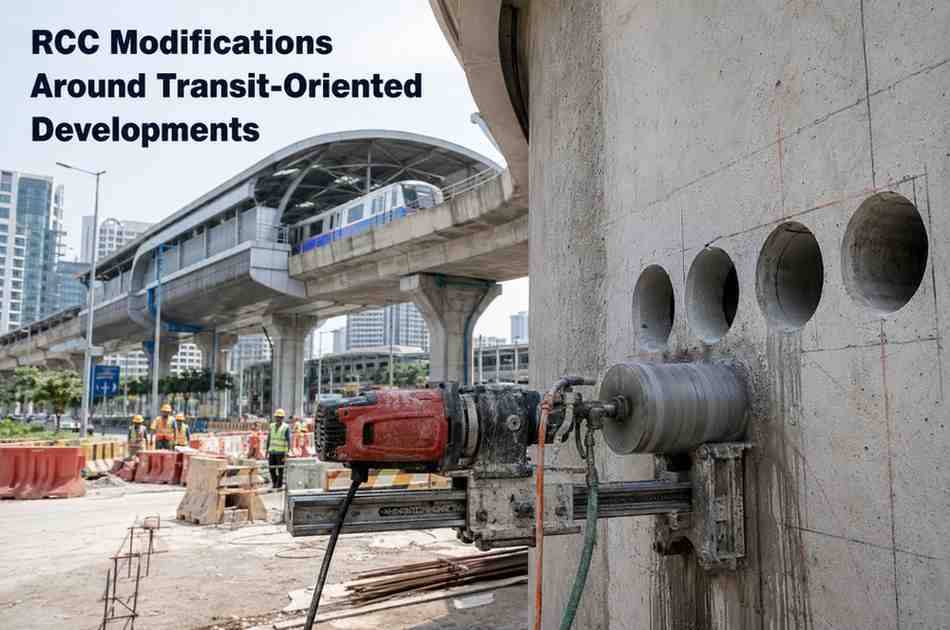
Urban India is transforming rapidly, and at the center of this transformation lies a simple but powerful planning philosophy: Transit-Oriented Development, or TOD. Cities like Delhi, Mumbai, Bengaluru, Pune, and Ahmedabad are reshaping their skylines around metro corridors, railway stations, and bus rapid transit systems. As buildings, commercial complexes, and residential towers rise closer to these transit nodes, the demand for precise, safe, and code-compliant RCC (Reinforced Cement Concrete) modifications has never been higher.
At Core Cutting India ([email protected]), we specialize in exactly this kind of high-precision structural work. From core cutting and concrete coring to controlled demolition and retrofitting, our team plays a critical role in helping developers, contractors, and civic authorities integrate new infrastructure into the tight, sensitive environments that surround transit hubs. In this blog, we break down what RCC modification really means in the context of TOD, why it matters, and how it's done safely and efficiently.
What Is Transit-Oriented Development (TOD)?
Transit-Oriented Development is an urban planning approach that concentrates housing, offices, retail, and public amenities within walking distance of mass transit stations — typically metro rail, suburban rail, or bus rapid transit corridors. The goal is to reduce dependency on private vehicles, cut commute times, decongest roads, and create vibrant, walkable neighborhoods.
In India, TOD policies have been adopted by metro rail authorities and urban development bodies as part of Metro Rail Policy guidelines. This has triggered a wave of construction activity: new high-rises, mixed-use complexes, pedestrian skywalks, multi-level parking structures, and last-mile connectivity infrastructure — almost all of it built in RCC, and almost all of it built in close proximity to live transit corridors.
This proximity is where the real engineering challenge begins.
Why RCC Structures Near Transit Corridors Require Special Modification
Reinforced Cement Concrete is the backbone of nearly every structure in a TOD zone — station buildings, foundations, elevated corridors, skywalks, parking decks, and the buildings that surround them. But building or modifying RCC structures near an active or under-construction transit line is fundamentally different from standard construction. Several factors make this the case:
1. Proximity to Live Infrastructure
Metro lines, railway tracks, and underground tunnels are often already operational by the time surrounding TOD development picks up pace. Any RCC cutting, drilling, or structural alteration near these lines must account for vibration limits, safety clearances, and strict monitoring protocols to avoid disturbing rail operations.
2. Utility Integration
TOD zones are dense with underground and overhead utilities — power cables, fiber optic lines, stormwater drains, sewage lines, and metro ventilation shafts. RCC modification work frequently involves cutting precise openings in existing concrete slabs and walls to route these utilities without compromising structural integrity.
3. Retrofitting Older Structures
Many TOD corridors pass through established urban areas where older buildings need retrofitting to comply with new transit-zone building codes, fire safety norms, or structural strengthening requirements. This means modifying existing RCC elements — beams, columns, slabs — without demolishing the entire structure.
4. Space Constraints
Transit hubs are, by definition, high-density, space-constrained environments. Structural modification work has to be done with minimal footprint, often using diamond core cutting and wall sawing techniques instead of heavy demolition equipment that would require more working space.
5. Strict Timelines and Night Work Windows
Because many transit corridors cannot be shut down for long, RCC modification work is frequently scheduled during off-peak hours or short maintenance windows, demanding fast, precise execution.
Common Types of RCC Modifications in TOD Projects
Core Cutting and Coring
Core cutting is one of the most widely used RCC modification techniques in TOD construction. It involves using diamond-tipped drilling equipment to create clean, precise circular openings in concrete slabs, walls, and beams — typically for HVAC ducts, plumbing risers, electrical conduits, elevator shafts, or structural inspection points. Unlike traditional breaking methods, core cutting produces minimal vibration, dust, and noise, making it ideal for sensitive transit-adjacent zones.
Wall Sawing
For larger openings — such as new doorways, connecting corridors between buildings and station entries, or skywalk connections — wall sawing is used. This technique cuts straight, controlled lines through RCC walls with a track-mounted diamond blade, ensuring structural precision without unnecessary cracking.
Slab Cutting and Floor Opening
TOD buildings often need new floor openings for staircases, escalators, or service shafts connecting to metro concourses. Slab cutting allows contractors to create these openings with exact dimensions while protecting the surrounding reinforcement structure.
Structural Strengthening and Jacketing
Where existing RCC columns or beams need to bear additional load from new construction — such as an added floor, a pedestrian bridge connection, or a heavier facade system — structural jacketing (wrapping existing RCC elements with additional reinforced concrete or fiber-reinforced polymer) is a common modification technique.
Controlled Demolition
When entire sections of outdated RCC structures need removal to make way for new transit-linked infrastructure, controlled demolition techniques ensure that only the intended sections are removed, without affecting adjoining structures or nearby transit assets.
Expansion Joint Modifications
Because TOD structures often connect multiple buildings or link into elevated transit corridors, expansion joints in RCC need careful modification to accommodate differential settlement, thermal movement, and vibration — especially where a private building physically connects to a metro station structure.
The Role of Vibration Control in RCC Modification Near Transit Lines
One of the most critical technical aspects of RCC modification around TOD zones is vibration management. Transit authorities enforce strict vibration thresholds for any construction activity near operational rail lines, tunnels, or elevated viaducts, since excessive vibration can affect:
- Structural integrity of adjacent tunnel linings or viaduct piers
- Sensitive railway signaling and communication equipment
- Passenger comfort and safety during operational hours
- Long-term durability of nearby heritage or older structures
This is precisely why diamond-based cutting techniques — such as core cutting and wall sawing — are preferred over hydraulic breakers or jackhammers in TOD zones. Diamond cutting tools work through abrasion rather than impact, drastically reducing vibration output while maintaining cutting precision.
At Core Cutting India, our teams use calibrated, low-vibration diamond cutting equipment specifically suited for these sensitive zones, ensuring compliance with transit authority safety norms while still meeting tight project deadlines.
Regulatory and Safety Considerations
RCC modification work near transit-oriented developments isn't just a technical exercise — it is heavily regulated. Depending on the city and transit authority involved, contractors typically need to account for:
- No-construction and controlled-construction zones: Most metro corridors define buffer zones around tracks and stations where construction activity is restricted or requires special permissions.
- Structural safety certificates: Any modification affecting load-bearing RCC elements typically requires sign-off from a structural engineer and, in many cases, approval from the metro rail authority or municipal body.
- Vibration and noise monitoring: Real-time monitoring equipment is often mandated during cutting or drilling operations near live tracks.
- Working hour restrictions: Many transit authorities only permit RCC cutting or demolition work during non-peak hours or designated maintenance windows.
- Fire and life safety compliance: TOD buildings must meet enhanced fire safety codes given their high occupancy and proximity to mass transit, which often triggers RCC modifications for fire shafts, refuge areas, and evacuation routes.
Working with an experienced RCC modification partner who understands these regulatory layers is essential to avoiding project delays, safety violations, or costly rework.
Why Precision Matters: The Core Cutting India Approach
Every TOD project brings its own set of structural challenges — a metro station connector might need a precisely angled core cut for a ventilation shaft, while a commercial tower adjoining a transit hub might need reinforced slab openings for new elevator cores. There's little room for error.
At Core Cutting India, our approach to RCC modification around transit-oriented developments is built on three principles:
- Precision Engineering – Every cut, core, or structural alteration is planned using detailed structural drawings and, where needed, ground-penetrating radar scanning to avoid existing reinforcement, cables, or utility lines before any cutting begins.
- Low-Impact Execution – We rely on diamond core drilling, wall sawing, and wire sawing techniques that minimize vibration, dust, and noise — critical for projects operating near live transit infrastructure or occupied buildings.
- Compliance-First Delivery – Our teams work closely with structural consultants, transit authorities, and project management teams to ensure every modification meets safety codes, vibration limits, and project specifications.
Whether it's cutting utility openings for a metro station concourse, retrofitting an aging RCC structure for TOD compliance, or creating structural connections between a new development and an existing transit corridor, our team brings the technical expertise and specialized equipment needed to execute these projects safely and on schedule.
The Future of RCC Modification in India's TOD Landscape
As India's metro network continues to expand — with new lines under construction or planned in cities across the country — the volume of RCC modification work tied to TOD projects will only grow. Urban redevelopment authorities are increasingly mandating TOD-compliant construction within defined radii of transit stations, which means more retrofitting, more utility integration, and more structural upgrades to existing buildings.
This growing demand is also pushing the industry toward smarter, more efficient RCC modification techniques: robotic-assisted core cutting, real-time vibration sensors, 3D scanning for utility mapping before cutting, and modular retrofitting systems that reduce on-site work time. Contractors and developers who partner with experienced, technically capable RCC modification specialists will be far better positioned to deliver TOD projects safely, on time, and within regulatory limits.
Conclusion
RCC modification around Transit-Oriented Developments is a specialized discipline that sits at the intersection of structural engineering, urban planning, and precision construction technique. From core cutting and wall sawing to structural jacketing and controlled demolition, every modification must be executed with an acute awareness of vibration limits, regulatory compliance, and the operational realities of live transit infrastructure.
As India's cities continue to grow around their metro and rail networks, the need for skilled, precise, and compliant RCC modification partners will only increase. Core Cutting India brings the technical expertise, specialized equipment, and regulatory know-how needed to support developers and contractors through every stage of TOD-related structural work.
For expert consultation on RCC modification, core cutting, or structural retrofitting for your next Transit-Oriented Development project, reach out to Core Cutting India at [email protected].