
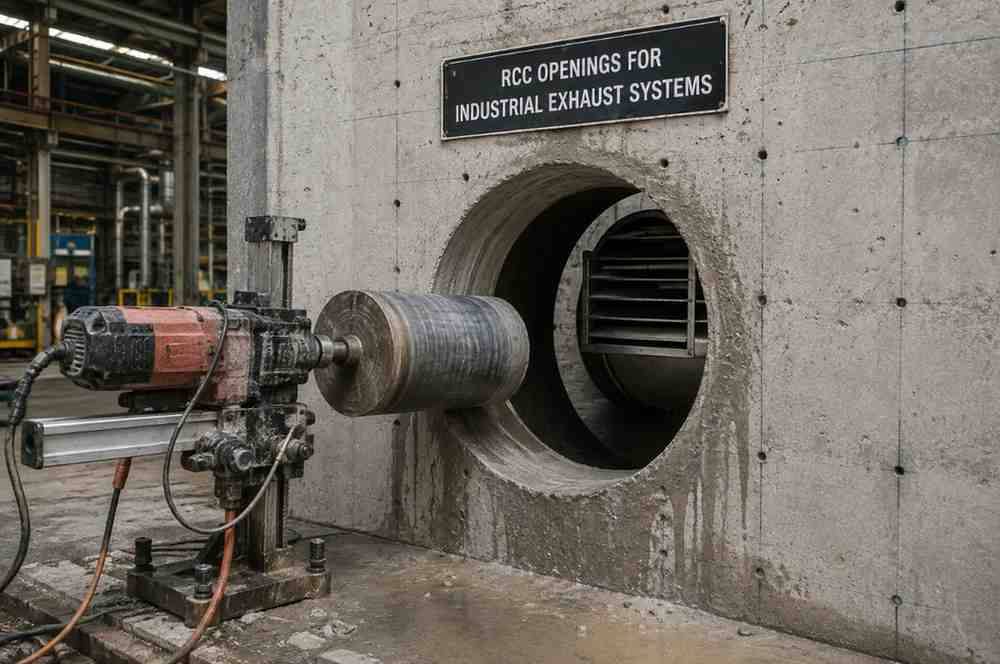
Industrial manufacturing, chemical processing, and large-scale warehousing require robust environmental control frameworks to ensure worker safety, maintain air quality, and comply with strict occupational health regulations. At the heart of these frameworks lie powerful industrial exhaust and ventilation systems. However, installing massive ductwork, heavy-duty blowers, and filtration units across heavy concrete infrastructure demands precise structural modifications. Specifically, creating RCC (Reinforced Cement Concrete) openings for industrial exhaust systems is a critical engineering task that bridges the gap between mechanical design and civil integrity.
Target-Related Searches & People Also Ask
-
Target-Related Searches: Diamond core cutting for ventilation, RCC wall penetration for exhaust fans, industrial duct core drilling, concrete cutting contractor for HVAC, structural core cutting services.
-
People Also Ask:
-
What is the best method for making openings in RCC walls for exhaust ducts?
-
Does core cutting weaken the structural integrity of concrete columns and slabs?
-
How are dust and vibrations managed during industrial concrete cutting?
-
Why is diamond tool technology preferred for industrial exhaust penetrations?
-
Introduction: The Crucial Role of Exhaust Ventilation in Industry
Modern industrial plants generate significant quantities of airborne contaminants, including heat, toxic fumes, chemical vapors, dust particles, and humidity. Without a properly engineered exhaust system, these pollutants can degrade indoor air quality, threaten employee well-being, and damage sensitive machinery.
However, running heavy-gauge steel ductwork through a heavy-duty facility requires penetrating thick concrete walls, floors, and roofs. Unlike residential buildings constructed with lightweight framing, industrial facilities rely heavily on Reinforced Cement Concrete (RCC) to support extreme loads and harsh operational conditions. Creating precise RCC openings for industrial exhaust systems requires specialized tools, rigorous engineering calculations, and professional execution to avoid compromising the building’s structural framework.
Why Precision RCC Openings Matter for Industrial Ventilation
An industrial exhaust layout is a complex network of blowers, hoods, cyclones, scrubbers, and duct lines. Any mismatch between the mechanical design and the physical concrete penetrations leads to costly delays, structural weak points, and inefficient airflow.
1. Maintaining Aerodynamic Efficiency
Exhaust systems rely on smooth, unobstructed airflow paths to maintain static pressure and velocity. If an RCC opening is ragged, undersized, or misaligned, it forces installers to cram or bend ductwork. This creates flow restrictions, increases turbulence, drops system efficiency, and forces exhaust motors to work harder, driving up energy consumption.
2. Protecting Structural Load-Bearing Capacities
RCC elements like beams, columns, and shear walls carry the primary load of an industrial building. Haphazard breaking or chipping of concrete to create exhaust routes can sever internal reinforcement bars (TMT bars), drastically reducing load capacity. Professional core cutting guarantees that structural integrity remains uncompromised.
3. Preventing Seepage and Air Leaks
Exhaust penetrations must be completely sealed to prevent the entry of rainwater, pests, or fugitive gases. Smooth, circular core-drilled openings allow for tight installation with industrial-grade mechanical sleeves and firestop sealants, ensuring a weather-tight and airtight finish.
Advanced Techniques for Creating Concrete Openings
Traditional methods of breaking concrete using heavy pneumatic hammers or sledgehammers are obsolete in modern industrial engineering. They cause uncontrolled micro-cracking, excessive noise, structural damage, and heavy dust pollution. Instead, specialized techniques are deployed for industrial exhaust installations:
Diamond Core Drilling
Diamond core drilling is the gold standard for creating circular apertures ranging from small utility holes to massive diameter passages for heavy-duty round ductwork. Industrial-grade diamond segments embedded in high-torque core barrels slice through hardened aggregate and high-tensile steel reinforcement smoothly without inducing shockwaves.
Wire Sawing and Wall Sawing
For rectangular or oversized square openings required by large rectangular industrial ventilation trunks, combination techniques like wall sawing and stitch-drilling (overlapping core holes) are implemented. This achieves clean geometric corners and exact dimensions matching blueprint layouts.
Step-by-Step Execution Workflow by Experts
Executing concrete penetrations in an active industrial facility demands a systematic, safety-first protocol:
-
Structural Blueprint Analysis & Scanning: Before any cutting begins, non-destructive testing (NDT) methods—such as ground-penetrating radar (GPR) or X-ray radiography—are used to map out internal rebar layouts and embedded electrical or plumbing lines.
-
Marking and Alignment: Precise center points and circumferences are marked according to the HVAC engineer’s exhaust routing schematics.
-
Rig Setup and Anchoring: Heavy-duty core drilling rigs are rigidly bolted or vacuum-anchored to the RCC surface to prevent any slippage or deviation during high-speed rotation.
-
Controlled Wet or Dry Cutting: Water delivery systems are typically integrated to cool the diamond bits, suppress dust completely, and flush out slurry. In dry cutting environments, high-efficiency particulate air (HEPA) dust extraction shrouds are utilized.
-
Core Extraction and Site Clean-up: Once the cylindrical concrete core is severed, it is safely extracted, and the interior walls of the opening are smoothed out, prepped, and handed over to the mechanical duct installation crew.
Safety, Compliance, and Environmental Considerations
Industrial retrofitting must align with strict occupational safety guidelines.
-
Vibration Control: Diamond core cutting produces virtually zero vibration, protecting surrounding sensitive machinery and preventing structural fatigue.
-
Noise and Dust Mitigation: Wet-cutting mechanisms minimize crystalline silica dust exposure, safeguarding workers on site.
-
Professional Partnership: Ensuring that structural modifications meet safety standards requires working with certified execution teams. For tailored industrial solutions, facility managers can consult with specialists directly through [email protected].
Conclusion
Integrating efficient industrial exhaust systems is non-negotiable for maintaining a safe, productive, and compliant manufacturing environment. However, the success of these ventilation networks ultimately relies on the precision of the civil infrastructure modifications housing them. By utilizing advanced diamond cutting methodologies and adhering to rigorous engineering practices, facility operators can achieve flawless RCC openings for industrial exhaust systems, ensuring long-term structural safety and optimal airflow performance.