
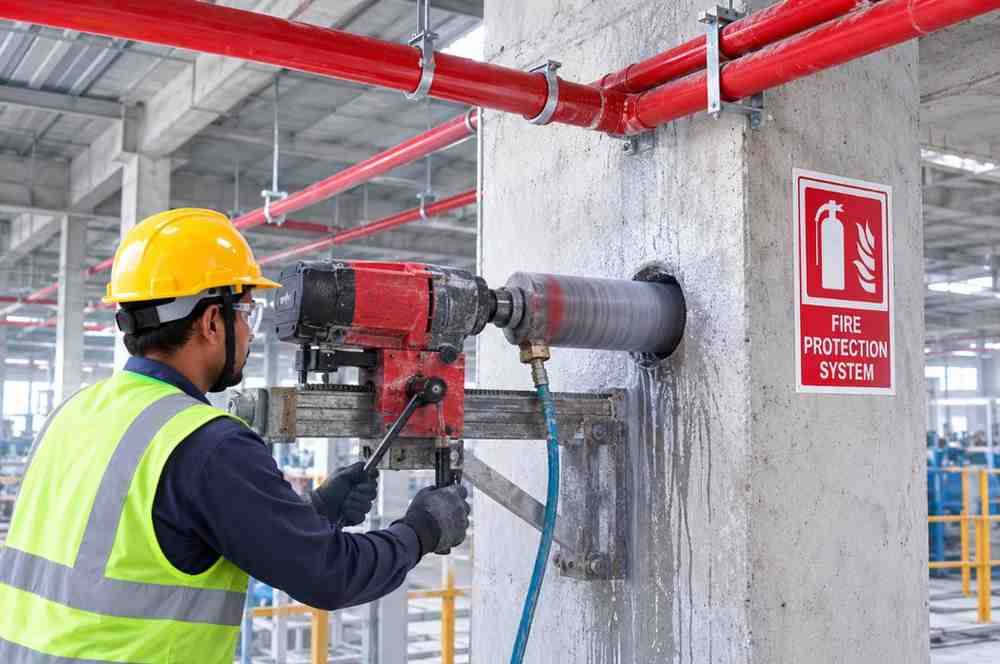
Surat has grown into one of India's most important industrial and manufacturing hubs, home to thousands of textile mills, diamond processing units, chemical plants, and engineering factories. As industries expand and modernize, safety compliance has become a non-negotiable part of every factory's operations — and fire protection systems sit right at the top of that list. But installing a reliable fire protection network inside an existing RCC (Reinforced Cement Concrete) structure is never as simple as laying pipes along a wall. It requires precise, controlled openings through concrete slabs, beams, and walls — a process known as RCC penetration work or core cutting.
At Core Cutting India ([email protected]), we specialize in exactly this kind of technical, safety-critical work. In this article, we'll walk you through what RCC penetration work involves, why it's essential for fire protection systems, the methods used, the challenges specific to Surat's industrial belt, and what factory owners should look for when hiring a core cutting contractor.
What Is RCC Penetration Work?
RCC penetration work refers to the process of creating precise openings — holes, slots, or channels — through reinforced concrete structural elements such as walls, floors, slabs, and beams. These openings allow pipes, cables, ducts, and conduits to pass from one section of a building to another without compromising the structural integrity of the building.
In the context of fire protection systems, RCC penetration work is used to route:
- Fire sprinkler pipelines through floor slabs and walls
- Fire hydrant risers between floors
- Smoke detection and fire alarm cabling
- Ventilation ducts for smoke exhaust systems
- Fire-rated cable trays for emergency lighting and alarm circuits
- Water supply lines connecting to fire pumps and storage tanks
Unlike ordinary drilling, RCC penetration for fire protection must be executed with extreme precision. The size, location, and depth of every cut is usually dictated by fire safety drawings approved by consultants and, in many cases, local fire departments. A poorly executed penetration can weaken structural members, damage embedded reinforcement bars, or create gaps that compromise fire compartmentalization — the very thing the fire protection system is meant to prevent.
Why Fire Protection Systems Need Specialized RCC Penetration Work
Fire protection systems are only as effective as their installation. A sprinkler system with pipes routed through poorly cut openings can leak, misalign, or create weak points in the structure. Here's why specialized RCC penetration work matters so much for fire safety installations specifically:
1. Structural Safety Comes First
Factories in Surat are often multi-storey RCC structures carrying heavy machinery loads. Cutting into a slab or beam without knowing the reinforcement layout can sever load-bearing rebar, leading to long-term structural weakness. Professional core cutting teams use scanning equipment to detect embedded rebar and electrical conduits before cutting, ensuring the structure's load-bearing capacity remains intact.
2. Precision Sizing for Pipe and Cable Routing
Fire protection pipelines come in standardized diameters, and the penetration opening must match these sizes closely — too large, and you compromise fire-rated sealing; too small, and installation becomes difficult or impossible. Diamond core cutting technology allows for exact, clean-edged circular openings that match pipe specifications precisely.
3. Maintaining Fire Compartmentalization
Modern fire codes require that walls and floors act as fire barriers, stopping the spread of fire and smoke between compartments. Every penetration made for a pipe or cable must later be sealed with fire-stop materials rated to match the wall or floor's fire resistance rating. Clean, accurately sized penetrations make this sealing process effective; rough or oversized openings make it nearly impossible to achieve a proper fire seal.
4. Minimal Disruption to Ongoing Operations
Most RCC penetration work in Surat factories happens in structures that are already operational. Textile units, chemical plants, and diamond processing facilities cannot afford extended production downtime. Modern core cutting techniques are low-vibration, low-dust, and low-noise compared to traditional hammer drilling, allowing work to be carried out with minimal disturbance to daily operations.
Common RCC Penetration Techniques Used in Fire Protection Installations
Diamond Core Drilling
This is the most widely used method for creating circular openings for pipes, cables, and conduits. A diamond-tipped core bit rotates at high speed, cutting a smooth, precise hole through concrete, brick, or RCC without generating the vibration or cracking associated with traditional drilling. Core drilling is ideal for:
- Sprinkler riser pipe penetrations
- Fire hydrant line openings
- Cable and conduit routing for alarm systems
Wall Sawing
For larger rectangular or slot-shaped openings — such as those required for larger duct banks or multiple pipe clusters — wall saws using diamond blades are used to cut clean, straight edges through concrete walls.
Wire Sawing
In situations involving very thick RCC sections, unusual shapes, or structural elements with heavy reinforcement, diamond wire sawing offers a flexible, high-precision cutting solution that can navigate complex geometries with minimal structural disturbance.
Wall Chasing / Grooving
For surface-routed fire alarm cabling or smaller conduit runs, controlled chasing equipment is used to cut precise grooves into walls without the extensive breakage caused by manual chiseling.
RCC Penetration Work in Surat's Industrial Context
Surat's factory landscape presents its own unique set of conditions that make specialized core cutting expertise particularly valuable:
Dense industrial zones: Areas like Pandesara, Sachin GIDC, Udhna, and Katargam host a concentration of textile, chemical, and processing units, often located close together. Cutting work must be carried out with strict control over dust, noise, and vibration to avoid disturbing neighboring units.
Retrofitting older structures: Many factories built decades ago are now being upgraded to meet current fire safety norms mandated by the Gujarat Fire Prevention and Life Safety Measures Act and local municipal fire NOC requirements. This means core cutting teams frequently work on aging RCC structures where reinforcement drawings may not be readily available, making pre-cutting scanning even more critical.
High-value production environments: In sectors like diamond processing and textile manufacturing, even brief production halts translate into significant financial loss. Efficient, well-planned RCC penetration scheduling helps minimize downtime.
Compliance-driven timelines: With increased enforcement of fire safety regulations following various industrial incidents across Gujarat in recent years, many Surat factories are working against firm deadlines to complete fire protection upgrades and secure fire NOCs. Reliable, fast-turnaround core cutting services have become essential to meeting these compliance timelines.
Step-by-Step Process: How Professional RCC Penetration Work Is Carried Out
- Site Survey and Drawing Review – The team reviews approved fire protection layout drawings to identify exact penetration points, sizes, and elevations.
- Structural Scanning – Ground-penetrating radar or rebar scanners are used to map embedded reinforcement, electrical conduits, and existing utilities within the cutting zone.
- Marking and Planning – Precise markings are made on the wall or slab surface, cross-checked against structural drawings to avoid critical load-bearing elements.
- Cutting Execution – Using diamond core drills, wall saws, or wire saws depending on the opening size and location, the penetration is cut cleanly and accurately.
- Debris and Dust Management – Wet-cutting methods and vacuum dust extraction systems are used to control debris, particularly important in factory environments with sensitive machinery or materials nearby.
- Quality Inspection – The finished opening is checked against specifications for size, alignment, and edge quality.
- Handover for Fire-Stop Sealing – Once pipes or cables are routed through, the opening is handed over for fire-rated sealing using approved fire-stop materials, restoring the fire compartment rating of the wall or floor.
Choosing the Right RCC Penetration Contractor in Surat
Given the structural and safety stakes involved, factory owners and facility managers should evaluate core cutting contractors on a few key factors:
- Experience with fire protection installations specifically — not just general demolition or drilling work
- Availability of scanning equipment to detect rebar and utilities before cutting
- Trained and certified operators familiar with diamond core drilling, wall sawing, and wire sawing techniques
- Dust and noise control practices, especially important in occupied industrial facilities
- Ability to work around production schedules, including night shifts or planned shutdown windows
- Coordination capability with fire protection consultants, MEP contractors, and fire-stop sealing teams
- Track record with local fire NOC and compliance requirements specific to Gujarat's regulatory framework
Why Precision Matters More Than Speed
It can be tempting for factory owners under compliance pressure to prioritize speed above all else. However, rushed or imprecise RCC penetration work creates risks that outlast the immediate installation: weakened structural members, poorly sealed fire compartments, leaking pipe penetrations, and potential rework costs. A methodical, scan-first approach — even if it adds a small amount of time upfront — ultimately protects both the structure and the effectiveness of the fire protection system itself.
Conclusion
Fire protection systems are only as reliable as the structural work that supports them, and RCC penetration work forms the invisible but critical foundation of every sprinkler line, hydrant riser, and alarm cable running through a factory building. For Surat's fast-growing industrial sector — where structures range from decades-old textile mills to modern manufacturing units — precise, professional core cutting is essential not just for compliance, but for genuine life safety.
Core Cutting India brings specialized expertise in diamond core drilling, wall sawing, and wire sawing for fire protection installations across Surat's industrial zones. From structural scanning to clean, code-compliant penetrations, our teams are equipped to support factories through every stage of their fire safety upgrade — with minimal disruption to ongoing operations.
For RCC penetration work, core cutting, or any concrete cutting requirement related to fire protection system installation in your Surat factory, reach out to us at [email protected].
People Also Ask
1. What is RCC penetration work used for in fire protection systems? RCC penetration work creates precise openings through concrete walls, slabs, and beams to allow fire sprinkler pipes, hydrant risers, alarm cabling, and ventilation ducts to pass between floors and rooms without weakening the building's structure.
2. Is core cutting safe for load-bearing walls and slabs? Yes, when performed by trained professionals using rebar scanning equipment to map reinforcement before cutting. This ensures openings avoid critical structural elements and preserve the building's load-bearing capacity.
3. How is core cutting different from normal drilling? Core cutting uses diamond-tipped rotary bits to cut smooth, precise, vibration-free openings through concrete, whereas conventional drilling relies on impact force, which can cause cracking and structural micro-damage.
4. Why do factories in Surat need fire protection retrofitting? Many older factories in Surat's industrial areas were built before current fire safety norms were enforced. As regulations under the Gujarat Fire Prevention and Life Safety Measures Act have tightened, factories are upgrading their fire protection systems and require RCC penetration work to install compliant piping and cabling.
5. What happens after a penetration hole is cut for a fire sprinkler pipe? Once the pipe or cable is routed through the opening, it must be sealed using fire-rated fire-stop materials to restore the fire-resistance rating of the wall or floor, maintaining proper fire compartmentalization.
6. How long does RCC penetration work take for a factory fire protection upgrade? Timelines vary based on the number and size of penetrations, structural complexity, and site access, but professional teams typically plan work around production schedules to minimize downtime, often completing multiple penetrations within a single shift.
7. Does core cutting cause dust and noise disruption in an operating factory? Modern diamond core cutting methods use wet-cutting and vacuum dust extraction systems, significantly reducing dust and noise compared to traditional drilling or breaking methods, making it suitable for occupied industrial environments.