
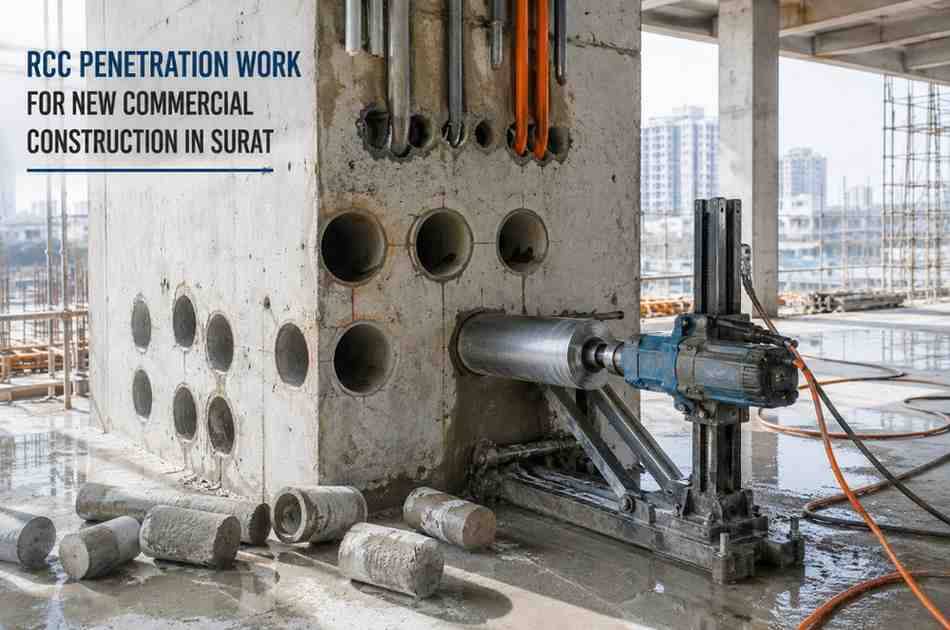
Surat's skyline is changing fast. Textile hubs, diamond markets, IT parks, retail malls, and multi-storey commercial complexes are rising across the city at a pace few other Gujarat cities can match. But behind every gleaming glass façade and every functioning HVAC system lies a less visible, highly technical process — RCC penetration work. Without it, the pipes, cables, ducts, and fire-safety lines that keep a commercial building running would have nowhere to run through the structure.
At Core Cutting India ([email protected]), we specialize in precision RCC penetration work for new commercial construction projects across Surat. In this blog, we'll walk you through what this work involves, why it matters, and what builders and contractors should know before hiring a core cutting agency.
What Is RCC Penetration Work?
RCC (Reinforced Cement Concrete) penetration work refers to the process of creating precise openings, holes, or channels through concrete slabs, walls, beams, and columns to allow the passage of mechanical, electrical, and plumbing (MEP) services. This includes:
- Electrical conduits and cable trays
- Plumbing and drainage pipelines
- HVAC ducting and ventilation shafts
- Fire-fighting sprinkler lines
- Data and telecom cabling
- Structural expansion joints
Since RCC is a load-bearing composite material embedded with steel reinforcement bars, penetrating it isn't as simple as drilling through a wooden partition. It requires specialized tools, trained technicians, and a deep understanding of structural engineering to ensure the building's integrity isn't compromised.
Why RCC Penetration Work Matters in Commercial Construction
Commercial buildings — whether office towers, retail complexes, hospitals, or industrial facilities — have significantly more complex service requirements than residential structures. A single commercial floor may need dozens of penetrations for electrical risers, chilled water pipes, exhaust ducts, and structured cabling.
Getting this wrong can lead to:
- Structural weakening — Cutting through main reinforcement bars without proper planning can compromise load-bearing capacity.
- Water seepage and leakage — Poorly sealed penetrations are one of the most common causes of water damage in commercial buildings.
- Fire safety violations — Unsealed penetrations can allow fire and smoke to spread between floors, violating fire code compliance.
- Project delays and cost overruns — Incorrect cutting often means redoing work, which costs both time and money.
This is exactly why builders in Surat are increasingly turning to specialized core cutting and penetration contractors rather than relying on generic labor for this critical task.
Methods Used in RCC Penetration Work
Professional core cutting companies like Core Cutting India use a range of techniques depending on the thickness of the RCC element, the size of the opening required, and the location within the building.
1. Diamond Core Drilling
This is the most widely used method for creating circular openings in RCC slabs and walls. A diamond-tipped hollow drill bit rotates at high speed, cutting cleanly through concrete without generating excessive vibration or dust. It's ideal for:
- Plumbing pipe penetrations
- Electrical conduit passages
- Small to medium HVAC duct openings
- Anchor bolt holes for machinery foundations
Diamond core drilling produces clean, precise, circular holes with minimal micro-cracking, which helps preserve the structural integrity of the surrounding concrete.
2. Wall Sawing
For larger rectangular or square openings — such as door frames, window openings, or larger duct passages — wall sawing is preferred. A track-mounted diamond blade saw cuts straight, controlled lines through vertical RCC walls.
3. Floor Sawing
Similar to wall sawing but used on horizontal RCC slabs, floor sawing is commonly used to create openings for elevator shafts, staircases, floor drains, and large service risers in multi-storey commercial buildings.
4. Chain Saw and Ring Saw Cutting
For tight corners or areas where a track saw cannot maneuver, chain saws and ring saws with diamond-tipped chains or blades allow contractors to complete precise cuts in confined spaces.
5. Wire Sawing
Used for very thick RCC sections or unusually shaped cuts, wire sawing involves a diamond-embedded cable that can cut through extremely dense reinforced concrete, often used in heavy industrial or infrastructure-grade commercial projects.
RCC Penetration Work in Surat's Commercial Construction Boom
Surat has witnessed a sharp rise in commercial real estate development — from Diamond Bourses and textile market complexes to IT parks and shopping malls in areas like Vesu, Adajan, Piplod, and City Light. This rapid growth has increased the demand for skilled RCC penetration contractors who can work within tight construction schedules without compromising quality.
A few sector-specific applications we frequently handle in Surat include:
- Diamond and textile trading complexes — where extensive electrical and data cabling networks require multiple precise wall and floor penetrations across large trading floors.
- Shopping malls and retail complexes — requiring HVAC duct penetrations, fire sprinkler routing, and escalator/elevator shaft openings.
- Office towers and IT parks — needing structured cabling penetrations, chilled water piping for centralized air conditioning, and floor-to-floor riser shafts.
- Hospitals and healthcare facilities — where medical gas piping, specialized ventilation, and stringent fire-safety sealing standards apply.
- Industrial and warehousing units — requiring large openings for heavy machinery foundations and utility corridors.
The RCC Penetration Process: Step by Step
When Core Cutting India takes on a commercial project in Surat, our process typically follows these stages:
1. Site Assessment and Structural Drawing Review
Before any cutting begins, our team reviews structural drawings alongside MEP layout plans to identify the exact location, size, and depth of each required penetration. This step is critical to avoid cutting through primary reinforcement bars or post-tensioned cables.
2. Rebar Scanning
Using rebar detection scanners, we map the exact position of steel reinforcement within the concrete before cutting. This ensures we avoid structurally critical bars and only cut through areas that have been engineering-approved.
3. Marking and Layout
Precise markings are made on-site based on approved shop drawings, ensuring alignment with the MEP contractor's routing plan across multiple floors.
4. Cutting Execution
Depending on the requirement, our technicians use diamond core drilling, wall sawing, or floor sawing equipment. Wet-cutting methods are typically used to minimize dust and control heat generated during cutting.
5. Debris Removal and Site Cleanup
Concrete slurry and debris are collected and removed immediately, keeping the site clean and safe for other trades working simultaneously.
6. Sealing and Fire-Stopping
Once services are routed through the penetration, proper fire-rated sealants and waterproofing compounds are applied to restore the fire and moisture resistance of the opening — a step that's often overlooked but essential for occupancy certification.
Why Choose a Specialized Contractor Over General Labor
Many contractors in Surat still rely on unskilled labor with basic tools for concrete cutting work, which can lead to serious problems down the line. Here's what sets a specialized RCC penetration contractor apart:
- Precision equipment that produces clean cuts with minimal vibration and no structural cracking
- Trained technicians who understand load paths and reinforcement layouts
- Dust and noise control methods suited for occupied or partially operational sites
- Compliance awareness regarding fire safety codes and structural safety norms
- Faster turnaround due to purpose-built machinery rather than manual chiseling or hammering
Choosing the right partner for RCC penetration work isn't just about getting a hole cut — it's about protecting the long-term integrity, safety, and compliance of the entire building.
Common Challenges in Commercial RCC Penetration Work
Every commercial project comes with its own set of challenges, and Surat's fast-paced construction environment is no exception:
- Congested reinforcement zones near beam-column junctions require extra caution and sometimes design modifications.
- Multiple trade coordination — electrical, plumbing, HVAC, and fire-fighting teams often need penetrations in overlapping areas, requiring careful sequencing.
- Post-tensioned slabs in high-rise commercial buildings require specialized scanning to avoid cutting tensioned cables, which can be extremely dangerous if damaged.
- Working in occupied buildings — for renovation or expansion projects, cutting work must be carried out with strict dust and noise control to avoid disrupting ongoing business operations.
Experienced core cutting teams anticipate these challenges and plan accordingly, reducing on-site surprises and keeping the project on schedule.
Cost Factors in RCC Penetration Work
The cost of RCC penetration work varies based on several factors:
- Thickness of the RCC element — thicker slabs or walls require more time and specialized equipment.
- Diameter or size of the opening — larger openings cost more due to higher material removal and labor time.
- Location within the building — penetrations in congested or hard-to-access areas may require additional setup time.
- Number of penetrations — bulk penetration work across multiple floors is typically more cost-effective per unit than isolated small jobs.
- Sealing and fire-stopping requirements — projects requiring certified fire-rated sealing may involve additional material costs.
For an accurate estimate tailored to your commercial project in Surat, it's best to consult directly with a specialized contractor who can assess your drawings and site conditions.
Safety Standards Followed During RCC Penetration Work
Safety is non-negotiable when working with reinforced concrete structures. Reputable core cutting contractors follow strict safety protocols, including:
- Use of personal protective equipment (PPE) for all site personnel
- Water-fed cutting tools to suppress dust and reduce airborne silica exposure
- Barricading and signage around active cutting zones
- Regular equipment inspection and maintenance
- Adherence to local municipal and fire safety guidelines applicable to commercial structures in Surat
Why Core Cutting India Is Trusted for Commercial Projects in Surat
At Core Cutting India, we bring together technical expertise, modern diamond cutting equipment, and a deep understanding of Surat's commercial construction landscape. Whether it's a diamond bourse, a retail mall, a corporate office tower, or an industrial facility, our team ensures every penetration is executed with precision, safety, and minimal disruption to the ongoing construction schedule.
Our services for commercial construction projects in Surat include:
- Diamond core drilling for MEP openings
- Wall and floor sawing for large-format openings
- Rebar scanning and structural assessment
- Fire-rated sealing and waterproofing of penetrations
- Renovation and retrofit cutting work for operational buildings
Conclusion
RCC penetration work may not be the most visible part of commercial construction, but it's one of the most critical. Every duct, pipe, and cable that keeps a modern commercial building functional depends on precisely executed openings in the structure — done in a way that protects both safety and structural integrity.
As Surat continues to grow as a commercial and industrial hub, the demand for skilled, technology-driven RCC penetration contractors will only increase. If you're planning a new commercial construction project or renovation in Surat, partnering with an experienced team can save time, reduce risk, and ensure long-term structural performance.
For professional RCC penetration work, diamond core drilling, and concrete cutting services in Surat, reach out to Core Cutting India at [email protected].
Target-Related Searches
- RCC cutting services Surat
- Diamond core drilling for commercial buildings
- Concrete coring contractor near me
- Wall sawing and floor sawing services Surat
- RCC opening cutting for MEP work
- Core cutting company in Gujarat
- Concrete penetration for plumbing and electrical
- Fire-rated sealing after core cutting
- Structural core drilling services India
- Commercial building construction contractors Surat
People Also Ask
1. What is RCC penetration work in construction? RCC penetration work involves creating precise openings in reinforced cement concrete structures — slabs, walls, beams, or columns — to allow the passage of electrical, plumbing, HVAC, and fire-fighting services.
2. Is diamond core drilling safe for load-bearing walls? Yes, when performed by trained professionals using rebar scanning to avoid critical reinforcement bars, diamond core drilling is a safe and structurally sound method for creating openings in load-bearing walls.
3. How much does RCC core cutting cost in Surat? Costs vary depending on the thickness of the concrete, size and number of openings, location within the building, and any additional sealing requirements. It's best to get a site-specific quote from a specialized contractor.
4. Why is sealing required after RCC penetration work? Sealing restores the fire resistance and waterproofing of the structure after a penetration is made, preventing fire spread, smoke migration, and water seepage between floors.
5. Can RCC penetration work be done in an occupied commercial building? Yes, with proper dust control, noise management, and scheduling, RCC penetration work can be carried out in occupied or partially operational commercial buildings with minimal disruption.
6. What equipment is used for RCC cutting in commercial buildings? Common equipment includes diamond core drills, wall saws, floor saws, chain saws, ring saws, and wire saws — selected based on the size, shape, and location of the required opening.