
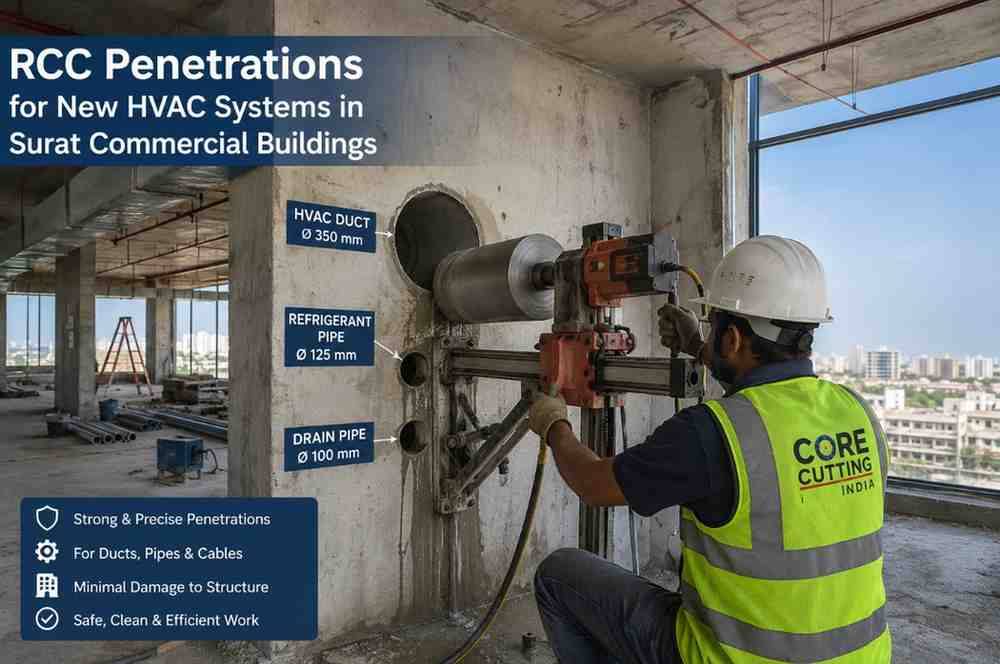
Surat's skyline is changing fast. From the diamond bourses of Varachha to the glass-fronted corporate towers along Ring Road and the sprawling textile markets of Ved Road, commercial construction in the city has entered a new phase. With this growth comes a demand that every builder, MEP contractor, and facility manager eventually runs into: how do you get HVAC ductwork, chilled water pipes, and refrigerant lines through solid reinforced cement concrete (RCC) without compromising the structure?
This is where RCC penetration work — commonly known as core cutting or core drilling — becomes one of the most critical, and most underestimated, parts of any HVAC installation project. At Core Cutting India ([email protected]), we've worked on commercial buildings across Surat where a rushed or poorly planned penetration turned a simple duct run into weeks of structural repair. This blog breaks down everything a Surat-based commercial building owner, architect, or MEP consultant needs to know about RCC penetrations for new HVAC systems.
Why RCC Penetrations Matter for HVAC in Surat's Commercial Buildings
Surat's commercial real estate — malls, IT parks, hospitals, hotels, and diamond trading complexes — almost universally relies on RCC framed construction for its strength, fire resistance, and durability in the region's humid, high-load climate. But RCC is dense, load-bearing, and reinforced with steel rebar, which makes it fundamentally different from brick or block walls when it comes to creating openings.
HVAC systems need multiple types of penetrations through RCC slabs, beams, and walls:
- Supply and return air duct openings
- Chilled water and condenser water pipe risers
- Refrigerant line pass-throughs for VRF/VRV systems
- Exhaust and fresh air intake shafts
- Cable and control wiring conduits for BMS-integrated HVAC
- Drain pipe routes for condensate removal
Each of these has a different size, shape, and structural sensitivity requirement. A 300mm duct opening on a transfer beam is a completely different engineering decision than a 50mm refrigerant pipe sleeve through a non-load-bearing wall. Getting this wrong doesn't just delay the HVAC contractor — it can compromise the building's structural integrity, trigger costly retrofits, or create fire and acoustic compliance issues down the line.
The Core Cutting Method: Why It's the Standard for New HVAC Installations
For decades, penetrations in RCC were made using breakers, chisels, or jackhammers. This approach is now largely obsolete for commercial projects, and for good reason. Diamond core cutting has become the industry standard across Surat's commercial construction sector because it offers precision, safety, and speed that manual breaking simply cannot match.
How Diamond Core Drilling Works
A diamond core drilling machine uses a hollow, diamond-tipped cylindrical bit that rotates at high speed while water is continuously fed to cool the bit and flush out concrete slurry. The result is a clean, perfectly round hole with smooth edges — exactly what's needed for HVAC sleeves, duct collars, and pipe penetrations.
Unlike impact-based breaking methods, core drilling produces almost no vibration. This matters enormously in occupied or partially occupied commercial buildings, where adjacent tenants, ongoing finishing work, or sensitive equipment cannot tolerate structural shock.
Key Advantages for HVAC Penetration Work
- Precision sizing — Core bits are available in diameters ranging from 25mm to over 600mm, allowing exact matches to duct collars and pipe sleeves without oversized, messy openings.
- No micro-cracking — Vibration-free cutting prevents the hairline cracks that hammer-breaking often causes around an opening, which can later widen and cause water seepage or reinforcement corrosion.
- Rebar-safe execution — When combined with rebar scanning, core drilling allows contractors to cut around or between existing reinforcement rather than severing it blindly.
- Dust and noise control — Wet cutting keeps dust levels low, which is essential for HVAC work happening in finished commercial spaces, hospitals, or retail environments where air quality and noise restrictions apply.
- Faster turnaround — A single opening that might take hours with a breaker can often be completed in 15–30 minutes with the right core rig, which matters when HVAC schedules are tightly linked to overall project handover dates.
Planning RCC Penetrations: What Happens Before the Cutting Starts
Experienced core cutting contractors in Surat don't just show up with a drill. Proper HVAC penetration work follows a structured process, and skipping steps is where most site problems originate.
1. Coordination Between MEP and Structural Drawings
The single biggest cause of penetration errors is a mismatch between HVAC shop drawings and structural drawings. Duct routes are often finalized after the RCC structure is cast, especially in fast-tracked commercial projects common in Surat's competitive construction timelines. Before any cutting begins, the HVAC contractor's duct and pipe layout must be overlaid on the structural drawings to confirm exact locations, beam positions, and slab thickness.
2. Structural Engineer Sign-Off
Any penetration through a beam, load-bearing wall, or transfer slab requires review by a structural engineer. In multi-storey commercial buildings — increasingly common across Surat's business districts — even slab penetrations near columns or shear walls need clearance to avoid affecting load paths. Reputable core cutting firms will not proceed on structural elements without this approval.
3. Rebar Detection and GPR Scanning
Before drilling, the exact cutting location is scanned using a rebar detector or Ground Penetrating Radar (GPR). This identifies the position, depth, and spacing of reinforcement steel so the core position can be adjusted by a few centimetres if needed to avoid cutting primary structural bars. In post-tensioned slabs — increasingly used in Surat's larger commercial and mall projects — this scanning step is non-negotiable, since cutting a live tendon can be dangerous and structurally severe.
4. Marking and Method Statement
Each penetration point is marked on-site matching the approved drawing, along with the required diameter, angle, and depth. A method statement covering water management, dust containment, working-at-height protocols, and adjacent-area protection is prepared, particularly important for occupied buildings or upper floors where water runoff needs controlled drainage.
Common HVAC Penetration Scenarios in Surat Commercial Projects
Duct Openings Through RCC Slabs (Vertical Shafts)
Multi-storey commercial buildings often route main supply and return ducts vertically through dedicated shafts. Where shaft openings weren't cast during construction, or need to be enlarged post-handover for a system upgrade, core cutting teams create rectangular or circular openings using a combination of core drilling at the corners followed by wall-saw cutting between the holes — a technique that avoids the cracking risk of straight-line breaking.
Pipe Sleeves Through RCC Beams and Walls
Chilled water pipe risers frequently need to pass through beams connecting floors. Because beams carry significant structural load, these penetrations are limited to specific "sweet zones" — generally within the middle third of the beam span and away from the top and bottom reinforcement layers, per structural engineering guidance. Core drilling allows contractors to hit these precise zones accurately.
Refrigerant Line and Drain Pipe Pass-Throughs
VRF and split AC systems common in Surat's retail and office spaces need smaller-diameter penetrations (typically 50–100mm) for refrigerant piping and condensate drains. These are usually lower-risk penetrations through non-structural walls but still benefit from clean core cutting to allow proper sleeve installation and fire-rated sealing afterward.
Exhaust and Fresh Air Intake Shafts
Kitchens, generator rooms, and basement parking areas in commercial complexes require dedicated exhaust penetrations, often through thick external RCC walls. These larger-diameter cores (up to 600mm+) demand heavy-duty rigs and experienced crews, since wall thickness in Surat's newer high-rise commercial developments can exceed 300mm.
Post-Penetration Requirements: Sealing, Fire-Stopping, and Compliance
Cutting the opening is only half the job. Once HVAC ducts and pipes are installed through the RCC penetration, the surrounding gap must be properly treated:
- Fire-stopping — Fire-rated sealant, mortar, or intumescent collars are applied around duct and pipe penetrations through fire-compartment walls and slabs, as required under National Building Code (NBC) fire safety provisions applicable to Indian commercial buildings.
- Acoustic sealing — In hotels, offices, and hospitals, penetrations are sealed with acoustic-rated compounds to prevent sound transfer between floors and rooms.
- Waterproofing — For terrace-level or exterior penetrations, waterproof sealant and flashing prevent water ingress, an important consideration during Surat's monsoon season.
- Structural patching — Any temporary support or make-good concrete work around the opening is completed to restore the finished appearance and, where relevant, structural continuity.
Choosing the Right RCC Core Cutting Contractor in Surat
Given how much precision and structural risk is involved, commercial developers and MEP contractors should evaluate core cutting partners on a few key factors:
- Experience specifically with commercial and high-rise RCC structures, not just residential work
- Availability of rebar detection/GPR equipment, not just drilling rigs
- Track record of coordinating directly with structural engineers and MEP consultants
- Proper dust and water management practices suited to occupied or semi-finished buildings
- A range of core bit diameters to handle everything from small refrigerant sleeves to large duct shafts
- Compliance awareness around fire-stopping and NBC requirements post-cutting
Core Cutting India has supported HVAC contractors, builders, and facility teams across Surat's commercial sector with exactly this kind of coordinated, engineering-led approach to RCC penetration work — from early-stage shaft planning to final sealing and compliance sign-off.
Final Thoughts
As Surat's commercial construction sector continues to grow — with new malls, IT parks, hospitals, and corporate campuses coming up across the city — the demand for precise, structurally sound RCC penetrations for HVAC systems will only increase. Getting this work right protects not just the HVAC installation timeline, but the long-term structural health, fire safety, and value of the building itself.
Whether you're planning a new HVAC installation, a retrofit, or a capacity upgrade in an existing commercial building, working with an experienced core cutting team from the earliest planning stage — not after ducts are already stuck at site — makes the difference between a smooth project and a costly rework.
For RCC core cutting, diamond drilling, and structural penetration services for HVAC and MEP works across Surat, reach out to Core Cutting India at [email protected].
Target-Related Searches
- RCC core cutting for HVAC ducting Surat
- Diamond core drilling contractor Surat
- Wall cutting for AC pipe Surat
- Concrete coring services for commercial buildings
- HVAC duct opening RCC slab
- Core cutting company near me Surat
- RCC penetration for chilled water pipe
- Structural core drilling for MEP works
- Wall saw cutting Surat commercial building
- Rebar scanning before core cutting
People Also Ask
1. What is RCC core cutting used for in HVAC installation? RCC core cutting creates precise, clean openings in concrete slabs, beams, and walls to allow HVAC ducts, chilled water pipes, refrigerant lines, and exhaust vents to pass through the structure without breaking or weakening the surrounding concrete.
2. Is core cutting safe for load-bearing RCC walls and beams? Yes, when done correctly. Core cutting is safe for load-bearing elements only after structural engineer approval and rebar/GPR scanning to avoid cutting critical reinforcement, and when penetrations are placed within approved structural zones.
3. How much does RCC core cutting cost in Surat? Cost depends on the core diameter, RCC thickness, number of penetrations, and site accessibility (upper floors, occupied buildings, or basement locations typically cost more). It's best to get a site-specific quote from a local contractor like Core Cutting India.
4. What is the difference between core drilling and wall sawing? Core drilling creates round holes using a rotating diamond bit, ideal for pipes and small duct openings, while wall sawing cuts straight lines and is used for larger rectangular openings such as duct shafts or door/window modifications.
5. Can core cutting damage the structural integrity of a building? Improperly planned core cutting can damage structural integrity if it severs critical rebar or post-tensioned cables. This risk is minimized through rebar scanning, engineer approval, and precise, vibration-free diamond cutting techniques.
6. How long does it take to cut an RCC opening for HVAC ducting? A standard pipe-sized core (50–150mm) usually takes 15–30 minutes, while larger duct openings or beam penetrations can take a few hours depending on thickness, reinforcement density, and site conditions.
7. Do RCC penetrations need fire-rated sealing after HVAC installation? Yes. Any penetration through a fire-compartment wall or slab must be sealed with fire-rated sealant, mortar, or intumescent collars to maintain the building's fire safety rating as per National Building Code requirements.