
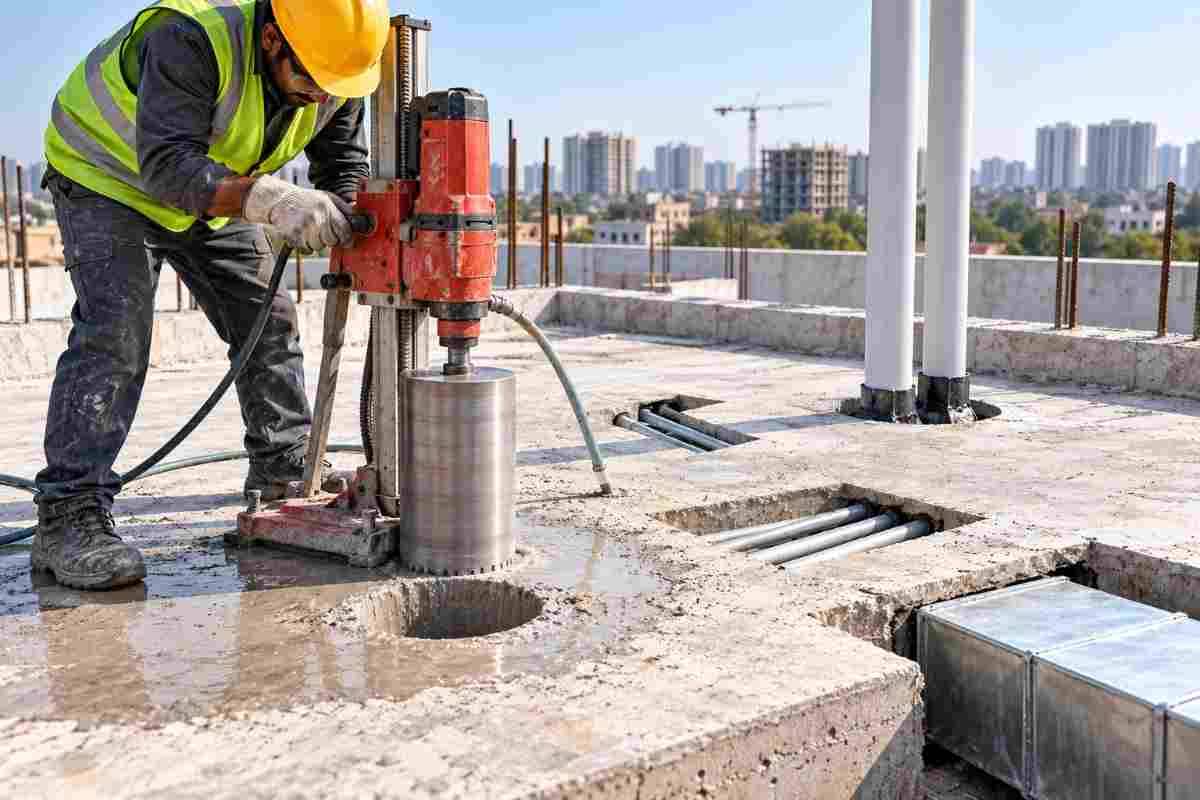
Every building changes over time. A commercial complex adds a new HVAC system, a hospital upgrades its medical gas lines, a factory installs fresh exhaust ducts, or a homeowner finally gets the rooftop water tank and solar plumbing they always wanted. In almost all of these cases, one challenge appears first: the reinforced cement concrete (RCC) roof slab stands in the way.
Cutting through an RCC roof is not like drilling into brick or plaster. It involves dense concrete, steel reinforcement, structural loads and the safety of everyone below. Done poorly, it can cause cracks, leaks, vibration damage, or even structural weakening. Done right, it is clean, precise and almost invisible once the installation is complete.
At Core Cutting India, we specialise in controlled concrete cutting that lets you add pipes, ducts and utilities to existing buildings without demolishing more than you need to. This guide explains how RCC roof cutting works, which methods suit which jobs, what to plan for, and how to avoid costly mistakes.
What Is RCC Roof Cutting?
RCC roof cutting is the process of creating openings, holes or channels in a reinforced concrete roof slab using specialised diamond-tipped tools. Instead of breaking concrete with hammers or jackhammers, which sends shock waves through the structure, diamond cutting grinds through the material cleanly and precisely.
Typical outcomes include:
- Round holes for plumbing, drainage and conduit pipes
- Rectangular or square openings for ducts, shafts and ventilation
- Larger cut-outs for staircases, skylights, lift shafts or equipment access
- Narrow slots or channels for cables and utility lines
Because RCC contains steel bars embedded in hardened concrete, the cutting method must handle both materials without damaging the surrounding slab.
Why Avoid Traditional Breaking Methods?
Many people still assume the fastest way through a roof slab is a hammer and chisel or a heavy breaker. In reality, this approach causes several problems:
1. Structural stress and micro-cracks. Impact breaking sends vibrations through the slab, beams and columns. Hidden micro-cracks may not show immediately but can grow over time, letting in moisture and corroding the rebar.
2. Rough, irregular edges. Broken openings are uneven and oversized, which makes sealing, sleeving and waterproofing much harder.
3. Noise, dust and disruption. Hammering is loud and creates heavy debris, which is a serious issue in occupied offices, hospitals, schools and homes.
4. Higher repair costs. Oversized openings need patching, grouting and finishing, which adds time and expense.
Diamond cutting avoids these issues because it removes material along a defined line rather than shattering it.
Main Methods of RCC Roof Cutting
Different jobs call for different techniques. Choosing the right one depends on slab thickness, opening size, accessibility and site conditions.
1. Core Cutting (Core Drilling)
Core cutting uses a hollow cylindrical diamond bit mounted on a drilling rig. As it rotates, it cuts a circular hole and leaves behind a solid concrete “core” that can be lifted out.
Best for:
- Plumbing and drainage pipes
- Electrical conduits and cable entries
- Fire-fighting and sprinkler lines
- Circular HVAC refrigerant line penetrations
- Anchor and bolt holes
Core cutting offers excellent precision. Holes can range from very small diameters to large openings, and the edges are smooth enough for direct sleeving and sealing. It is the most common method for new pipe and utility installations.
2. Slab Saw and Wall Saw Cutting
For rectangular or straight-line openings, a slab saw (for horizontal surfaces) or a wall saw (for vertical or inclined surfaces) is used. A large diamond blade cuts straight lines through the concrete, often running on a rail for accuracy.
Best for:
- Duct openings and ventilation shafts
- Staircase and lift openings
- Skylight and hatch openings
- Equipment access cut-outs
These saws produce clean, straight edges and can cut deep into thick slabs while keeping vibration low.
3. Wire Saw Cutting
A wire saw uses a continuous loop of diamond-impregnated wire to cut through concrete. It is ideal where blades or core bits can’t reach or where the section is very large or irregularly shaped.
Best for:
- Very thick slabs
- Large, complex cut-outs
- Cuts in tight or hard-to-reach locations
4. Hand Saw / Ring Saw Cutting
Handheld ring saws and compact cutting tools help finish corners and cut in confined spaces where larger machines cannot fit.
In practice, an experienced cutting team often combines these methods. For example, core holes at the corners of a rectangular opening can be paired with straight saw cuts for a clean, accurate finish.
Common Applications: Where RCC Roof Cutting Is Needed
New Plumbing and Drainage Pipes
Adding bathrooms, kitchens, rooftop water lines or rainwater downpipes often requires new penetrations. Core cutting creates exact-size holes so pipes fit snugly and can be sealed against leaks.
HVAC Ducts and Ventilation Systems
Air conditioning upgrades, exhaust systems, kitchen extraction and fresh-air ducts all need openings that match duct dimensions. Rectangular saw cutting gives clean frames that make duct installation and flashing far easier.
Electrical and Communication Conduits
Cable trays, conduits and data lines frequently need to pass between floors or to the roof for solar panels, antennas, CCTV and lighting.
Fire Safety and Sprinkler Systems
Fire-fighting pipelines, smoke exhaust ducts and sprinkler risers require accurate penetrations, often with strict compliance requirements for fire-stopping afterwards.
Rooftop Solar and Equipment
Solar installations, water heaters, generators, cooling towers and rooftop plant equipment all need cable and pipe routes through the slab.
Medical Gas and Special Utility Lines
Hospitals and laboratories upgrading gas, vacuum or specialised utility lines need clean cuts with minimal dust and vibration so ongoing operations are not disturbed.
Key Factors to Plan Before Cutting
A good cutting job starts well before the machine is switched on. These are the main points to consider.
1. Structural Assessment
Not every part of a slab can be cut freely. Beams, columns, and heavily reinforced zones carry critical loads. Before cutting, a structural engineer should confirm:
- Where openings are safe
- Whether additional support or framing is required
- How many reinforcement bars will be cut, if any
Cutting through primary structural elements without approval is dangerous and should never be attempted.
2. Locating Reinforcement and Embedded Services
Rebar, electrical conduits, water lines and post-tension cables may be hidden inside the slab. Scanning methods such as ground-penetrating radar (GPR) or rebar detectors help locate them. Cutting into a post-tensioned cable, in particular, can be extremely hazardous.
3. Slab Thickness and Concrete Strength
Thicker or higher-grade concrete takes more time, calls for more powerful equipment and may need different diamond bit specifications. Knowing the slab thickness in advance helps plan the right tools.
4. Opening Size and Position
Accurate marking of the opening location, dimensions and spacing prevents rework. Openings placed too close to edges, beams or one another can weaken the slab.
5. Access and Working Conditions
Rooftop access, power supply, water supply for cooling the diamond bit, and available working space all influence the method and schedule.
6. Waterproofing and Sealing Plan
Roof penetrations are common leak points. Plan sleeves, flashing, sealants and waterproofing treatments as part of the same project, not as an afterthought.
Step-by-Step: How a Professional RCC Roof Cutting Job Works
- Site inspection and survey. The team assesses slab thickness, access, existing services and project requirements.
- Scanning and marking. Reinforcement and embedded utilities are detected, and exact cutting lines are marked.
- Safety setup. The area below is cleared or protected, barricades and signage are placed, and dust and water management is arranged.
- Machine mounting and anchoring. Core rigs or saw rails are fixed firmly to ensure straight, accurate cuts.
- Cutting. Diamond tools cut through concrete and rebar with continuous water cooling, which controls dust and heat.
- Core or block removal. Cut sections are safely lifted or lowered, especially for large pieces.
- Cleaning and inspection. Slurry is removed, edges are checked, and the opening is verified against the required dimensions.
- Handover for installation. The openings are ready for sleeves, pipes, ducts and sealing.
Benefits of Professional Diamond Cutting for Roof Openings
Precision. Openings match required dimensions, reducing gaps and making installations neat and secure.
Minimal vibration. Because there is no hammering, the surrounding structure, finishes and nearby equipment stay undisturbed.
Reduced noise and dust. Wet cutting methods keep dust low, which matters in occupied buildings.
Structural integrity. Controlled cuts limit micro-cracking and preserve the slab’s strength around the opening.
Faster completion. Clean openings need little patching, so downstream work such as plumbing, ducting and waterproofing can begin sooner.
Safer working conditions. Proper planning, scanning and equipment reduce the risk of accidents, from hitting live cables to unexpected collapses.
Common Mistakes to Avoid
- Skipping scanning. Hitting hidden conduits or tensioned cables can cause injuries and costly damage.
- Cutting without engineer approval. Openings in the wrong spot can weaken the structure.
- Using the wrong tool. A core bit is not a substitute for a slab saw on large rectangular openings.
- Ignoring waterproofing. Even a perfect opening will leak if it is not sleeved and sealed correctly.
- Overcutting or oversizing. Extra-large openings require patching and reduce slab capacity.
- Hiring inexperienced operators. Concrete cutting looks simple but demands training, the right equipment and judgement.
What Affects the Cost of RCC Roof Cutting?
Pricing varies from job to job, but these are the main factors:
- Number and diameter of holes, or total length and depth of saw cuts
- Slab thickness and concrete grade
- Amount and density of reinforcement
- Site access, height and working constraints
- Special requirements such as dust-free operation or night work
- Equipment needed and project timeline
A site visit is the most reliable way to get an accurate quote, since conditions vary widely across buildings.
Safety and Compliance Considerations
Responsible concrete cutting involves more than good machinery:
- Protective equipment for operators, including eye, ear, hand and foot protection
- Water management to control slurry and prevent it from damaging finishes below
- Load and fall protection when removing heavy concrete pieces
- Clear communication with occupants and other contractors
- Fire-stopping and sealing after installation to maintain building safety ratings
Following good practice protects workers, occupants and the building itself.
Why Choose Core Cutting India?
When you are cutting into a structural element, experience matters. Core Cutting India focuses on precise, controlled concrete cutting for residential, commercial and industrial projects. Our approach centres on:
- Careful planning and site assessment before any cutting begins
- Modern diamond cutting equipment suited to different slab conditions
- Clean, accurate openings that make your pipe, duct and utility installation straightforward
- Attention to safety, dust control and minimal disruption to occupants and operations
- Practical advice on opening sizes, positioning and coordination with your engineers and installers
Whether you need a handful of core holes for plumbing or a large rectangular opening for ductwork, our aim is to deliver cuts that are accurate, tidy and structurally responsible.
Frequently Asked Questions (People Also Ask)
Can you cut a hole in an RCC roof slab?
Yes. With the right diamond cutting tools and proper planning, holes and openings can be safely cut in RCC slabs. The key is to avoid structural elements, locate reinforcement beforehand, and have the opening location approved by a structural engineer where required.
How is a hole cut in a concrete roof for pipes?
The usual method is core drilling. A diamond core bit is mounted on a drill rig, anchored to the slab and rotated with water cooling. It cuts a clean circular hole, and the concrete core is then removed so the pipe or sleeve can be installed.
Does cutting a concrete slab weaken it?
Small, well-planned openings placed in suitable locations typically have little effect, but larger or poorly placed cuts can reduce capacity. This is why an engineer’s assessment is important, and why diamond cutting, which limits cracking, is preferred to hammering.
Can you cut through rebar when core drilling?
Yes, diamond core bits can cut through steel reinforcement. However, cutting rebar should be limited and approved where possible, since reinforcement is part of the slab’s strength. Scanning helps position holes to avoid unnecessary bar cuts.
What is the difference between core cutting and slab sawing?
Core cutting makes round holes using a hollow cylindrical bit, while slab or wall sawing makes straight-line cuts for rectangular or large openings. Many projects use both.
Is diamond concrete cutting noisy or dusty?
Compared with breaking, it is much quieter and, with wet cutting, produces far less airborne dust. This makes it well suited to occupied buildings.
How long does RCC roof cutting take?
It depends on slab thickness, hole size, number of openings and site conditions. Small core holes can take minutes each, while large saw-cut openings may take several hours or longer.
How do I prevent leaks around pipe penetrations in a roof?
Use properly sized sleeves, quality sealants, flashing and waterproofing treatments around each penetration, and plan this as part of the installation rather than a later fix.
Do I need permission before cutting an RCC roof?
In many cases, yes. Society, building owner or local authority approvals may be required, and a structural engineer’s sign-off is strongly recommended, particularly for larger openings.
Final Thoughts
Adding new pipes, ducts and utility lines to an existing building does not have to mean noise, mess and structural risk. With the right planning and diamond cutting techniques, RCC roof openings can be made accurately, safely and with minimal disruption.
The key points are simple: assess the structure first, scan for hidden elements, choose the right cutting method, and plan sealing and waterproofing from the start. Entrusting the job to an experienced team ensures each of those steps is handled properly.
If you are planning an installation that requires cutting through an RCC roof, visit Core Cutting India to discuss your project and get practical guidance on the best approach.