
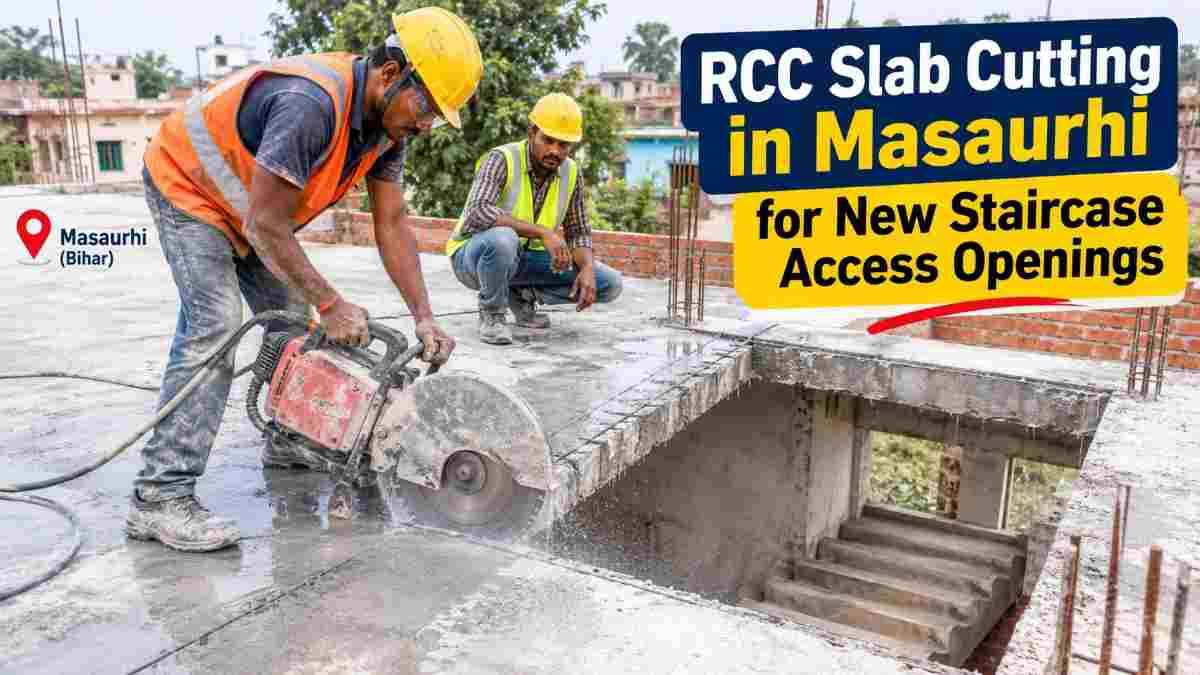
Creating vertical access across multi-story structural layouts requires precision engineering. Whether retrofitting an existing residential property, expanding a commercial establishment, or modifying an industrial structure in Masaurhi, Patna district, creating a new staircase opening through a load-bearing Reinforced Cement Concrete (RCC) slab demands exact structural evaluation and clean execution.
Traditional concrete demolition using jackhammers, sledgehammers, or uncontrolled impact tools is unsuited for structural modifications. Impact-driven breaking sends severe vibrational shocks through the floor diaphragm, inducing micro-cracks in adjacent concrete structural elements, damaging bond strength between rebar and concrete, and generating hazardous structural stress.
Core Cutting India uses advanced diamond-blade wet sawing, track-mounted wall sawing, and diamond wire cutting technologies to create smooth, zero-vibration RCC slab openings across Masaurhi with millimeter-level precision.
1. Structural Engineering Considerations Before Cutting an RCC Slab
Modifying a cast-in-situ or post-tensioned RCC floor slab requires strict adherence to structural engineering standards. A floor slab acts as a horizontal diaphragm, transferring gravity and lateral loads to supporting beams, columns, and shear walls. Cutting a section out of this continuous plane alters internal stress distribution.
Load Redistribution & Structural Assessment
Before initiating any physical saw cutting in Masaurhi, the target slab area must undergo thorough engineering analysis:
-
Slab Type Identification: Determining whether the floor is a one-way slab, two-way slab, flat slab with drop panels, or post-tensioned (PT) slab.
-
Structural Framing Location: Locating main reinforcement bars, distribution steel, hidden electrical conduits, and embedded plumbing channels using Ground Penetrating Radar (GPR) or high-frequency concrete scanners.
-
Load Path Recalculation: Assessing how bending moments and shear stresses shift once the slab cutout is removed.
-
Auxiliary Steel Support Framing: Designing temporary shoring props (ISMC channels, heavy-duty props, or structural steel trimmers) around the slab opening perimeter prior to cutting to prevent structural deflection or sagging.
       TYPICAL STAIRCASE SLAB CUTOUT STRUCTURAL SHORING LAYOUT
  _________________________________________________________________
 |                                                                 |
 |       Existing RCC Slab Structure (Remains Intact)             |
 |                                                                 |
 |      +---------------------------------------------------+      |
 |      |  Perimeter Steel Trimmer Beams / Shoring Props    |      |
 |      |   +-------------------------------------------+   |      |
 |      |   |                                           |   |      |
 |      |   |   PLANNED CUTOUT SECTION                  |   |      |
 |      |   |   (Slab Block Removed via Diamond Saw)    |   |      |
 |      |   |                                           |   |      |
 |      |   +-------------------------------------------+   |      |
 |      |  Perimeter Steel Trimmer Beams / Shoring Props    |      |
 |      +---------------------------------------------------+      |
 |                                                                 |
 |_________________________________________________________________|
2. Advanced Cutting Methodologies: Wire Sawing vs. Diamond Wall Sawing
Selecting the correct diamond cutting method depends on concrete thickness, reinforcement density, room access, and water slurry management constraints on-site in Masaurhi.
| Feature / Metric | Diamond Track Wall Sawing | Diamond Wire Sawing | Handheld Ring / Chain Sawing |
| Max Cutting Depth | Up to 500 mm (20 inches) | Unlimited slab thickness | Up to 260 mm |
| Vibration Level | Zero structural vibration | Zero structural vibration | Minimal operator vibration |
| Edge Finish | Smooth, straight, plumb edge | Smooth, accurate contouring | Clean edge with slight manual drift |
| Noise Profile | Low noise (electric motor) | Low operational noise | Moderate drive noise |
| Water Requirement | Continuous wet cooling flow | Continuous wet cooling flow | Continuous wet cooling flow |
| Primary Application | Standard RCC floor & deck cuts | Thick foundations, beams & deep slabs | Small corner cuts & flush adjustments |
Diamond Track-Mounted Wall & Floor Sawing
Track-mounted diamond saws employ heavy-duty guide rails anchored directly to the concrete surface. High-torque electric or hydraulic power heads drive industrial-grade diamond circular blades ranging from 600 mm to 1400 mm in diameter.
The blade moves precisely along the steel track, making incremental passes (depth cuts of 50 mm to 100 mm per pass) until full penetration is achieved. This guarantees straight vertical side profiles, eliminating the need for expensive edge plastering or concrete patching before installing structural steel or RCC staircase stringers.
Diamond Wire Sawing
For heavy RCC slabs exceeding 500 mm in thickness or heavily reinforced structures with dense high-yield strength steel (HYSD/TMT rebar), diamond wire sawing offers unlimited depth capability. A flexible steel wire impregnated with sintered diamond beads is routed around the cut perimeter through pre-drilled corner core holes. The continuous wire loop is driven under high tension by a hydraulic pulley flywheel, slicing smoothly through dense concrete and embedded rebar alike.
3. Step-by-Step Execution Protocol for Staircase Openings
Executing a staircase slab cut inside an occupied building or an ongoing construction project in Masaurhi requires a systematic, multi-phase technical procedure:
[Phase 1: GPR Scanning & Layout Marking]
                   │
                   ▼
[Phase 2: Shoring Prop Installation & Safety Rigging]
                   │
                   ▼
[Phase 3: Corner Core Drilling (Over-Cut Prevention)]
                   │
                   ▼
[Phase 4: Track Anchoring & Diamond Saw Cutting]
                   │
                   ▼
[Phase 5: Slab Block Rigging, Lowering & Disposal]
Phase 1: Site Survey, Scanning & Precision Layout Marking
-
Conduct GPR scanning to plot rebar spacing, structural tension cables, and live service pipes.
-
Transfer architectural staircase dimensions to the underside and top face of the slab using laser layout levels.
-
Calculate the weight of the concrete slab block to be removed (density of heavily reinforced concrete = $2500 \text{ kg/m}^3$).
Phase 2: Installing Load Support Shoring & Lifting Rigging
-
Install adjustable steel Acrow props with wooden sole plates directly under the cutout block and along the adjacent structural span.
-
Fix drop-forged heavy-duty eye bolts into the center of the target slab segment to connect chain pulley blocks or Gantry cranes for controlled lowering.
Phase 3: Corner Core Drilling
-
Execute core holes (typically $\varnothing 100\text{ mm} - 150\text{ mm}$) at all four corners of the rectangular cut boundary using diamond core drill rigs.
-
Core drilling prevents corner over-cutting caused by circular diamond blades, preserving the structural integrity of intersecting slab joints.
Phase 4: Track Anchoring & Blade Cutting Passes
-
Anchor steel guide tracks parallel to the marked cut lines using expansion anchor bolts.
-
Mount the diamond saw head and connect water feed lines to control silica dust and cool the diamond segments.
-
Perform longitudinal and transverse side cuts, maintaining continuous water slurry collection using industrial wet-vacuum extractors.
Phase 5: Controlled Block Extraction & Rigging Lowering
-
Once cuts are complete on all four sides, lower the isolated RCC slab block safely to the ground floor using rigged mechanical hoists or gantry systems.
-
Break down the extracted block on ground level for efficient removal and haulage.
4. Safety Standards, Dust Management & Structural Precautions
Working with heavy concrete structural modifications in urban environments like Masaurhi demands stringent safety protocols:
-
Silica Dust Control: Wet diamond cutting suppresses airborne crystalline silica dust at the point of origin, protecting workers and nearby occupants from respiratory hazards.
-
Slurry Containment & Vacuum Extraction: Double-stage industrial wet vacuums collect concrete slurry directly at the cut line, preventing water seepage into lower floors or surrounding finishes.
-
Vibration-Free Preservation: Zero-vibration cutting ensures zero structural disturbance to load-bearing columns, brick masonry walls, or existing ceiling plasterwork.
-
Personal Protective Equipment (PPE): Rigorous use of cut-resistant gloves, ear defenders, high-impact eye protection, steel-toe boots, and safety helmets certified under IS/ISO safety standards.
5. Target-Related Searches
-
RCC slab cutting in Masaurhi for staircase access
-
Diamond saw concrete slab cutting service Bihar
-
Concrete floor cutting for duplex staircase opening Masaurhi
-
Wire saw concrete cutting price per sq ft Masaurhi
-
RCC beam and slab cutting without vibration Patna Masaurhi
-
Structural slab opening contractors Core Cutting India
-
Staircase cutout in existing concrete slab cost Masaurhi
-
Core drilling and wall sawing services in Masaurhi Bihar
6. People Also Ask (PAA)
Q1: Can we cut an existing RCC slab to make space for a new staircase?
Yes. Existing RCC slabs can be cut cleanly using track-mounted diamond wall saws or diamond floor saws. However, a structural engineer must inspect the slab beforehand to verify load distribution and install temporary steel shoring props around the opening before any cutting begins.
Q2: Will slab cutting cause cracks in the rest of my house or floor?
No, provided diamond saw cutting technology is used. Unlike traditional jackhammers or breakers that transmit violent impact shocks, diamond cutting works through high-speed micro-grinding. It operates with zero vibration, preserving the surrounding concrete, rebar bond, and plaster intact.
Q3: How long does it take to cut a staircase opening in an RCC slab?
For a standard residential staircase cutout (approx. $10 \text{ ft} \times 4 \text{ ft}$ in a $5\text{--}6 \text{ inch}$ thick RCC slab), the core drilling, track setup, diamond saw cutting, and controlled block lowering typically take 1 to 2 working days.
Q4: Why is core drilling required at the corners of a rectangular slab cut?
Circular diamond saw blades cut deeper at the center than at the top surface. Core drilling at all four corners creates clean round radius stops that prevent the circular blade from cutting beyond the corner lines (over-cutting), maintaining full structural integrity at the slab joints.
Q5: How is concrete slurry managed during interior floor slab cutting?
Continuous water cooling is mandatory for diamond tools. To protect interior spaces, field technicians install slurry containment barriers and run continuous heavy-duty wet vacuums directly along the blade path, collecting concrete water before it can spread.
Technical Consultation & Contracting Services in Masaurhi
For precise, zero-vibration RCC slab cutting, staircase opening creation, core drilling, or structural modifications in Masaurhi and surrounding regions across Bihar:
-
Website: https://corecuttingindia.com/
-
Direct Helpline / WhatsApp: +91 70096 79903
-
Official Email: info@corecuttingindia.com
-
Rate Calculator: https://corecuttingindia.com/rate-calculator/