
When undertaking a home renovation, commercial remodeling, or structural upgrade, re-routing or introducing new plumbing and drainage systems is one of the most complex tasks. Modern residential and commercial buildings in India rely heavily on Reinforced Cement Concrete (RCC) for structural slabs, floors, and roofs. Unlike brickwork or plain cement, RCC contains high-grade concrete embedded with a dense web of high-tensile steel rebars.
Creating channels, core holes, or trenches through an RCC slab for new water supply lines, soil pipes, wastewater drains, and vent stacks requires specialized machinery, engineering precision, and strict safety protocols. Manual hammering or crude breaking methods can cause severe structural micro-cracking, compromise load-bearing capacities, and lead to costly repairs.
At Core Cutting India, we specialize in precision diamond concrete cutting, core drilling, and slab channeling. In this comprehensive guide, we explore everything you need to know about RCC slab cutting for new plumbing and drainage connections—from techniques and structural safety to execution and cost estimation.
1. Understanding RCC Slabs and the Plumbing Integration Challenge
An RCC slab is a composite structural element designed to withstand heavy dead loads (the weight of the building itself) and live loads (occupants, furniture, equipment). When builders or property owners decide to install new bathrooms, kitchens, island sinks, or multi-floor drainage stacks, they frequently encounter a major bottleneck: how to pass pipes through horizontal concrete barriers.
Why Traditional Breaking Fails
-
Vibration Damage: Traditional sledgehammers and pneumatic breakers generate massive shockwaves that travel through the concrete, loosening aggregate bonds and weakening the slab far beyond the cut zone.
-
Rebar Destruction: Indiscriminate breaking often severs crucial structural reinforcement bars without regard for load distribution, risking structural sag or failure.
-
Imprecise Openings: Manual breaking leaves jagged, uneven edges, making waterproof sealing, pipe jointing, and grouting extremely difficult and prone to future leakage.
Professional RCC slab cutting solves these issues by utilizing diamond-tipped machinery that slices cleanly through both concrete aggregate and steel reinforcement with zero structural shock.
2. Key Scenarios Requiring RCC Slab Cutting for Plumbing
Plumbing retrofits and new installations in existing or under-construction buildings typically demand precision slab cutting in the following scenarios:
-
Bathroom Layout Redesign: Shifting Indian-style floor-mounted WC traps to wall-hung European water closets (EWCs), or relocating shower drains and bathtub waste lines.
-
Kitchen Island Retrofits: Running water supply and drainage lines underneath the floor slab to central kitchen islands where dishwashers, sinks, and filtration systems are installed.
-
Multi-Storey Drainage Stacks: Creating vertical core penetrations across multiple floor slabs to run main soil, waste, and vent (SWV) pipes.
-
Rainwater Harvesting & Downspouts: Cutting roof and balcony slabs to integrate modern rainwater drainage networks.
-
Commercial Restroom Expansion: Installing heavy-duty commercial plumbing manifolds in retail malls, office complexes, and hospitals.
3. Advanced Technologies Used in RCC Slab Cutting
To ensure clean, accurate, and structurally safe pipe openings, professional contractors deploy specialized diamond cutting technologies:
A. Diamond Core Drilling
For circular pipe penetrations (ranging from 2 inches to 12+ inches in diameter), diamond core drilling machines are the gold standard. A cylindrical core drill bit embedded with industrial diamond segments rotates at high speeds, cutting a perfect circular core through the slab. This leaves zero peripheral damage and produces clean cylindrical slugs of concrete.
B. Wall and Floor Sawing
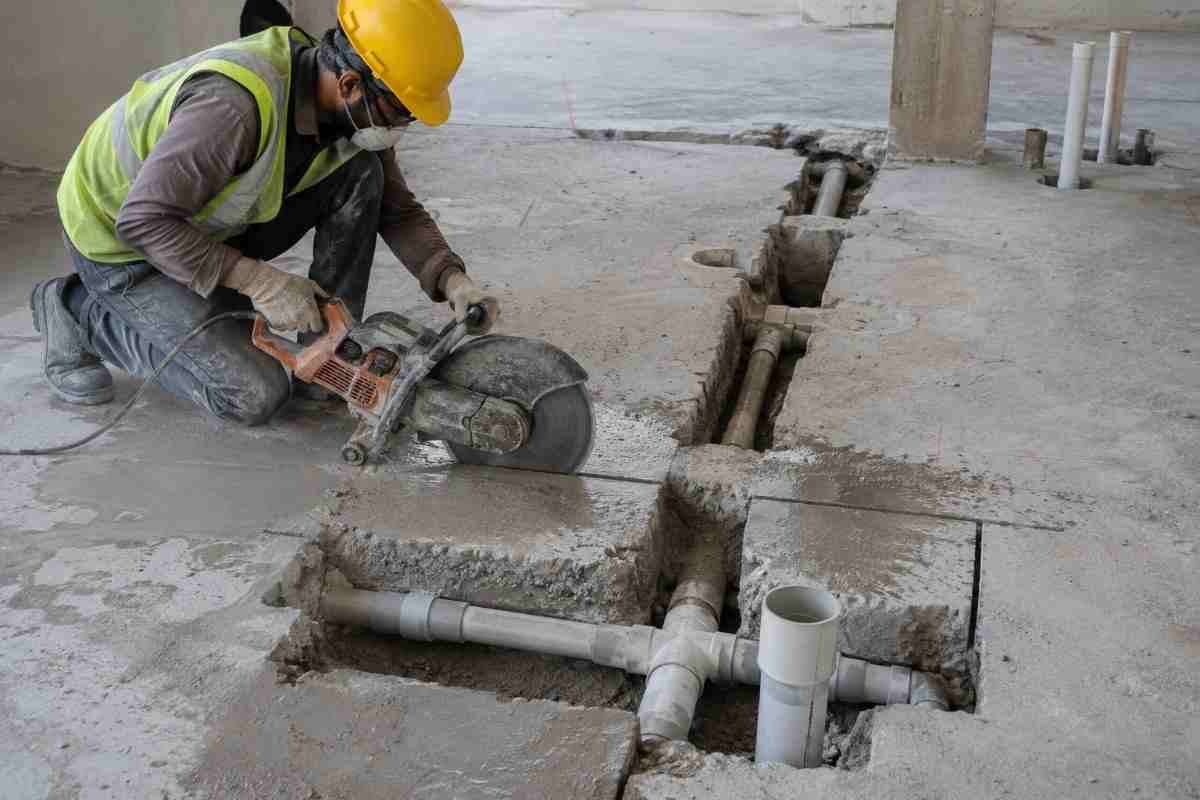
When linear trenches are required to bury horizontal drainage pipes within the floor screed or structural slab, walk-behind floor saws or handheld diamond saws are used. These saws create straight, vertical parallel cuts, allowing technicians to lift out neat channels of concrete without fracturing the surrounding floor.
C. Wire Sawing
For exceptionally thick foundation slabs, massive concrete beams, or complex structural configurations where conventional saws cannot reach, diamond wire sawing uses a continuous steel cable threaded with diamond beads to slice through thick concrete effortlessly.
4. Structural Safety and Load-Bearing Considerations
Before any blade touches an RCC slab, a thorough engineering assessment is mandatory. Cutting concrete without understanding structural behavior can compromise building safety.
-
Identifying Tension and Compression Zones: Concrete slabs handle compression well, while embedded steel rebars handle tension. Cutting principal bending reinforcement in high-stress zones (such as mid-span or near column supports) requires careful structural evaluation.
-
Consulting Structural Engineers: For large openings (greater than 300mm x 300mm) or multiple core holes in primary load-bearing slabs, consulting a structural engineer ensures that adequate beam framing, steel collars, or carbon-fiber wrap reinforcement can be planned.
-
Sleeve Installation: Whenever pipes pass through an RCC slab, professional installers insert protective PVC or GI sleeves slightly larger than the pipe, sealing the annular space with non-shrink waterproof grout to prevent water seepage between floors.
5. Step-by-Step Execution Process of Professional Slab Cutting
Executing an RCC slab cutting project safely and efficiently requires a systematic methodology:
-
Site Inspection & Scanning: Technicians inspect the layout, verify architectural drawings, and use non-destructive testing (NDT) or rebar locators where necessary to map embedded steel bars and electrical conduits.
-
Marking & Setup: Precise dimensions for the plumbing or drainage trench/core are marked on the concrete surface. Water supply lines are connected for wet cutting to suppress dust and cool the diamond blades.
-
Precision Cutting / Drilling: Using state-of-the-art diamond equipment, operators execute the cuts or core holes smoothly, maintaining strict vertical and horizontal alignments.
-
Core Removal & Debris Extraction: The cut concrete sections or core slugs are safely hoisted or lifted out of the opening. The work area is cleaned of slurry and debris.
-
Waterproofing & Sealing: Edges are treated with bonding agents, and plumbing sleeves are securely grouted to ensure 100% leak-proof integration.
6. Addressing People Also Ask (PAA) Questions
Can we cut an RCC slab for new plumbing lines?
Yes, you can cut an RCC slab for plumbing and drainage lines, provided it is done using vibration-free diamond cutting or core drilling tools rather than heavy manual hammers. Proper planning ensures structural integrity remains intact.
Does cutting an RCC slab affect structural integrity?
Small core holes (under 4 inches) for individual pipes usually have a negligible impact on a well-designed slab. However, large openings or cutting primary reinforcing bars can weaken the structure unless proper structural strengthening (such as steel framing or micro-concrete jacketing) is implemented.
What tools are used for cutting concrete slabs for drainage?
Professionals use diamond core drills, walk-behind floor saws, wall saws, and hydraulic wire saws equipped with industrial diamond segments combined with water-cooling systems.
How much does RCC slab cutting cost in India?
The cost depends on slab thickness, core hole diameter or trench length, concrete grade, and site accessibility. To get an accurate estimate tailored to your project requirements, you can check our online estimation tools at https://corecuttingindia.com/rate-calculator/.
How do you reinforce an RCC slab after cutting a hole?
For larger penetrations, structural engineers typically recommend adding perimeter steel channels, epoxy-bonded dowel bars, or carbon-fiber-reinforced polymer (CFRP) wrapping to transfer loads around the opening.
7. Why Choose Core Cutting India?
When precision, safety, and speed matter, partnering with seasoned professionals is essential. At Core Cutting India, we bring unmatched technical expertise to every project:
-
State-of-the-Art Equipment: Latest imported diamond core drills and floor saws for dust-free, vibration-free execution.
-
Experienced Technicians: Skilled operators trained in structural safety, precise alignment, and adherence to engineering guidelines.
-
Pan-India Service Network: Reliable execution capabilities across major metropolitan hubs and regional tiers.
-
Transparent Pricing: Clear, upfront cost evaluations via our digital portal.
Conclusion & Get in Touch
Installing new plumbing and drainage connections in RCC structures no longer has to be a destructive, messy ordeal. With advanced diamond-cutting technology and sound structural principles, you can achieve flawless pipe placement while safeguarding your building's long-term durability.
For expert consultation, reliable execution, and professional RCC slab cutting services, reach out to our team today:
-
Website: https://corecuttingindia.com/
-
Project Cost Estimator: https://corecuttingindia.com/rate-calculator/
-
Helpline / WhatsApp: +91 70096 79903
-
Email: info@corecuttingindia.com