
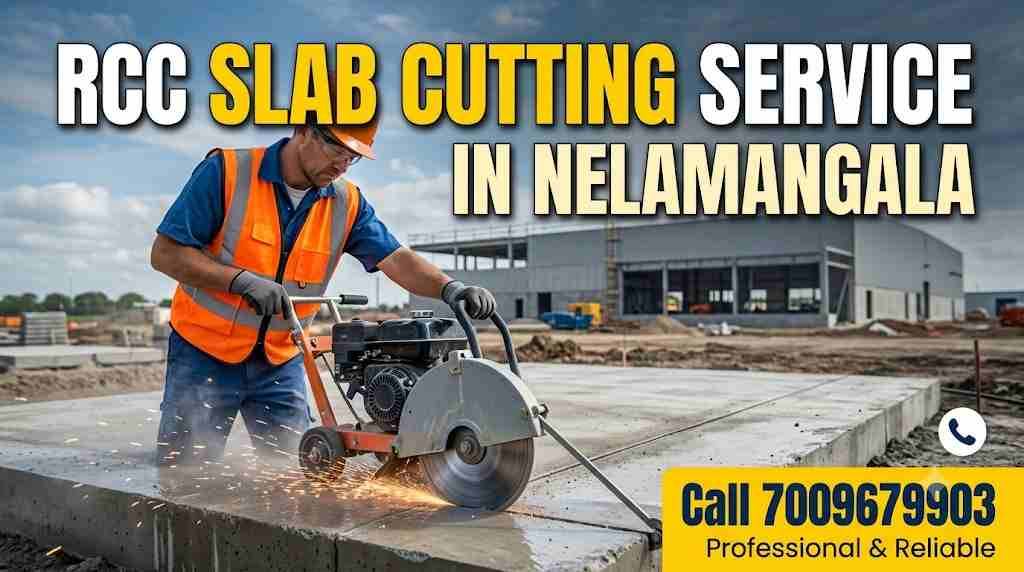
If you have ever watched a crew attack a reinforced concrete slab with a hammer and breaker, you already know the problem. It is loud, it is messy, it cracks things you never meant to touch, and the edges look like a rock quarry. That is exactly why more homeowners, builders and factory managers around Nelamangala now choose RCC slab cutting instead of manual breaking.
This guide explains, in plain language, what slab cutting is, when you need it, how it is done safely, what affects the price, and how to pick a contractor you can trust in Nelamangala and nearby areas such as Dobbaspet, Sompura and the Tumakuru Road (NH-48) belt.
Need slab cutting done properly, this week? 📞 Call: 7009679903 | 💬 WhatsApp: Chat now ✉️ info@corecuttingindia.com
What Is RCC Slab Cutting?
RCC slab cutting is the process of cutting a precise section out of a reinforced cement concrete slab using diamond-tipped blades or wires, without shattering the surrounding structure. The diamond segments grind through both concrete and steel reinforcement, leaving a clean, straight edge.
Think of it as surgery for your building. Instead of breaking everything and repairing the damage, the cutter removes only what needs to go.
Typical equipment includes:
- Floor saws for horizontal cuts on slabs, industrial floors and roads
- Wall saws for vertical cuts through walls, beams and shear walls
- Wire saws for thick, irregular or hard-to-reach sections
- Hand-held ring saws for tight corners and flush cuts
- Core drilling machines for round holes, which you can read about on our core cutting service in Nelamangala page
When Do You Actually Need Slab Cutting?
Most people call us after a plan change on site. Here are the situations we see again and again in Nelamangala:
1. New staircase or lift shaft openings. Adding a second-floor staircase to an existing house, or retrofitting a lift in an older commercial building, means opening the slab precisely.
2. Plumbing, HVAC and electrical shafts. Service ducts, AC pipes and cable trays need openings that match the drawings, not approximate holes.
3. Partial demolition and renovation. Removing a damaged portion, merging two rooms or reworking a terrace without bringing the whole structure down.
4. Industrial floor modifications. Factories and warehouses around Dobbaspet and Sompura often need trenches for machine foundations, drainage or conveyor lines.
5. Expansion joints and crack control cuts. Relief cuts in pavements and floors prevent random cracking later.
6. Slab removal for structural repair. When an engineer certifies that a section is weak or corroded, it needs to come out cleanly so new reinforcement can be tied in.
Why Cutting Beats Breaking
Here is a straight comparison, based on what we see on real sites.
| Factor | Manual breaking | Professional slab cutting |
|---|---|---|
| Accuracy | Rough, uneven edges | Straight, to the marked line |
| Vibration | High, can crack beams and walls | Very low |
| Noise | Very loud | Moderate and controlled |
| Dust | Heavy and uncontrolled | Water-cooled, minimal |
| Damage to adjacent structure | Common | Rare |
| Rework and patching | Significant | Minimal |
| Time on a precise job | Slower, with cleanup | Faster overall |
The upfront rate for cutting can look higher than a labour gang with breakers. Once you add repair plastering, structural rework and cleanup, cutting frequently works out cheaper and certainly cleaner.
How Professionals Cut an RCC Slab: Step by Step
Not every contractor follows a proper process. This is what a responsible job looks like.
Step 1: Site visit and marking
The team checks slab thickness, access, power and water availability, and what lies above and below the slab. Cut lines are marked clearly, ideally against your drawing or your engineer's instructions.
Step 2: Scanning for hidden services
Slabs hide post-tension cables, conduits and pipes. Where there is any doubt, scanning with GPR or a rebar detector should happen before a blade touches the surface. Cutting through a post-tensioned cable is dangerous and expensive, so this step is not optional.
Step 3: Securing the work area
Barricades go up, people are moved away, and the section to be removed is supported or lifted so it cannot fall unexpectedly. Falling concrete blocks are among the biggest risks in slab removal.
Step 4: Cutting with water cooling
The operator makes the cuts with diamond blades while a steady water flow cools the blade and suppresses dust. Overcuts at corners are avoided or planned for, because they weaken the slab.
Step 5: Lifting and removing the block
Larger pieces are cut into manageable blocks and lifted out with a chain pulley, crane or hoist, depending on the weight.
Step 6: Slurry cleanup and finishing
The wet slurry is collected, the edge is inspected, and the site is left clean. Where required, edges are prepared for new reinforcement or grouting.
Safety and Structural Checks You Should Not Skip
A slab is part of the load path of your building. Cutting it changes how forces travel. Before any major opening, you should know three things:
- Get a structural engineer's approval for openings in load-bearing slabs, especially near beams, columns or support lines.
- Confirm the slab type. A one-way, two-way, flat or post-tensioned slab behaves very differently.
- Plan reinforcement around the opening. Extra trimmer bars or edge beams are often needed after cutting.
Our crews cut what is marked and approved. We are cutting specialists, not a substitute for your structural consultant, and we will say so honestly if a job needs an engineer's sign-off first.
What Affects the Cost of RCC Slab Cutting in Nelamangala?
People always ask for a flat number, but honest pricing depends on the job. The main factors are:
- Slab thickness (deeper cuts take longer and wear more blade)
- Total running length of cutting
- Reinforcement density (heavy rebar slows the cut)
- Access and height (basement, upper floor, tight space)
- Method used (floor saw, wall saw, wire saw or ring saw)
- Power and water availability on site
- Number of openings and whether debris removal is included
You can get a ballpark figure in under a minute with our concrete cutting rate calculator. For a firm quote, send us a photo and approximate measurements on WhatsApp and we will respond with a clear estimate, no vague promises.
Areas We Serve Around Nelamangala
We work across Nelamangala town and the surrounding industrial and residential belt, including:
- Nelamangala town and Bengaluru–Tumakuru highway corridor
- Dobbaspet industrial area
- Sompura and nearby layouts
- Villages and farmhouses off the NH-48 stretch
- North Bengaluru locations within easy reach
Our local presence matters. Our crews are not travelling in from another state, so scheduling, mobilisation and follow-up are quicker than with a distant contractor. Full details of what we do locally are on our Nelamangala core cutting service page.
How to Choose the Right Slab Cutting Contractor
After years of seeing clients struggle with poor workmanship in this industry, here is the checklist we would hand to a friend:
- Ask what equipment they use. Diamond-blade, water-cooled machines are the standard. Be wary of anyone proposing a breaker for a "cutting" job.
- Ask about scanning. A serious contractor asks what is inside the slab before cutting.
- Ask for a written scope and rate. Per running metre, per cut or per opening, it should be written and clear.
- Check safety practices. Barricading, PPE, block support and slurry management say a lot about the crew.
- Look at past work. Real photos from real sites beat generic stock images.
- Confirm what is included. Debris removal, lifting and cleanup should not be a surprise add-on.
- Check responsiveness. If they take days to reply to an enquiry, imagine the site experience.
Real-World Scenario: A Staircase Opening in an Old House
Here is a common case. A family in a single-storey house near Nelamangala wants to add a first floor. The existing slab needs a staircase opening, roughly two metres by one metre.
A crew with a breaker would pound away for a day, likely crack the nearby plaster and send vibrations through old brickwork. A diamond cutting crew marks the opening, checks for conduits, makes four clean cuts, lifts out the block in sections and hands the owner a straight-edged opening ready for the engineer's reinforcement detail. The family stays in the home with far less noise, dust and stress.
That difference, quiet precision versus brute force, is the whole reason this service exists.
Slab Cutting vs Core Cutting: Which One Do You Need?
They are related but not the same.
- Slab cutting creates square, rectangular or linear openings and trenches.
- Core cutting creates round holes for pipes, drains, sleeves, cables and anchors.
Many projects use both. A single site might need a rectangular opening for a staircase and a dozen small core holes for plumbing. If you are unsure which applies, describe your project and we will recommend the right method.
Frequently Asked Questions
What is the best way to cut an RCC slab without damaging the structure?
Use diamond-blade floor saws or wall saws with water cooling, after scanning for hidden cables and pipes and with proper support for the block being removed. This method limits vibration and keeps cuts within the marked lines.
Is slab cutting safe for an occupied building?
Yes, when planned correctly. Cutting produces far less vibration and dust than breaking. Barricading, water suppression and block support keep occupants safe. Structural approval is still needed for load-bearing slabs.
How long does RCC slab cutting take?
Small openings often take a few hours, while larger or thicker slabs can take a day or more. Time depends on thickness, reinforcement and access.
How much does slab cutting cost in Nelamangala?
Pricing depends on thickness, length, rebar density and access. Use our online rate calculator for an instant estimate or WhatsApp us for a site-specific quote.
Can you cut slabs that contain post-tensioned cables?
Only after proper scanning and with the structural engineer's guidance. Cutting a stressed cable without precautions is hazardous, so we do not take risks here.
Do you handle debris removal?
Block lifting and slurry cleanup are part of a responsible job. Confirm the exact scope when you request your quote so nothing is left ambiguous.
Do I need permission before cutting a slab?
For anything affecting structural elements, get your engineer's written approval. Society or apartment rules may also require permission.
Do you work on industrial sites?
Yes. Factories and warehouses in the Dobbaspet and Sompura areas regularly need trench cutting, opening modifications and floor sawing.
Why Customers Choose Core Cutting India
We keep our promises simple:
- Clean, accurate cuts that match your drawing
- Low vibration and controlled dust for occupied or sensitive sites
- Transparent pricing with a handy rate calculator
- Local response for Nelamangala and surrounding areas
- Honest advice, including telling you when a job needs an engineer first
Learn more about our full range of services on the Core Cutting India website.
Ready to Get Your Slab Cut Properly?
Do not gamble with hammers and guesswork. Share your requirement today and get a clear plan and price.
📞 Call Now: 7009679903
💬 WhatsApp Enquiry: Message us instantly
✉️ Email: info@corecuttingindia.com
Tip for a faster quote: send a photo of the slab, approximate opening size, slab thickness and your location in Nelamangala when you message us.
You can also check pricing instantly with the rate calculator, or explore our Nelamangala core cutting service page for local details.
Precision cutting. Fewer headaches. Call or WhatsApp 7009679903 today.