
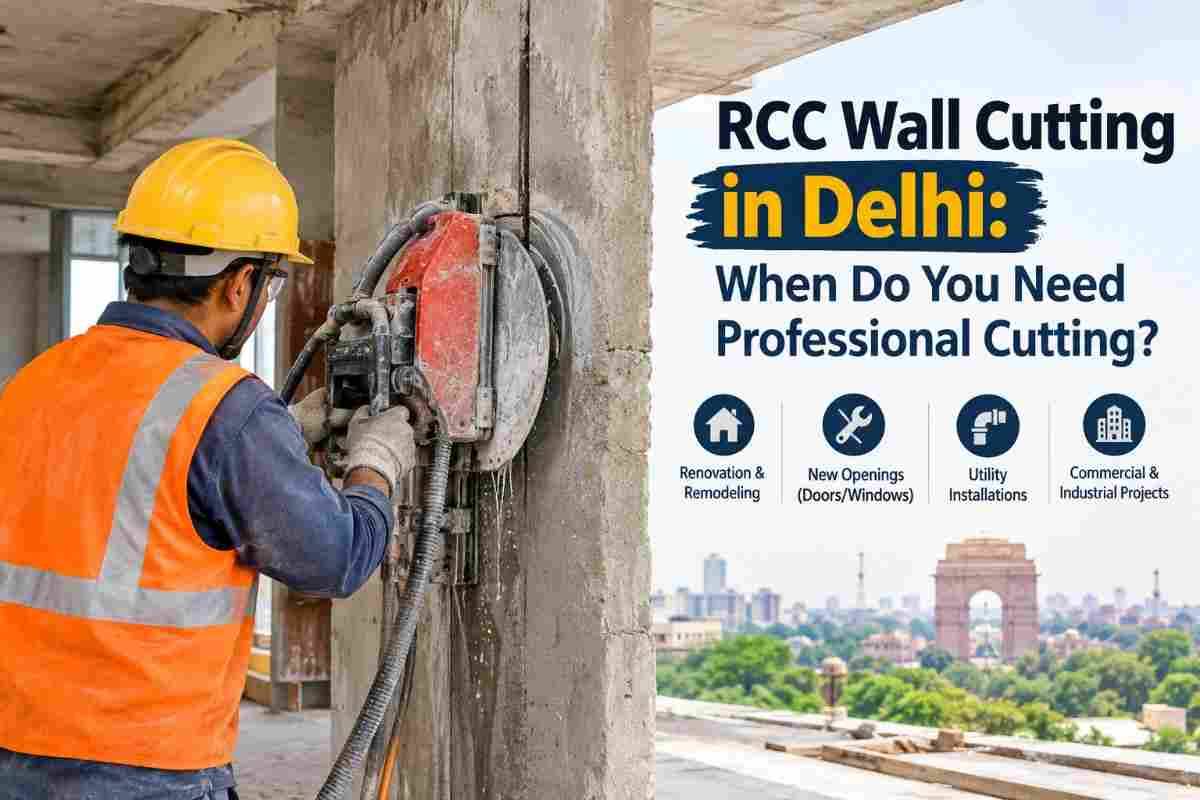
Delhi is a city that never stops building, and it never stops renovating either. Older homes in Lajpat Nagar, Karol Bagh and Rajouri Garden are being redesigned for modern families. Offices in Connaught Place and Nehru Place are being reconfigured. Industrial units in Okhla and Bawana are being upgraded. In almost every one of these projects, someone eventually asks the same question: "Can we open up this wall?"
When the wall is made of reinforced cement concrete (RCC), the answer is yes, but only if the job is done correctly. RCC is one of the strongest and most durable building materials in use, and that strength is exactly why you can't treat it like a brick partition. Cutting it takes the right equipment, trained operators, and a clear understanding of how the structure carries load.
In this guide from Core Cutting India, we explain what RCC wall cutting is, the situations in Delhi that call for it, the warning signs of a risky DIY attempt, and what to expect when you hire a professional team.
What Is RCC Wall Cutting?
RCC wall cutting is the controlled removal of a section of a reinforced concrete wall to create an opening, adjust its shape, or take it down in parts. The concrete is typically reinforced with steel bars (rebar) arranged in a grid, so the cutting tool has to handle both hard aggregate and steel at once.
Professionals use diamond-based tools for this work. The diamond segments grind through concrete and steel cleanly, producing straight edges with minimal vibration. The most common methods are:
- Wall saw cutting: A track-mounted saw with a large diamond blade makes precise, straight cuts through thick walls. It suits door openings, window openings and large rectangular cutouts.
- Wire saw cutting: A diamond-impregnated wire is looped around the element and pulled through it. It handles very thick or irregularly shaped sections and places where a blade can't reach.
- Core cutting: Circular diamond core bits drill clean round holes, usually for pipes, ducts, cables and anchor points. Many people confuse this with wall cutting, but the two are complementary services.
- Hand saw and ring saw cutting: Compact tools for tight spaces where a track-mounted machine won't fit.
Traditional demolition with hammers and breakers does exist, but it sends shockwaves through the structure, cracks the surrounding concrete and makes a mess. That is why precision cutting has become the standard for any serious project in the city.
10 Situations in Delhi When You Need Professional RCC Wall Cutting
Not every project needs a specialist, but the following situations almost always do.
1. Creating New Doors or Openings
Homeowners often want to connect two rooms, add a doorway to a balcony or open a path to a new extension. In an RCC wall, a clean-edged opening needs a wall saw. A rough breaker-made opening weakens the edges, leaves uneven surfaces and makes finishing expensive.
2. Adding or Enlarging Windows
Many older Delhi buildings have small windows and poor ventilation. Enlarging them improves light and airflow, but the cut must be exactly where the plan says. Professional cutting follows marked lines to the millimetre, so the frame fits without extra plastering or patchwork.
3. Open-Plan Renovations
Modern layouts often combine the kitchen, dining and living areas into one space. If the wall in between is RCC, a professional cutting contractor working with a structural engineer is essential. Removing part or all of such a wall changes how loads move through the building.
4. Installing Lifts in Existing Buildings
Retrofitting a lift in a multi-storey building is increasingly common in Delhi, particularly in older residential societies. This requires cutting through RCC slabs and walls to create the shaft opening, and it demands accurate, low-vibration cutting so the rest of the building stays intact.
5. Staircase and Slab Openings
Adding an internal staircase or a service shaft means cutting through floor slabs as well as walls. The same diamond cutting principles apply, and because the work happens above occupied rooms, controlled cutting protects the people below.
6. Plumbing, HVAC and Electrical Routing
Commercial fit-outs require space for ducts, large pipes, cable trays and fire-fighting lines. Larger openings are best made with wall saws, and smaller ones with core cutting. Planning these early saves a great deal of rework.
7. Commercial and Industrial Modifications
Warehouses, factories and showrooms in areas like Mundka, Narela and Okhla often need new machinery bays, loading openings or partition changes. Production schedules are tight, so quick, clean cutting with minimal disruption has real financial value.
8. Structural Repairs and Partial Demolition
Sometimes a damaged section must be cut out and replaced. Examples include a wall hit by water seepage, a corroded section with exposed rebar, or an element damaged in a fire. Controlled cutting removes only the affected area, leaving the sound concrete undisturbed.
9. Working Near Sensitive Structures
Hospitals, data centres, heritage buildings and occupied residential towers can't tolerate heavy vibration or flying debris. Diamond cutting is quiet and controlled compared with demolition, which makes it suitable near equipment, patients and neighbours.
10. Dismantling Walls in Pieces
When a full wall needs to come down in a tight urban plot, cutting it into manageable blocks is safer than knocking it down. Each block can be lifted and removed without disturbing adjacent structures.
Why You Shouldn't Attempt DIY RCC Cutting
It can be tempting to hire a local mason with a breaker and save a little money. In practice, that choice often costs far more later. Here is why RCC cutting should not be a DIY job.
Hidden reinforcement. You can't see the steel inside concrete. Cutting into a rebar-heavy zone with the wrong tool damages the machine, wastes time and can compromise structural integrity.
Vibration damage. Hammering sends shockwaves through the entire wall, slab and connected beams. This can create micro-cracks that show up months later as visible structural cracking.
Uneven edges. Breaker-made openings are rough and irregular, which means extra plastering, extra material and a poor finish.
Safety hazards. Falling chunks, flying debris and silica dust endanger workers and occupants. Respirable silica dust is a known health hazard, which is why dust control matters.
Legal and structural risk. Cutting a load-bearing wall without proper assessment can lead to sagging slabs, deflection or even partial collapse. In a densely built city like Delhi, an error affects neighbours too.
Do You Need Permission to Cut an RCC Wall in Delhi?
This is one of the most common questions we hear, and the answer depends on the nature of the work.
- Non-structural openings in your own flat may need only society or RWA permission, along with a structural engineer's confirmation that the wall is not load-bearing.
- Structural changes to load-bearing walls, columns, beams or slabs generally require a qualified structural engineer's assessment and design. Depending on the property and the extent of the change, approval from the local authority such as MCD or DDA, or from the housing society, may also be required.
- Commercial and industrial properties usually have additional compliance requirements, including fire safety and building bylaws.
Rules change, so confirm the current requirements with your local authority or architect before starting. A reputable cutting contractor will always ask whether a structural engineer has cleared the work. If one doesn't, treat that as a warning sign.
How Professional RCC Wall Cutting Works: Step by Step
A well-run project follows a clear sequence. This is what you can expect when you work with a professional team.
Step 1: Site inspection and assessment. The team visits the site, studies the wall thickness, the reinforcement pattern where known, access conditions and the surrounding structure.
Step 2: Structural clearance. A structural engineer confirms whether the wall can be cut and whether temporary supports (props or needles) are needed.
Step 3: Marking and layout. The exact cutting lines are marked on the wall, usually following the architect's drawings. Accurate marking saves time and avoids costly mistakes.
Step 4: Setup and protection. The area is cleared, floors and nearby items are protected, and the cutting machine is anchored securely. Water supply for cooling and dust suppression is arranged.
Step 5: Cutting. Operators run the wall saw or wire saw along the marked lines. Water keeps the blade cool and suppresses dust. Cutting through steel and concrete in a controlled way produces smooth, straight edges.
Step 6: Safe removal of cut sections. If the cut piece is heavy, it is secured and lifted out using appropriate methods. This stage matters because uncontrolled falling blocks are dangerous.
Step 7: Cleaning and handover. Slurry and debris are removed, and the opening is left ready for framing, lintel work or finishing.
Benefits of Hiring a Professional RCC Wall Cutting Service
Precision
Diamond cutting delivers clean, straight edges that fit frames and fixtures neatly. That reduces finishing costs significantly.
Structural Safety
Low-vibration cutting protects the surrounding concrete and the rest of the building from unnecessary stress.
Speed
Cutting machines move through thick concrete much faster than manual breaking, so projects finish sooner and disruption is lower.
Cleaner, Quieter Work
Water-cooled cutting suppresses most of the dust, and noise levels are far lower than demolition with breakers. This matters in residential colonies, offices and hospitals.
Cost Efficiency Over Time
The upfront cost of professional cutting may look higher, but you save on rework, repairs, extra plastering and potential structural fixes. Cutting costs depend on the thickness of the wall, the amount of reinforcement, the size of the opening, access and location, so a site visit is the only way to get an accurate quote.
Compliance with Dust and Noise Norms
Delhi-NCR has strict rules on construction dust and noise, especially during periods of poor air quality. Professional teams understand these requirements and use wet cutting and dust control methods to help you stay compliant.
Wall Saw Cutting vs. Core Cutting: What's the Difference?
People often use these terms interchangeably, but they serve different purposes.
Wall saw cutting is used for large, straight cuts: doors, windows, lift openings, slab sections and wall removal. It cuts along lines and produces rectangular or custom-shaped openings.
Core cutting drills round holes, typically from 25 mm up to several hundred millimetres in diameter. It's ideal for pipes, cables, drainage, ventilation and anchor bolts.
Many projects need both. A commercial fit-out, for example, might use wall saws for door openings and core cutting for plumbing and electrical routes. A company offering both services, like Core Cutting India, can handle the whole job and keep the work coordinated.
Signs You Need to Call a Professional
Consider calling a cutting specialist if any of the following apply to your project:
- The wall is thicker than a standard partition or is clearly concrete.
- You plan to create an opening bigger than a pipe hole.
- The wall may be load-bearing or sits near beams and columns.
- The work will happen in an occupied building.
- You need clean edges for glass, aluminium or steel frames.
- The site has limited access or tight working space.
- Dust, noise and vibration need to be kept under control.
- The project has a deadline and rework isn't an option.
Tips for Choosing an RCC Cutting Contractor in Delhi
Not all contractors are equal. Keep these points in mind when comparing options.
- Check experience. Ask about similar projects in Delhi NCR, in residential, commercial and industrial settings.
- Ask about equipment. Modern wall saws, wire saws and core drills indicate a serious operation.
- Look for trained operators. Skilled operators make the difference between a clean cut and a costly mistake.
- Confirm safety practices. Protective equipment, dust control and safe handling of cut sections should be standard.
- Request a site visit. A reliable contractor inspects before quoting, rather than giving a blind price over the phone.
- Get a clear quotation. It should explain the scope, the method and what is and isn't included.
- Ask about structural coordination. The contractor should be comfortable working with your engineer or architect.
Common Mistakes to Avoid
- Skipping the structural check. This is the most dangerous mistake.
- Choosing purely on price. The cheapest quote often means inadequate equipment or untrained labour.
- Poor planning of openings. Changing the layout after cutting begins leads to wasted work.
- Ignoring society rules. Cutting without RWA permission can cause disputes and work stoppages.
- Not protecting the surroundings. Floors, furniture and fittings need protection before cutting starts.
Frequently Asked Questions
Can you cut an RCC wall?
Yes. RCC walls can be cut with diamond wall saws, wire saws or core cutters. The key is to assess the structure first and use the right equipment for the thickness and reinforcement.
Is it safe to cut a load-bearing wall?
It can be done safely, but only with a structural engineer's design and proper temporary support during the work. Cutting a load-bearing wall without this planning is dangerous and should never be attempted casually.
How much does RCC wall cutting cost in Delhi?
The cost varies with wall thickness, opening size, rebar density, location and access. Most professionals price by the running length or area of the cut, plus any extra setup. A site inspection gives the most reliable estimate.
Does RCC cutting damage the building?
Diamond cutting is low-vibration and precise, so it causes far less stress than breaker-based demolition. When done correctly, the remaining structure is left intact.
How long does it take to cut an RCC wall?
A standard door or window opening can often be completed within a few hours to a day, depending on thickness and conditions. Larger or more complex projects take longer.
Is RCC wall cutting dusty and noisy?
Wet cutting keeps dust to a minimum, and diamond cutting is significantly quieter than demolition. Some noise is unavoidable, but professionals plan work to limit disturbance.
What is the difference between wall saw cutting and core cutting?
Wall saws make large, straight cuts for openings. Core cutters drill round holes for pipes and cables.
Why Choose Core Cutting India?
At Core Cutting India, we focus on precise, safe and efficient concrete cutting for homes, offices, institutions and industrial sites across Delhi NCR. Our approach is straightforward: understand the structure, plan the cut, use the right diamond equipment and leave you with a clean, ready-to-finish opening.
Whether you need a single doorway, a lift shaft opening, slab cutting or multiple core holes for a fit-out, our team can guide you from the first inspection through to handover.
Conclusion
RCC wall cutting in Delhi is not something to improvise. The strength that makes reinforced concrete so valuable is the same quality that makes it hard to modify without the right skill and tools. If your project involves a new opening, a structural alteration, a lift installation, or any change to a thick concrete wall, professional cutting is the safest, cleanest and often the most economical route.
Plan carefully, involve a structural engineer where required, and choose a contractor who values precision and safety. Done properly, the result is a clean opening, an undamaged structure and a project that stays on schedule.
Ready to get started? Visit Core Cutting India to request a site inspection and a clear quotation for your RCC wall cutting project in Delhi NCR.