
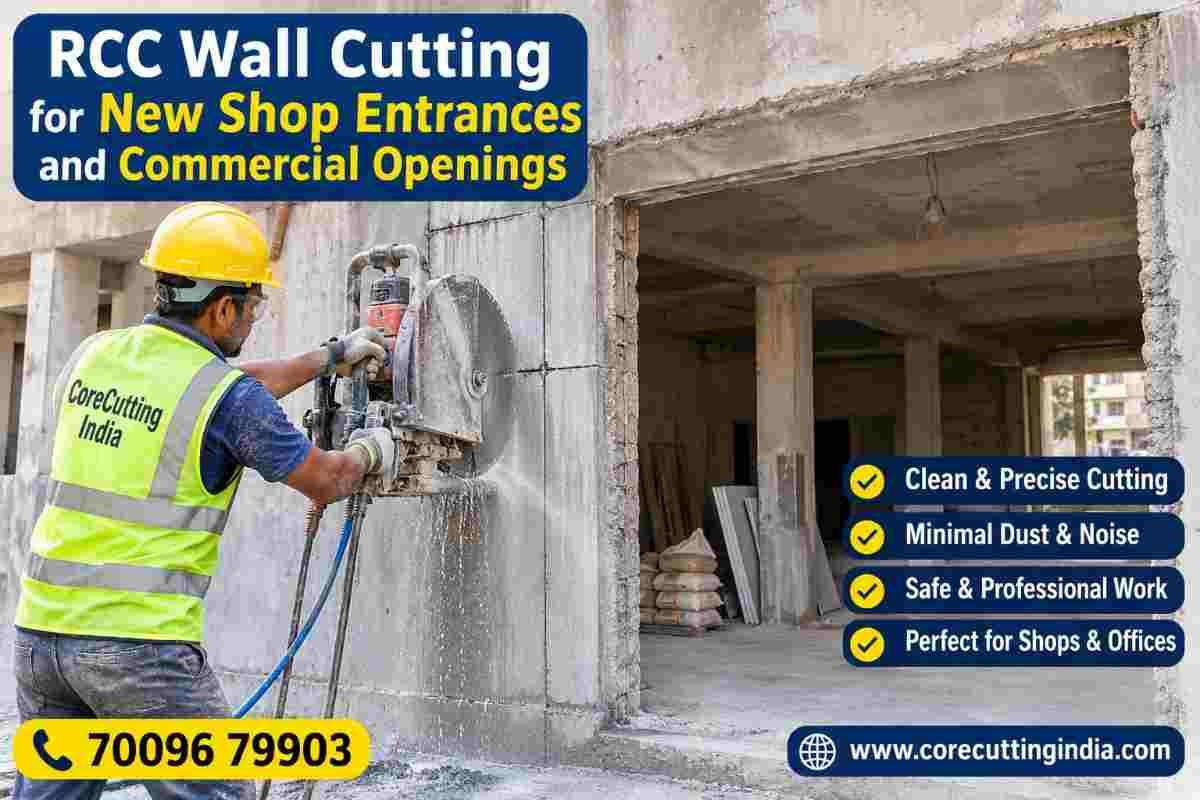
Every successful shop starts with a good first impression, and that begins at the entrance. A wide, well-placed opening draws customers in, improves visibility, and makes the most of a street-facing frontage. But many commercial properties in India are built with RCC (reinforced cement concrete) walls and columns. Opening a doorway, shutter, or display window in one cannot be done with a hammer and chisel.
That is where RCC wall cutting comes in. It is the controlled, precise removal of concrete using diamond-tipped tools. Done properly, it gives you a clean, accurate opening without damaging the rest of the structure. Done badly, it can crack walls, weaken beams, and put people at risk.
This guide explains how RCC wall cutting works for new shop entrances and commercial openings, what to plan for, what it costs you in time and effort, and how to choose a reliable contractor. It is written for shop owners, builders, architects, and property managers.
What Is RCC Wall Cutting?
RCC wall cutting is a method of making openings in reinforced concrete walls, slabs, and partitions using diamond-embedded cutting equipment. Instead of breaking the concrete through impact, which sends shock waves through the building, the equipment grinds through it in a smooth, controlled line.
The result is a straight-edged opening with minimal vibration, little dust (when water cooling is used), and no damage to the surrounding structure. Because the cuts are so precise, you can often fit doors, shutters, or glass frames directly into the opening with very little finishing work.
The method is widely used for:
- New shop entrances and shutter openings
- Enlarging existing doorways
- Windows and display openings
- Staircase and lift openings
- Connecting two adjacent shops or units
- Service openings for ducts, pipes, and cables
Why Shop Owners Choose RCC Wall Cutting for New Entrances
1. Better Visibility and Footfall
A wider entrance or large glass frontage makes a shop more visible from the street. In busy markets, a clear and inviting opening can make the difference between a passer-by walking in or walking past.
2. Flexible Use of Existing Space
Not every unit is built with the entrance you need. You may have rented a space that was originally a showroom, office, or residential portion, and now want to convert it into a retail outlet. Cutting a new opening lets you adapt the building instead of searching for a new one.
3. Cost-Effective Compared to Rebuilding
Demolishing and rebuilding a wall is slow, expensive, and disruptive. Cutting only the portion you need is faster, cheaper, and keeps the rest of the structure intact.
4. Clean, Professional Finish
Diamond cutting leaves smooth edges. This means less plastering and patch work, and your door frame, shutter guide, or glass panel fits neatly.
5. Minimal Disruption to Neighbours
Traditional breaking methods are noisy and shake the whole building. Wall sawing and wire sawing produce far less vibration, which matters in shared buildings, markets, malls, and residential-commercial complexes.
Common RCC Cutting Methods Used for Commercial Openings
Different projects need different tools. A good contractor will choose the method based on wall thickness, reinforcement, access, and location.
Wall Saw Cutting
A wall saw is a track-mounted machine with a large circular diamond blade. It is fixed to the wall and cuts in straight lines, making it ideal for rectangular openings such as shutters and doors. It can cut through thick RCC walls with accurate depth control.
Wire Saw Cutting
A diamond wire saw uses a flexible wire threaded with diamond beads. It is useful for very thick walls, large structural elements, or places where a wall saw cannot be mounted. It can cut in tight or awkward spaces.
Hand Saw / Ring Saw Cutting
Handheld ring saws are used for smaller cuts, corners, and finishing work, particularly where a wall saw cannot reach the full depth or corners.
Core Drilling
Core drilling makes round holes, from small pipe sleeves to larger openings. In wall cutting jobs, contractors often drill cores at the corners of a rectangular opening so the saw cuts finish cleanly without over-cutting past the line.
Many commercial projects use a combination of these methods to achieve a neat, accurate result.
Step-by-Step: How an RCC Wall Cutting Job Works
Step 1: Site Inspection and Assessment
The process begins with a visit to the site. The contractor checks wall thickness, the type of reinforcement, access for equipment, water and power availability, and the surroundings, including shops, offices, and residents nearby.
Step 2: Structural Safety Check
This is the most important step. Before any cut is made, you need to know whether the wall is load-bearing or a partition wall. Cutting a load-bearing RCC wall or a wall that carries a beam above it needs a structural engineer’s approval and often additional support.
Step 3: Marking the Opening
The exact position, width, and height of the entrance are marked on the wall. Accurate marking is vital, because the cut is permanent. It should match your door, shutter, or glass frame dimensions, with allowance for finishing.
Step 4: Providing Temporary Support
For larger openings, especially those that remove part of a beam or load path, temporary props or needle supports are placed to carry the load during the work. A lintel or header beam may then be built above the new opening to carry the load permanently.
Step 5: Cutting
The wall saw or wire saw is mounted, water cooling is started, and the cut is made along the marked lines. Cut sections are usually broken into manageable blocks and lowered or removed safely.
Step 6: Removal of Debris
Concrete blocks and slurry are removed and cleaned up. Water-based cutting keeps dust down, which is important in shops that continue to operate nearby.
Step 7: Finishing and Reinforcement
Exposed rebar is treated, edges are finished, and any lintel, frame, or jamb work is done. After this, the opening is ready for door frames, shutters, glass, or cladding.
Important Things to Consider Before You Cut
Structural Safety
An RCC wall may be a structural element. Removing or cutting it without proper analysis can cause cracks, sagging, or even failure. Always consult a qualified structural engineer, especially for load-bearing walls, columns, and shear walls.
Permissions and Approvals
Depending on the property, you may need permission from the building owner, the housing or market association, the society, or the local municipal authority. Altering the external façade of a building often has specific rules. Check requirements before you start, as unauthorised alterations can lead to penalties or stop-work orders.
Building Type and Age
Older buildings may have different construction methods, lower-grade concrete, or hidden services. A thorough inspection helps avoid surprises.
Concealed Services
Walls often hide electrical conduits, water lines, gas pipes, and data cables. These should be identified and isolated before cutting.
Water and Power Access
Wall saws need water for cooling and a suitable power supply. Make sure the contractor knows what is available on site.
Working Hours and Noise
In busy commercial areas, work may need to be scheduled for off-hours. Diamond cutting is much quieter than breaking, but it is not silent. Plan with neighbours and building management.
RCC Wall Cutting vs. Manual Breaking
| Factor | RCC Wall Cutting (Diamond) | Manual / Hammer Breaking |
|---|---|---|
| Accuracy | Very high, straight clean edges | Low, uneven edges |
| Vibration | Minimal | High, risk of cracks |
| Noise | Lower | Very high |
| Dust | Low with water cooling | Heavy |
| Structural damage risk | Low | High |
| Finishing work | Minimal | Extensive |
| Speed | Faster for precise openings | Slower and messy |
| Suitable for thick RCC | Yes | Difficult and unsafe |
For any commercial project where appearance, safety, and timelines matter, diamond cutting is the clear choice.
Types of Commercial Openings You Can Create
Shop shutter entrances. Wide openings sized for rolling shutters, ideal for markets and retail rows.
Glass door and showroom frontage. Large openings for glass façades that display products to the street.
Internal connecting doors. Openings between two shops or units when a business expands.
Windows and ventilation openings. Extra natural light and airflow, or openings for exhaust and AC ducts.
Staircase and lift openings. Cuts through slabs and walls to add vertical access in a commercial building.
Service openings. Smaller cuts and core holes for plumbing, electrical, HVAC, and fire safety lines.
Benefits of Hiring a Professional RCC Wall Cutting Company
- Safety first: Trained operators, proper supports, and risk controls.
- Right equipment: Wall saws, wire saws, and core drills matched to the job.
- Precision: Openings that match your frame dimensions.
- Less damage: Lower vibration and controlled cuts protect the surrounding structure.
- Time savings: Faster work means your shop opens sooner.
- Cleaner sites: Slurry management and debris removal are built into the process.
- Peace of mind: Experienced teams know how to handle unexpected rebar, thick sections, and tight access.
How to Choose the Right RCC Wall Cutting Contractor
- Experience with commercial projects. Ask about similar jobs, such as shop entrances, shutters, or retail conversions.
- Modern equipment. Look for wall saws, wire saws, and diamond core drills rather than only manual tools.
- Safety practices. A responsible contractor talks about supports, protective measures, and structural checks.
- Clear quotation. Costs should be explained: per-running-foot or per-square-foot rates, minimum charges, debris removal, and any extra for height or access.
- Site visit before pricing. Reliable companies inspect before quoting.
- Reputation. Reviews, referrals, and past work are good indicators.
- Communication. The team should explain the process, timeline, and any risks plainly.
Factors That Affect RCC Wall Cutting Cost
Pricing varies from project to project. The main factors are:
- Wall thickness and concrete strength
- Density of reinforcement (rebar)
- Total cutting length or area
- Cutting method (wall saw, wire saw, hand saw)
- Height of the work and ease of access
- Water and power availability
- Debris removal and disposal
- Working hours (night or off-hours work may cost more)
- Location and mobilisation of equipment
- Any structural support or lintel work required
The best way to get an accurate figure is a site visit and written quotation.
Safety Tips for Shop Owners
- Never cut or break a structural wall on your own or with untrained labour.
- Always get structural advice before opening up RCC walls and columns.
- Keep customers and staff clear of the work zone.
- Protect stock, fittings, and finished interiors from dust and slurry.
- Make sure temporary supports are installed properly before cutting begins.
- Confirm that electrical and plumbing lines are disconnected or marked.
- Plan for a safe, clear path for removing debris.
Frequently Asked Questions (People Also Ask)
Can you cut a door opening in an RCC wall?
Yes. A door or shutter opening can be made in an RCC wall using a wall saw or wire saw. If the wall is load-bearing, a structural engineer must approve the design, and a lintel or support beam is usually needed above the new opening.
How much does RCC wall cutting cost in India?
Cost depends on wall thickness, the amount of reinforcement, the length of cut, access, and the cutting method. Most companies quote per running foot or per square foot after a site inspection. For an accurate estimate, contact the contractor with the wall details and location.
Is concrete wall cutting safe for the building?
When done by trained professionals with proper equipment and structural planning, yes. Diamond cutting causes far less vibration than breaking, so it is much gentler on the structure than traditional methods.
How long does it take to cut an opening in an RCC wall?
A typical shop door or shutter opening can often be completed in a few hours to a day, depending on thickness, reinforcement, and access. Larger or structurally complex openings take longer.
Do I need permission to cut an opening in an RCC wall?
Often, yes. You may need approval from the building owner, society or market association, and sometimes local authorities, especially if the work changes the exterior of the building or affects structural elements. Check the rules for your property before starting.
What is the difference between wall sawing and wire sawing?
A wall saw uses a circular diamond blade on a track and is best for straight cuts. A wire saw uses a diamond-beaded cable, which is better for very thick walls, large elements, and difficult locations.
Is wall cutting noisy or dusty?
It is much quieter and cleaner than manual breaking. Water-cooled cutting reduces dust, though some noise and slurry are unavoidable, so site protection is still needed.
Can a load-bearing wall be cut for a shop entrance?
Sometimes, but only with a structural engineer’s design and proper support. Never cut a load-bearing wall without professional assessment.
What happens to the steel reinforcement when cutting RCC?
Diamond tools can cut through rebar as well as concrete. The exposed cut ends are then treated or protected, and if needed, additional reinforcement or a new lintel is added around the opening.
Can wall cutting be done while neighbouring shops are open?
In most cases, yes, since diamond cutting causes limited vibration and dust. Contractors often schedule noisier steps at suitable times and use water-cooling and barriers to limit disturbance.
Why Choose Core Cutting India for Your RCC Wall Cutting Project
At Core Cutting India (https://corecuttingindia.com/), we specialise in precision concrete cutting for homes, shops, offices, showrooms, and industrial sites. Whether you are opening a new shop entrance, widening a doorway, creating a glass frontage, or connecting two units, our team is equipped to handle the job safely and accurately.
Here is what you can expect when you work with us:
- Professional site inspection and practical advice
- Modern diamond wall saws, wire saws, and core drilling equipment
- Clean, accurate cuts with minimal vibration
- A focus on safety and protecting your property
- Clear communication and transparent quotations
- Timely completion so your business can open sooner
Every project is different, so we begin by understanding your requirements, your building, and your timeline, and then recommend the best cutting method for the job.
Conclusion
A new shop entrance or commercial opening can transform how a business looks, feels, and performs. But in an RCC building, creating that opening needs far more care than simply breaking through a wall. The right method, a proper structural assessment, and an experienced team make the difference between a clean, durable result and costly damage.
RCC wall cutting gives you precision, safety, and speed. It protects the structure around the opening, reduces mess and disruption, and leaves you with an entrance that is ready for finishing. If you are planning a new shop shutter, door, window, or internal connection, speak to a professional before any work starts.
Ready to plan your RCC wall cutting project?
Contact Core Cutting India today for a site visit and a clear quotation.
📞 Call: +91 70096 79903
🌐 Website: https://corecuttingindia.com/