
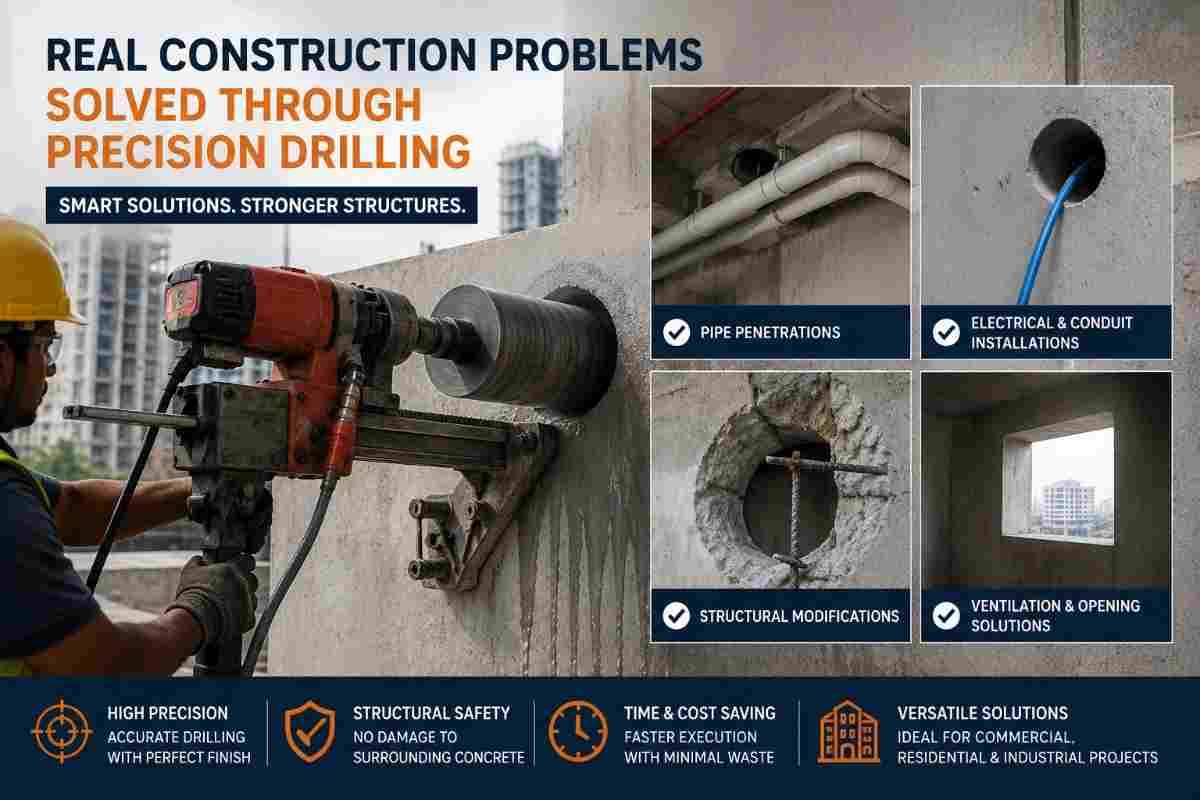
Construction sites rarely run exactly the way blueprints promise. Walls turn out thicker than expected, rebar shows up where nobody marked it, and a single misplaced hole can set a project back by days. This is where precision drilling steps in — not as a nice-to-have, but as the difference between a clean, on-schedule build and a costly, structurally risky mess.
At Core Cutting India, we've spent years working on sites where "close enough" simply wasn't an option. This blog walks through the real, everyday construction problems that precision drilling — particularly diamond core drilling — solves, and why more contractors, MEP teams, and structural engineers are building it into their project plans from day one.
What Is Precision Drilling, Really?
Precision drilling is the controlled process of cutting clean, accurately sized holes through concrete, brick, stone, or reinforced structures using diamond-tipped core bits. Unlike traditional hammer drilling, which relies on impact and force, precision or core drilling uses rotary cutting action to remove a solid cylindrical core of material without vibration, cracking, or unnecessary damage to the surrounding structure.
It sounds like a small technical detail. In practice, it changes the outcome of almost every major construction task that involves cutting into an existing structure — from running a single conduit to coring dozens of openings for a building's entire mechanical, electrical, and plumbing (MEP) system.
Problem 1: Damaging Rebar and Compromising Structural Integrity
One of the most common — and most dangerous — mistakes on a job site is drilling straight into embedded steel reinforcement without knowing it's there. Hitting rebar with a standard drill can weaken the structural capacity of a slab or wall, cause micro-cracking, and in some cases lead to long-term integrity issues that only surface years later.
How precision drilling solves it: Before any cut is made, precision drilling teams use rebar scanning and ground-penetrating radar (GPR) to map the exact location of reinforcement, post-tension cables, and embedded utilities. The drilling path is then planned around these obstructions, or adjusted using core bits designed to cut cleanly through steel when unavoidable, without shattering the surrounding concrete. This scan-first approach is now standard practice for any responsible core cutting company, including the workflow we follow at Core Cutting India on every commercial project.
Problem 2: Cracked or Fractured Concrete Around the Hole
Traditional hammer drilling and jackhammering generate significant impact force. That force doesn't stay contained to the hole — it radiates outward, often producing hairline cracks, spalling, or fractures in the surrounding concrete. On load-bearing walls or slabs, this weakens the very structure the hole was cut into.
How precision drilling solves it: Diamond core drilling is a rotary process, not a percussive one. The diamond segments on the bit grind through the material smoothly, producing a clean, round hole with minimal stress transferred to the surrounding concrete. This is particularly critical in retrofit and renovation projects, where the existing structure has already aged and has less tolerance for additional stress.
Problem 3: Inaccurate Hole Placement for MEP Systems
HVAC ducts, plumbing risers, and electrical conduits all need openings that align precisely with pre-installed systems, equipment specifications, and floor-to-floor routing plans. A hole that's off by even a few centimeters can mean a duct doesn't align with its riser, a pipe can't reach its fixture, or a conduit clashes with another trade's work already installed.
How precision drilling solves it: Core drilling allows for millimeter-level accuracy in both hole diameter and placement. Contractors can specify exact core sizes — from small-diameter holes for electrical conduit to large-diameter cores for HVAC ducting — and get a consistent, repeatable result across dozens or hundreds of penetrations on a single site. This is especially valuable on multi-story buildings where the same core pattern needs to repeat accurately floor after floor.
Problem 4: Water Infiltration and Leaks After Penetration
Every penetration through an exterior wall, roof slab, or below-grade structure is a potential entry point for water. Rough or irregular holes cut with poor technique create gaps and micro-fractures that are difficult to seal properly, leading to leaks that show up months after the project is "complete."
How precision drilling solves it: Because core drilling produces a smooth, uniform cylindrical hole, it creates an ideal surface for sealants, grommets, and fire-rated sleeves to bond tightly. This dramatically reduces the risk of water ingress and makes waterproofing detailing far more reliable — a detail that matters enormously on basements, terraces, and building envelopes.
Problem 5: Excessive Noise and Vibration in Occupied Buildings
Renovating an occupied hospital, office building, or residential complex comes with a unique constraint: work has to happen without disrupting the people still using the building. Traditional drilling and breaking methods generate heavy noise and vibration that can shut down adjacent operations, disturb patients, or violate local noise regulations.
How precision drilling solves it: Diamond core drilling produces significantly less vibration and a more consistent, lower-impact noise profile compared to jackhammering or hammer drilling. Many precision drilling setups also support wet cutting, which further reduces dust and airborne particulate — a major advantage for hospitals, data centers, and buildings with sensitive equipment nearby.
Problem 6: Dust Contamination in Sensitive Environments
Standard drilling and cutting methods generate large volumes of fine concrete dust. In environments like hospitals, laboratories, food processing facilities, or data centers, this dust isn't just a cleanup hassle — it can contaminate sensitive equipment, compromise sterile environments, or trigger fire suppression systems.
How precision drilling solves it: Wet diamond core drilling suppresses dust at the source by using water to cool the bit and capture particulate as it's generated. Combined with vacuum extraction systems, this keeps dust contained and airborne contamination to a minimum, making it possible to core drill safely even in operating hospitals or cleanroom-adjacent spaces.
Problem 7: Delays From Rework and Repairs
Every mistake on site — a misaligned hole, a cracked slab, a hole cut in the wrong location — triggers rework. Rework isn't just wasted material; it's wasted time, and time is the one resource construction schedules can least afford to lose.
How precision drilling solves it: Because precision drilling is planned using scans, markups, and exact specifications before a single cut is made, the margin for error shrinks dramatically. Fewer mistakes mean fewer redos, which keeps dependent trades — electricians, plumbers, HVAC installers — moving on schedule instead of waiting on a corrected opening.
Problem 8: Cutting Through Unusual or Composite Materials
Not every wall or slab is straightforward concrete. Job sites increasingly involve composite materials, post-tensioned slabs, natural stone, brick with varying density, or structures with embedded conduit and old repairs of unknown composition. Standard drilling equipment often struggles with these mixed materials, leading to inconsistent results or tool failure.
How precision drilling solves it: Core drilling equipment is available in a range of bit compositions and diamond bond hardness levels, allowing operators to match the tool to the material. Experienced operators — the kind you'll find at Core Cutting India — assess the material composition on site and select the right bit and drilling speed, avoiding the trial-and-error approach that damages both the structure and the equipment.
Problem 9: Limited Access and Tight Working Spaces
Basements, service shafts, rooftop plant rooms, and tight mechanical spaces often don't have room for large drilling rigs or heavy breaking equipment. Getting a clean penetration in these constrained environments is a persistent challenge on renovation and retrofit projects.
How precision drilling solves it: Core drilling rigs are modular and can be mounted on stands, rails, or handheld setups depending on the space available. This flexibility allows technicians to cut precise holes in confined areas — including horizontal, vertical, and overhead orientations — without needing to demolish surrounding structure just to create working room.
Problem 10: Inconsistent Quality Across Multiple Contractors
On large projects, different trades and subcontractors may each need their own penetrations cut, often at different phases of construction. Without a standardized approach, hole quality, size, and placement can vary wildly from one contractor to the next, creating coordination headaches for the project manager.
How precision drilling solves it: Bringing in a single, specialized core cutting team to handle all structural penetrations — rather than leaving it to individual trades — standardizes quality and placement across the entire project. This is one of the most overlooked efficiency gains on multi-trade construction sites, and it's a service model that companies like Core Cutting India are built around.
Why Precision Drilling Is Becoming the Industry Standard
As buildings get denser, MEP systems get more complex, and renovation work on aging structures increases, the tolerance for error in structural penetrations keeps shrinking. Precision drilling isn't just a cleaner alternative to traditional methods — it's increasingly a requirement for projects where structural integrity, safety compliance, and schedule reliability all matter.
Contractors who adopt precision drilling early in a project typically see fewer change orders, less rework, and smoother coordination between trades. It also tends to reduce long-term maintenance costs, since cleanly cut, properly sealed penetrations are far less likely to develop leaks, cracks, or structural issues down the line.
Choosing the Right Precision Drilling Partner
Not all drilling services offer the same level of precision. When evaluating a partner for core cutting and precision drilling work, it's worth looking at:
- Whether they use GPR or rebar scanning before cutting
- The range of core diameters and equipment they can deploy
- Experience with your specific material type (RCC, PT slabs, brick, stone)
- Dust and noise control measures for occupied or sensitive sites
- Track record on projects of similar scale and complexity
At Core Cutting India, these are the exact standards we hold ourselves to on every project — whether it's a single core for a conduit or a full-building MEP penetration package.
Final Thoughts
Precision drilling has quietly become one of the most impactful tools in modern construction, solving problems that used to be accepted as "part of the job" — cracked concrete, misaligned holes, damaged rebar, leaks, dust, and delays. As construction projects grow more complex and structures more sensitive to damage, the case for precision drilling over traditional methods only gets stronger.
If your project involves cutting into concrete, brick, or reinforced structures, it's worth asking whether precision drilling could save you time, money, and structural headaches down the line. Reach out to Core Cutting India to discuss how our precision core cutting services can support your next project.
People Also Ask
1. What is the difference between core drilling and regular drilling? Core drilling uses a rotary diamond-tipped bit to cut a clean, cylindrical hole through concrete or masonry with minimal vibration, while regular (hammer) drilling relies on impact force, which can cause cracking and structural stress around the hole.
2. Is precision drilling safe for load-bearing walls? Yes, when performed correctly. Precision drilling teams scan for rebar and post-tension cables beforehand and calculate load impact, allowing holes to be cut without compromising the wall's structural capacity.
3. How much does precision core drilling cost in India? Costs vary based on hole diameter, material thickness, site accessibility, and project scale. It's best to request a site-specific quote from a specialized provider like Core Cutting India for an accurate estimate.
4. Can precision drilling be done on occupied buildings? Yes. Diamond core drilling generates significantly less noise, vibration, and dust than traditional methods, making it suitable for hospitals, offices, and residential buildings that remain in use during construction.
5. What materials can be cut using precision drilling? Precision drilling can cut through reinforced concrete, brick, natural stone, post-tensioned slabs, and composite materials, using diamond bits matched to the specific material hardness and composition.
6. Why is dust control important in construction drilling? Uncontrolled dust can contaminate sensitive environments like hospitals, labs, and data centers, and pose respiratory hazards to workers. Wet diamond drilling suppresses dust at the source, keeping sites cleaner and safer.