
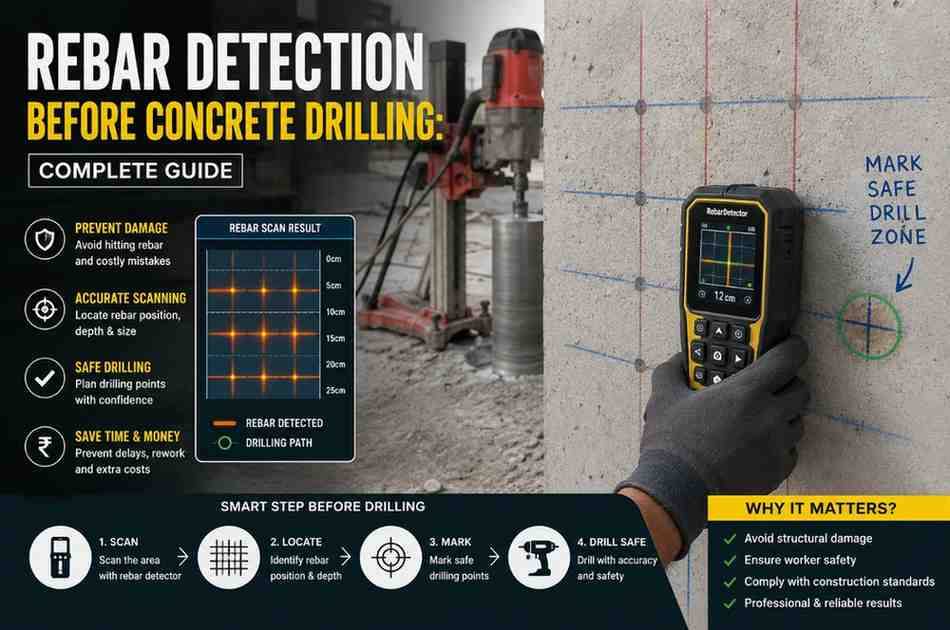
Concrete drilling and core cutting are routine parts of construction, renovation, and MEP (mechanical, electrical, plumbing) installation work. But hidden beneath every slab, wall, and column lies a network of steel reinforcement bars — rebar — along with post-tension cables, conduits, and pipes. Drilling into these without warning can compromise structural integrity, damage utilities, injure workers, and derail project timelines. That's why rebar detection before concrete drilling isn't an optional extra; it's a critical safety and quality control step.
At Core Cutting India, we've seen firsthand how a five-minute scan can prevent thousands of rupees in damage and days of rework. This guide walks through everything you need to know about rebar detection: why it matters, how it works, the tools involved, and how to choose the right service provider for your next project.
Why Rebar Detection Matters
Reinforced concrete relies on embedded steel bars to handle tensile loads that plain concrete cannot resist. When you drill or cut into a slab without knowing where that rebar sits, you risk several serious consequences.
Structural weakening is the most obvious concern. Cutting through even a single load-bearing rebar can reduce a structure's capacity to carry weight, especially in slabs, beams, and columns that were engineered with specific reinforcement patterns. Over time, this weakening can lead to cracking, sagging, or in extreme cases, structural failure.
Damage to embedded utilities is another major risk. Modern concrete slabs often contain electrical conduits, water lines, gas pipes, and post-tension cables in addition to rebar. Drilling blindly into a post-tension cable is particularly dangerous — these cables are under extreme tension and can release with explosive force if severed, posing a serious injury risk to workers nearby.
Equipment damage and downtime also matter from a business standpoint. Drilling into steel with the wrong equipment can destroy diamond core bits, damage drilling rigs, and bring a project to a halt while replacement tools are sourced.
Cost and schedule overruns follow naturally from the above. Repairing a severed cable, patching a structurally compromised area, or replacing damaged equipment all add unplanned expense and delay to a project that was likely already running on a tight schedule.
Rebar detection eliminates these risks by giving contractors a clear picture of what lies beneath the surface before a single hole is drilled.
What Is Rebar Detection?
Rebar detection is the process of using specialized scanning equipment to locate and map the position, depth, and sometimes the diameter of steel reinforcement within concrete. It also helps identify other embedded elements like conduits, post-tension cables, and voids.
Unlike guesswork based on architectural drawings — which are often outdated or inaccurate due to on-site changes during original construction — scanning provides real-time, on-site data about the actual condition of the concrete being drilled.
Common Methods and Tools for Rebar Detection
Several technologies are used in the industry, each with strengths suited to different situations.
1. Ground Penetrating Radar (GPR)
GPR is the most widely used and versatile method for rebar detection before concrete drilling. It sends electromagnetic pulses into the concrete and measures the reflected signals to build a picture of what's underneath. GPR can detect rebar, conduits, post-tension cables, voids, and even changes in concrete density.
GPR works well on slabs of varying thickness and can scan quickly across large areas, making it a favorite for commercial and industrial projects. Modern GPR units display real-time results on a screen, allowing technicians to mark exact drilling locations directly on the concrete surface.
2. Electromagnetic Cover Meters (Rebar Locators)
Cover meters, sometimes called rebar locators or rebar scanners, use electromagnetic induction to detect metal within concrete. They're typically more affordable and easier to operate than GPR units, making them common for smaller residential and light commercial jobs.
The limitation is that cover meters primarily detect ferrous metal (steel) and are less effective at identifying non-metallic elements like plastic conduits or at reading depths beyond a certain range, especially in densely reinforced concrete.
3. X-Ray Imaging
X-ray scanning offers the most detailed and accurate imaging of embedded elements, including rebar, conduits, and voids, even in thick or heavily reinforced concrete. It's often used for critical structural elements or when other methods yield ambiguous results.
However, X-ray scanning requires strict safety protocols, controlled access zones, and trained radiation-safety personnel, since it involves ionizing radiation. It's also slower and more expensive than GPR, so it's typically reserved for high-stakes or complex scans.
4. Ultrasonic Testing
Less common for rebar detection specifically, ultrasonic pulse-echo methods can help evaluate concrete thickness and internal structure. They're more frequently used alongside other methods for a comprehensive structural assessment rather than as a primary rebar-locating tool.
The Rebar Detection Process: Step by Step
A professional rebar detection service typically follows a structured process to ensure accuracy and safety.
Step 1: Site assessment and planning. The technician reviews the project scope, drilling locations, and any available structural drawings to understand what to expect.
Step 2: Surface preparation. The concrete surface is cleaned of debris, dust, and obstructions that could interfere with scanning accuracy.
Step 3: Scanning. Using GPR or an electromagnetic locator, the technician scans the marked drilling area in a grid pattern, moving the device slowly and steadily to capture consistent readings.
Step 4: Data interpretation. The technician reads the real-time display or captured data to identify the position, orientation, and approximate depth of rebar and other embedded objects.
Step 5: Marking safe zones. Detected rebar and utilities are marked directly on the concrete surface, often with color-coded chalk or paint, clearly indicating safe versus restricted drilling zones.
Step 6: Reporting. For larger or regulated projects, a written scan report with annotated images or diagrams is often provided as documentation for compliance and record-keeping.
Only after this process is complete should core drilling or cutting begin.
When Should You Scan for Rebar?
Rebar detection should be performed before any of the following activities:
- Core drilling for plumbing, electrical, or HVAC penetrations
- Installing anchor bolts or dowels for structural connections
- Cutting expansion joints or removing sections of slab
- Renovation work involving floor or wall openings
- Any drilling near known post-tension cable zones, such as parking structures or high-rise floor slabs
Essentially, if you're putting a drill bit, saw blade, or anchor into structural concrete, a scan should come first — regardless of how confident you are in the existing drawings.
Choosing the Right Rebar Detection Service
Not all scanning services offer the same level of accuracy or reliability. Here's what to look for:
Experience with your building type. A technician experienced in post-tension residential slabs will approach a scan differently than one working on an industrial warehouse floor. Ask about relevant project history.
Equipment quality. Modern GPR units offer better depth penetration and clearer imaging than older cover meters. Ask what equipment will be used and why it's suited to your project.
Clear documentation. A reliable provider gives you marked-up results and, ideally, a written report — not just a verbal "you're good to drill here."
Combined services. Many projects benefit from a provider that offers rebar detection alongside the actual core cutting and drilling work, since the same team scanning the slab will also be responsible for executing the cuts safely.
Responsiveness and turnaround. Construction schedules are tight. A provider who can mobilize quickly and deliver same-day results keeps your project moving.
How Core Cutting India Approaches Rebar Detection
At Core Cutting India, rebar detection is treated as a non-negotiable first step before any core drilling or concrete cutting job — residential, commercial, or industrial. Our technicians use GPR and electromagnetic scanning to map rebar, conduits, and post-tension cables before marking clear, color-coded drilling zones on-site.
Because we handle both the scanning and the drilling, there's no handoff risk between a separate scanning company and the drilling crew. The same team that identifies safe zones is the team executing the cuts, which means fewer surprises, safer job sites, and faster project completion.
Whether you're planning a single anchor hole or a full floor of core penetrations for MEP work, our team can assess your site, recommend the right scanning approach, and complete the drilling with precision.
Final Thoughts
Skipping rebar detection before concrete drilling is a gamble that too many contractors still take — usually because of time pressure or a false sense of confidence in old drawings. The reality is that a proper scan takes a fraction of the time that repairing a severed cable, replacing a damaged bit, or reinforcing a weakened slab would take.
If you have an upcoming drilling or core cutting project, don't leave what's inside your concrete to chance. Reach out to Core Cutting India at [email protected] to schedule a professional rebar detection and core drilling service, and get your project done safely, accurately, and on schedule.
Target-Related Searches
- rebar detection before drilling
- concrete scanning services near me
- GPR scanning for concrete
- rebar locator for construction
- post-tension cable detection
- core drilling safety precautions
- concrete X-ray scanning services
- how to find rebar in concrete wall
- rebar detection cost
- core cutting and drilling company India
People Also Ask
- How do you detect rebar before drilling into concrete? Technicians use tools like Ground Penetrating Radar (GPR) or electromagnetic rebar locators to scan the concrete surface and identify the position and depth of steel reinforcement before drilling begins.
- What happens if you drill into rebar accidentally? Drilling into rebar can damage drill bits, weaken the structural integrity of the concrete, and in the case of post-tension cables, cause a dangerous, forceful release of tension.
- Is rebar detection necessary for small drilling jobs? Yes. Even small holes, such as those for anchor bolts, can hit rebar or utilities if the exact location isn't confirmed beforehand, so scanning is recommended regardless of hole size.
- How deep can GPR detect rebar in concrete? Most GPR units can detect rebar effectively up to 12–18 inches deep, depending on concrete density, moisture content, and rebar spacing, though results vary by equipment and slab conditions.
- What is the difference between a rebar scanner and GPR? A rebar scanner (electromagnetic cover meter) primarily detects metal objects at shallower depths, while GPR can detect a wider range of embedded materials, including non-metallic conduits and voids, at greater depths.
- Can rebar detection find post-tension cables? Yes, GPR and specialized scanning equipment can typically detect post-tension cables, which is critical since cutting into a tensioned cable can be extremely dangerous.
- How much does rebar detection service cost in India? Costs vary based on project size, scanning method, and location, but many providers, including Core Cutting India, offer combined scanning and drilling packages to keep costs predictable — contact [email protected] for a quote.