
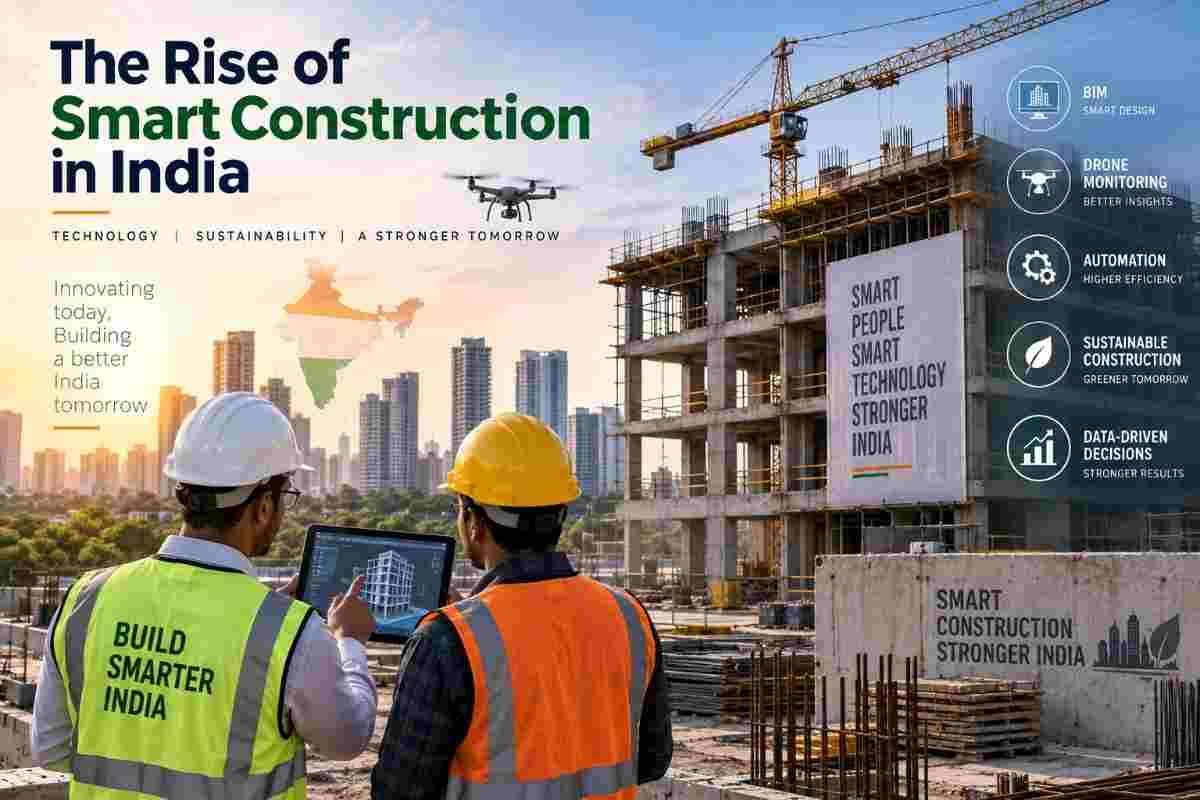
India is undergoing a monumental infrastructural transformation. From sprawling metro rail networks connecting Tier-1 and Tier-2 cities to towering skyscrapers, massive highways, and sustainable smart cities, the nation's landscape is changing at a breakneck pace. Fueling this massive economic expansion is the Indian construction sector, which stands as the second-largest employer in the country and a primary contributor to its GDP.
However, for decades, the traditional Indian construction industry has grappled with persistent challenges: project delays, cost overruns, safety hazards, labor shortages, and high environmental footprints. Traditional methods of manual estimation, paper-based tracking, and reactive problem-solving are no longer sufficient to meet the scale and speed demanded by modern urbanization.
Enter Smart Construction—the fusion of cutting-edge digital technologies, sustainable practices, and advanced engineering techniques that are reshaping how India builds. By leveraging innovations like the Internet of Things (IoT), Building Information Modeling (BIM), Artificial Intelligence (AI), automation, and specialized engineering services such as those provided by Core Cutting India, the Indian construction sector is leaping into the future.
In this comprehensive blog, we will explore the drivers behind the rise of smart construction in India, key technological trends, the challenges being overcome, and what the future holds for the nation’s infrastructure ecosystem.
1. The Catalyst: Why India Needs Smart Construction Now
India’s urban population is projected to reach over 600 million by 2030. To accommodate this demographic shift, the government has launched ambitious initiatives such as the Smart Cities Mission, Pradhan Mantri Awas Yojana (PMAY), Bharatmala, and Sagarmala. These initiatives demand rapid infrastructure development, but time is of the essence.
Several factors are driving the transition from traditional building methods to smart construction:
-
Unprecedented Urbanization Pressure: Cities are expanding vertically and horizontally. Building faster without compromising structural integrity requires precision tools, automated planning, and high-tech execution.
-
Cost and Time Efficiency: In traditional construction, inefficiencies often lead to projects running years behind schedule and budgets inflating by 30% to 50%. Smart construction utilizes predictive analytics to eliminate bottlenecks before they occur.
-
Sustainability and Green Building Mandates: Construction is one of the largest consumers of natural resources and a major emitter of carbon dioxide. India’s commitment to achieving net-zero emissions by 2070 places immense pressure on builders to adopt eco-friendly materials, minimize waste, and implement energy-efficient building techniques.
-
Safety and Labor Welfare: Construction sites have historically been prone to accidents. Digital monitoring, wearable tech, and automated machinery drastically reduce human exposure to hazardous site conditions.
2. Core Pillars of Smart Construction in India
Smart construction is not just about using one fancy gadget; it is an ecosystem of interconnected technologies. Let’s look at the core pillars driving this revolution in India:
A. Building Information Modeling (BIM)
BIM is the digital cornerstone of smart construction. Instead of relying on traditional 2D blueprints that often lead to miscommunication and on-site clashes, BIM creates a shared 3D digital representation of a facility throughout its lifecycle.
-
How it helps: Architects, structural engineers, and contractors can collaborate in real-time. If an HVAC duct clashes with a concrete beam in the digital model, it is caught and resolved virtually before a single brick is laid or core cutting is performed on-site.
-
Adoption in India: Government bodies like the National Highways Authority of India (NHAI) and major real estate developers are increasingly making BIM mandatory for large-scale public and private projects.
B. Internet of Things (IoT) and Smart Sensors
IoT brings the physical construction site online. By embedding sensors into building materials, machinery, and safety gear, project managers gain real-time visibility over operations.
-
Asset Tracking & Management: Heavy machinery (excavators, cranes, transit mixers) are tracked via GPS to optimize fuel consumption and prevent theft.
-
Structural Health Monitoring: Sensors embedded in concrete curing processes can measure temperature and humidity, telling engineers precisely when the concrete has achieved optimal strength, which is vital before proceeding with structural modifications or diamond core cutting.
C. Artificial Intelligence (AI) and Machine Learning (ML)
AI is changing how construction projects are planned, budgeted, and executed.
-
Predictive Analytics: ML algorithms analyze historical data from thousands of past projects to predict where a current project is likely to face delays or cost overruns.
-
Computer Vision for Safety: AI-powered CCTV cameras installed on construction sites monitor whether workers are wearing helmets and safety harnesses, immediately alerting site managers to safety violations.
D. Prefabrication and Modular Construction
Instead of building everything from scratch on a chaotic job site, smart construction favors prefabrication. Components like walls, bathroom pods, and pre-cast concrete slabs are manufactured in controlled factory environments and then assembled on-site like Lego blocks. This drastically cuts down construction time, reduces material wastage by up to 30%, and lowers noise and air pollution in dense urban neighborhoods.
3. The Role of Specialized Engineering and Precision Execution
While software and digital planning lay the groundwork, the physical execution requires extreme precision. Modern buildings demand complex layouts for electrical wiring, plumbing, HVAC systems, and structural retrofitting. This is where specialized physical infrastructure services become indispensable.
For instance, when executing modifications in existing concrete structures—such as creating openings for utility pipes, core drilling for wiring, or wall sawing for doors and windows—traditional hammering and breaking methods cause micro-cracks, structural weakness, and massive dust pollution. Smart construction demands precision techniques like diamond core cutting and wire sawing.
Companies specializing in these domains utilize advanced diamond-tipped machinery to cut through heavily reinforced concrete smoothly, silently, and accurately without damaging the surrounding structural integrity. Integrating expert physical execution services—such as those offered by Core Cutting India—ensures that the high-tech digital designs planned on BIM software are translated into flawless, safe physical realities on the ground.
4. Government Initiatives Boosting Smart Construction
The Indian government has played a pivotal role in accelerating the adoption of smart technologies through policy backing and regulatory encouragement:
-
National Infrastructure Pipeline (NIP): A Rs 111 lakh crore project initiative that requires modern, tech-enabled execution to ensure projects are delivered efficiently.
-
Make in India & Digital India: These campaigns encourage domestic startups to develop indigenous construction tech solutions, drones, and IoT devices tailored to Indian site conditions, reducing reliance on expensive foreign imports.
-
PMAY and Affordable Housing: To build millions of affordable homes rapidly, developers are heavily leaning toward precast technologies and aluminium formwork systems.
5. Challenges on the Road to Smart Construction in India
Despite the massive momentum, the transition to smart construction in India is not without roadblocks:
-
High Initial Capital Investment: Implementing BIM software, drones, IoT sensors, and automated machinery requires substantial upfront capital. Small and medium contractors (SMCs), who form the backbone of the Indian construction market, often struggle to afford these technologies.
-
Skill Gap and Training Deficit: Operating advanced construction tech requires specialized training. There is a notable shortage of engineers and laborers skilled in handling digital tools like BIM, AI analytics, and precision cutting equipment.
-
Resistance to Change: The construction sector is historically conservative. Many veteran builders prefer traditional "rule of thumb" methods over data-driven digital workflows.
-
Fragmented Supply Chain: The Indian construction market involves numerous unorganized sub-contractors, making it difficult to achieve seamless data integration across all tiers of a project.
6. Overcoming the Hurdles: The Path Forward
To unlock the full potential of smart construction, stakeholders across the ecosystem must collaborate:
-
Upskilling the Workforce: Technical institutions, ITIs, and engineering colleges must integrate construction tech, BIM modules, and modern engineering practices into their curriculums.
-
SaaS and Pay-As-You-Go Models: Tech providers should offer software-as-a-service (SaaS) and flexible financing models so that small and medium contractors can adopt smart tools without breaking the bank.
-
Emphasizing Quality and Safety Standards: Stricter enforcement of building codes and safety regulations will naturally compel builders to adopt smart, non-destructive testing and precision execution methods.
7. The Future Outlook: What Lies Ahead for India (2030 and Beyond)
As we look toward the future, smart construction in India will move from being a competitive advantage to an absolute necessity.
-
Autonomous Machinery: Expect to see autonomous bulldozers, robotic bricklayers, and AI-driven surveying drones becoming common sights on Indian mega-project sites.
-
Green Smart Cities: Construction will heavily integrate recycled aggregates, carbon-cure concrete, and energy-neutral buildings designed to combat climate change.
-
Digital Twins: Full-scale digital twins of entire urban sectors will allow city planners to simulate traffic flow, disaster management, and energy usage before physical changes are made.
Conclusion
The rise of smart construction in India marks a thrilling paradigm shift. By merging the power of digital intelligence with rigorous physical engineering—from BIM planning in boardrooms to precision diamond core cutting on the job site—India is building a resilient, sustainable, and modern foundation for its future generations.
As the industry continues to evolve, embracing these technological leaps will determine which companies lead the market. Whether you are a large infrastructure developer, an architect, or a property owner looking for reliable, tech-enabled structural modifications, partnering with industry experts is essential. To learn more about professional, precise, and advanced cutting solutions tailored to modern engineering standards, visit Core Cutting India.
The future of building in India is smart, safe, and sustainable—and the revolution has only just begun.
Add-on Information Section
Related Keywords:
-
Construction technology trends in India
-
BIM implementation in Indian infrastructure
-
IoT applications in civil engineering
-
Precast and modular construction India
-
Precision concrete cutting and core drilling
-
Sustainable building materials India
-
Digital transformation in real estate development
People Also Ask (PAA):
-
Q: What is smart construction?
A: Smart construction refers to the integration of advanced digital technologies (like BIM, IoT, AI, and automation) and sustainable practices to optimize planning, building, and management processes in the construction industry.
-
Q: How is technology changing the construction industry in India?
A: Technology is reducing project delays and cost overruns through real-time data tracking, automated machinery, digital 3D modeling (BIM), and eco-friendly prefabrication methods.
-
Q: Why is precision core cutting important in modern construction?
A: Precision core cutting and wire sawing allow builders to create accurate openings for utilities and structural modifications without causing micro-cracks or weakening the structural integrity of reinforced concrete.
-
Q: What are the main challenges of smart construction in India?
A: High initial equipment costs, a lack of skilled labor trained in digital tools, and resistance to moving away from traditional construction methods are the primary challenges.