
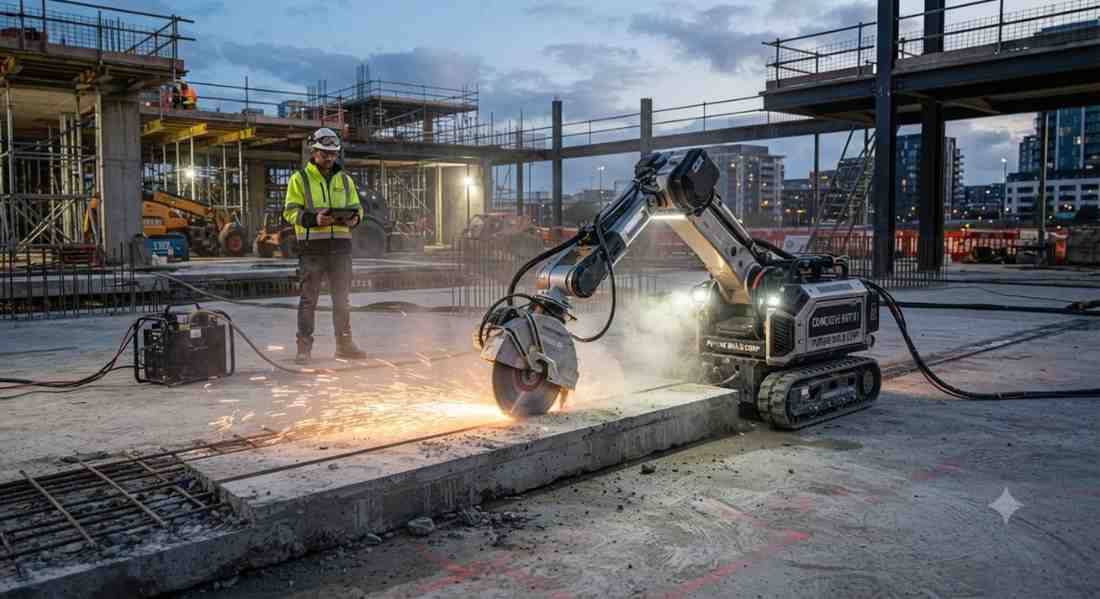
Construction sites have always been noisy, dusty, and physically demanding places. For decades, cutting through concrete meant handheld saws, manual core drills, and workers standing dangerously close to heavy vibrating equipment. That picture is changing fast. Robotic concrete cutting is emerging as one of the most talked-about innovations in modern construction, and companies like Core Cutting India ([email protected]) are already putting this technology to work on real projects.
But is robotic concrete cutting really the future of construction, or just another buzzword riding the automation wave? In this article, we'll break down what robotic concrete cutting actually is, how it works, why it matters, and what it means for contractors, engineers, and project owners across India.
What Is Robotic Concrete Cutting?
Robotic concrete cutting refers to the use of remote-controlled or semi-autonomous machines to cut, drill, saw, or demolish concrete structures with minimal human intervention at the point of impact. Instead of a technician holding a handheld saw directly against a wall or slab, an operator controls a robotic unit from a safe distance using a remote panel or joystick console.
These machines are typically equipped with diamond-tipped blades, core bits, or hydraulic breakers, and they can perform tasks such as:
- Wall sawing for openings, doors, and windows
- Floor sawing for slab removal or expansion joints
- Core drilling for pipes, cables, and structural inspections
- Wire sawing for thick or heavily reinforced concrete
- Selective demolition of walls, columns, or floors
The core idea is simple: separate the operator from the point of physical risk while improving precision, consistency, and speed.
Why the Construction Industry Is Turning to Robotics
Construction has long struggled with three persistent challenges: labor shortages, safety risks, and the demand for faster project timelines. Robotic concrete cutting speaks directly to all three.
Industry data backs this shift. On-site construction robotics is <cite index="6-1">still a low single-digit billion dollar global market growing at mid-teens annual rates</cite>, but adoption is accelerating quickly. Notably, <cite index="6-1">construction robotics attracted 1.36 billion dollars in venture funding through the third quarter of 2025, a 125 percent increase year-on-year</cite>. That kind of investment signals that robotics in construction, including cutting and demolition applications, is moving from experimental pilot projects to mainstream adoption.
Within the broader category of construction robotics, <cite index="1-1">systems that drill, cut, fasten, and route cable, conduit, and ductwork fall under the MEP and utilities workflow family</cite>, one of several workflow clusters where robots are now doing repeatable, documented work on real jobsites rather than just appearing in demo videos.
1. Improved Worker Safety
Safety is the single biggest driver behind robotic adoption in concrete cutting. Traditional cutting exposes workers to flying debris, high noise levels, silica dust, and the physical strain of holding heavy machinery for extended periods. With robotic systems, <cite index="2-1">remote-operated demolition units allow technicians to perform heavy removal tasks without standing near the work zone</cite>, dramatically reducing exposure to these hazards.
2. Greater Precision and Structural Accuracy
Modern construction projects demand tighter tolerances than ever before. Whether it's cutting an opening for an HVAC duct or removing a section of a load-bearing wall, even a small miscalculation can compromise structural integrity. Robotic systems, when paired with digital layout data and scanning technology, can execute cuts with a level of consistency that is difficult to match manually.
3. Faster Project Timelines
Labor shortages continue to squeeze construction schedules across India and globally. Robotic equipment doesn't get fatigued, doesn't need frequent breaks during long cutting sessions, and can often run for extended periods with consistent output quality. This translates directly into shorter project timelines for contractors under pressure to deliver.
4. Reduced Damage to Critical Infrastructure
One of the most dangerous risks in concrete cutting is accidentally striking embedded rebar, electrical conduits, or post-tension cables. Modern robotic cutting is almost always paired with scanning technology to prevent exactly this kind of accident.
The Role of Scanning Technology in Robotic Cutting
Robotic cutting doesn't work in isolation. It's part of a broader digital workflow that starts well before the blade ever touches concrete. Ground Penetrating Radar, or GPR, has become a standard part of pre-cutting protocol. <cite index="2-1">GPR sends electromagnetic signals into a concrete slab and detects variations in density caused by embedded materials, creating a visual map of reinforcement bars, electrical lines, and tension cables</cite>.
This matters enormously for safety. <cite index="2-1">Accidental contact with a post-tension cable can cause immediate structural damage, since these cables remain under high tension</cite>. By scanning first, technicians and robotic operators can plan a cutting path that avoids these critical elements entirely, protecting both the structure and the people working around it.
At Core Cutting India, this scan-first approach is treated as a non-negotiable step for any core drilling or wall cutting project, especially in occupied buildings, hospitals, and industrial facilities where the cost of an error is high.
How Robotic Concrete Cutting Fits Into the Bigger Construction Robotics Picture
It helps to understand robotic concrete cutting as one piece of a much larger transformation happening across construction sites. Industry analysts now categorize construction robotics into distinct workflow families rather than treating "construction robots" as one broad category. According to a recent industry breakdown, <cite index="1-1">these workflow families include layout and measurement, groundworks and earthmoving, structural and concrete work such as rebar support, and MEP and utilities tasks that involve drilling, cutting, fastening, and routing</cite>.
This matters because it shows robotic concrete cutting isn't an isolated gadget, it's part of a coordinated shift where digital models, scanning, and physical execution increasingly work together. A recent workflow analysis found that <cite index="6-1">four workflows, layout, groundworks, rebar tying, and digital capture, are now in repeatable production with documented return on investment</cite>, while more complex task-execution robots are still catching up in adoption. Cutting and drilling applications sit right at this frontier, moving from novelty to standard practice on more job sites every year.
Broader trends across the construction robotics sector reinforce this trajectory. As one 2026 industry overview put it, <cite index="4-1">scale, complexity, and risk remain constant challenges in construction, and these issues are now compounded by labor shortages, growing demand for large-scale infrastructure, and the need for safer job sites</cite>. Automation and robotics are increasingly seen as the practical answer to these pressures, rather than a futuristic add-on.
Applications of Robotic Concrete Cutting in India
India's construction and infrastructure sector is uniquely positioned to benefit from robotic cutting technology, given the scale of ongoing metro projects, industrial expansions, and urban redevelopment work. Common applications include:
Metro and Infrastructure Projects Tunnel boring, station construction, and utility corridor work often require precise concrete cutting in confined or high-risk spaces where robotic systems significantly reduce worker exposure.
Industrial Plant Modifications Factories and manufacturing units frequently need openings cut into thick concrete floors and walls for new machinery, piping, or ductwork, all while keeping the rest of the facility operational.
Commercial Building Renovations Retrofitting older commercial buildings with modern HVAC, electrical, or plumbing systems often requires selective demolition and core drilling without disturbing the surrounding structure.
Bridge and Structural Repair Robotic wire saws and wall saws are increasingly used for controlled removal of damaged bridge sections or structural elements that need replacement.
Is Robotic Concrete Cutting Actually Safer and More Cost-Effective?
This is the question every contractor and project owner eventually asks. The honest answer is: it depends on the scope of work, but the trend clearly favors robotics for medium to large-scale cutting and demolition tasks.
For safety, the answer is straightforward. Removing workers from direct contact with vibrating machinery, flying debris, and structural collapse risk is a measurable improvement, not a marketing claim. Industry safety research bodies have taken note of this shift, with dedicated studies now examining <cite index="1-1">safety and risk trends specifically tied to robotics and automation adoption in construction</cite>.
For cost, the picture is more nuanced. Robotic equipment typically requires a higher upfront investment and specialized operator training. However, for larger projects, the reduction in rework, faster turnaround, and lower liability risk from accidents often offsets this initial cost. Smaller, one-off cutting jobs may still be more economical with traditional methods, which is why experienced contractors like Core Cutting India assess each project individually rather than defaulting to a one-size-fits-all approach.
Challenges Facing Robotic Concrete Cutting Adoption
Despite the momentum, robotic concrete cutting isn't without obstacles.
High Initial Investment: Robotic cutting rigs, remote control systems, and diamond tooling represent a significant capital outlay compared to traditional handheld saws.
Skilled Operator Requirement: Operating robotic cutting equipment safely and effectively requires trained personnel, and the talent pool is still growing in many regions.
Site Accessibility: Not every job site is designed with robotic equipment in mind. Tight spaces, uneven terrain, or limited power access can complicate deployment.
Market Maturity: The broader construction robotics market remains small relative to total construction spend, meaning adoption is still concentrated among specialized contractors rather than being universal across the industry. As one industry report notes, <cite index="6-1">on-site construction robotics still represents less than 0.03 percent of global construction spend</cite>, underlining that this is very much an emerging technology rather than an established norm.
These challenges explain why robotic concrete cutting is growing steadily rather than replacing traditional methods overnight. It's a gradual, workflow-by-workflow shift, not an industry-wide overnight transformation.
What This Means for Contractors and Project Owners
If you're planning a construction, renovation, or infrastructure project that involves concrete cutting or drilling, here's the practical takeaway: robotic cutting is becoming the preferred choice for projects where safety, precision, and minimal disruption matter most. This includes occupied buildings, structurally sensitive work, and any project where downtime or rework carries a high cost.
For smaller, straightforward jobs, traditional cutting methods still hold up well and remain cost-effective. The key is working with a contractor who understands both approaches and can recommend the right method for your specific project rather than pushing robotics as a blanket solution.
Why Choose Core Cutting India for Robotic and Precision Concrete Cutting
At Core Cutting India, we combine modern cutting technology with decades of hands-on construction expertise. Our team uses GPR scanning, diamond core drilling, wall sawing, and where appropriate, robotic and remote-operated systems, to deliver precise, safe, and efficient concrete cutting solutions across residential, commercial, and industrial projects.
Whether you're managing a metro infrastructure project, retrofitting an industrial facility, or need reliable core cutting services for a commercial renovation, our team evaluates every job individually to recommend the safest and most cost-effective cutting method.
Get in touch with Core Cutting India today at [email protected] to discuss your next concrete cutting or drilling project.
Frequently Asked Questions
What is robotic concrete cutting? Robotic concrete cutting is the use of remote-controlled or semi-autonomous machines fitted with diamond blades, core bits, or hydraulic breakers to cut, drill, or demolish concrete, operated from a safe distance rather than by direct manual contact.
How does robotic concrete cutting work? An operator controls the machine using a remote panel while the equipment performs sawing, drilling, or breaking tasks. Many projects also use Ground Penetrating Radar scanning beforehand to map rebar, cables, and utilities so the cutting path avoids critical structural elements.
Is robotic concrete cutting safe? Yes, it is generally safer than traditional manual cutting because it removes workers from direct exposure to vibration, dust, flying debris, and the risk of striking hidden electrical or tension cables.
What is the cost of robotic concrete cutting in India? Costs vary depending on project scope, site conditions, and equipment required. Robotic cutting typically involves a higher initial cost than manual methods but can reduce rework and downtime on larger or structurally sensitive projects. Contact Core Cutting India for a project-specific estimate.
What is the difference between core cutting and concrete cutting? Core cutting typically refers to drilling precise circular holes through concrete for pipes, cables, or inspection purposes, while concrete cutting more broadly covers wall sawing, floor sawing, and demolition of larger concrete sections.
Can robots replace manual concrete cutting workers? Not entirely. Robotic systems are increasingly handling high-risk or high-precision tasks, but skilled human operators are still essential to control, supervise, and maintain the equipment, and many smaller jobs remain more practical with traditional methods.
What equipment is used in robotic concrete cutting? Common equipment includes remote-controlled wall saws, wire saws, core drilling rigs, hydraulic breakers, and demolition robots, often paired with GPR scanning tools for pre-cutting structural mapping.
Core Cutting India | [email protected]