
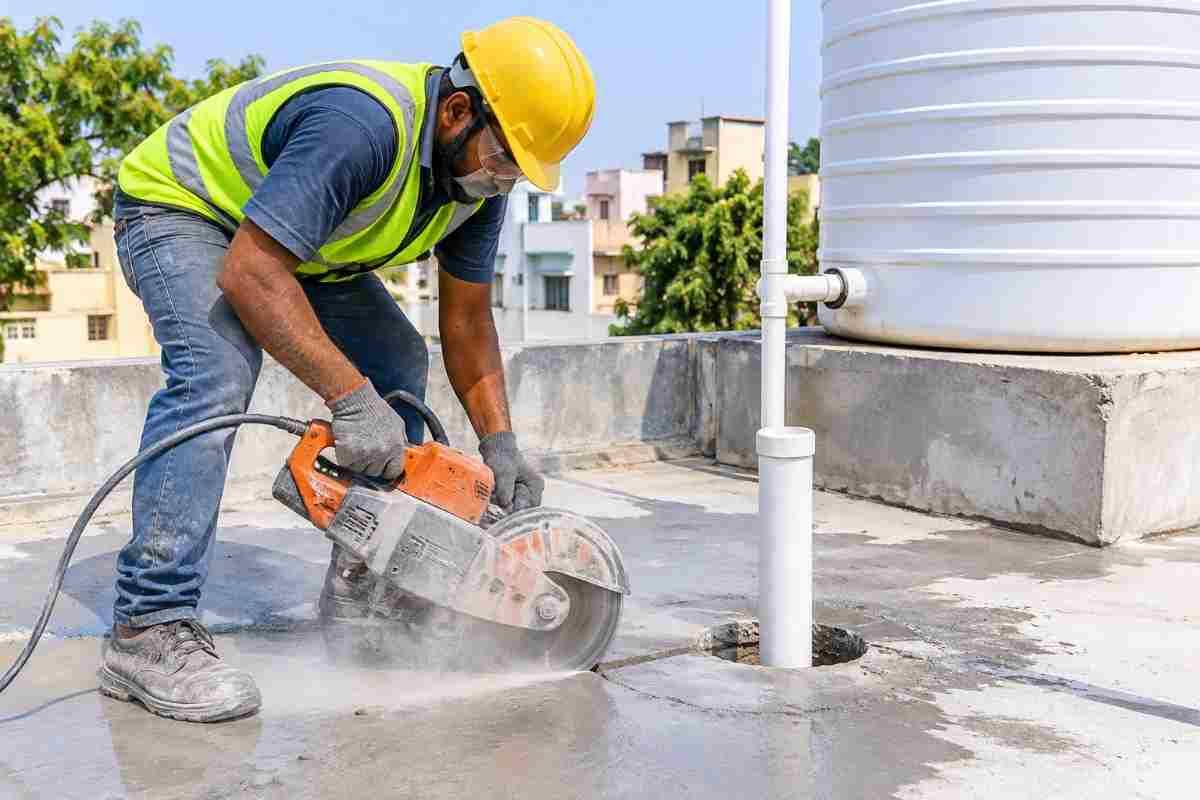
Every home with an overhead water tank depends on a network of pipes: an inlet line, an outlet line, an overflow pipe, a drain or washout line and sometimes a vent. Where a house is already built, getting these pipes through the roof slab is one of the trickiest parts of the job. A badly made opening can crack the slab, cause leakage, weaken the structure and leave you with expensive repairs.
This guide explains how roof cutting for water tank pipe installation is done properly, what methods are used, how to prepare and what mistakes to avoid. It is written for homeowners, builders, plumbers and property managers across India. At Core Cutting India (https://corecuttingindia.com/), we cut openings in residential RCC roofs every day, so this advice comes from real site experience.
Why Roof Cutting Is Needed for Water Tank Pipes
In most Indian homes, the water tank sits on the terrace or on a raised platform above the top slab. The main supply line usually starts at the ground floor or sump, and the distribution lines run down from the tank to bathrooms, kitchens and taps.
Wherever these lines need to cross the roof slab, you need a clean, accurate opening. Common reasons include:
- New tank installation: Adding a tank to a house that has none, or relocating the existing one.
- Adding extra pipelines: Separate lines for borewell water, municipal supply, solar heater feed or RO systems.
- Replacing old pipes: Corroded GI pipes being replaced with CPVC, UPVC or PPR lines of a different diameter.
- Adding a floor or extension: New plumbing for an added bathroom or kitchen below the tank.
- Overflow and drain lines: Safe discharge of tank overflow, which many older homes lack entirely.
In all these cases, the opening must be sized correctly, placed away from reinforcement where possible and finished so water cannot seep around the pipe.
Why You Should Not Use a Hammer and Chisel
Many people still try to break through the slab with a hammer, chisel or electric breaker. It looks cheaper, but it usually costs more in the end.
Problems with manual breaking:
- Cracks and micro-fractures. Vibration travels through the slab and creates hairline cracks, which later become leakage points.
- Uneven, oversized holes. Breaking never produces a neat circle, so you end up filling large gaps around a small pipe.
- Damage to reinforcement. Uncontrolled impact can bend or expose steel bars, causing corrosion over time.
- Noise, dust and debris. Residents suffer for days, and debris can fall into the rooms below.
- Structural risk. Repeated impact can weaken the slab, especially in older buildings.
A professional core cutting method avoids almost all of these issues.
What Is Core Cutting for Roof Openings?
Core cutting, also called diamond core drilling, uses a hollow cylindrical drill bit with diamond segments on its edge. The bit rotates at controlled speed while water cools it and flushes out slurry. It cuts a precise circular hole and removes the concrete as a solid “core”.
For water tank pipes, this method is ideal because:
- The hole is smooth and perfectly round.
- Vibration is minimal, so the surrounding slab stays intact.
- Hole sizes are accurate, typically from about 25 mm to 300 mm or more.
- The process is quieter and cleaner than breaking.
- It can cut through concrete, reinforced concrete, brick and stone.
For most residential water tank connections, hole diameters fall between 40 mm and 150 mm, depending on the pipe size, whether you want to sleeve the pipe and how many lines share one opening.
Step-by-Step Process of Roof Cutting for Water Tank Pipes
Here is how a professional team handles a typical job.
1. Site Inspection and Planning
The team visits the terrace and the floor below. They check the slab thickness, the location of beams and columns, existing plumbing or electrical conduits and the exact spot where the pipe will come through. Good planning at this stage prevents most problems.
2. Marking the Hole Position
The cutting point is marked on the terrace and cross-checked from below, so the opening lines up with the shaft, duct or wall where the pipe will run. Marking accurately matters, because a hole that is even 50 mm off can force awkward bends in the pipe.
3. Scanning for Reinforcement
Where possible, the slab is checked for steel bars and embedded conduits. Cutting through a conduit or a main bar can be dangerous and damaging, so the hole is shifted slightly if required. Where a bar must be cut, it should be done with an engineer’s guidance.
4. Fixing the Machine
The core cutting machine is anchored firmly to the slab, using an anchor bolt or vacuum base. A stable rig prevents wobbling, which would cause jagged edges and damage the bit.
5. Wet Cutting
The operator starts cutting with a continuous water supply. Water cools the bit, controls dust and carries away slurry. A professional team will contain this slurry so that it does not run into the building or stain the terrace.
6. Core Removal
When the bit breaks through, the cylindrical core is lifted out. The opening is then cleaned and checked for size and straightness.
7. Cleaning and Handover
The area is wiped down, the slurry is removed and the hole is ready for pipe fixing and waterproofing.
Choosing the Right Hole Size
A common mistake is cutting a hole far larger than needed. A better approach is to size the opening based on the pipe plus a sleeve and sealing allowance.
| Purpose | Typical Pipe Size | Suggested Hole Size |
|---|---|---|
| Inlet / supply line | 20 mm – 32 mm | 50 mm – 75 mm |
| Outlet / downtake line | 25 mm – 50 mm | 75 mm – 100 mm |
| Overflow pipe | 32 mm – 50 mm | 75 mm – 100 mm |
| Drain / washout line | 40 mm – 50 mm | 75 mm – 100 mm |
| Multiple pipes in one shaft | Varies | 100 mm – 150 mm |
These are general guides, and your plumber or engineer should confirm the final size. Cutting slightly larger lets you fit a PVC sleeve, which protects the pipe and makes future replacement easier.
Waterproofing and Sealing After Cutting
Cutting the hole is only half the job. The part most often overlooked is sealing it. A pipe passing through a terrace slab is a classic leakage point, and poor sealing can lead to damp patches and peeling paint on the ceiling below.
Follow these steps after the pipe is installed:
- Fit a sleeve. A PVC or HDPE sleeve passes through the slab and holds the pipe in position.
- Fill the gap. Use non-shrink grout or polymer-modified mortar around the sleeve.
- Apply a waterproofing coat. Brush a waterproofing compound around the base of the pipe and across the surrounding terrace.
- Create a collar. A small raised collar around the pipe stops water from pooling at the base.
- Flexible sealant at the top. Use a good-quality sealant where the pipe meets the grout, as this allows for slight movement.
- Test before finishing. Pond a little water around the pipe for 24 hours and check the ceiling below for any seepage.
Taking these steps seriously saves you from costly leak repairs during the monsoon.
Safety Considerations for Residential Roof Cutting
Cutting into a roof slab is not a casual task. Residential buildings have people living below, so safety must come first.
- Check the slab condition. If the roof is old, cracked or showing exposed steel, have an engineer inspect it first.
- Avoid cutting near beams and columns. These carry the building’s load, so openings there need professional approval.
- Protect the rooms below. Cover furniture, and keep people away from the area directly under the cut.
- Control water and slurry. Wet cutting creates run-off, so manage it to avoid damage to walls and electrical points.
- Use trained operators. Experience affects accuracy, safety and the life of the equipment.
- Follow electrical safety. Wet cutting and electricity need careful handling, with proper earthing and a safe power supply.
Advantages of Hiring a Professional Core Cutting Service
You can find laborers who will break a hole in a day. But a specialist service offers clear advantages:
- Precision: Exact diameters and clean edges.
- Structural safety: Minimal vibration and no unnecessary cracking.
- Speed: Many residential holes are completed within minutes.
- Cleanliness: Controlled dust and slurry, with less mess in your home.
- Right equipment: Quality diamond bits and rigs suited to the slab.
- Better finish: A smooth hole makes pipe fitting and waterproofing far easier.
- Fewer repairs later: A clean opening reduces the risk of leaks and cracks.
At Core Cutting India, our teams use modern diamond core drilling equipment to handle residential, commercial and industrial jobs, including roof openings for water tank pipes. You can learn more at https://corecuttingindia.com/.
Cost Factors for Roof Cutting
There is no single fixed price, because the cost depends on several factors:
- Hole diameter: Larger holes need bigger bits and take longer.
- Slab thickness: A thicker slab means more cutting depth.
- Reinforcement density: Heavily reinforced concrete is harder to cut.
- Number of holes: Multiple holes in a single visit are usually more economical per hole.
- Access and height: Difficult access to the terrace, or limited power and water, can affect the quote.
- Location: Travel distance and local conditions can influence pricing.
The best way to get an accurate number is to share your requirement, including hole size, number of holes and photos if possible, and request a quotation. Call +91 70096 79903 for a free estimate.
Common Mistakes to Avoid
- Choosing the hole location without checking below. Always check what lies under the cut.
- Cutting without scanning the slab. Hidden conduits can be damaged.
- Making the hole too big. Excess gap means more grouting and more chance of leakage.
- Skipping the sleeve. Pipes embedded directly in concrete are harder to replace.
- Ignoring waterproofing. This is the leading cause of leaks near terrace pipes.
- Hiring on price alone. The cheapest option often costs more in repairs.
- Cutting near a beam or column without approval. This can compromise the structure.
Tips for Homeowners Before the Cutting Day
- Decide the final tank position and pipe routes first.
- Confirm pipe sizes with your plumber.
- Clear the terrace area and the room below.
- Make sure water and electricity are available on site.
- Keep children and pets away from the work zone.
- Ask the contractor about slurry cleanup.
- Plan the waterproofing work right after the pipe is fixed.
People Also Ask (FAQs)
How is a hole cut in an RCC roof for a water tank pipe?
A diamond core cutting machine is fixed to the slab, and a hollow diamond bit rotates with water cooling to cut a clean circular hole. The concrete core is then removed, leaving a smooth opening for the pipe.
Is core cutting safe for residential buildings?
Yes. Core cutting produces far less vibration than breaking with a hammer or breaker, so it is considered one of the safest ways to make openings, provided it is done by trained operators after checking the slab.
What size hole is needed for a water tank pipe?
It depends on the pipe diameter and whether you use a sleeve. Many residential holes are between 50 mm and 100 mm, but your plumber or engineer should confirm the right size.
Can I cut a hole in my terrace slab myself?
It is not recommended. DIY cutting risks cracking the slab, hitting reinforcement or conduits and creating leaks. A professional service gives better accuracy and safety.
How long does roof cutting for a pipe take?
A single standard hole often takes only a short time once the machine is set up, though setup, marking and cleanup add to the total. Larger or thicker slabs take longer.
Will core cutting weaken my roof?
A properly planned hole of reasonable size does not significantly affect a slab, as long as it avoids beams, columns and main reinforcement. For unusual or large openings, consult a structural engineer.
How do I prevent leakage around the pipe after cutting?
Use a sleeve, fill gaps with non-shrink grout, apply a waterproofing coat, make a small collar around the pipe and finish with a flexible sealant. Test with water before final finishing.
How much does core cutting cost for a water tank pipe?
Cost depends on hole size, slab thickness, number of holes and site access. Contact Core Cutting India at +91 70096 79903 for a quotation.
Why Choose Core Cutting India?
When it comes to roof cutting for water tank pipe installation, accuracy and care make all the difference. Core Cutting India offers:
- Experienced operators trained in residential and commercial work
- Modern diamond core drilling equipment
- Clean, dust-controlled, low-vibration cutting
- Honest advice on hole size and placement
- Prompt service and fair quotations
Whether you are installing a new tank, adding a pipeline or upgrading an old setup, our team can deliver a neat, durable opening that makes the rest of your plumbing work easier.
Conclusion
A water tank is only as reliable as the pipes connected to it, and those pipes are only as reliable as the openings they pass through. Roof cutting done carelessly leads to cracks, leaks and repeated repairs. Done properly, with careful planning, diamond core drilling, correct sizing, and good waterproofing, it gives you a clean, long-lasting installation.
If you are planning a water tank pipe installation in your home, let a specialist handle the cutting. Visit core cutting india or call +91 70096 79903 to book a site visit and get a free quotation from Core Cutting India.
Call to Action: Need a clean, precise hole in your roof slab? Contact Core Cutting India today at +91 70096 79903 or visit core cutting india.