
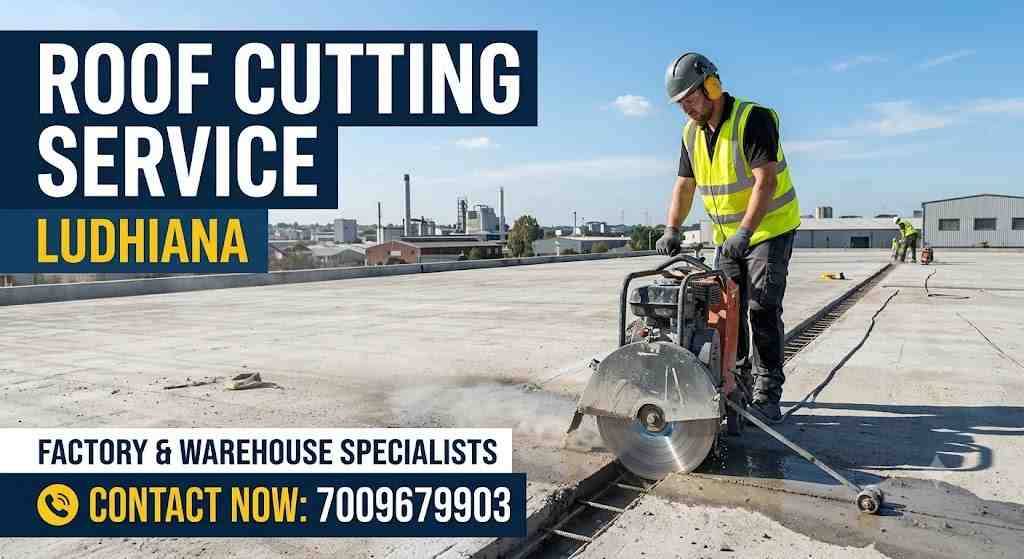
In a factory, time is the most expensive material you handle. Every hour a production line stands idle costs orders, labour and goodwill. So when a plant expansion, a new machine or a warehouse upgrade means opening part of an RCC roof, the question is never only "Can it be cut?" It is "How fast, how safely and with how little disruption?"
That is the standard a good industrial roof cutting service in Ludhiana should meet. This guide is written for plant managers, factory owners, project engineers and warehouse operators who need a roof or slab opened accurately while the business keeps moving. To discuss a requirement right away, call or WhatsApp 7009679903.
📞 Factory or Warehouse Roof to Open? Call Now
Call or WhatsApp: 7009679903 Email: info@corecuttingindia.com Share the slab details, drawing or photos. We will respond with a clear scope and quote. 👉 Chat on WhatsApp
Ludhiana's Industry Never Stands Still
Ludhiana is one of Punjab's busiest industrial cities. Knitwear and hosiery units, auto-component makers, cycle parts manufacturers, machine tool shops, steel and foundry operations and a large network of suppliers and warehouses all operate here, from the Focal Points to Industrial Area A and B, and along the GT Road, Chandigarh Road and Ferozepur Road corridors.
Plants in this environment keep changing. Machines get bigger. Production lines get reorganised. New floors are added. Ventilation and fire safety standards are upgraded. Each change can involve an RCC roof or slab that was poured years ago for a different purpose.
When that structure needs an opening, owners usually face three choices: break it manually, cut it with diamond equipment or redesign the project to avoid it. In most cases, diamond cutting is the one that protects both the building and the schedule.
What Industrial Roof Cutting Means
Industrial roof cutting is the precise removal of defined sections of RCC roofs, floors and slabs in factories, warehouses, cold stores and similar buildings. It uses diamond-tipped slab saws, wall saws, wire saws and core drills that cut through concrete and embedded steel along a pre-marked outline.
Compared with a residential slab, industrial slabs bring added complications:
- Greater thickness and heavier reinforcement
- Larger spans and bigger openings
- Heavy equipment above, below or nearby
- Live operations in the same building
- Tight shutdown windows for the work
A contractor who works mostly on small house jobs may not be set up for this level of demand. Industrial work needs bigger machines, stricter planning and clearer communication.
Six Industrial Situations That Need Roof Cutting
1. Installing a large machine through the roof
Sometimes a new press, boiler, compressor or CNC machine cannot enter through existing doors. A temporary opening in the roof lets a crane lower it into place. The slab is then restored or permanently framed.
2. Adding ventilation and exhaust shafts
Foundries, dyeing units and paint shops need stronger exhaust. Openings in the roof allow ducting to run out cleanly.
3. Creating openings for conveyors and material lifts
Multi-storey units often need vertical movement of goods. A neat slab opening is the starting point.
4. Installing industrial lifts and staircases
Adding a goods lift or fire-escape staircase to an existing building calls for cutting through each floor level.
5. Skylights and daylight panels
Opening part of a roof to install translucent panels reduces lighting costs and improves working conditions.
6. Partial slab removal for height or layout changes
Some plants need a double-height area for tall equipment or overhead cranes.
If a project also involves vertical walls, see how we handle that on our wall cutting service in Ludhiana page.
Why Diamond Cutting Suits a Running Factory
Think of what manual breaking does inside a working plant: shock waves travel through beams and columns, machines vibrate, dust spreads over stock and product, and the noise stops work in adjoining bays.
Diamond cutting behaves differently:
- Low vibration protects precision machinery and nearby structure.
- Water-cooled cutting keeps dust down, which matters in textile, food and electronic units.
- Precise boundaries mean only the planned area is affected.
- Controlled removal allows sections to be lifted out safely.
- Shorter execution shrinks the shutdown window.
For many plants, these benefits are not conveniences. They are requirements.
Planning the Shutdown: A Practical Framework
The most successful industrial cuts are won on paper before any machine arrives. Here is a framework you can use.
Define the objective. What must the opening achieve? Machine entry, shaft, stairs, light?
Get drawings and approvals. Share structural drawings with your engineer. They decide where beams, edge reinforcement or supports are needed.
Map the surroundings. Identify machines, electrical panels, pipes and stored material near and below the cut zone.
Choose the window. Pick a period when production is lowest, such as a weekend, a festival break or a scheduled maintenance period.
Prepare the site. Clear the area, cover sensitive equipment and arrange power, water and lifting equipment.
Sequence the work. Cut, lift, clean and then frame or restore the opening, in a planned order.
Agree a contingency. Know what happens if the slab is thicker than expected or hidden services appear.
Sharing this plan with your cutting contractor early helps them quote accurately and arrive prepared.
The Equipment That Matters on Industrial Jobs
| Equipment | Typical Use on Industrial Sites |
|---|---|
| Slab or floor saw | Long straight cuts through roof and floor slabs |
| Wall saw | Thick walls, beams and vertical faces |
| Wire saw | Very thick, large or hard-to-reach concrete |
| Hand-held ring saw | Corners and restricted areas |
| Core drill | Corner relief, anchor holes, pipe and cable holes |
| Lifting gear and cranes | Removing heavy cut sections safely |
Contractors who bring the right equipment mix can complete large openings in fewer passes and fewer days.
How Industrial Roof Cutting Is Priced
Prices vary because industrial buildings vary. Pricing is typically based on cutting length and slab thickness, adjusted for site conditions. Key factors:
- Slab thickness and steel density
- Concrete strength
- Total cutting length and number of openings
- Access, height and obstacles
- Need for propping, shoring or additional lifting
- Availability of power and water
- Debris handling and removal
- Shift timing, including night or holiday work
To get a first estimate, use the rate calculator. For multi-opening or complex projects, an on-site visit gives the most reliable figure.
Safety Standards You Should Insist On
Industrial work involves higher stakes. Ask your contractor to confirm:
- Engineer-approved plan for the opening and any strengthening
- Propping and shoring under the slab where needed
- Isolation of power and services near the cut zone
- Exclusion zones below and around the opening
- Lifting plan for heavy cut sections
- Protective equipment for the crew and clear site rules
- Housekeeping to keep slurry and debris from spreading
A contractor who speaks fluently about these points is usually a safer choice than one who only talks price.
What to Check Before Hiring an Industrial Cutting Contractor
- Experience with industrial-scale slabs, not just domestic jobs
- Suitable machines for deep and long cuts
- A written scope that lists openings, sizes and inclusions
- Clear timelines that fit your shutdown window
- Coordination ability with your engineers, riggers and electricians
- Reliable communication by phone and WhatsApp
- Local presence to inspect quickly and respond to changes
Common Mistakes in Factory Roof Projects
- Cutting before the structural check. Always get the plan approved first.
- Ignoring services above and below. Hidden cables and pipes cause delays and danger.
- Underestimating the lifting requirement. A cut slab section can weigh several tonnes.
- Scheduling too tightly. Leave buffer time for surprises.
- Choosing only the cheapest bid. Poor equipment can extend the shutdown and cost more overall.
- Forgetting the restoration. Plan edge beams, covers, sheeting or railings right after cutting.
Where We Work in and Around Ludhiana
- Focal Point Phases I to VIII
- Industrial Area A and B
- Sherpur, Dugri and Giaspura
- Jamalpur, Dhandari Kalan and Sahnewal
- Ladhowal and Tibba Road
- GT Road, Chandigarh Road, Ferozepur Road and Jalandhar Bypass belts
If your plant is in a nearby location, call us. We will confirm availability quickly.
Why Core Cutting India?
We know that factory clients want answers, not excuses. So we keep the process direct: a fast reply, a clear scope, a safety-first plan, accurate cutting and a clean site at the end. Whether it is a single machine opening or a multi-floor expansion, you get the same structured approach.
✅ Request an Industrial Quote
📞 Call: 7009679903 💬 WhatsApp: Start a chat ✉️ Email: info@corecuttingindia.com 🌐 Website: corecuttingindia.com
Frequently Asked Questions (FAQ)
1. What is an industrial roof cutting service?
It is the controlled cutting of RCC roofs and slabs in factories, warehouses and similar buildings using diamond saws and wire saws to create openings for machines, shafts, stairs, lifts and ventilation.
2. Do you provide industrial roof cutting in Ludhiana?
Yes. We handle RCC roof and slab cutting for factories and warehouses across Ludhiana and surrounding industrial areas. Call or WhatsApp 7009679903.
3. Can the work be done while the factory is running?
In many cases, yes. Low-vibration, water-cooled cutting limits disruption, and work can be scheduled during low-production periods. The plan is confirmed after inspection.
4. How much does industrial roof cutting cost in Ludhiana?
Cost depends on slab thickness, steel density, cutting length, access and lifting needs. Use the rate calculator for a starting estimate, then request a site-specific quote.
5. Is it safe to cut an industrial RCC slab?
Yes, when planned with an engineer and executed with proper propping, isolation and lifting arrangements.
6. How long does a typical industrial opening take?
Smaller openings can take a day or two. Larger or multiple openings take longer. We give a schedule after reviewing drawings and the site.
7. Can you remove the cut slab sections from site?
Yes, removal and disposal can be included in the scope or quoted separately. Confirm this in the written quotation.
8. Do you also cut walls in factories and warehouses?
Yes. See our wall cutting service in Ludhiana page for details.
9. What should I send for a quote?
Drawings if available, photos of the roof from above and below, approximate opening sizes, slab thickness if known and your preferred shutdown dates.
10. How do I book an industrial roof cutting service in Ludhiana?
Call or WhatsApp 7009679903, or email info@corecuttingindia.com with your site details.
Conclusion
In a factory or warehouse, a roof opening must be exact, safe and quick. A capable industrial roof cutting service in Ludhiana delivers precise cuts, low vibration, controlled dust and a shorter shutdown, so your plant can get back to work sooner.
Estimate your budget with the rate calculator, then call or WhatsApp 7009679903 to plan your industrial roof cutting project today.