
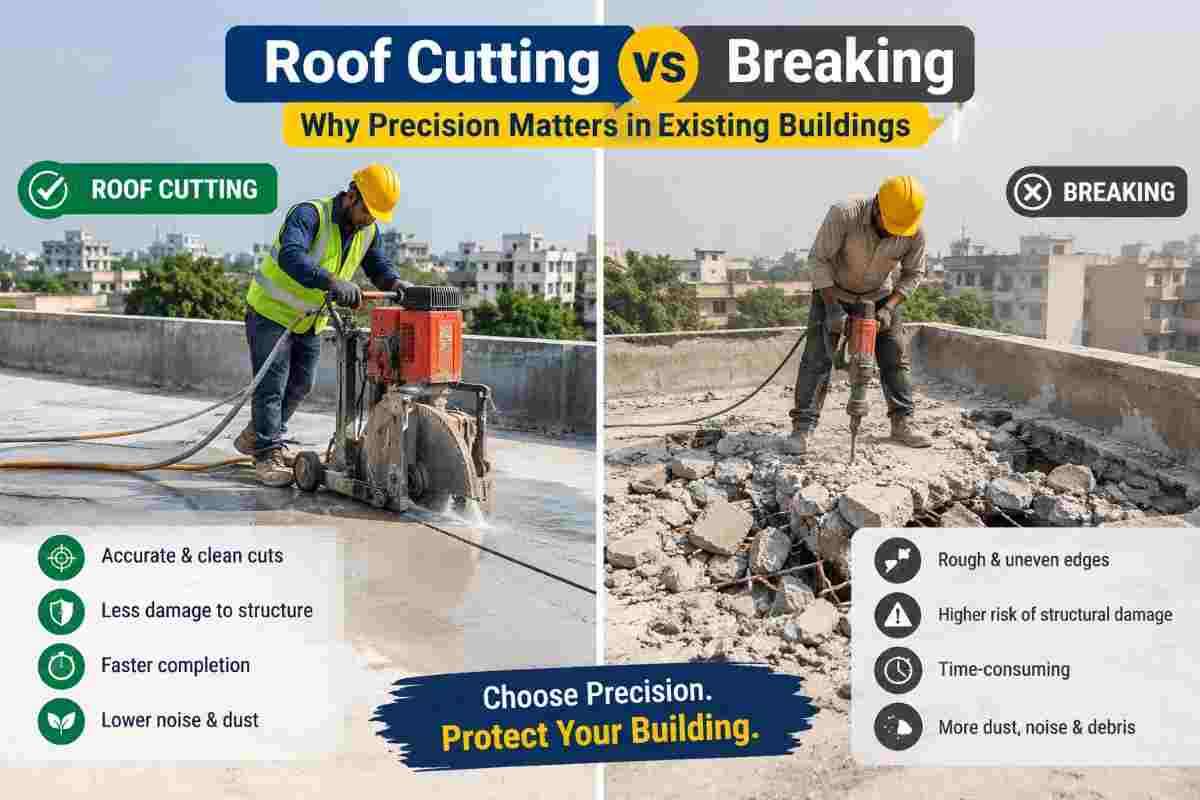
Every building eventually needs change. A staircase has to be added, a lift shaft opened, a skylight installed, or a duct, pipe or cable run pushed through a slab that was poured years ago. In each case someone has to open the roof or slab of a building that is already standing, already occupied and already carrying load.
There are two ways to do it. The traditional way is to break the concrete with hammers and jackhammers. The modern way is to cut it with diamond tools. On paper both end with a hole in the roof. In practice they lead to very different outcomes for your structure, your budget, your neighbours and your timeline.
At Core Cutting India, we see the consequences of this choice on almost every project. This guide explains how the two methods differ, why precision matters so much in existing buildings, and how to decide which approach your project needs.
What Is Roof Cutting?
Roof cutting, also called roof slab cutting or RCC slab cutting, is the process of removing a defined section of a concrete roof or floor slab using diamond-tipped cutting equipment. The cut follows exact dimensions marked in advance, so the opening ends up with clean, straight edges.
The main tools are:
- Slab saws (floor saws): Machines with large diamond blades that make straight cuts across horizontal surfaces.
- Wall saws (track saws): Track-mounted saws that make deep, precise cuts in walls, parapets and thick slabs.
- Wire saws: Diamond wire loops used for very thick, heavily reinforced or awkwardly shaped sections.
- Core drills: Hollow diamond bits that drill clean round holes for pipes, ducts and anchor points.
- Hand saws and ring saws: Compact tools for tight corners and close-to-wall cuts that large machines cannot reach.
Diamond tools grind through concrete and steel reinforcement with very little vibration, so the work is controlled from start to finish. The section being removed is usually cut into manageable blocks and lifted out cleanly, leaving the surrounding structure untouched.
What Is Roof Breaking?
Roof breaking is the conventional demolition approach. Workers use pneumatic breakers, electric jackhammers or hydraulic hammers to smash the concrete into rubble, then cut or bend the exposed reinforcement bars by hand.
It is fast to set up, needs less specialised equipment, and often looks cheaper on a quotation. For a building that is being fully demolished, it can be a perfectly reasonable method. For an existing building that will keep standing, it brings serious risks.
The Real Problem: Impact Energy Travels
Hammering sends repeated shock waves through the concrete, and those waves do not stop at the line you drew on the slab. They travel through the slab into adjoining beams, columns and walls, and into the reinforcement itself.
The usual consequences are:
1. Micro-cracking beyond the work area. Impact fractures can extend well past the intended opening. These cracks are often invisible at first and appear weeks or months later as hairline fractures in plaster, tiles or ceilings.
2. Damage to the bond between steel and concrete. A reinforced slab works because the concrete grips the steel bars. Vibration can loosen that grip, especially in older buildings where concrete is already ageing. A weaker bond means reduced load-carrying capacity around the opening.
3. Spalling and ragged edges. Broken edges are uneven and chipped, with exposed and damaged bars. Contractors then have to patch and reshape the edge before anything can be installed.
4. Over-breaking. Hammering is hard to control. Workers frequently remove more material than planned, which means more repair work and sometimes structural reassessment.
5. Stress on the rest of the building. Vibration can unsettle plaster, loosen fixtures, crack glass and disturb sensitive equipment on lower floors.
In a new building under demolition, none of this matters. In an existing building that people use every day, all of it does.
Why Precision Matters in Existing Buildings
An existing building is a system. Each slab, beam and column carries load and passes it to the next element. When you open a roof or slab, you change how that load travels. Precision is what keeps the change safe.
Structural Safety
A precisely cut opening has clean edges and a known size. Structural engineers can calculate exactly how the load redistributes around it, then design framing, lintels or trimmer beams to match. With a broken opening, the actual shape and the extent of hidden damage are both uncertain, and engineers have to guess or over-design.
Cutting also leaves the surrounding concrete and reinforcement intact. The slab outside the opening keeps all of its original strength, which is exactly what the structural design assumes.
Protecting the Occupied Space
Many roof and slab projects take place while the building is in use: a hospital, an office, a school, a factory floor, or a family living below. Cutting produces far less vibration and impact noise than breaking, which makes it possible to work around people rather than evacuating them. Where noise or dust is a concern, wet cutting with controlled slurry collection keeps the work area clean.
Accuracy for Fit-Out
Lift shafts, staircases, skylights, HVAC ducts and service risers all need openings of exact dimensions. A cut opening lets the next trade fit frames and equipment on the first attempt. A broken opening usually needs rework, chasing and filling before anything fits.
Cleaner Edges, Less Repair
Cut edges are smooth and straight. There is little or no patching, plastering or re-profiling afterwards. That saves labour, materials and days of schedule, and it is one reason cutting often costs less overall than breaking even when the initial quote is higher.
Cutting vs Breaking: A Direct Comparison
| Factor | Roof Cutting | Roof Breaking |
|---|---|---|
| Accuracy | Exact dimensions, straight edges | Rough, uneven edges |
| Vibration | Very low | High |
| Risk of micro-cracking | Minimal | Significant |
| Effect on reinforcement | Clean cut, bond preserved | Bond may loosen |
| Noise | Moderate, steady | Loud, intermittent impact noise |
| Dust | Controlled with wet cutting | Heavy and widespread |
| Safe in occupied buildings | Yes | Generally not advisable |
| Post-work repair | Minimal | Often extensive |
| Debris handling | Removed in solid blocks | Loose rubble |
| Best suited for | Existing buildings, precise openings | Full demolition |
Common Situations Where Cutting Is the Right Choice
Lift and elevator shafts. Retrofitting a lift into an existing building requires accurate openings through multiple floors. Errors compound as you go up.
New staircases. Opening a slab for a staircase demands clean edges that line up with the structural design.
Skylights and roof openings. Cutting preserves the waterproofing layers and the surrounding slab, which reduces leakage risk afterwards.
Duct, pipe and cable penetrations. Core drilling gives round, accurate holes in exactly the right location, with no damage to nearby reinforcement when paired with scanning.
Slab removal for renovation. Converting a double-height space or removing part of a floor is far safer when sections are cut and lifted out rather than smashed.
Parapet and wall modifications. Wall saws make straight, deep cuts for new door and window openings without shaking the structure.
Heritage and sensitive structures. Where vibration could damage old masonry or delicate finishes, cutting is often the only responsible option.
How a Professional Roof Cutting Job Works
A well-run cutting project is methodical. Here is the typical sequence.
1. Site assessment. The team inspects the slab, checks thickness and access, and notes what lies above and below, including occupancy, equipment and services.
2. Scanning for reinforcement and services. Before any cutting begins, the slab is scanned to locate steel bars, post-tension tendons, conduits and pipes. Cutting through an unmarked tendon or live conduit is dangerous, so this step is essential.
3. Marking and structural confirmation. The opening is marked precisely, and where required, confirmed against the structural engineer’s design.
4. Propping and safety measures. Where needed, temporary supports are installed so the slab remains stable during and after the cut.
5. Cutting. The right tool is chosen for the thickness, location and reinforcement: slab saw, wall saw, wire saw or core drill. Water is used for cooling and dust suppression.
6. Sectioning and removal. The cut portion is divided into blocks that can be safely lifted, lowered or moved out using appropriate handling methods.
7. Cleanup and handover. Slurry is collected, the area is cleaned, and the opening is handed over ready for framing or finishing.
Addressing the Common Concerns
Does roof cutting weaken the structure?
Not when it is planned properly. Cutting removes only the intended section and leaves the rest undisturbed. The structural impact comes from the opening itself, which engineers account for with additional framing or reinforcement. Breaking, by contrast, can cause weakening you cannot see.
Is cutting more expensive than breaking?
Per square metre of opening, cutting may cost more upfront. But once you add repair, patching, re-plastering, rework, dust cleanup and the risk of structural remediation, breaking is frequently the more expensive route in an existing building. Cost depends on slab thickness, reinforcement density, access and the area to be cut.
Is it noisy or dusty?
Diamond cutting is steadier and quieter than hammering, and wet cutting keeps dust low. It is far better suited to occupied buildings than breaking.
Can any concrete roof be cut?
Almost all RCC and plain concrete slabs can be cut, including thick, heavily reinforced and post-tensioned ones. Post-tensioned slabs need extra care and specialist planning because tendons are under tension.
How thick a slab can you cut?
With wall saws and wire saws, very thick sections are cut routinely. The right tool depends on the slab, so a site visit gives a firm answer.
How long does it take?
Typically less time than people expect, because there is little cleanup and rework. Most residential and commercial openings can be completed in hours or days rather than weeks, depending on size and complexity.
Safety and Compliance Considerations
Whichever method you choose, a few principles apply.
- Get structural input. Any opening in a load-bearing slab or roof should be reviewed by a qualified structural engineer.
- Scan before you cut. Never assume where reinforcement or services are, even if drawings exist. Older buildings often differ from their drawings.
- Support the structure. Temporary props prevent unplanned movement.
- Control water and slurry. Proper collection prevents damage to the floors below and keeps the site clean.
- Use trained operators. Cutting equipment is powerful. Experience matters for blade selection, cutting sequence and safe lifting.
- Plan debris removal. Heavy blocks need proper rigging and access routes.
A reputable concrete cutting contractor will walk you through all of these before starting.
When Is Breaking Still Acceptable?
Breaking has its place. It can be appropriate when:
- The entire structure is being demolished
- The slab is isolated and vibration will not affect anything of value
- The opening is irregular, rough edges do not matter, and no one is nearby
Even then, many contractors now combine the two methods, cutting the perimeter first to protect the surrounding structure and then breaking out the centre. This hybrid approach keeps most of the speed of breaking while preventing damage to the part of the building that stays.
How to Choose the Right Contractor
For something as consequential as opening an existing roof, the contractor matters as much as the method. Look for:
- Specialised equipment such as slab saws, wall saws, wire saws and core drills in a range of sizes
- Experience with similar projects in your building type
- Scanning capability to detect reinforcement and services before cutting
- Clear communication about method, timeline, safety and cleanup
- A site visit before quoting, since remote quotes rarely account for real conditions
- Trained, supervised crews who follow safety procedures
At Core Cutting India, precision cutting is what we do. Whether you need a single opening for a staircase or multiple penetrations across a commercial building, our approach is to protect the structure first and deliver clean, accurate results.
The Bottom Line
Breaking a roof opens a hole. Cutting a roof opens exactly the hole you designed, while keeping the rest of the building as strong, stable and intact as before.
In an existing building, that difference decides whether your project finishes on time and on budget, or turns into a cycle of cracks, repairs and structural second-guessing. Precision protects the structure, the people inside it, and your investment in the work.
If you are planning a roof, slab or wall opening and want an honest assessment of the right method, talk to a specialist before the first tool touches the concrete.
Planning a roof or slab opening? Visit Core Cutting India to discuss your project and get expert advice on the safest, most accurate way to proceed.
FAQs: People Also Ask
What is roof cutting?
Roof cutting is the controlled removal of a section of concrete roof or slab using diamond cutting tools such as slab saws, wall saws, wire saws and core drills, producing clean, accurate openings.
Is cutting concrete better than breaking it?
For existing buildings, yes in most cases. Cutting produces less vibration, cleaner edges, less dust and far less risk of hidden structural damage.
Can you cut an opening in an RCC roof?
Yes. RCC slabs can be cut safely with the right equipment, provided reinforcement is scanned and a structural engineer confirms the design.
Does cutting a hole in a slab weaken it?
Any opening changes how a slab carries load, but a precisely cut opening with proper structural support maintains safety. Uncontrolled breaking can cause additional hidden damage.
How much does roof slab cutting cost?
Cost depends on slab thickness, reinforcement, access, opening size and method. A site visit gives the most accurate quote.
Is concrete cutting noisy or messy?
Diamond cutting is quieter and cleaner than breaking, especially with wet cutting and slurry collection.