
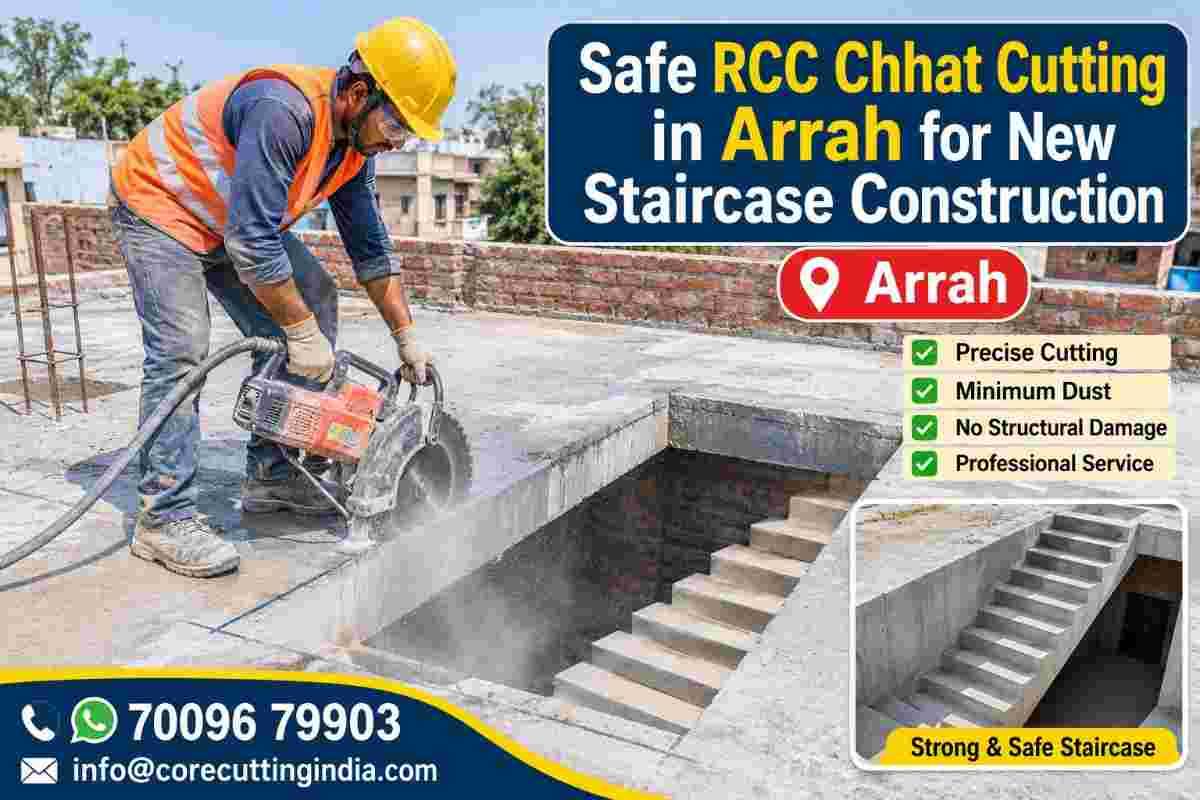
Every growing family in Arrah eventually hits the same problem: the house needs more usable space, but the plot has no room to spread out. The natural answer is to build upward, adding a first floor, a terrace room, or a rental unit. To reach these upper areas, you need a staircase, and if the existing roof was built without a stair opening, you must cut through the RCC chhat (reinforced cement concrete slab).
This is one of the most delicate jobs in renovation. Done carelessly, it can crack the slab, weaken beams, damage the plaster below and put workers at risk. Done properly, it leaves a clean, accurate opening with the structure intact. This guide explains how safe RCC chhat cutting works, what to plan before you begin, and how Core Cutting India helps homeowners, builders and contractors in Arrah get it right.
Why Cutting an RCC Roof Needs Expert Handling
An RCC slab is not a block of plain concrete. It is a carefully engineered system of concrete and steel reinforcement bars that work together to carry loads. The slab transfers its weight to beams, and the beams pass it to columns and then to the foundation. When you cut an opening, you interrupt that load path.
This is why the traditional method of breaking a slab with a hammer and chisel is risky. Heavy hammering sends vibrations through the whole structure. It can create micro-cracks in nearby concrete, loosen the bond between steel and concrete, and damage rooms below. Rough breaking also leaves ragged edges that need a lot of repair work before you can build the staircase.
Modern concrete cutting solves these problems. Using diamond-tipped tools, the slab is cut in a controlled way, along exact lines, with very little vibration. The result is a neat opening with straight edges, ready for finishing.
Common Reasons for Cutting a Chhat in Arrah
Homeowners in Arrah and nearby areas usually need slab cutting for several reasons:
- New internal staircase: Connecting the ground floor to a new first floor without climbing outside.
- External-to-internal conversion: Replacing an outside stair with one that opens inside the house.
- Terrace access: Giving direct access to the roof for a water tank, solar panels or a terrace garden.
- Commercial buildings: Adding a staircase in a shop, clinic, school or warehouse that is expanding vertically.
- Lift shaft or duct openings: Creating space for lifts, pipes, wiring or ventilation.
Whatever the purpose, the principle is the same: the cut must be planned, measured and executed in a way that protects the building.
Step 1: Get Structural Advice Before Any Cutting
The most important step happens before any machine is switched on. Never decide the position of a staircase opening based only on convenience. Ask a qualified structural engineer or experienced civil contractor to check:
- Slab type and thickness. Is it a one-way or two-way slab? How thick is it, and how is it reinforced?
- Beam and column layout. Cutting close to a beam can reduce its capacity. The opening should generally keep a safe distance from major structural members.
- Load paths. The engineer will confirm how loads will redistribute once the opening exists.
- Need for additional support. Large openings may require new edge beams or reinforcement around the cut to restore strength.
- Age and condition of the building. Older houses may have corroded steel or weaker concrete, which changes the approach.
A drawing showing the exact opening size and location should be ready before work begins. A typical straight staircase opening needs adequate width and enough length for headroom and the run of the steps, so careful measurement matters.
Step 2: Choose the Right Cutting Method
Different jobs call for different tools. A professional service will pick the method based on slab thickness, access, location and noise or dust limits.
Wall Saw Cutting
A wall saw is a track-mounted machine with a large diamond blade. It is fixed to the slab and moves along a guide rail, cutting straight, precise lines. It is well suited to cutting thick RCC slabs and creating clean, square openings for staircases. Because the cut follows the rail, the edges are accurate and need minimal finishing.
Hand-Held and Ring Saw Cutting
Where space is tight or corners need finishing, hand-held diamond saws and ring saws are used. They are useful for cutting into corners that a larger blade cannot reach and for smaller or irregular openings.
Wire Saw Cutting
For very thick slabs, heavy structures or awkward locations, a diamond wire saw is used. A wire studded with diamond beads loops around the section and cuts through concrete and steel together. It is flexible and can handle jobs other tools cannot.
Core Drilling at the Corners
Many professionals first drill core holes at the corners of the planned opening. These holes relieve stress at the corners, prevent over-cutting and give the saw blade a clean point to stop. This is why core drilling is central to the work of Core Cutting India: a neat corner prevents cracks from running into the surrounding slab.
Why Not Just Use a Breaker?
Breakers and jackhammers still appear on some sites because they seem cheap and quick. However, they create heavy vibration, noise and dust, and they can damage the rest of the slab. For a new staircase, where precision and structural safety matter, diamond cutting is the better choice.
Step 3: Marking and Preparation
Good preparation is what separates a clean job from a messy one.
- Marking the opening. The exact outline is drawn on the slab surface according to the approved drawing, and again checked from below.
- Locating services. Electrical conduits, water pipes and cables inside or below the slab are identified so they are not cut by accident.
- Protecting the room below. Furniture, flooring and fittings are covered or moved. Water used in cutting can drip, so waterproof sheets are laid.
- Clearing the work area. Nobody should stand under the section being cut, and the zone around the opening must be restricted.
- Planning removal. Large cut slab pieces are heavy. Planning how to lift or lower them with a hoist, chain block or crane prevents accidents and damage.
Step 4: The Cutting Process
Once the machines are set up, the process generally follows this order:
- Core drill the corners to relieve stress and mark the end points.
- Mount the wall saw or position the cutter along the marked lines.
- Cut using water cooling. Water keeps the diamond blade cool, extends its life and suppresses dust.
- Support the slab piece before it is fully cut so it cannot fall suddenly. Sections may be cut into smaller blocks for safe removal.
- Lift out and lower the pieces carefully using proper lifting equipment.
- Cut or trim the reinforcement steel at the edges as planned by the engineer.
- Clean and inspect the opening for straight edges and accurate dimensions.
Because the cutting is smooth and controlled, there is little chance of cracking beyond the marked lines.
Safety Precautions That Should Never Be Skipped
Safety is not optional when you are opening up a structural slab. A responsible team will follow these practices:
- Propping and shoring. Temporary supports may be placed under the slab around the opening, especially for larger cuts, so loads are carried safely while the work is in progress.
- Personal protective equipment. Helmets, goggles, ear protection, gloves, masks and safety shoes for all operators.
- Skilled operators. Trained technicians who understand the machines and the structure.
- Safe electrical connections. Water and electricity are a dangerous mix on a cutting site, so proper earthing and waterproof connections matter.
- Controlled access. Keeping children, family members and unauthorised workers away from the area.
- Weather awareness. Cutting on a terrace during heavy rain or wind increases risk, so the schedule should be flexible.
Step 5: Strengthening and Finishing After the Cut
Cutting the opening is only part of the job. Afterwards, the structure around it must be made ready for the staircase.
- Edge beam or lintel. Many openings need a reinforced edge beam so the slab around the hole stays strong.
- Exposed steel treatment. Cut reinforcement should be treated with anti-corrosion coating and covered properly so it does not rust.
- Staircase connection. The new stair is tied to the slab and floor below according to the structural design.
- Repair and plaster. The edges are finished with plaster or concrete repair material, and any damage below is repaired.
- Waterproofing. If the opening reaches the terrace, a proper headroom or staircase cover and waterproofing prevent leakage during the monsoon.
Benefits of Professional Core Cutting for Your Staircase
Choosing a specialist service instead of manual breaking gives you several advantages:
- Accuracy. Straight, clean edges that match your drawing.
- Structural safety. Minimal vibration and less risk of cracks in beams, columns and walls.
- Less noise and dust. Water-cooled cutting is much quieter and cleaner than hammering, which is kinder to your family and neighbours.
- Faster completion. Machine cutting is usually quicker, and the staircase work can begin sooner.
- Lower repair cost. Clean edges mean less patching, plastering and rework.
- Peace of mind. Trained operators handle the risky part of the job.
Things to Consider Before Hiring a Slab Cutting Service
Before you book anyone for RCC chhat cutting in Arrah, ask the following:
- What equipment will you use? Look for diamond wall saws, core drills and wire saws, not only breakers.
- Do you have experience with staircase openings? Past work in similar buildings is a good sign.
- How will you protect the structure and the rooms below?
- Is the price clearly quoted? Cutting is commonly priced by area, depth or running length, depending on the job. Ask for a written estimate that mentions what is included.
- Do you carry out the work with trained operators and safety gear?
- Can you start on a convenient date and finish on time?
The final cost depends on slab thickness, amount of steel, size of the opening, accessibility and the method chosen, so a site visit is the most reliable way to get an accurate quote.
Why Choose Core Cutting India for Arrah
Core Cutting India provides concrete cutting, core drilling and slab opening services built around precision and safety. For homeowners and builders in Arrah who need a new staircase, our approach is simple:
- We study your plan and the structure before cutting.
- We use modern diamond cutting equipment suited to the job.
- We protect your property and keep dust and noise low.
- We deliver clean, accurate openings that are ready for staircase construction.
- We communicate openly about methods, timelines and costs.
Whether you are adding a floor to a family home or extending a commercial building, we aim to make the cutting stage smooth and stress-free.
Frequently Asked Questions
Is it safe to cut an RCC slab for a staircase?
Yes, when the opening is planned by a structural professional and cut with proper equipment and supports. Unplanned or careless cutting is what creates danger.
How long does RCC chhat cutting take?
A standard staircase opening can often be completed within a day, depending on slab thickness, reinforcement, size and access. Larger or more complex jobs take longer.
Will cutting the slab cause cracks in my house?
Diamond cutting produces far less vibration than hammering, so the risk is much lower. Careful corner drilling and correct support further reduce cracking.
Can a slab be cut without damaging the rooms below?
Yes. With protection, water control and controlled removal of the cut piece, damage to the floor below can be kept to a minimum.
How do I decide where to place the staircase opening?
Consider the room layout, headroom, beam positions and the direction of the slab. A structural engineer should confirm the location.
Do I need extra reinforcement around the opening?
Often yes. Depending on its size and position, an edge beam or additional steel may be needed to restore strength.
Is wall saw cutting better than breaking with a hammer?
For structural slabs, yes. Wall saw cutting is more accurate, quieter and safer for the surrounding structure.
Final Thoughts
A new staircase can transform a house in Arrah, giving you extra living space, rental income or easy terrace access. But the success of that project depends on how carefully the first cut is made. Planning with a structural expert, choosing diamond cutting over rough breaking, following safety steps and finishing the opening correctly will protect your building for years to come.
If you are planning a staircase and need safe, precise RCC chhat cutting in Arrah, contact Core Cutting India today.
📞 Call: +91 70096 79903
🌐 Website: https://corecuttingindia.com/
Share your slab details, and our team will guide you on the best method and give you a clear estimate.