
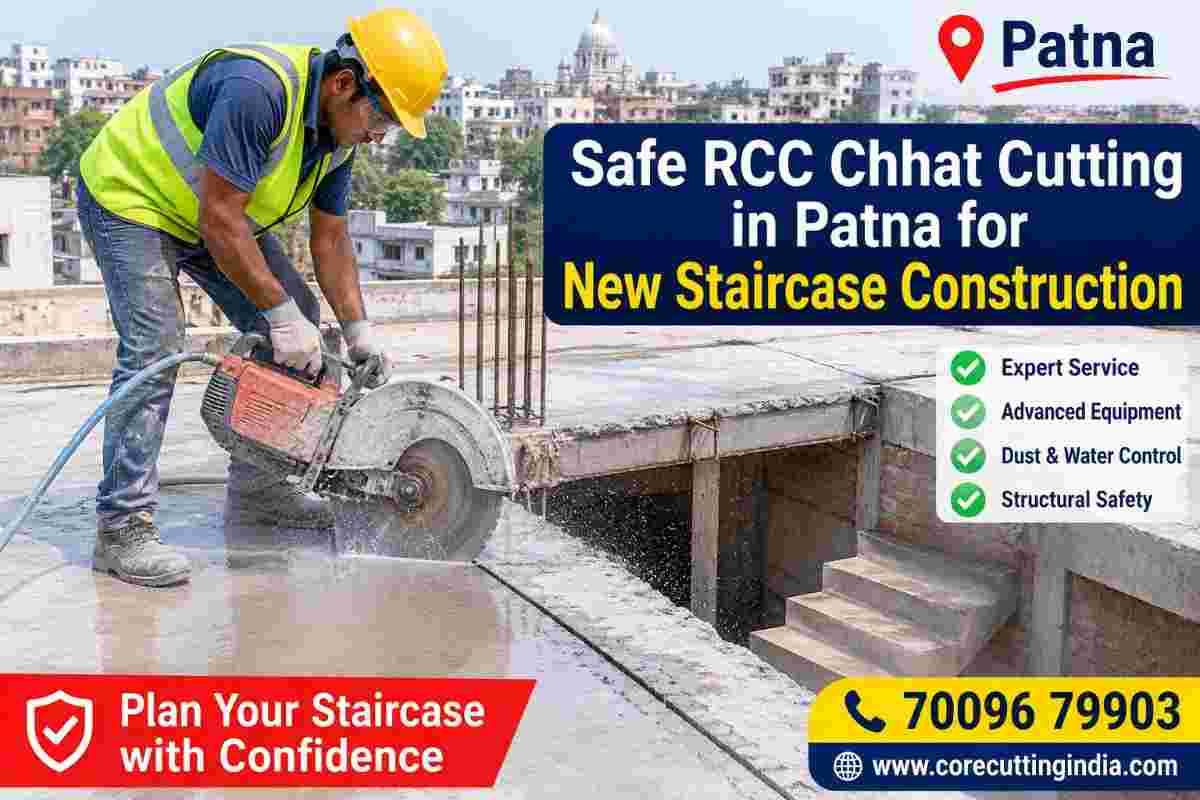
Many homeowners in Patna realise they need a new staircase only after the house is built. Maybe you want to add a floor for a growing family, open the terrace for a rental unit, or connect the ground floor to a new first-floor portion. The obstacle is almost always the same: a solid RCC (Reinforced Cement Concrete) chhat, or slab, sits exactly where the staircase needs to go.
Breaking that slab with a hammer and chisel is the old way of doing it. It is noisy, messy and risky. It can crack beams, shake the whole building and damage parts of the slab you wanted to keep. Modern RCC chhat cutting is a precision job, done with diamond-tipped equipment that removes exactly the section you marked and leaves the rest of the structure undisturbed.
This guide explains how safe RCC chhat cutting works for new staircase construction in Patna: the methods, the process, the safety checks, the cost factors and the mistakes to avoid. It comes from Core Cutting India, which provides professional concrete cutting services across the region.
Why Do You Need to Cut the RCC Chhat for a Staircase?
A staircase needs a clear opening, called a stairwell or staircase void, through every floor it passes. If your building was designed without one, or if you are adding a staircase later, a portion of the slab must be removed.
Common situations in Patna homes include:
- Adding a new floor: You want an internal staircase from the first floor to a new second floor, or from the second floor to the terrace.
- Converting an external staircase to an internal one: This is common in older houses where access was originally from outside.
- Creating a separate entry for tenants: Many owners in Patna build rental portions and need independent access.
- Commercial renovation: Shops, clinics and offices often need a staircase between floors after the building is already finished.
- Layout correction: The original staircase is too narrow, badly placed or unsafe, and needs to be relocated.
In every one of these cases, the quality of the cut decides how well the staircase fits, how strong the surrounding slab stays, and how much finishing work you will need afterwards.
Is It Safe to Cut an RCC Slab?
Yes, when it is planned properly and done by trained professionals. RCC cutting is a very common practice in construction and renovation. The risk comes from doing it carelessly, not from the act of cutting itself.
An RCC slab is not just concrete. It has steel reinforcement bars (rebar) arranged to carry loads, and it works together with beams and columns. When you remove part of a slab, you change how loads travel through the structure. That is why the question of safety has two parts:
- Structural safety: Will the building remain stable after the opening is made?
- Working safety: Will the cutting itself happen without accidents, damage or injuries?
Both parts need attention before any blade touches the concrete.
Structural Considerations
Before cutting, the following should be checked:
- Slab type: Is it a one-way or two-way slab? This affects which direction the main reinforcement runs and how loads are shared.
- Position of beams and columns: Cutting too close to a beam or column can weaken it. The opening should sit within the slab panel and respect the structural layout.
- Size of the opening: A staircase void is typically a large rectangular opening. The bigger the opening, the more carefully the surrounding slab must be assessed.
- Reinforcement layout: Cutting through main bars changes load paths. Sometimes additional support, such as trimmer beams or edge strengthening, is required around the opening.
- Age and condition of the building: Older buildings in Patna may have lower-grade concrete or corroded steel, which needs inspection first.
We strongly recommend that a qualified structural engineer reviews the plan and approves the opening dimensions before work begins. A good cutting contractor will ask for this approval, not skip it.
Methods of RCC Chhat Cutting Used for Staircase Openings
Several techniques are used to cut concrete slabs. The right one depends on slab thickness, access, noise limits, and the size and shape of the opening.
1. Slab Saw (Floor Saw) Cutting
A floor saw is a machine with a large diamond blade that runs along the slab surface. It makes straight, clean cuts and works well for slabs of moderate thickness. It is fast and accurate for rectangular openings, though the blade depth limits what it can cut in a single pass and the corners often need to be finished another way.
2. Wall Saw Cutting
A wall saw is mounted on a rail and driven by a powerful motor. Despite the name, it can be set up to cut slabs as well as walls. It handles thick concrete and gives very straight edges, which makes it popular for larger openings.
3. Wire Saw Cutting
A diamond wire saw uses a flexible wire loop with diamond beads. It is excellent for thick or heavily reinforced slabs and for locations where large blades cannot be set up. It can cut with very little vibration, which suits delicate or older structures.
4. Core Drilling for Corners
Core drilling makes round holes using a hollow diamond bit. For staircase openings, cores are often drilled at the four corners first. This prevents over-cutting, relieves stress and gives clean, rounded corners that can then be joined with straight saw cuts.
5. Hand Saw Cutting
For tight spaces, a handheld diamond saw can be used on thinner slabs or for finishing details.
Whichever method is chosen, the common advantage is the same. Diamond cutting is controlled, low-vibration and precise, unlike breaker or chisel work, which sends shock through the whole structure.
Step-by-Step Process of Safe RCC Chhat Cutting
A professional job follows a clear sequence. Here is what you should expect.
Step 1: Site Inspection and Assessment
The team visits the site, checks slab thickness, notes access routes, locates water lines, electrical conduits and any hidden services, and discusses your staircase plan. Scanning for embedded pipes and cables avoids dangerous surprises.
Step 2: Structural Approval
The opening dimensions are confirmed against the structural drawings or an engineer’s advice. Any required strengthening is planned before cutting starts.
Step 3: Marking the Cut Lines
The exact outline of the staircase opening is marked on the slab with paint or chalk. Measurements are double-checked, because a cut cannot be undone.
Step 4: Setting Up Safety and Dust Control
The area below is cleared and barricaded. Floors, furniture and fittings are protected. Water-cooled cutting is used to control dust, since the water keeps the blade cool and suppresses harmful silica dust.
Step 5: Core Drilling at Corners
Holes are drilled at the corners of the marked rectangle to give clean cut points and avoid cracks.
Step 6: Cutting Along the Lines
The slab is cut along the marked lines using the chosen saw. The cuts are made carefully through concrete and reinforcement.
Step 7: Controlled Removal of the Slab Piece
This is the most safety-critical stage. A cut slab section can weigh hundreds of kilograms or more. It must be secured, supported and lifted or sectioned in a controlled way. Large openings are usually cut into smaller blocks that are lowered or moved out safely, instead of letting the whole piece fall.
Step 8: Clean-Up and Finishing
Slurry and debris are removed, edges are inspected, and the opening is handed over for staircase construction, edge strengthening and finishing.
Key Safety Measures That Should Never Be Skipped
Safe chhat cutting depends on discipline. These are the precautions to look for:
- Clear the area below the cut. Nobody should stand or work underneath a slab section that is being cut or removed.
- Support the slab piece. Props, slings or lifting arrangements must hold the cut section before the final cut releases it.
- Use water cooling and dust control. This protects workers’ lungs and keeps your home cleaner.
- Wear proper protective gear. Helmets, goggles, gloves, ear protection, dust masks and safety shoes are basic requirements.
- Check for hidden utilities. Cutting through a live wire or water line is dangerous and expensive.
- Isolate electrical supply where needed. Power to the working area should be controlled while cutting is on.
- Avoid overloading the slab. Heavy machines and stacked debris should not sit on weak or partly cut sections.
- Follow the engineer’s instructions. Never cut beyond the approved dimensions.
Why Professional Cutting Beats Manual Breaking
Some contractors still suggest breaking the slab with hammers or jackhammers because it looks cheaper at first. Here is what usually follows:
| Factor | Manual Breaking | Professional Diamond Cutting |
|---|---|---|
| Accuracy | Rough, uneven edges | Straight, clean edges |
| Vibration | High, can crack beams and walls | Very low |
| Noise | Very loud | Much lower |
| Dust | Heavy and uncontrolled | Controlled with water |
| Risk to nearby structure | High | Minimal |
| Finishing work needed | A lot | Little |
| Time | Slow and tiring | Faster for the same opening |
The cheaper method often costs more in the end because of repairs to cracked plaster, damaged tiles and weakened edges.
Factors That Affect the Cost of RCC Chhat Cutting in Patna
Prices differ from job to job, so any contractor quoting a figure without seeing the site should be treated with caution. The main factors are:
- Slab thickness: Thicker slabs need more cutting depth and time.
- Opening size and number of cuts: More running length of cut means more effort.
- Reinforcement density: Heavily reinforced slabs wear blades faster.
- Access and floor level: Working on upper floors or in tight spaces needs extra equipment handling.
- Method used: Wire saw jobs differ from floor saw jobs in setup and cost.
- Debris removal: Moving and disposing of cut blocks adds to the work.
The best approach is to request a site visit and a written quote. At Core Cutting India, we assess the job first so the estimate reflects the actual work.
Common Mistakes to Avoid
- Cutting before getting structural advice. This is the biggest mistake and the hardest to fix.
- Choosing the lowest quote without checking the method. A very low price often means hammering, not cutting.
- Ignoring hidden pipes and cables. Always scan and mark them.
- Making the opening too large or badly placed. Plan the staircase dimensions, headroom and landing before cutting.
- Skipping edge strengthening. Some openings need extra support around the edges.
- Not protecting the area below. Dust, slurry and falling debris can damage furniture and flooring.
- Hiring untrained labour. Concrete cutting equipment demands skill and experience.
Planning Your Staircase Opening in Patna: Practical Tips
- Decide the staircase design first. Know the width, number of steps, landing position and headroom so the opening matches.
- Allow for headroom. Building codes expect adequate clear height above the stairs, so the opening length must support the stair rise and run.
- Think about the monsoon. If the cut is on a terrace or exposed slab, plan around rain and have waterproofing ready.
- Coordinate with your mason and engineer. The cutting, edge treatment and staircase construction should be sequenced so the opening is not left exposed for long.
- Keep the family safe. Keep children and pets away from the work zone and the open void afterwards, and install temporary railings until the staircase is complete.
Frequently Asked Questions (People Also Ask)
Can we cut an RCC slab for a staircase in an existing house?
Yes. It is commonly done, but it needs structural assessment and the right cutting method so the remaining slab stays safe.
Is RCC slab cutting safe for the building?
It is safe when planned with an engineer’s approval and done by trained professionals using diamond cutting equipment. Uncontrolled breaking is what creates risk.
How is an RCC slab cut without damaging the structure?
Diamond saws and core drills make precise, low-vibration cuts along marked lines, which protects the beams, columns and the rest of the slab.
How long does RCC chhat cutting take?
A typical staircase opening can often be completed within a day or two, depending on slab thickness, size, access and removal arrangements. A site visit gives a reliable estimate.
Do I need permission to cut a slab?
Rules vary by building and local authority, and apartments or society buildings may need approval from the association. Check your local requirements and get engineering advice before starting.
What is the difference between core cutting and slab cutting?
Core cutting drills round holes using a hollow diamond bit. Slab cutting makes straight cuts to remove larger sections. Staircase openings usually use both.
Will cutting create a lot of dust and noise?
Professional wet cutting keeps dust low, and diamond cutting is far quieter than hammering, though some noise is unavoidable.
What should I look for in a concrete cutting company in Patna?
Look for modern diamond equipment, trained operators, safety practices, willingness to inspect the site first, and clear written quotes.
Why Choose Core Cutting India for RCC Chhat Cutting in Patna?
At Core Cutting India, our focus is precise, safe and clean concrete cutting. We use diamond-based cutting methods so your staircase opening is accurate, with minimal vibration and minimal mess. Our team inspects the site, discusses your plan, follows safe working practices and works to finish the job efficiently so your construction can move ahead without delays.
Whether you are building a new internal staircase in a residential home, adding access to a commercial floor, or modifying an older structure, we can handle the cutting part carefully so the rest of your project goes smoothly.
Conclusion
A new staircase can transform how you use your building, giving you more space, better access and added value. But it starts with a single critical step: opening the RCC chhat correctly. Doing it with hammers and guesswork invites cracks, delays and safety hazards. Doing it with proper planning, structural approval and precision diamond cutting protects your property and your family.
If you are planning a staircase opening in Patna, get the cutting done by professionals who treat safety as the first priority.
Call Core Cutting India today at +91 70096 79903 or visit https://corecuttingindia.com/ to book a site inspection and get a clear, no-surprise quote.