
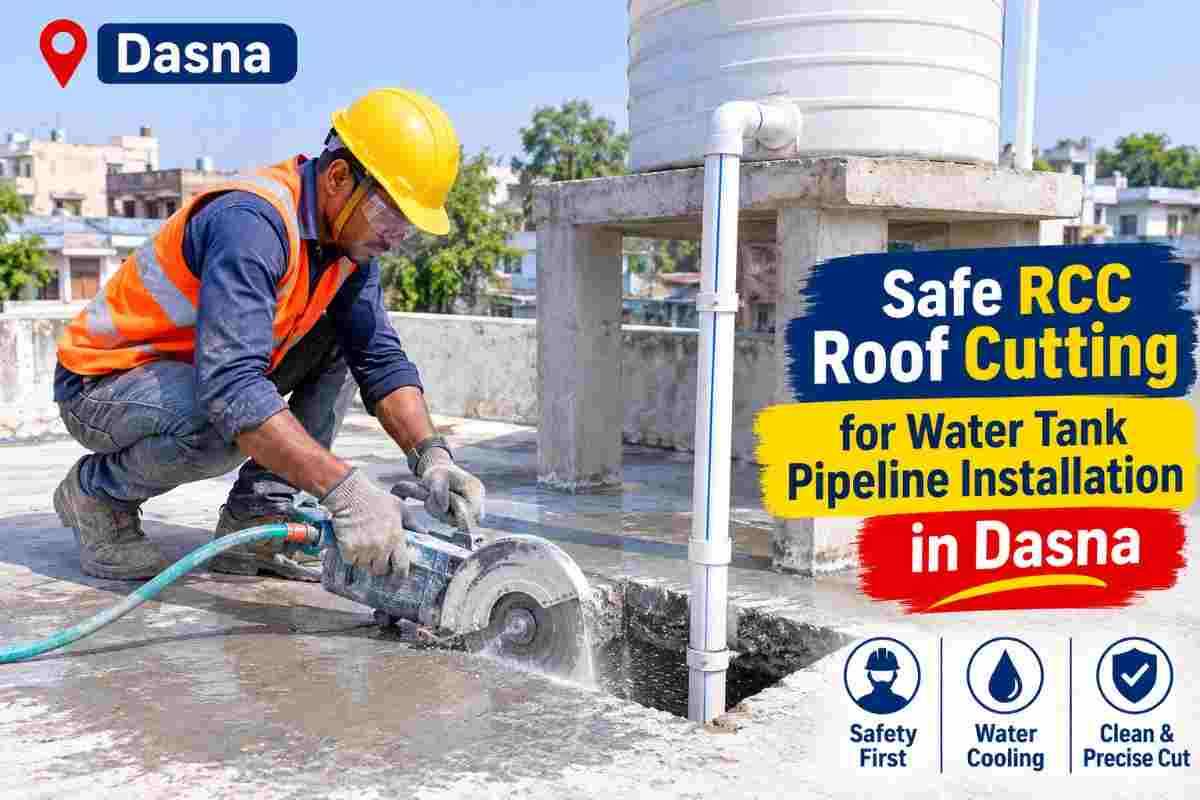
If you own or manage a building in Dasna, you probably know how important a reliable water supply is. Whether it is a new house, a school, a factory, a warehouse or a residential society, there usually comes a point when the water tank on the terrace needs a new pipeline, and that pipeline has to pass through a reinforced cement concrete (RCC) roof.
This is where many property owners make a costly mistake. They call a local mason, who attacks the slab with a hammer and chisel or a heavy breaker. The result is often cracked concrete, damaged reinforcement, leaking joints and, in the worst cases, a weakened structure.
There is a far better way. Professional RCC roof cutting using diamond core drilling lets you create clean, precise openings for water pipelines without damaging the structure. In this guide, we explain how the process works, why safety matters, what to check before work begins, and how to choose the right service provider in Dasna.
Why Water Tank Pipelines Need Openings in the RCC Roof
Overhead water tanks are installed on rooftops so that gravity can supply water to every floor. To make this system work, you need:
- An inlet pipe carrying water from the borewell, pump or municipal line up to the tank
- An outlet pipe carrying water down to bathrooms, kitchens and taps
- An overflow line to prevent flooding when the tank is full
- A drain or washout line for cleaning the tank
- Sometimes electrical conduits for float switches or motor controls
Each of these lines may need to cross the terrace slab. If your building was constructed without planned sleeves or openings, or if you are adding a new tank, upgrading pipe sizes or changing the plumbing layout, the slab has to be cut.
The Problem With Traditional Hammer-and-Chisel Methods
Breaking RCC manually or with a jackhammer might look cheaper at first, but the hidden costs are high:
- Micro-cracks spread beyond the hole. Vibration travels through the slab and creates hairline cracks that let water seep in during the monsoon.
- Rebar gets damaged. Steel reinforcement carries the tensile load in a slab. Cutting or bending it carelessly weakens the roof.
- Edges are rough and uneven. This makes it difficult to seal around the pipe properly.
- Noise and dust are excessive. This disturbs neighbours and building occupants.
- Debris falls into the room below. This can damage furniture, ceilings and, more seriously, injure people.
- Repairs take longer. You often need extra patchwork, plastering and waterproofing afterward.
In a place like Dasna, where residential and industrial properties often sit close together, these problems quickly turn into disputes and extra expenses.
What Is RCC Core Cutting?
RCC core cutting, also called concrete core drilling, uses a hollow cylindrical drill bit with diamond segments on its cutting edge. The bit is mounted on a rig and rotated at controlled speed while water is supplied to cool it and flush out slurry.
Instead of smashing the concrete, the diamond bit grinds through it, leaving a smooth, perfectly round hole. A solid concrete “core” comes out in one piece.
Key advantages for water tank pipeline work:
- Precision: The hole is exactly the size you need, such as 50 mm, 75 mm, 100 mm, 150 mm or larger.
- Minimal vibration: The slab stays structurally sound.
- Clean finish: The smooth walls make sleeving and sealing straightforward.
- Low dust: Wet drilling keeps airborne dust under control.
- Speed: A single hole can often be completed in minutes rather than hours.
- Rebar can be cut cleanly: Diamond bits cut through steel as well as concrete when this is structurally acceptable.
For larger openings, such as a rectangular cutout for a pipe shaft or access hatch, contractors may use wall saws, wire saws or slab saws instead of core drills.
Step-by-Step: How Safe RCC Roof Cutting Is Done
A professional job follows a clear sequence. Here is what you should expect when you hire a qualified team.
1. Site Inspection and Planning
The team visits the property, checks the slab thickness, accessibility, the location of the tank, and the route the pipeline will take. They also ask about the building’s age, structural drawings, and whether the slab is a standard flat slab, a beam-supported slab or a ribbed slab.
2. Scanning for Rebar, Conduits and Hidden Utilities
Before any cut is made, the position of reinforcement bars, embedded electrical conduits and any hidden pipes should be identified. Techniques range from simple rebar locators to ground-penetrating radar (GPR) scanners on larger or more critical projects. This prevents accidental damage to important elements, and sometimes the hole position can be shifted a few centimetres to avoid a main bar.
3. Marking the Cut Location
Once the position is confirmed, the operator marks the exact centre and diameter. The location should keep a safe distance from beams, columns and slab edges wherever possible. Your structural engineer’s guidance matters here, especially if several holes are close together.
4. Securing the Equipment
The drilling rig is anchored to the slab using an expansion bolt or a vacuum base. A firm base is essential. A rig that shifts mid-cut can jam the bit and cause an uneven hole or even injury.
5. Arranging Water Supply and Slurry Control
Wet drilling needs a steady water flow. A good crew will contain the slurry using a slurry ring, wet vacuum or other collection method so that muddy water does not stain the terrace, run into the tank or flow into the rooms below.
6. Drilling the Hole
The operator starts slowly to create a guide groove, then increases to the proper speed and feeds the bit steadily. Applying too much pressure causes bit glazing and wasted time. When the bit nears the underside of the slab, the operator reduces pressure so the core does not break away abruptly.
7. Core Removal and Safe Handling
The cut core can be heavy. For thick slabs and larger diameters, it should be supported or lifted carefully so that it does not fall through. Someone should always check the area underneath to be sure nobody is standing there.
8. Cleaning, Inspection and Sleeve Installation
After the core is out, the hole is cleaned and inspected. A PVC, GI or HDPE sleeve may be inserted, and the pipe is then passed through it.
9. Sealing and Waterproofing
This step is just as important as the cut itself. The gap between the pipe or sleeve and the concrete should be filled with non-shrink grout or a suitable waterproof sealant. On a roof, you should also treat the surrounding area with a waterproofing compound, and many people add a small raised collar or puddle flange to stop rainwater from tracking down along the pipe.
Safety Considerations You Should Never Ignore
Roof cutting is not just a construction task. It is also a safety-critical operation. Keep these points in mind.
Structural Safety
- Never cut main reinforcement bars without structural approval.
- Avoid cutting too close to beams, columns and slab supports.
- If many holes are planned in a small area, ask an engineer to review the layout.
- For large openings, temporary propping beneath the slab may be required.
Worker and Occupant Safety
- Cordon off the area below the cut.
- Operators should wear helmets, safety shoes, gloves, eye protection and hearing protection.
- On rooftops without parapet walls, use fall protection or edge barriers.
- Keep electrical connections dry, use proper earthing and use an RCCB-protected supply because water and electricity are always a risky combination on a wet job site.
Environmental and Neighbour Considerations
- Control slurry runoff so it does not enter drains or neighbouring properties.
- Choose working hours that minimise disturbance.
- Remove debris and cores promptly.
A reliable contractor will explain these precautions to you before starting, not after something goes wrong.
Choosing the Right Core Size for Your Pipeline
The hole should be slightly larger than the outer diameter of the pipe or sleeve, leaving enough space for sealing material. As a general guide:
- Small supply lines (20 to 40 mm pipes): 50 to 75 mm cores
- Medium lines (50 to 75 mm pipes): 100 to 125 mm cores
- Large inlet or outlet lines (100 mm and above): 150 to 200 mm cores or more
If you are unsure, tell the cutting team your pipe material, outer diameter and whether you plan to use a sleeve. They can recommend the right bit size.
Common Mistakes to Avoid
- Starting plumbing work before the cutting is planned. Always finalise the pipe route first.
- Cutting without scanning. Hitting a live conduit or main bar is dangerous and expensive.
- Skipping waterproofing. A tiny gap around the pipe can cause seepage for years.
- Choosing the lowest quote blindly. Cheap work often means worn bits, poor supervision and no safety gear.
- Making holes too close together. This can weaken the slab.
- Ignoring building rules. In housing societies or industrial units, check whether permission is needed before altering the structure.
Why Dasna Properties Benefit From Professional Core Cutting
Dasna, in the Ghaziabad district of Uttar Pradesh, is developing quickly. The area lies along the Delhi–Meerut corridor, so it is seeing new housing, commercial buildings, warehouses and small manufacturing units. Old and new construction sit side by side, and both need plumbing updates.
Many older buildings in the region were built without planned pipe sleeves. Newer ones often get extra water lines, solar water heaters or additional tanks after the original construction. In each case, clean RCC cutting helps owners avoid structural trouble and monsoon leakage.
Because of heat, heavy rain and hard water in the region, a poorly sealed roof penetration deteriorates faster than most people expect. That is another reason to get the job done properly the first time.
Applications Beyond Water Tank Pipelines
The same technique can be used for:
- Drainage and rainwater pipe openings
- Electrical and cable conduit openings
- Solar panel mounting and cable entry points
- AC and ventilation duct openings
- Staircase and lift shaft cutouts
- Anchor bolt holes for structural fixings
- Sampling of concrete cores for strength testing
How Much Does RCC Roof Cutting Cost?
Pricing depends on several factors rather than one fixed rate:
- Hole diameter: Bigger cores need more time and a more expensive bit.
- Slab thickness: Deeper cuts take longer.
- Reinforcement density: More steel slows the cutting.
- Number of holes: Multiple holes in one visit often reduce the per-hole cost.
- Accessibility: Difficult roof access, no water supply or no power point can add to the effort.
- Type of equipment: Wall sawing or wire sawing for large openings costs more than simple core drilling.
The most reliable way to get an accurate figure is to request a site-specific quote. A responsible contractor will give you a clear estimate after understanding your requirements.
How to Pick a Trustworthy RCC Cutting Service in Dasna
Look for these signs of a dependable provider:
- Experience with roofs, slabs, walls and industrial floors
- Modern diamond equipment in good working condition
- Trained operators who understand structural safety
- Clear communication about the process, timing and cleanup
- Transparent quotations with no hidden charges
- Respect for your property, including dust and slurry control
- Prompt response when you call with questions
At Core Cutting India, our focus is on precise, low-vibration, low-dust cutting that protects your structure and your schedule. Whether you need one hole for a single pipeline or multiple openings for a larger plumbing upgrade, our team can plan and execute the work with care.
Frequently Asked Questions (People Also Ask)
Is it safe to drill a hole in an RCC roof slab?
Yes, when done correctly. Diamond core drilling is the safest method because it creates minimal vibration and a clean opening. Scanning for rebar beforehand and avoiding structural members keeps the slab sound.
How long does it take to core drill through an RCC slab?
For a typical 100 to 150 mm hole in a standard residential slab, the actual drilling often takes only a few minutes to under half an hour, depending on thickness and reinforcement. Setup and cleanup add some extra time.
Can you cut through rebar while core drilling?
Yes. Diamond bits can cut steel reinforcement. However, you should avoid cutting main bars unless a structural engineer has approved it.
How do you seal a pipe passing through a concrete roof?
Use a sleeve if needed, fill the gap with non-shrink grout or a suitable sealant, and apply waterproofing around the penetration on the terrace side. A small raised collar helps keep rain from entering.
What is the difference between core cutting and wall sawing?
Core cutting makes round holes using a hollow drill bit. Wall sawing uses a circular diamond blade on a track to make straight, large, rectangular openings.
Do I need permission to cut an RCC slab?
For your own independent house, you generally just need good engineering judgement. For apartments, societies, commercial or industrial buildings, you should confirm with the management or the structural consultant before altering the slab.
Will core cutting make a mess?
Some water and slurry are normal, but a professional team will contain and clean it. Wet cutting also keeps dust low.
Can I cut a hole myself with a regular drill?
A regular hammer drill is not suitable for large holes in RCC. It is slow, unsafe and likely to damage the slab. Use proper diamond coring equipment operated by trained professionals.
Final Thoughts
A water tank pipeline is a long-term part of your building, and the opening through the roof is its most vulnerable point. If it is cut badly or sealed carelessly, you may face leaks, cracks and repair bills for years. If it is done properly, you will hardly notice it exists.
Safe RCC roof cutting depends on three things: accurate planning, the right diamond equipment and disciplined safety practices. With those in place, your project in Dasna can move forward smoothly, with no unnecessary damage and no unpleasant surprises during the next monsoon.
Contact Core Cutting India
Planning a water tank pipeline installation and need a clean, safe RCC roof opening in Dasna?
Core Cutting India
🌐 Website: https://corecuttingindia.com/
📞 Call or WhatsApp: +91 70096 79903
Call today to discuss your requirement and get a site-specific quote.