
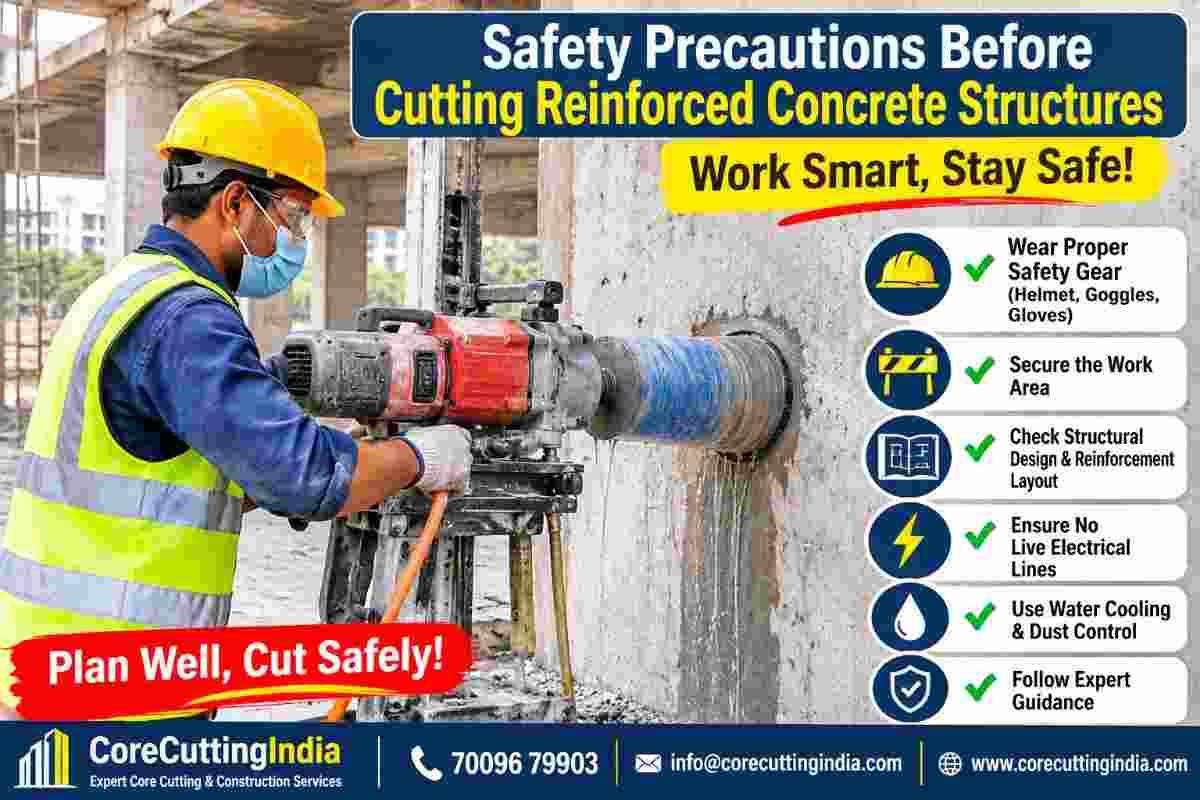
Reinforced concrete is the backbone of modern construction. Flyovers, factories, high-rise buildings, parking structures and bridges all depend on steel bars embedded in concrete to carry heavy loads. But when a renovation, utility installation or demolition project requires you to cut through that material, the same strength that makes it reliable can make the work dangerous.
Cutting reinforced concrete is not like cutting wood or drywall. A single wrong cut can sever a load-bearing bar, strike a live electrical conduit, trigger a partial collapse or send a cloud of silica dust into the lungs of everyone nearby. Most accidents in this field are preventable, and almost all of them trace back to skipped preparation.
At Core Cutting India, safety is built into every job before a blade ever touches the surface. In this guide, we walk through the essential safety precautions to take before cutting reinforced concrete structures, so that your project stays safe, compliant and on schedule.
Why Safety Comes First in Concrete Cutting
Concrete cutting combines several hazards at once: heavy machinery, high-speed diamond blades, water and electricity working side by side, fine hazardous dust, noise, vibration and the risk of structural movement. Each hazard alone is manageable. Together, without planning, they can lead to serious injury, expensive structural damage and legal trouble.
Good preparation delivers three benefits:
- Protection of people: operators, site workers and occupants of the building.
- Protection of the structure: avoiding unintended damage to beams, columns, slabs and post-tensioned elements.
- Protection of your project: fewer delays, fewer repairs, no rework and lower insurance and liability exposure.
The precautions below should be completed before cutting begins.
1. Get a Structural Assessment First
The first question is not "how do we cut this?" but "what happens to the structure if we do?"
Every opening, slab cut or wall removal changes how loads travel through a building. Removing a section of a shear wall, cutting through a beam or enlarging an opening in a slab can redistribute forces in ways that are not obvious by eye.
Before cutting:
- Consult a structural engineer. They should confirm which elements are load-bearing, what size of opening is acceptable and whether strengthening is required.
- Review drawings. Check original architectural and structural drawings, along with any renovation records. Be aware that old drawings may not match what was actually built.
- Identify the structural system. Is it a conventional RCC frame, a flat slab, a precast system or a post-tensioned slab? Each behaves differently.
- Get written approval. Document the engineer's sign-off on the cutting plan, including cut locations and sequence.
Never cut a structural member on assumption. If the drawings are missing or unclear, the safe default is to investigate further or stop.
2. Locate Rebar, Conduits and Hidden Utilities
Reinforced concrete hides things. Steel bars, electrical conduits, water lines, gas pipes, data cables and even post-tensioning tendons may sit inside the slab or wall you are about to cut.
Use scanning technology. Ground-penetrating radar (GPR) and electromagnetic rebar locators let you map reinforcement and embedded services without damaging the concrete. A proper scan shows bar position, spacing, approximate depth and the presence of conduits.
Pay special attention to post-tensioned slabs. Post-tensioning cables are held under extreme tension. Cutting one can release stored energy violently, causing the cable to whip out of the concrete and potentially causing fatal injury and serious structural failure. If there is any possibility that a slab is post-tensioned, treat the area as high-risk, confirm with the structural engineer and mark every tendon clearly before proceeding.
Mark the cutting area. Once scanning is complete, mark the safe cutting lines and any no-cut zones directly on the surface with paint or crayon, so operators can see them at a glance.
Isolate utilities. Where conduits or pipes are present, coordinate with the relevant utility teams to switch off, drain or disconnect them. Verify the isolation yourself; do not rely on a verbal assurance.
3. Choose the Right Cutting Method
Different jobs call for different techniques, and picking the wrong one increases both risk and cost. The common methods include:
- Core drilling: for round holes for pipes, ducts, cables and anchor bolts.
- Wall sawing: for doorways, windows, lift openings and full wall removal.
- Slab sawing (flat sawing): for expansion joints, trenches, floor openings and road or pavement cutting.
- Wire sawing: for very thick, large or awkwardly shaped structures such as bridge piers and heavy foundations.
- Hand sawing / ring sawing: for tight spaces where a larger machine cannot fit.
Factors that influence the choice include concrete thickness, rebar density, available access, noise and vibration limits, dust control requirements and whether the building is occupied. Diamond cutting methods are generally preferred for precision work because they limit vibration and reduce the risk of micro-cracking compared with percussive demolition.
A professional contractor will match the method to the structure rather than the other way around.
4. Wear the Right Personal Protective Equipment (PPE)
PPE is the last line of defence, and it is non-negotiable. Everyone within the work zone should wear suitable gear:
- Hard hat to guard against falling debris.
- Safety glasses or a face shield to protect against slurry, chips and sparks from steel bars.
- Hearing protection because concrete cutting often exceeds safe noise levels.
- Respirator or dust mask rated for fine particulates. Concrete dust contains respirable crystalline silica, which can cause serious lung disease with long-term exposure.
- Cut-resistant, well-fitted gloves to protect against sharp edges and rough surfaces, though not near rotating parts where gloves could be caught.
- Steel-toe, slip-resistant boots for protection against dropped cores and wet surfaces.
- Fitted work clothing with no loose sleeves, hanging cords or jewellery that could snag on rotating machinery.
- Fall protection when cutting at height or near open edges.
Inspect equipment before every shift. Damaged or ill-fitting PPE gives a false sense of security.
5. Set Up a Safe Work Zone
A well-organised site prevents injuries that have nothing to do with the cutting itself.
- Barricade the area and use warning signs so that unauthorised people cannot walk into the cutting zone.
- Plan for falling pieces. When you cut an opening, the removed section can weigh hundreds of kilograms or several tonnes. Decide in advance how it will be supported, lifted or lowered, and keep people from standing below or beside it.
- Clear the area of tools, cables, hoses and debris to eliminate trip hazards.
- Ensure good lighting and ventilation, especially for indoor, basement or confined-space work.
- Keep walkways and exits unobstructed so that people can leave quickly in an emergency.
- Protect adjacent surfaces and sensitive equipment, such as server rooms, hospital machinery or finished interiors, with covers or barriers.
If the building remains occupied, communicate the schedule clearly to occupants and arrange to work during low-traffic hours when possible.
6. Control Dust and Slurry
Dust and slurry are among the most underestimated hazards in concrete cutting.
Silica dust. Cutting dry or with poor dust control releases fine crystalline silica that can lodge deep in the lungs. Over time, this may cause silicosis, chronic respiratory disease and other health problems.
Wet cutting. Using water at the blade reduces dust at the source, cools the diamond segments and extends blade life. It is the standard approach for most reinforced concrete work.
Vacuum extraction. For indoor jobs or dry-cutting situations, use dust extraction systems with appropriate filtration.
Slurry management. Wet cutting produces a slurry that is slippery and alkaline. Contain it with barriers, collect it with wet vacuums and dispose of it responsibly rather than letting it flow into drains, soil or water bodies. Slurry left on floors is a major slip hazard.
7. Inspect Equipment and Electrical Safety
Power tools and water are a hazardous combination. Before starting:
- Check machines thoroughly: blade condition, guards, mounting, hoses, couplings, anchors and hydraulic or pneumatic connections.
- Use the correct blade or core bit for the material and rebar density. A dull, glazed or wrong-specification blade can bind, overheat or shatter.
- Secure the machine properly. Core drills and wall saws must be anchored or braced rigidly. A rig that shifts mid-cut can cause serious injury.
- Use protective devices such as residual current devices (RCD/GFCI) and ensure correct earthing.
- Inspect cables and connections for damage and keep them off wet ground and out of walkways.
- Verify power supply capacity and stability to avoid overloads.
Only trained and authorised operators should use cutting equipment. Familiarity with the machine and the manufacturer's operating guidelines is essential.
8. Plan Shoring, Support and the Cutting Sequence
Removing concrete changes how a structure carries load, even temporarily. Where required, install temporary support before cutting.
- Shoring and propping: supports placed under slabs, beams or above openings stabilise the structure while the cut is made and until permanent strengthening, such as lintels or steel frames, is in place.
- Cutting sequence: your engineer may specify the order in which cuts are made to keep the structure balanced.
- Section control: large sections should be cut into smaller, manageable pieces that can be safely lifted, slung and removed with suitable lifting equipment.
- Securing the offcut: a free-standing cut block can fall, tip or slide. Use lifting lugs, slings, wedges or supports so it cannot move unexpectedly.
Skipping this step is one of the most dangerous shortcuts a contractor can take.
9. Obtain Permits, Follow Regulations and Brief the Team
In India, construction and demolition-related work falls under various safety, labour and local municipal requirements, along with Indian Standards and site-specific rules. Depending on the project, you may need:
- Permission from the building owner, society or management.
- Local authority approvals for structural alterations.
- A work permit from the facility, particularly in industrial plants, hospitals and commercial complexes.
- A documented risk assessment and method statement.
Before starting, hold a short briefing that covers the scope of work, hazards, cut locations, emergency exits, communication signals and who is responsible for what. Everyone on site should know that any person can stop the job if something looks unsafe.
10. Prepare for Emergencies
Even with excellent planning, you should be ready for the unexpected.
- Keep a first-aid kit on site and ensure someone is trained to use it.
- Have fire extinguishers available, since sparks from cutting steel can ignite nearby materials.
- Know the location of the nearest hospital and keep emergency numbers visible.
- Establish an evacuation plan and a meeting point.
- Know how to shut off power and water quickly.
A few minutes of preparation can make the difference between a minor incident and a major one.
11. Why Hiring Professionals Matters
Some people attempt DIY or ad-hoc concrete cutting to save money. With reinforced concrete, this is a risky decision. Professional concrete cutting teams bring trained operators, calibrated equipment, scanning technology, dust and slurry management, insurance and an understanding of structural behaviour.
When you work with an experienced provider like Core Cutting India, you benefit from:
- Safety-first planning and site assessment.
- Precision cutting with minimal vibration and overbreak.
- Cleaner results with reduced dust, noise and disturbance.
- Faster completion with less risk of rework.
- Guidance on the most suitable cutting method for your project.
If you are planning a core cutting, wall sawing or slab cutting job, call +91 70096 79903 to discuss your requirements.
Quick Pre-Cutting Safety Checklist
- Structural engineer has reviewed and approved the plan.
- Drawings checked and site conditions verified.
- Rebar, conduits, pipes, and tendons scanned and marked.
- Utilities isolated and verified.
- Cutting method and equipment selected and inspected.
- Machine securely anchored and electrical safety devices in place.
- Shoring and offcut handling plan ready.
- PPE worn by all personnel.
- Work zone barricaded and signposted.
- Dust and slurry controls ready.
- Permits obtained and team briefed.
- Emergency plan, first aid and fire protection available.
People Also Ask (FAQs)
Placeholder questions have been used below. Replace them with your actual PAA questions if you have them.
What safety precautions should be taken before cutting reinforced concrete?
Start with a structural assessment, scan for rebar and hidden utilities, choose the correct cutting method, wear proper PPE, set up a barricaded work zone, control dust and slurry, inspect and secure equipment, plan shoring and offcut handling, and prepare an emergency plan.
Is concrete cutting dangerous?
It can be if done without planning. Hazards include structural instability, contact with live utilities, silica dust, noise, flying debris, heavy falling sections and electrical risks. With trained operators and proper precautions, the risks can be controlled.
How do you find rebar before cutting concrete?
Professionals use GPR (ground-penetrating radar) or electromagnetic rebar scanners to detect the position, spacing and depth of reinforcement and embedded conduits. The results are then marked directly on the surface.
What PPE is needed for concrete cutting?
Hard hat, eye or face protection, hearing protection, a respirator suitable for fine dust, gloves, safety boots and fitted clothing. Fall protection may also be needed at height.
Why is wet cutting preferred for concrete?
Water suppresses dust at the source, cools the blade and helps the blade last longer. It also reduces the amount of airborne silica, though slurry then needs to be managed properly.
Can you cut a post-tensioned slab?
Only with extreme caution and after expert structural evaluation. Cutting a tensioned cable can cause serious injury and structural damage, so tendons must be located and handled according to an engineer's plan.
Conclusion
Cutting reinforced concrete safely is a matter of preparation, not luck. Structural assessment, accurate scanning, the right method, proper PPE, a controlled work zone, dust and slurry management, equipment checks, shoring and emergency planning all work together to protect people and property.
If you are planning a project that involves core cutting, wall sawing, slab sawing or opening creation in RCC structures, trust a team that treats safety as the starting point. Visit Core Cutting India or call +91 70096 79903 to speak with the experts at Core Cutting India and get a safe, precise and professional solution for your project.