
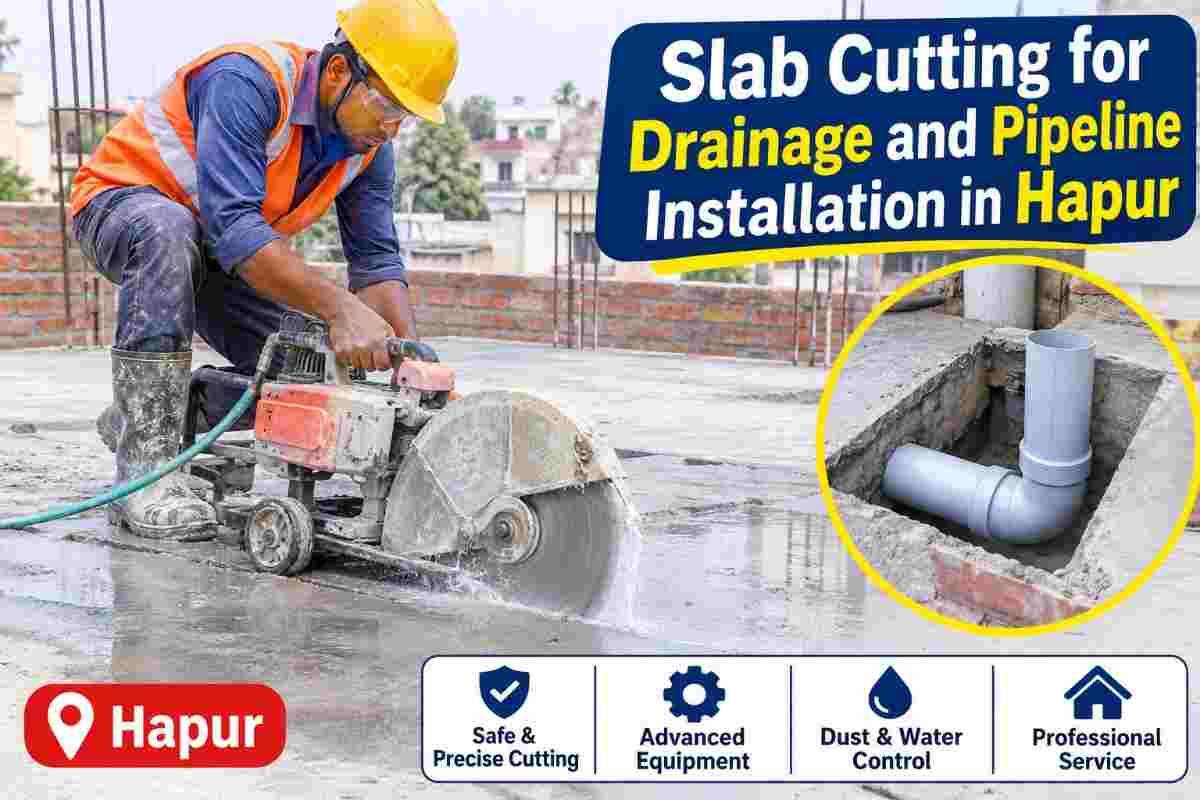
Hapur is growing fast. Residential colonies, warehouses, factories, schools, hospitals and commercial complexes keep coming up across the city and along the Delhi–Meerut corridor. With this growth comes a steady need to upgrade underground infrastructure: new drainage lines, sewer connections, water supply pipelines, gas lines and electrical or telecom ducts.
Much of this infrastructure has to pass through existing concrete floors, roads, basements and RCC slabs. Breaking the concrete with hammers and jackhammers is slow, noisy and unpredictable. It cracks surrounding structures, creates heavy dust and leaves a ragged edge that is hard to repair.
This is where slab cutting for drainage and pipeline installation in Hapur becomes valuable. Modern diamond-blade cutting removes only the concrete that needs to go, leaving clean edges and the rest of the structure undisturbed. Core Cutting India (https://corecuttingindia.com/) provides this kind of precision concrete cutting for homeowners, builders, industries and contractors. This guide explains how the process works, when to use it, what it costs and how to choose the right service provider.
What Is Slab Cutting?
Slab cutting is the controlled cutting of reinforced or plain concrete slabs using diamond-tipped blades, wire saws or core drills. The slab may be a floor, a ceiling, a driveway, an industrial platform or a road surface.
Diamond is the hardest known material, so diamond-impregnated blades cut through concrete and embedded steel reinforcement cleanly. Water is usually applied during cutting to cool the blade and suppress dust. The result is a straight, accurate cut along a marked line, whether you need a narrow trench, a rectangular opening or a precise cutout.
For drainage and pipeline work, slab cutting lets contractors open a defined path for pipes without damaging the rest of the floor or the foundation.
Why Hapur Projects Need Precision Slab Cutting
Several local factors make precision cutting a smart choice in Hapur.
1. Rapid urban and industrial expansion. Industrial units, packaging facilities and warehouses regularly modify existing floors to lay new drainage, effluent or utility lines. Production often cannot stop for long, so fast and clean work matters.
2. Dense residential layouts. In many colonies, buildings stand close together. Heavy breaking creates vibration that can affect neighboring walls and foundations. Low-vibration cutting protects adjacent properties.
3. Retrofitting older buildings. Many older structures in and around Hapur were built without provision for modern plumbing, sewer or drainage layouts. Adding these later means cutting through finished floors.
4. Monsoon drainage demands. Waterlogging is a recurring concern in many parts of western Uttar Pradesh. New or upgraded drainage channels through concrete surfaces help manage stormwater and reduce flooding around buildings.
5. Noise and dust regulations. Residential neighborhoods, hospitals and schools are sensitive to noise and dust. Diamond cutting with water suppression is considerably quieter and cleaner than traditional breaking.
Common Slab Cutting Methods Used for Drainage and Pipeline Installation
Different jobs call for different equipment. Here are the main techniques.
Floor Saw (Slab Saw) Cutting
A floor saw is a walk-behind or ride-on machine with a large diamond blade. It is the standard tool for cutting straight trenches in concrete floors, driveways and roads. For drainage lines and pipeline trenches, it produces uniform, straight-edged cuts to a controlled depth. It suits industrial floors, parking areas, basements and ground-level slabs.
Wall Saw and Hand Saw Cutting
For vertical or hard-to-reach areas, such as cutting through a wall where a pipe must pass, wall saws and hand-held ring saws are used. They allow neat openings in walls, columns or slab edges.
Core Drilling
Core cutting uses a hollow cylindrical diamond bit to drill perfectly round holes. It is ideal when a pipe has to pass through a slab, beam or wall. Typical uses include:
- Sleeve openings for drainage pipes through floors
- Holes for water supply lines
- Openings for gas, electrical and cable conduits
- HVAC and fire-fighting pipe penetrations
Core drilling is highly accurate and produces smooth hole walls that let pipes fit snugly.
Wire Saw Cutting
Where slabs are very thick or machinery cannot access the area, wire saws can cut large concrete sections. This method is less common for routine drainage work but useful for heavy industrial or demolition-linked jobs.
Step-by-Step Process of Slab Cutting for Drainage Lines
A professional job follows a clear sequence. Here is how it typically works.
Step 1: Site inspection and planning. The team studies the slab thickness, reinforcement, existing utilities and the planned path of the drainage or pipeline. Drawings or marked layouts are reviewed.
Step 2: Detecting hidden services. Before cutting, hidden electrical conduits, water lines or post-tension cables must be identified. Scanning equipment such as a GPR or rebar detector helps avoid accidental damage, which is especially important in older buildings where records may be missing.
Step 3: Marking the cut lines. Cutting lines are marked precisely to match the pipe diameter, required slope and trench width. Drainage lines need accurate gradient planning so water flows by gravity.
Step 4: Setting up water and dust control. Water supply is arranged for blade cooling, and slurry control is planned so the work area stays clean. Barriers and covers protect nearby equipment and finishes.
Step 5: Cutting the slab. Operators cut along the marked lines to the required depth using the appropriate saw. Cuts are made in controlled passes, keeping edges straight.
Step 6: Removing the concrete. The cut concrete strip is broken into manageable pieces or lifted out, then taken away. Because the edges are already defined, removal is simple and the surrounding slab stays intact.
Step 7: Excavation and pipe laying. The trench is excavated to the correct depth and gradient, bedding is prepared and the pipes are laid and jointed. They are tested for leaks before backfilling.
Step 8: Backfilling and restoration. The trench is backfilled and compacted, then the slab is restored with new concrete, often with dowel bars or bonding agents to tie it to the existing slab. The surface is finished to match the original floor.
Slab Cutting for Pipeline Installation
Pipelines of various kinds often have to cross existing concrete. Slab cutting supports several scenarios:
- Sewer and wastewater lines: New connections from toilets, kitchens and utility areas to the main sewer.
- Water supply pipelines: Fresh water lines through floors or road crossings.
- Industrial process pipes: Chemical, effluent or cooling-water lines in factories.
- Gas pipelines: Domestic and commercial gas connections that must cross concrete areas.
- Cable and conduit ducts: Power, telecom and fiber lines in commercial and institutional buildings.
In each case, precision matters. Pipes must align accurately, trenches must hold the right slope and the finished surface must carry loads again after restoration. Cutting rather than breaking keeps the structural impact small.
Key Benefits of Professional Slab Cutting
Accuracy. Cuts follow marked lines within tight tolerances, which makes pipe alignment and gradient control much easier.
Minimal structural damage. Only the targeted section is removed. Cracks do not spread into the rest of the slab, which preserves its strength.
Low vibration. Diamond cutting transmits far less vibration than hammering, protecting neighboring structures, equipment and sensitive environments.
Reduced noise and dust. Wet cutting controls dust, and noise levels are lower, so work can continue near occupied buildings.
Faster project completion. Clean cuts mean quicker removal, simpler restoration and less rework.
Neater finishing. Straight edges make patching and flooring repairs easier, with a better final look.
Better safety. Controlled cutting reduces flying debris and uncontrolled fractures, which makes the site safer for workers and occupants.
Cost efficiency over the project. Cutting may cost more per unit than rough breaking, but savings on repairs, cleanup, labor time and structural damage often make it the more economical option overall.
Safety and Quality Considerations
Slab cutting is skilled work. A reliable provider should follow these practices:
- Trained operators who understand slab behavior and machine handling.
- Pre-cut scanning to avoid hitting rebar clusters, live wires or buried pipes.
- Personal protective equipment, including helmets, goggles, ear protection, gloves and safety footwear.
- Slurry and waste management so wet residue does not spread or clog drains.
- Structural awareness, since cutting load-bearing slabs may require propping or an engineer’s opinion.
- Well-maintained equipment for consistent, safe performance.
If the slab supports heavy loads, such as an industrial floor or an upper-story slab, consult a structural engineer before cutting.
Factors That Affect Slab Cutting Cost in Hapur
Pricing depends on the specifics of each job. The main factors are:
- Cut length and depth: Longer, deeper cuts need more blade wear and machine time.
- Slab thickness and reinforcement: Dense steel mesh or thick RCC takes longer to cut.
- Method used: Floor saw, core drilling and wire sawing are priced differently.
- Site access: Tight, elevated or cluttered spaces increase effort.
- Working hours: Night or off-hours work for commercial and industrial sites may carry a premium.
- Debris removal and restoration: Whether you need disposal of cut concrete and later patching.
- Project size: Larger jobs often get better per-unit rates.
The most reliable way to get an accurate figure is a site visit and written quotation. Beware of quotes given without inspecting the site.
How to Choose a Slab Cutting Contractor in Hapur
When hiring, check the following:
- Experience with drainage, pipeline and RCC cutting projects.
- Modern diamond equipment appropriate to your slab type.
- Clear, written estimates with defined scope.
- Safety practices and trained staff.
- References or past work in similar settings.
- Responsiveness and willingness to work around your schedule.
- Post-work cleanliness, including debris and slurry removal.
A good contractor will explain the plan, point out risks and suggest the right cutting method rather than pushing one option for every job.
Why Choose Core Cutting India for Slab Cutting in Hapur?
Core Cutting India (https://corecuttingindia.com/) offers concrete cutting and drilling services built around accuracy, safety and clean results. For drainage and pipeline projects in Hapur, customers can expect:
- Precision cutting for trenches, openings and core holes
- Dust-controlled, low-vibration methods suited to occupied buildings
- Equipment for varied jobs, from floor saws to core drilling machines
- Support for homes, commercial buildings and industrial facilities
- Practical advice on planning cuts, pipe routes and restoration
- Prompt response and coordination with your contractors and engineers
Whether you are a homeowner adding a drainage line, a builder installing pipelines or a factory manager upgrading underground services, the team can assess your site and recommend the best approach.
Call +91 70096 79903 or visit https://corecuttingindia.com/ to discuss your project.
Related Searches
People looking for this service also search for:
- Concrete cutting services in Hapur
- RCC slab cutting contractor Hapur
- Core drilling for pipes in Hapur
- Floor saw cutting for drainage trenches
- Wall cutting and opening services near me
- Road cutting for pipeline laying
- Diamond cutting for sewer line installation
- Concrete drilling for plumbing in Hapur
People Also Ask (FAQs)
1. What is slab cutting used for in drainage work?
It creates clean, accurate trenches or openings in concrete floors so drainage pipes can be laid without damaging the rest of the structure.
2. Is slab cutting better than breaking concrete with a jackhammer?
In most cases, yes. Cutting is more precise, produces less vibration and gives cleaner edges, which makes repair and restoration simpler. Breaking can crack the surrounding slab and cause more disruption.
3. Can slab cutting damage the building structure?
When done correctly, it does not. Professionals scan for hidden services and rebar, and they get engineering input for load-bearing slabs. Poorly planned cutting, however, can weaken a structure, so planning matters.
4. How thick a slab can be cut?
Depending on the machine and blade, floor saws commonly handle slabs in the range of several inches to well over a foot, and wire saws or core drills can handle thicker sections. Your contractor can confirm what suits your slab.
5. Is core drilling the same as slab cutting?
They are related but different. Slab cutting makes straight cuts such as trenches and openings, while core drilling makes round holes, usually for pipes and conduits to pass through.
6. How long does slab cutting for a pipeline take?
It depends on the length, depth and slab thickness. Small residential jobs may take a few hours, while larger industrial or road projects can take several days. An on-site assessment gives the best estimate.
7. Will slab cutting create a lot of dust and noise?
Wet cutting keeps dust low, and diamond cutting is generally quieter than breaking. Some noise is unavoidable, but it is much more manageable.
8. Can the cut slab be repaired after pipes are installed?
Yes. After the pipes are laid and tested, the trench is backfilled and the slab is restored with fresh concrete, usually with bonding measures to join it to the old slab.
9. How do I get a quote for slab cutting in Hapur?
Contact Core Cutting India at +91 70096 79903 or through https://corecuttingindia.com/ with details of your slab, the length of cut and your location for an estimate.
Conclusion
Drainage and pipeline installation through existing concrete does not have to mean chaos, heavy damage and long delays. With professional slab cutting, Hapur property owners, builders and industries can get clean, accurate trenches and openings that protect the surrounding structure and make pipe laying and slab restoration far simpler.
Careful planning, the right equipment and skilled operators are what separate a smooth project from a troublesome one. If you are planning drainage, sewer, water or utility lines through a concrete slab in Hapur, the team at Core Cutting India is ready to help.
📞 Call: +91 70096 79903
🌐 Website: https://corecuttingindia.com/