
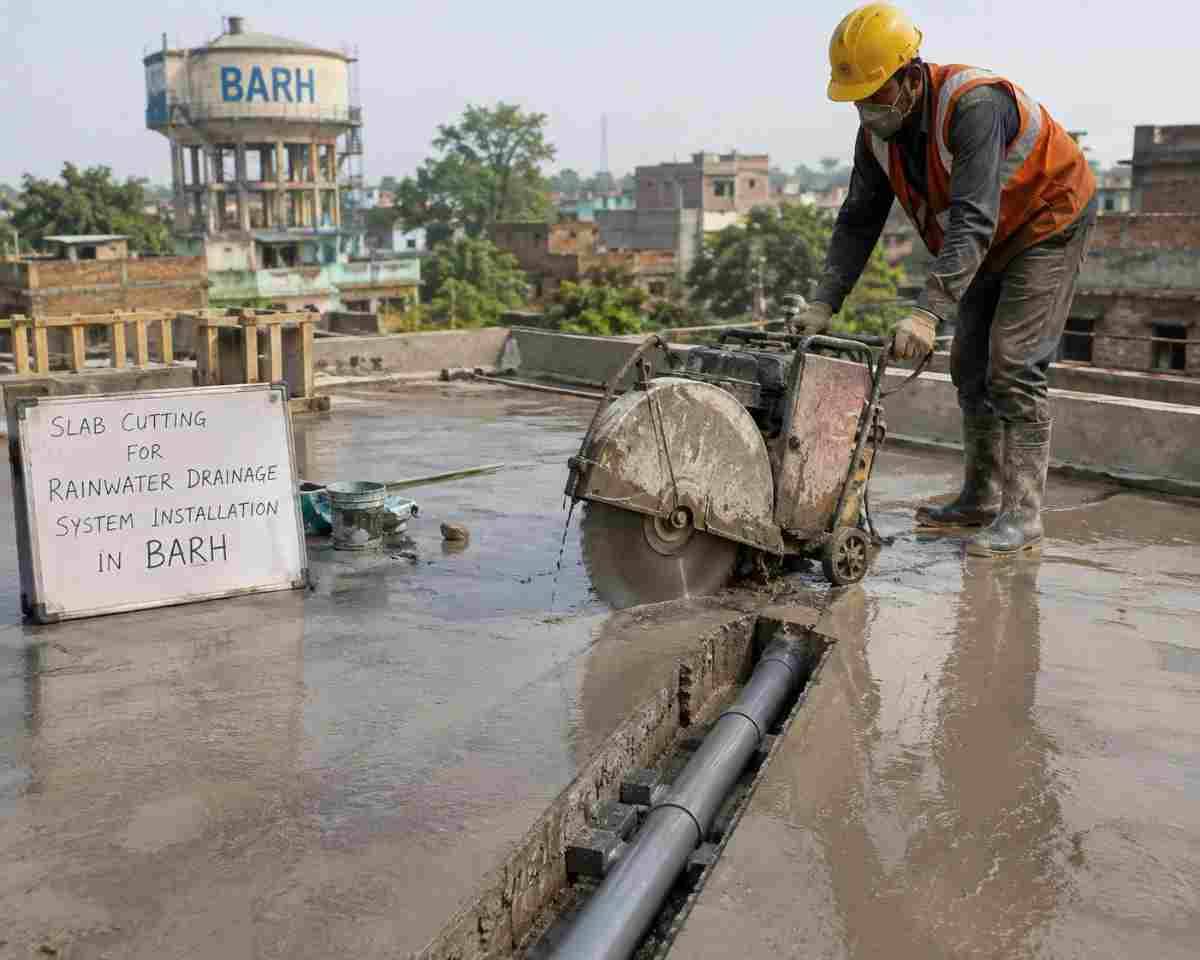
Barh, in the Patna district of Bihar, sits close to the Ganga plains. Every monsoon, rooftops, courtyards, ground-floor slabs and commercial yards here take heavy rainfall. When water has nowhere to go, it collects, seeps into concrete, weakens plastering, stains walls and eventually damages the structure itself. A properly planned rainwater drainage system is no longer a luxury for homes, schools, warehouses and factories in the region. It is a necessity.
But installing drainage in an existing building almost always means one thing: opening the concrete. Downpipes must pass through slabs. Drain channels must cross floors. Collection chambers and recharge pits must be connected to the building. Hammering and breaking the slab by hand is slow, noisy, and risky, because it sends cracks through reinforced concrete far beyond the area you actually wanted to open.
That is where professional slab cutting comes in. At Core Cutting India, we use diamond-based cutting equipment to open RCC slabs cleanly, accurately and safely, so your rainwater drainage system goes in without damaging the rest of your building. This guide explains how slab cutting works, why it suits drainage work, and what property owners in Barh should know before starting.
What Is Slab Cutting?
Slab cutting is the process of cutting reinforced cement concrete (RCC) floors, roofs and pavements using diamond-tipped blades or wires instead of impact tools. The diamond segments grind through concrete and steel reinforcement in a controlled line, leaving smooth, straight edges.
The most common methods include:
- Slab saw (floor saw) cutting: A walk-behind saw with a diamond blade cuts straight lines in horizontal surfaces such as floors, roads and yards.
- Wall saw cutting: A track-mounted saw cuts vertical walls or slab edges with precise depth control.
- Wire saw cutting: A diamond-bead wire is looped around thick or awkwardly placed concrete and pulled through it, useful where blades cannot reach.
- Core cutting (core drilling): A hollow diamond bit drills perfectly round holes, ideal for pipe and downpipe openings.
For rainwater drainage projects, a combination of these methods is often used: straight slab cuts for channels and chambers, and round cores for pipes.
Why Slab Cutting Is Needed for Rainwater Drainage Installation
A rainwater drainage system is not one single component. It is a network, and nearly every part of that network interacts with concrete. Typical places where slab cutting becomes necessary include:
- Downpipe openings: Rooftop water must travel down to ground level. Where no sleeve was provided during construction, a round opening has to be cored through the slab or parapet.
- Drainage channels in floors: Industrial sheds, parking areas and courtyards need shallow trenches to carry runoff toward an outlet. These are cut as straight, uniform slots.
- Inspection chambers and catch pits: Openings are cut in floors or pavements to build or connect chambers.
- Rainwater harvesting connections: Pipes leading to recharge wells or storage tanks often pass through plinth beams, floor slabs and boundary walls.
- Terrace outlet correction: Old terraces with poor slope or blocked outlets sometimes need new or enlarged drain openings.
- Basement and sump drainage: Water collected below ground level needs outlets and sump openings cut into base slabs.
In each case, accuracy matters. An opening that is too large weakens the slab. An opening in the wrong place can hit a beam or a bundle of reinforcement. A rough, cracked edge makes waterproofing difficult. Diamond cutting solves all three problems.
Advantages of Diamond Slab Cutting Over Manual Breaking
Many property owners in smaller towns still think of chiselling or using a jackhammer as the "cheaper" way to open concrete. In practice, it often costs more in the long run. Here is why professional cutting is the better choice for drainage work.
1. Clean, Accurate Edges
Diamond cutting follows a marked line. The result is a neat opening with straight sides, which makes it easy to fit pipes, frames, gratings or channel covers and to apply waterproofing around them.
2. No Micro-Cracks in the Surrounding Slab
Impact tools send vibration through the whole structure. This can cause hairline cracks that you may not notice until the monsoon, when water finds them. Cutting removes only the concrete you intend to remove.
3. Lower Noise and Vibration
If you are working in an occupied house, a school, a clinic or an operating shop, reduced vibration and noise is a major benefit. Neighbours and occupants are far less disturbed.
4. Controlled Dust and Slurry
Wet diamond cutting uses water to cool the blade, which also keeps dust down. Slurry is collected and cleaned, leaving the site tidy.
5. Faster Completion
A cut that might take a team of labourers a full day with hammers can be completed in a fraction of that time with the right machine, which shortens the total project timeline.
6. Safety for the Structure
Because the cut is controlled, the structural engineer or site supervisor can specify exact dimensions and depth. The slab's load path is respected, and reinforcement is cut only where it is planned.
7. Reusable Offcuts
The removed concrete comes out in clean blocks that are easy to handle and dispose of, rather than a heap of broken rubble.
Step-by-Step Slab Cutting Process for a Drainage Project
A good slab cutting job begins well before the machine is switched on. Here is how a typical drainage-related project is handled.
Step 1: Site Survey and Requirement Study
We first understand what the drainage design needs: pipe diameter, channel width and depth, slope direction, outlet location and slab thickness. If drawings are available, we review them. If not, we inspect the site and mark a practical layout together with the owner or contractor.
Step 2: Reinforcement and Services Check
Before cutting, the area is scanned or inspected for rebar position, electrical conduits, water lines and any embedded services. This avoids accidental damage and unexpected repair costs.
Step 3: Marking the Cut Lines
Cut lines are drawn clearly on the slab. For core holes, the centre point and diameter are marked. For channels, both edges and depth are marked.
Step 4: Equipment Setup
The saw, core drill or wall saw is anchored securely. A water supply is arranged for wet cutting, and slurry control is set up to protect floors and nearby areas.
Step 5: Controlled Cutting
Operators cut in stages, adjusting depth gradually. Corner overcuts are avoided where possible so the slab is not weakened. Round holes are drilled in a single steady pass.
Step 6: Removal and Cleaning
The cut concrete is lifted out, slurry is cleaned, and the opening is left ready for pipe fitting or channel construction.
Step 7: Handover for Plumbing and Waterproofing
Once the opening is ready, your plumber or contractor can install pipes, sleeves, grating or chambers. Proper sealing and waterproofing around the opening should follow immediately.
Types of Properties in Barh That Benefit From Slab Cutting for Drainage
Barh has a mix of residential, commercial, agricultural-processing and institutional buildings, and each has its own drainage needs.
Residential houses and apartments: Terrace water outlets, courtyard drains, balcony drainage and rainwater harvesting connections.
Schools and colleges: Large roof areas need multiple downpipes, and playground or courtyard drainage often requires channel cutting.
Warehouses and godowns: Floor channels prevent stored goods from getting damp during heavy rain.
Factories and workshops: Industrial floors need slope-managed drainage lines and trench cuts for runoff and wash-water.
Hospitals, clinics and hotels: Quiet, low-vibration cutting is essential in operating premises.
Farm-processing units and cold storages: Wash-down areas and loading bays need reliable drainage channels.
Roads, driveways and parking areas: Concrete pavements are cut for storm drains and inlet gratings.
Planning Your Rainwater Drainage System: Tips Before You Cut
Slab cutting is only one part of a good drainage system. A little planning will save money and avoid rework.
Decide Slope and Outlet First
Water flows by gravity. Before cutting anything, confirm where the water will finally go: a street drain, a recharge pit, a storage tank or a soak well. Then work backwards to determine where openings are needed.
Size the Pipes Correctly
For typical residential roofs, common downpipe sizes are 75 mm to 110 mm. Larger roofs and industrial sheds may need bigger diameters or multiple outlets. Your plumber or engineer should confirm sizes based on roof area and local rainfall intensity.
Keep Openings Away From Beams and Columns
Structural members carry loads. Avoid cutting through beams, column zones or heavily reinforced areas unless an engineer has approved it.
Plan for Waterproofing
Every opening is a potential leak point. Use proper sleeves, sealants and waterproofing compounds around pipes and channels. A neat diamond-cut opening makes this far easier.
Think About Maintenance
Install inspection chambers and removable gratings so that leaves, silt and debris can be cleared regularly, especially before the monsoon.
Consider Rainwater Harvesting
Bihar's groundwater levels and seasonal water patterns make harvesting valuable. A drainage system that directs clean roof water to a recharge pit or storage tank turns a problem into a resource.
Common Mistakes to Avoid
- Cutting without checking reinforcement: This can lead to damaged conduits or structurally significant rebar being cut accidentally.
- Making openings larger than needed: Oversized holes weaken slabs and waste repair material.
- Ignoring slab thickness: Blade and core bit selection depends on depth.
- Skipping waterproofing: Even a perfect opening will leak if not sealed correctly.
- Hiring untrained labour: Diamond equipment needs experienced operators for safe, accurate results.
- Cutting during heavy rain: Plan work in dry weather when possible, so openings are not left exposed.
Why Choose Core Cutting India for Slab Cutting in Barh?
Core Cutting India specialises in concrete cutting solutions for residential, commercial and industrial clients. When you hire us for slab cutting related to rainwater drainage, you can expect:
- Experienced operators who understand RCC structures and drainage requirements.
- Modern diamond equipment for slabs, walls, floors and core holes.
- Precise, clean cuts that reduce rework and finishing cost.
- Low-vibration, low-dust methods suitable for occupied buildings.
- Site-safe practices with careful handling of water, slurry and debris.
- Transparent quotations based on depth, length, number of cores and site access.
- Responsive support from the first call to project completion.
Whether you need one core hole for a downpipe or several metres of channel cutting across a warehouse floor, our team can plan the work around your schedule and your building's needs.
Factors That Affect Slab Cutting Cost in Barh
Pricing depends on the scope of work. Typical factors include:
- Cutting length or number of holes: Channel cuts are usually measured by running length and depth, while core holes are priced by diameter and depth.
- Slab thickness and reinforcement density: Thicker, heavily reinforced slabs take more time and blade wear.
- Cutting method: Wire saw and wall saw jobs differ from simple floor saw or core drilling.
- Site access: Upper floors, confined spaces and difficult access can affect setup time.
- Water and power availability: On-site water and electricity make work smoother.
- Quantity of work: Larger projects often allow better planning and efficiency.
The best way to know the exact price is a short site assessment or a call with details of your requirement. We are happy to guide you.
Safety and Quality Standards
Slab cutting involves heavy machinery, water and electricity, so safety is not optional. Our approach includes secure machine anchoring, proper electrical protection, trained operators, clear marking of work zones, and careful handling of cut sections. We also recommend that you inform occupants beforehand, protect nearby furniture and equipment, and keep children and pets away from the work area.
For structural alterations, it is wise to involve a qualified structural engineer, particularly when openings are large or located near load-bearing elements. We are glad to coordinate with your engineer or contractor.
Frequently Asked Questions (People Also Ask)
These questions are suggested to match common searches. Replace or add your own People Also Ask questions if you have a specific list.
What is slab cutting, and when is it needed for drainage?
Slab cutting is the precise removal of sections of a concrete slab using diamond blades or wires. It is needed for drainage when pipes, channels, chambers or outlets must pass through an existing floor, roof or pavement.
Is it safe to cut an RCC slab for a drain pipe?
Yes, when the work is planned and done correctly. Small openings away from beams and heavy reinforcement are generally manageable, but larger openings should be reviewed by a structural engineer.
How is core cutting different from slab cutting?
Core cutting produces round holes using a hollow diamond bit, making it ideal for pipes. Slab cutting usually refers to straight cuts for channels, openings and removal of concrete sections. Many drainage projects use both.
Can slab cutting be done in an occupied building?
Yes. Diamond cutting creates less vibration and noise than breaking with hammers, and wet cutting limits dust, so it is well suited to homes, schools and offices that remain in use.
How long does slab cutting take?
A few core holes can often be completed within hours. Longer channel cuts or thick slabs may take a day or more, depending on length, depth and access.
How much does slab cutting cost in Barh?
Cost varies with cut length, depth, hole diameter, reinforcement and site conditions. Contact Core Cutting India at +91 70096 79903 for a quotation based on your requirement.
Do I need waterproofing after cutting a slab for drainage?
Yes. Every new opening should be sealed with suitable sleeves, sealants or waterproofing materials to prevent leakage and dampness.
Can rainwater harvesting connections be made through existing floors?
Yes. Pipes to recharge pits or storage tanks can be routed through floors, plinth beams and walls using core holes or narrow cut channels.
What is the best time to install a drainage system?
The dry months before the monsoon are ideal, because cutting, plumbing and waterproofing can be completed without rain interruptions, and the system is ready when needed.
Related Services We Offer
Besides slab cutting for drainage, Core Cutting India supports a wider range of concrete cutting needs, including:
- RCC core cutting for pipes, ducts and cables
- Wall cutting for doors, windows and openings
- Wire saw cutting for thick or heavy structures
- Road and pavement cutting
- Floor sawing and expansion joint cutting
- Concrete demolition support and controlled removal
- Openings for HVAC, plumbing and electrical services
Conclusion: Build a Drainage System That Lasts
A rainwater drainage system protects your building, your belongings and your family or workforce from the damage that heavy monsoon rain can cause. But a good system starts with a good opening. Clean, accurate slab cutting ensures that pipes fit properly, channels carry water efficiently, and your structure stays strong.
If you are planning a rainwater drainage project in Barh, avoid risky and messy manual breaking. Choose diamond slab cutting that is precise, safe and efficient.
Contact Core Cutting India today:
- Website: https://corecuttingindia.com/
- Phone / WhatsApp: +91 70096 79903
Call us to discuss your site, get expert advice and receive a clear quotation for slab cutting for rainwater drainage system installation in Barh.