
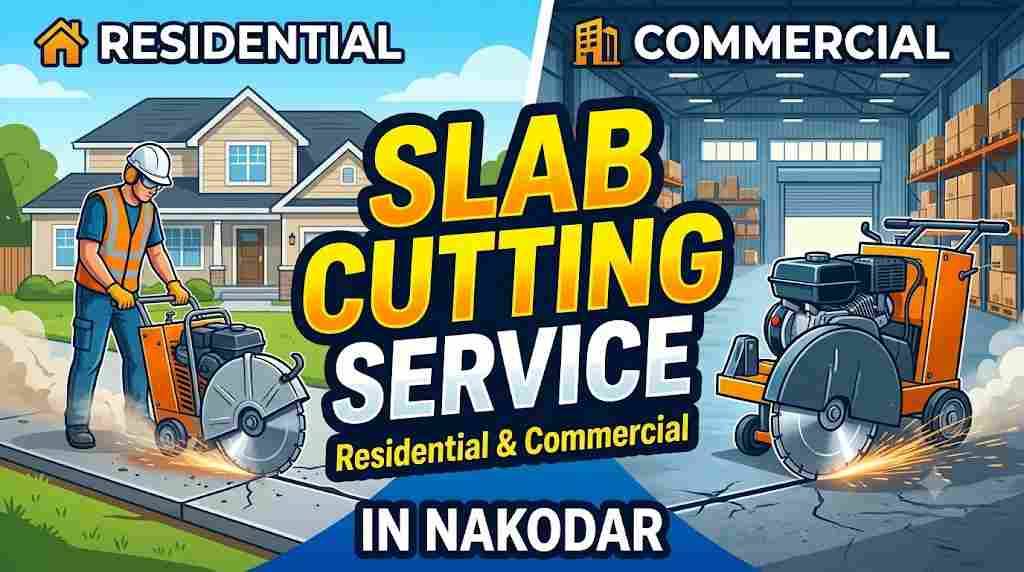
You have a concrete slab standing in the way of your plan. Maybe it is a new staircase opening, a lift shaft, a plumbing duct, or a section of floor that must go during a renovation. Breaking it with a hammer and chisel is the instinctive answer, but it is also the fastest way to crack beams, loosen reinforcement and spend extra on repairs.
That is why more property owners, builders and contractors in Nakodar now choose professional slab cutting. It is precise, controlled and far less damaging to the structure around the cut.
This guide explains what slab cutting is, where it is used in homes and commercial buildings, how the process works, what affects the price, and how to pick the right service provider in Nakodar.
📞 Call or WhatsApp now: 7009679903 | ✉️ info@corecuttingindia.com
What Is Slab Cutting?
Slab cutting is the process of cutting reinforced concrete (RCC) floors, roofs and slabs into clean, measured sections using diamond-tipped saws and wire or ring saws. Instead of smashing concrete, the blade grinds through it along a marked line. The result is a straight, smooth edge, minimal vibration and very little damage to the rest of the building.
In Nakodar, slab cutting is commonly used for staircase openings, lift and duct cut-outs, partial demolition, floor trenching and structural modifications.
Why Slab Cutting Matters in Nakodar
Nakodar, in Jalandhar district, is a growing town where old houses are being extended, shops are being redesigned, and new commercial buildings, warehouses and workshops keep coming up. Many older buildings were built with solid RCC slabs, and changing them without harming the structure takes proper equipment.
Traditional demolition has real drawbacks in a built-up area:
- Heavy vibration can crack neighbouring walls and beams.
- Noise and dust disturb families, shops and neighbours.
- Edges are rough, so extra plastering and repair work is needed.
- Cutting reinforcement bars by hand is slow and unsafe.
Diamond slab cutting solves these problems. If you want an overview of what the company does locally, see the dedicated core cutting service in Nakodar page.
Slab Cutting for Residential Projects
For homeowners, the biggest worry is damage to a house they still live in or plan to live in. Controlled cutting keeps the disruption small. Common residential uses include:
1. Staircase openings. Adding a staircase to reach a new floor or terrace means opening the existing roof slab. A saw cut gives a neat, square opening that is easy to frame and finish.
2. Home lifts. More families in Punjab are installing small residential lifts. The lift shaft needs an accurate cut through each floor slab.
3. Plumbing and drainage ducts. Relocating a bathroom or adding a pipe line often needs a duct through the slab. Core drilling and slab cutting make this clean and quick.
4. Window and door enlargement. Where a wall and its adjoining slab portion must be altered, wall sawing creates a straight opening without shaking the house.
5. Renovation and layout changes. Removing a section of slab to create a double-height living room, a skylight or a light well is far safer with cutting than with breaking.
6. Floor trenching. Cutting narrow channels in floors for new pipelines, drainage or electrical conduits.
The main benefit for a household is peace of mind. The cut follows your marked layout, and the surrounding structure stays intact.
Slab Cutting for Commercial Projects
Commercial sites have deadlines, safety rules and sometimes live operations next door. Precision cutting fits that environment well. Typical commercial applications include:
- Showrooms and shops: new staircases, mezzanine floors, service ducts and counter layouts.
- Offices and hospitals: lift shafts, cable and HVAC openings, with limited noise and dust.
- Factories and warehouses: machine foundations, trenches, drainage channels and floor sections that need replacing.
- Hotels, banquet halls and schools: structural modifications and utility routing in occupied buildings.
- Roads, ramps and industrial floors: joint cutting and slab sectioning for repairs.
Because the work is quick and exact, contractors can keep their schedules on track and avoid the cost of rework.
How Professional Slab Cutting Works: Step by Step
Understanding the process helps you ask the right questions and judge whether a provider is doing the job properly.
Step 1: Site inspection. The team checks the slab thickness, location of beams and columns, the likely position of reinforcement, and access for equipment. Safety comes first.
Step 2: Marking the cut line. Exact dimensions are marked on the slab based on your drawing or requirement. A clear marking avoids errors and wasted effort.
Step 3: Choosing the right method. Depending on the job, the team uses a floor saw for horizontal cuts, a wall saw for vertical cuts, or a wire saw for very thick or hard-to-reach sections. Core drilling is added where round holes are needed.
Step 4: Cutting with water cooling. Diamond blades are cooled with water, which controls dust, protects the blade and keeps the cut smooth.
Step 5: Sectioning and removal. Large cut-outs are divided into manageable blocks that can be safely lifted and removed, so heavy pieces do not fall.
Step 6: Clean-up. Slurry and debris are cleared, leaving the site ready for the next stage of construction.
Slab Cutting vs Manual Breaking: A Clear Comparison
| Factor | Diamond Slab Cutting | Manual Breaking |
|---|---|---|
| Accuracy | Straight, measured edges | Uneven, rough edges |
| Vibration | Very low | High, risk of cracks |
| Noise and dust | Controlled with water | Heavy noise and dust |
| Speed | Faster for large areas | Slow and labour-heavy |
| Structural safety | Protects nearby beams and walls | Can weaken the structure |
| Finishing work | Minimal | Extensive repair needed |
For almost every modern project, controlled cutting saves time and money in the long run even when the upfront rate looks higher.
What Affects the Cost of Slab Cutting?
There is no single price that fits every site. The final quote depends on several practical factors:
- Slab thickness and concrete strength. Thicker, denser concrete takes longer and wears blades faster.
- Amount of reinforcement steel. More rebar means slower cutting.
- Total length or area to be cut. Larger jobs usually work out cheaper per unit.
- Method needed. Floor saw, wall saw or wire saw each have different costs.
- Site access. Upper floors, tight spaces and limited power or water supply add effort.
- Timeline. Urgent jobs may need extra manpower.
To get a quick idea before you call, try the slab and core cutting rate calculator. Enter your project details and get an estimate to plan your budget. For an exact figure, a short site visit or a few photos on WhatsApp are usually enough.
How to Choose the Right Slab Cutting Contractor in Nakodar
A cheap quote is not always a good deal. Before you hire anyone, check these points:
- Modern diamond equipment. Ask whether they use floor saws, wall saws and wire saws, not just hand tools.
- Experience with similar jobs. A team that has done residential and commercial work understands both the sensitivity of homes and the pace of commercial sites.
- Safety practices. Look for proper handling, support for heavy sections and awareness of structural elements.
- Clear, written quote. The scope, rate basis and timeline should be spelled out.
- Local availability. A nearby team can inspect quickly, reach the site on time and respond if something changes.
- Honest advice. A good contractor will tell you if a cut should be reviewed by your structural engineer first. For any cut that affects beams, columns or load-bearing parts, always involve a qualified engineer.
Areas We Serve Around Nakodar
Core Cutting India supports projects in Nakodar and the surrounding region, including nearby towns and villages across the Jalandhar belt such as Shahkot, Nurmahal, Lohian Khas and Phillaur, as well as Jalandhar and Kapurthala. If your site is outside these areas, call and ask; availability may still be possible. You can also explore the wider range of services on the main website, Core Cutting India.
Tips to Prepare Your Site Before Cutting
A little preparation makes the job faster and safer:
- Keep your drawings or a clear sketch of the opening ready.
- Confirm with your engineer that the planned cut is structurally safe.
- Clear furniture, vehicles and valuables from the area.
- Make sure there is access to electricity and water.
- Inform neighbours or tenants about the schedule.
- Mark any known pipes, cables or hidden services.
Frequently Asked Questions (FAQ)
1. What is the best slab cutting service in Nakodar?
The best service is one that uses diamond cutting equipment, has experience with both homes and commercial sites, gives a clear quote and works safely. Core Cutting India offers professional slab cutting in Nakodar for residential and commercial projects. Call or WhatsApp 7009679903 to discuss your requirement.
2. Is slab cutting safe for an occupied house?
Yes, when done by trained professionals. Diamond cutting produces far less vibration than breaking, and water cooling controls dust. It is still wise to have a structural engineer approve cuts that involve beams or load-bearing elements.
3. How much does slab cutting cost in Nakodar?
Cost depends on slab thickness, reinforcement, the length or area to be cut, access and the method used. Use the rate calculator for an estimate, then confirm with a free enquiry.
4. How long does a slab cutting job take?
Small openings such as a duct or a staircase cut-out can often be completed in a few hours to a day. Larger commercial jobs take longer. A site inspection gives the most accurate timeline.
5. Can you cut a slab without damaging the rest of the building?
That is the main advantage of slab cutting. The saw follows a marked line, so adjoining slabs, walls and beams are protected as far as the structure allows.
6. Do you provide services for both residential and commercial projects?
Yes. Services cover homes, shops, offices, warehouses, factories and other commercial buildings. See the core cutting service page for Nakodar for more details.
7. What is the difference between slab cutting and core cutting?
Slab cutting removes larger sections or makes long straight cuts. Core cutting drills round holes, typically for pipes, cables or ducts. Many projects use both.
8. How do I book a slab cutting service?
Call or message 7009679903 on WhatsApp, share your location, a few photos and approximate dimensions, and ask for a quote. You can also email info@corecuttingindia.com.
9. Can slab cutting be done on upper floors?
Yes. Equipment can be set up on upper floors with proper planning for power, water and safe removal of the cut sections.
10. Do I need to arrange water and electricity?
Usually, yes. Cutting needs power and a water supply for cooling. If either is unavailable, tell the team in advance so alternatives can be arranged.
Get Your Slab Cutting Quote in Nakodar Today
Whether you are adding a staircase to your home, opening a lift shaft in a commercial building or modifying a factory floor, the right cutting method protects your structure, your schedule and your budget.
📞 Call Now: 7009679903
💬 WhatsApp Us: Chat on WhatsApp
✉️ Email: info@corecuttingindia.com
Quick links:
- 🌐 Visit Core Cutting India
- 🧮 Check your estimate with the rate calculator
- 📍 Explore core cutting service in Nakodar
Send a photo of your slab on WhatsApp and get a fast response. Precise cuts. Clean finish. Dependable service in Nakodar.
Note: This article is for general information. For cuts that affect structural elements, consult a qualified structural engineer before work begins.