
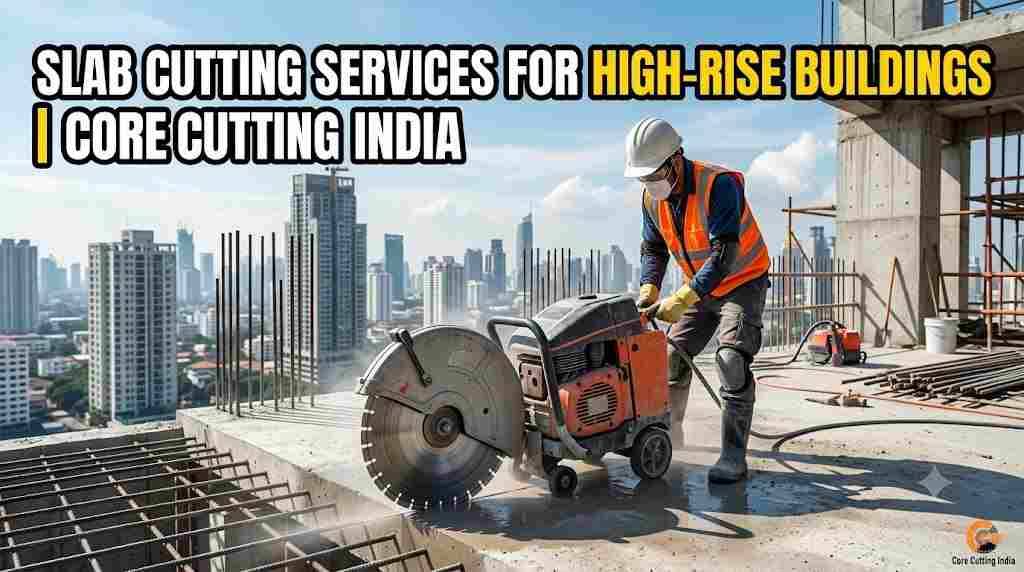
High-rise construction runs on tight schedules, tighter tolerances, and almost no room for error. One of the most technically demanding tasks on any tall-building site is slab cutting — opening up reinforced concrete floors for lift shafts, ducts, staircases, and structural modifications without weakening the building above or below. Done wrong, it delays the entire tower. Done right, it barely shows up as a blip on the project timeline.
This guide breaks down what slab cutting actually involves in high-rise projects, why it's different from cutting slabs in low-rise or residential work, and how to choose a contractor who won't put your structure — or your schedule — at risk.
Why Slab Cutting Is a Different Game in High-Rise Buildings
In a two- or three-storey structure, a slab cutting mistake is inconvenient. In a 20- or 40-storey tower, it's a structural event. Every floor in a high-rise carries load from everything above it, and slabs are tied into columns, shear walls, and post-tensioned cables that were never designed with a random hole in mind.
That's why slab cutting on high-rise sites needs to account for a few things residential jobs rarely deal with:
- Load transfer paths — cutting through the wrong section can redirect load onto beams or columns not designed for it.
- Post-tensioned (PT) slabs — many high-rises use PT slabs with live tensioned cables running through them. Cutting into a stressed cable without locating it first can be dangerous and structurally destructive.
- Services congestion — electrical conduits, plumbing lines, and HVAC ducts are often embedded inside slabs on upper floors, and cutting blind risks cutting through live services.
- Vibration and noise limits — occupied floors below or adjacent towers under finishing work mean vibration from cutting has to be controlled, not just tolerated.
- Access constraints — cutting equipment has to be moved up via hoists or cranes, and space on a working floor is often limited by scaffolding, formwork, or ongoing MEP work.
This is why high-rise slab cutting isn't a job for a general contractor with a demolition saw. It needs a team that reads structural drawings, scans before cutting, and sequences the work around the building's load path.
Common Applications of Slab Cutting in High-Rise Projects
Slab cutting services are used at almost every stage of a tall building's life cycle, not just during construction:
- Lift shaft and staircase openings — cutting precise openings for elevator cores and stair flights as floors are cast.
- HVAC and plumbing shaft creation — retrofitting vertical service risers after the structure is up.
- Structural modifications — creating openings for new staircases, mezzanine floors, or connecting adjacent units.
- Balcony and terrace alterations — cutting slab edges for new balconies, skylights, or terrace extensions.
- Demolition of partial floors — removing sections of a slab for redesign without disturbing the rest of the structure.
- Sample coring for testing — extracting core samples to verify concrete strength before further cutting or load calculations.
Each of these calls for a different cutting method — floor saws for straight cuts, wall saws for vertical sections, wire saws for thick or heavily reinforced slabs, and diamond core drilling for smaller, precise openings.
Methods Used for Slab Cutting in Tall Buildings
Diamond Floor Sawing The most common method for straight-line slab cuts. Diamond-tipped blades cut cleanly through reinforced concrete with minimal dust when paired with water suppression, and the depth can be controlled precisely — critical when a slab has embedded services close to the surface.
Wire Sawing Used for thick slabs, heavily reinforced sections, or where vibration needs to be kept to a minimum. A diamond wire loops around the section and cuts through slowly, making it ideal for load-sensitive high-rise work.
Core Drilling Used for smaller round openings — pipe penetrations, cable routing, or sampling. Core drilling causes almost no vibration, which matters when working near finished interiors or occupied floors.
Track-Mounted Wall Sawing Used on slab edges or vertical sections where a straight, deep cut is needed, such as balcony extensions or structural openings along a slab edge.
The right method depends on the slab thickness, reinforcement density, access, and how close the cut is to critical structural members — which is exactly why a structural assessment should always come before the saw does.
What a Reliable Slab Cutting Contractor Should Bring to a High-Rise Site
Before hiring a slab cutting team for a high-rise project, check for:
- A pre-cut structural survey using rebar scanning and GPR (ground-penetrating radar) to locate reinforcement, PT cables, and embedded services.
- Equipment suited for multi-storey access — compact saws, hoistable equipment, dust and slurry containment for upper floors.
- Experience with PT slabs specifically, since de-stressing cables safely before cutting is a specialised skill.
- A clear cutting sequence plan reviewed against the structural engineer's drawings.
- Proper vibration and dust control, especially on occupied or partially finished towers.
- Transparent, upfront pricing — you can check estimated costs instantly using our Slab Cutting Rate Calculator before committing to a quote.
If you're managing a project in the capital, our dedicated Slab Cutting Service in New Delhi page covers site-specific turnaround times, equipment availability, and local project examples.
Slab Cutting for High-Rise Projects Across Delhi NCR
Core Cutting India has handled slab cutting on residential towers, commercial high-rises, and mixed-use developments across Delhi NCR. Our teams are equipped for multi-storey access, PT slab identification, and low-vibration cutting near occupied or sensitive structures — with structural safety checked before every cut, not after.
We work directly with site engineers and project managers to fit cutting schedules around pouring, curing, and finishing timelines, so slab cutting never becomes the reason a floor slips behind schedule.
Get a Fast, No-Obligation Quote
If you have a high-rise slab cutting requirement — big or small — talk to our team directly.
📞 Call or WhatsApp us now at 7009679903 for a same-day site assessment and quote. 📧 Email: [email protected] 🌐 Visit: corecuttingindia.com
Whether it's a single lift shaft opening or a full floor's worth of service penetrations, our team responds fast and works around your site's timeline — not the other way around.
FAQs on Slab Cutting Services for High-Rise Buildings
1. Is slab cutting safe on occupied high-rise buildings? Yes, when done by an experienced team using low-vibration methods like wire sawing or core drilling, and after a structural survey confirms which areas are safe to cut. Occupied floors are typically monitored for vibration during the process.
2. How do you avoid cutting through post-tensioned cables? PT cables are located using rebar scanners and GPR before any cutting begins. If cables run through the planned cut line, they're either re-routed structurally or de-stressed under engineering supervision before cutting proceeds.
3. How long does slab cutting take on a high-rise floor? A standard lift shaft or duct opening usually takes a few hours to a full day, depending on slab thickness and reinforcement. Larger structural modifications may take longer and are scheduled around the building's construction sequence.
4. Do you provide slab cutting services outside Delhi NCR? We primarily serve Delhi NCR high-rise and commercial projects, with our New Delhi coverage detailed on our Slab Cutting Service page. For other locations, contact us directly to check availability.
5. How is slab cutting priced for high-rise projects? Pricing depends on slab thickness, reinforcement density, cutting method, and floor access. Use our Rate Calculator for an instant estimate, or call 7009679903 for a project-specific quote.
6. Can slab cutting weaken the building's structure? Not if it's planned correctly. A qualified team assesses load paths and gets structural sign-off before cutting, ensuring the building's integrity is preserved even after openings are made.
Need slab cutting for your high-rise project? Call/WhatsApp: 7009679903 | Email: [email protected] | Web: corecuttingindia.com