
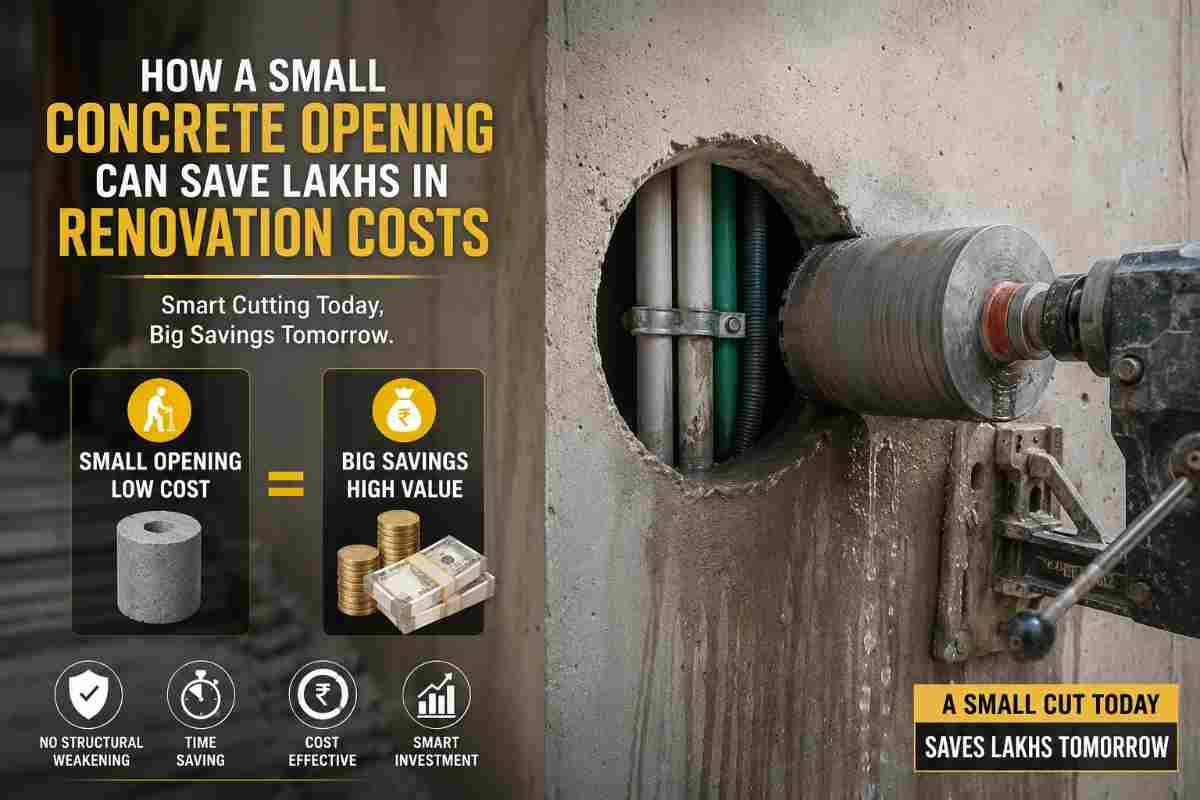
Renovation projects — whether in a home, office, hospital, or factory — often come with one unavoidable challenge: creating an opening in an existing concrete wall, slab, or beam. Traditionally, this has meant breaking, hammering, and demolishing large sections of concrete just to fit a single pipe, duct, or cable conduit. What most property owners don't realise is that this old-school approach isn't just messy and time-consuming — it's also needlessly expensive. A small, precisely cut concrete opening, created through modern core cutting techniques, can save lakhs of rupees in renovation costs while delivering a cleaner, safer, and faster result.
At Core Cutting India, we've seen this play out on hundreds of projects. A single well-placed core hole, cut with diamond precision, often replaces what would otherwise be days of demolition work, structural repair, and cleanup. In this blog, we break down exactly how this works, why it matters, and how you can apply this thinking to your next renovation.
The Hidden Cost of Traditional Demolition
When most contractors need to pass a pipe, cable, or duct through a concrete wall or slab, the default approach is manual breaking — using a hammer, chisel, or breaker machine to smash through the concrete until an opening is achieved. This method sounds simple, but it comes loaded with hidden costs:
1. Oversized openings. Manual breaking is imprecise. A job that needs a 4-inch hole often ends up as an 8- or 10-inch crater because concrete doesn't break cleanly along controlled lines. That extra material now needs to be replaced, patched, and finished — adding to material and labour costs.
2. Structural risk. Uncontrolled breaking can create micro-cracks that spread beyond the intended opening, weakening the surrounding structure. This sometimes forces engineers to recommend structural reinforcement, which can run into lakhs of rupees depending on the scale of the building.
3. Extended timelines. Breaking through reinforced concrete manually is slow, especially where steel reinforcement bars are present. Projects can stall for days, during which labour, equipment rental, and site supervision costs keep accumulating.
4. Collateral damage. Vibration from breaker machines can damage adjoining tiles, plastering, false ceilings, or fittings that have nothing to do with the actual opening required. Repairing this collateral damage is an unplanned cost that catches most renovation budgets off guard.
5. Dust, noise, and disruption. In occupied buildings — homes, offices, hospitals — traditional breaking generates enormous dust and noise, often requiring the space to be vacated, adding indirect costs like temporary relocation or business downtime.
When you add up material wastage, structural repair, labour hours, and collateral damage, a "simple" concrete opening created through demolition can spiral into a cost far beyond what the actual task required.
Enter Core Cutting: Precision Over Force
Core cutting, sometimes called diamond core drilling, is a modern construction technique that uses a diamond-tipped rotary bit to cut a precise, circular opening through concrete, brick, or masonry. Instead of smashing material away, the tool literally cuts through it — much like a drill bit through wood, but engineered for the hardness of reinforced concrete.
This process is used to create openings for:
- Plumbing and drainage pipes
- Electrical conduits and cable routing
- HVAC and AC ducting
- Fire sprinkler systems
- Structural inspection points
- Elevator shafts and staircases (for larger openings)
- Anchor bolt holes for machinery or railings
Because the cutting is guided and rotational rather than percussive, the resulting opening is clean, exact, and vibration-free. There's no guesswork about where the hole will end up or how large it will become.
Why a Small, Precise Opening Saves Lakhs
Here's where the real savings come in. Let's walk through the specific ways a small, well-planned concrete opening protects your renovation budget.
1. You Pay for Only What You Need
Core cutting machines are available in a wide range of diameters — from as small as 6mm for cable routing to over 500mm for larger duct or shaft openings. Because the size is exact, you're not paying to break, patch, and re-finish an oversized hole. If your project needs a 100mm opening for a drainage pipe, that's precisely what you get — nothing more.
2. No Structural Reinforcement Required
Uncontrolled demolition often nicks or exposes reinforcement bars (rebar), which then requires an engineer's assessment and possibly costly reinforcement work to restore structural integrity. Core cutting is done with careful pre-scanning (often using rebar detectors or GPR scanning) to avoid cutting through critical structural steel, or to cut around it cleanly when unavoidable. This alone can save the lakhs that would otherwise go into structural consultancy and repair.
3. Faster Turnaround Means Lower Labour Costs
A core cutting team can complete an opening in a matter of hours, compared to days of manual breaking for the same task, especially in reinforced concrete. Faster work directly translates to lower labour costs and less equipment rental time, and it means the rest of the renovation — flooring, painting, fitting — can proceed without long delays.
4. Minimal Collateral Damage
Because core cutting is vibration-free and contained to a defined area, there's no risk of cracks appearing in adjoining walls, no shattered tiles, and no damage to nearby finishes. This eliminates a whole category of unplanned repair costs that often blow up renovation budgets.
5. Dust Control and Cleaner Sites
Most professional core cutting services now use wet-cutting or vacuum dust-extraction systems, which drastically reduce the dust generated. This matters even more in hospitals, offices, or occupied residential spaces, where dust control isn't just about tidiness — it protects sensitive equipment, indoor air quality, and daily operations, avoiding costly downtime or cleanup.
6. No Need for Temporary Relocation
Since core cutting is quiet compared to breaker machines and produces far less dust and vibration, many renovation projects can continue with occupants still on-site or nearby. This avoids the added expense of temporarily relocating a family, shifting office operations, or pausing a factory line — a cost that's easy to underestimate until it hits the budget.
A Real-World Example
Consider a mid-sized office renovation that needs to run new HVAC ducting through three existing concrete floor slabs. Using traditional demolition, breaking three openings — one per floor — with manual tools could take 3-4 days, require patch repair on all three floors, risk hitting embedded rebar, and generate enough dust to require sealing off the work zone from daily operations for the better part of a week.
With core cutting, the same three openings, precisely sized to the duct diameter, can typically be completed in a single day, with clean, exact edges that need minimal finishing. No oversized craters. No emergency structural consultation. No week-long office disruption. When you tally the difference in labour, materials, structural review, cleanup, and lost productivity, the savings from choosing core cutting over demolition can easily run into several lakhs of rupees — particularly on larger commercial or industrial projects with multiple openings required.
When Should You Consider Core Cutting?
Core cutting isn't just for large commercial jobs — it's relevant anywhere a controlled opening is needed in concrete or masonry:
- Home renovations — adding a new bathroom, kitchen exhaust, or AC unit that requires pipe or cable routing through an existing wall or slab
- Office fit-outs — running new electrical, data, or HVAC lines through concrete floors between levels
- Industrial facilities — creating anchor points for new machinery or piping systems without disturbing surrounding structures
- Hospitals and labs — where noise, dust, and vibration must be minimised due to sensitive equipment or patient care areas
- Heritage or structurally sensitive buildings — where any unnecessary force on the structure needs to be avoided
In nearly all these cases, the smaller and more precise the opening, the lower the overall renovation cost — because the project scope stays contained to exactly what's needed.
Choosing the Right Core Cutting Partner
Not all core cutting work is equal. The savings we've described depend heavily on working with an experienced, well-equipped team that understands:
- How to read structural drawings and avoid critical rebar or post-tensioned cables
- Which diamond bit and machine specification suits the material (RCC, brick, stone, or masonry)
- How to manage dust and water runoff on occupied or sensitive sites
- How to size the opening exactly to the requirement, avoiding both undersized and oversized cuts
This is where a specialised service provider like Core Cutting India makes a measurable difference. With the right tools, trained operators, and a precision-first approach, a core cutting team can turn what used to be a costly, disruptive demolition task into a clean, fast, and budget-friendly part of your renovation.
Final Thoughts
Renovation budgets are often eaten away not by the big-ticket items everyone plans for, but by the "small" tasks that spiral out of control — like an oversized hole broken into a concrete wall that ends up needing structural repair, extra finishing, and days of extra labour. Core cutting flips this script. By using precision diamond-cutting technology to create exactly the opening you need — no more, no less — you protect your structure, your timeline, and, most importantly, your budget.
If you have an upcoming renovation that requires openings in concrete walls, slabs, or beams, it's worth asking your contractor whether core cutting is being considered, or reaching out directly to a specialist team. A small, precise cut today can be the difference between a renovation that stays on budget and one that quietly costs you lakhs more than it needed to.
For professional, precision core cutting services tailored to your renovation or construction project, visit Core Cutting India and get an on-site assessment from experienced experts.