
Concrete cutting has always been a demanding trade — equal parts precision, power, and patience. Whether it's a core drilling job for a new plumbing line, a wall-sawing project to create a doorway, or a large-scale demolition cut, the work involves heavy machinery, high vibration, airborne dust, and constant physical strain on both the operator and the equipment. For decades, contractors have relied on experience and instinct to judge when a blade is dulling, when a motor is overheating, or when vibration levels are creeping into unsafe territory.
That's changing. Smart sensors are now reshaping how concrete cutting operations are monitored, managed, and made safer. At Core Cutting India ([email protected]), we've seen firsthand how the integration of sensor-based technology is helping contractors move from reactive problem-solving to proactive, data-driven decision-making. In this article, we'll explore what smart sensors are, how they work in the context of concrete cutting, and why they're quickly becoming a must-have for modern construction and demolition companies.
What Are Smart Sensors in Concrete Cutting?
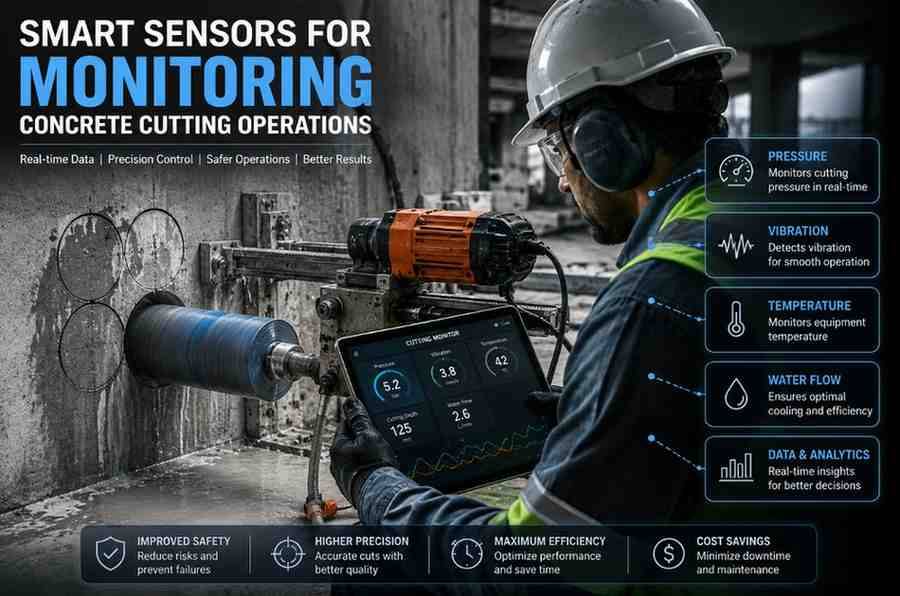
Smart sensors are compact electronic devices embedded in or attached to concrete cutting equipment — such as wall saws, wire saws, core drills, floor saws, and hand-held cutters — that continuously collect data about the machine's performance and the surrounding environment. Unlike traditional gauges that simply display a reading, smart sensors process data locally, transmit it wirelessly, and often trigger automated alerts or actions when readings move outside a safe or optimal range.
These sensors typically monitor:
- Vibration levels in the tool and the surrounding structure
- Blade or bit temperature to prevent overheating and premature wear
- Motor load and current draw to detect strain or blade dullness
- Dust particulate levels in the air near the cutting zone
- Noise levels to ensure compliance with occupational safety limits
- Water flow rate for wet-cutting applications, preventing dry-cutting damage
- Equipment position and orientation using GPS or gyroscopic sensors
- Operating hours and usage cycles for maintenance scheduling
By combining these data streams, smart sensors give operators, site supervisors, and equipment managers a real-time picture of exactly what's happening during a cutting operation — something that was previously impossible to know without constant physical inspection.
Why Concrete Cutting Needs Smarter Monitoring
Concrete cutting is inherently a high-risk, high-precision activity. A few key challenges make sensor-based monitoring especially valuable in this field:
1. Structural Safety Concerns
Cutting into reinforced concrete — especially in occupied buildings, bridges, or load-bearing walls — carries real structural risk. Excessive vibration or an incorrectly angled cut can compromise the integrity of a structure. Sensors that track vibration and cutting depth in real time allow operators to stop immediately if readings suggest a risk to the structure, rather than discovering a problem after the damage is done.
2. Operator Health and Safety
Concrete cutting exposes workers to silica dust, high noise levels, and repetitive vibration — all of which have documented long-term health effects, including silicosis and hand-arm vibration syndrome (HAVS). Regulatory bodies across the world, including in India, have tightened occupational exposure limits for these hazards. Smart sensors that continuously track dust concentration and vibration exposure help companies stay compliant while genuinely protecting their workforce.
3. Equipment Longevity and Cost Control
Concrete cutting blades, bits, and motors are expensive, and unplanned downtime on a job site can be costly. Sensors that monitor temperature, load, and wear patterns allow for predictive maintenance — replacing a blade or servicing a motor just before failure rather than after a costly breakdown mid-project.
4. Project Documentation and Accountability
On large infrastructure or commercial projects, clients and regulatory authorities increasingly expect documented proof of safe working practices. Sensor data creates an automatic, timestamped record of vibration levels, cutting parameters, and safety compliance — useful for audits, insurance claims, and dispute resolution.
Types of Smart Sensors Used in Concrete Cutting
Vibration Sensors (Accelerometers)
These are perhaps the most critical sensors in concrete cutting. Mounted on the saw or drill frame, accelerometers measure vibration frequency and amplitude in real time. This data helps prevent both operator injury (HAVS) and structural damage, and can trigger automatic shutoffs if vibration exceeds preset safety thresholds.
Temperature Sensors
Thermocouples or infrared temperature sensors monitor blade and motor heat. Since overheating is often the first sign of blade dullness, misalignment, or insufficient water cooling, early temperature alerts can prevent blade damage and reduce fire risk in dry-cutting applications.
Load and Current Sensors
By monitoring the electrical current drawn by a saw's motor, load sensors can detect when a blade is struggling against rebar or aggregate, indicating it may need replacing or that cutting speed should be adjusted.
Dust and Air Quality Sensors
Particulate matter (PM2.5/PM10) sensors placed near the cutting zone measure airborne silica dust in real time. When paired with automated water suppression systems, these sensors can trigger dust suppression sprays automatically when levels rise — a major advancement in respiratory health protection.
Noise Sensors
Decibel meters integrated into job-site monitoring systems track noise exposure over a shift, helping companies ensure workers stay within safe daily exposure limits and rotate tasks accordingly.
GPS and Positioning Sensors
For large-scale or multi-site operations, GPS-enabled sensors track equipment location, movement, and usage patterns — useful for fleet management, theft prevention, and verifying that cuts are being made in the correct location according to structural drawings.
Water Flow Sensors
In wet-cutting operations, consistent water flow is essential for cooling the blade and suppressing dust. Flow sensors alert operators immediately if water supply drops or stops, preventing dry-cutting damage to both the blade and the surrounding concrete.
How Smart Sensor Data Is Used On-Site
Collecting data is only half the story — the real value comes from how that data is processed and acted upon. Most modern sensor systems used in concrete cutting rely on a few key components:
- Wireless connectivity (Bluetooth, Wi-Fi, or LoRaWAN) to transmit data from the cutting equipment to a central hub or cloud platform without interrupting the work.
- Edge processing built into the sensor itself, allowing it to make instant decisions (like triggering an automatic shutoff) without waiting for cloud confirmation.
- Cloud dashboards and mobile apps that give site managers and remote supervisors a live view of ongoing operations across multiple job sites.
- Automated alerts via SMS, app notifications, or on-site alarms when readings cross safety or performance thresholds.
- Historical data logging for compliance reporting, maintenance scheduling, and performance analysis over time.
This means a project manager sitting in an office can now monitor vibration levels, dust exposure, and equipment health across several active cutting sites simultaneously — something that would have required physical presence at each location just a few years ago.
Benefits of Smart Sensor Integration in Concrete Cutting
- Enhanced worker safety through real-time exposure monitoring and automatic hazard alerts
- Reduced structural risk by catching excessive vibration or incorrect cutting parameters instantly
- Lower equipment costs through predictive maintenance rather than reactive repairs
- Improved project efficiency as operators spend less time on manual inspections and guesswork
- Stronger regulatory compliance with automatic, auditable safety records
- Better client confidence as documented, data-backed safety practices become a competitive advantage
- Reduced environmental impact through optimized water usage and dust control
Challenges and Considerations
While the benefits are substantial, adopting smart sensor technology does come with practical considerations. Initial setup costs, the need for reliable connectivity on remote or underground sites, sensor calibration, and training operators to interpret and respond to sensor data are all factors that companies need to plan for. Dust, heat, and constant vibration on a concrete cutting site are also harsh conditions for electronics, so sensors used in this environment need to be ruggedized and properly rated for industrial use.
That said, as sensor hardware becomes more affordable and construction-specific IoT platforms mature, these barriers are steadily coming down — making smart monitoring accessible even for mid-sized contractors, not just large infrastructure firms.
The Road Ahead: Smart Sensors and the Future of Concrete Cutting
The concrete cutting industry is moving toward increasingly connected, data-driven operations. In the coming years, we can expect to see tighter integration between smart sensors and building information modeling (BIM) systems, allowing cutting operations to be planned and verified against digital structural models in real time. Artificial intelligence is also beginning to play a role — using historical sensor data to predict blade wear, recommend optimal cutting speeds, and flag potential structural risks before a cut is even made.
For contractors, this shift represents more than just a technology upgrade. It's a fundamental change in how concrete cutting projects are planned, executed, and documented — with safety, efficiency, and accountability built into every cut.
Partner With Core Cutting India
At Core Cutting India, we combine skilled craftsmanship with the latest advancements in cutting technology to deliver safe, precise, and efficient concrete cutting services. Whether you're managing a small renovation project or a large-scale infrastructure job, our team understands how modern monitoring tools can make every cut safer and more reliable.
To learn more about our services or to discuss how smart sensor-monitored concrete cutting can benefit your next project, reach out to us at [email protected].
People Also Ask
1. What are smart sensors used for in construction? Smart sensors in construction are used to monitor equipment performance, structural safety, worker exposure to hazards (like dust, noise, and vibration), and environmental conditions in real time, helping teams make faster, safer, and more informed decisions on-site.
2. How do sensors improve safety in concrete cutting? Sensors track vibration, temperature, dust, and noise levels during cutting operations, sending instant alerts or triggering automatic shutdowns when readings exceed safe limits, reducing the risk of injury and structural damage.
3. Can smart sensors reduce dust and noise pollution during cutting? Yes. Dust sensors can trigger automated water suppression systems when particulate levels rise, while noise sensors help track and manage worker exposure, supporting compliance with occupational health regulations.
4. What is predictive maintenance in concrete cutting equipment? Predictive maintenance uses sensor data — such as motor load, temperature, and vibration patterns — to anticipate equipment wear or failure before it happens, allowing for timely servicing and reducing unplanned downtime.
5. How much do smart sensors cost for construction equipment? Costs vary widely depending on sensor type, connectivity, and platform integration, ranging from basic standalone sensors to comprehensive IoT monitoring systems. Contacting a specialist provider like Core Cutting India can help determine the right setup for your budget and project scale.
6. Are smart sensors suitable for small-scale concrete cutting projects? Yes. As sensor technology becomes more affordable, even small and mid-sized contractors can adopt basic monitoring tools for vibration, dust, and equipment health, improving safety without a major upfront investment.