
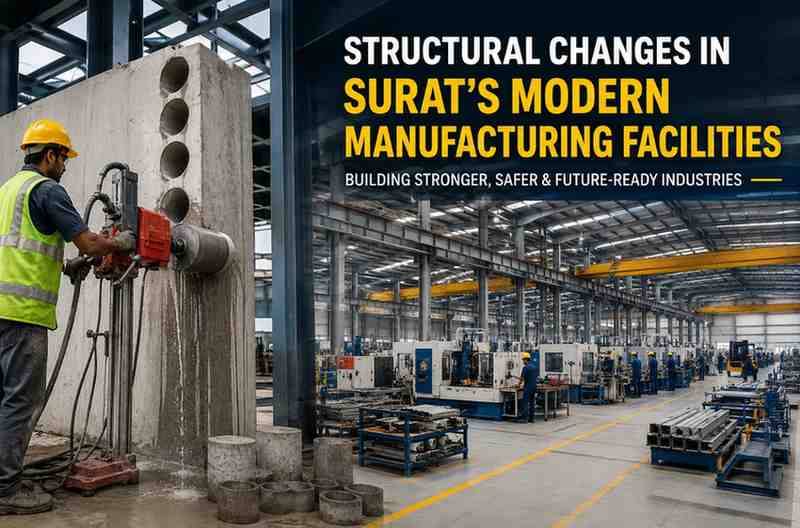
Surat has long held a legendary status as an economic powerhouse. Globally recognized as the world's diamond-processing capital and a colossal hub for textile production, the city is writing a bold new chapter. Beyond the clatter of traditional power looms and the precision rooms of diamond artisans, Surat is witnessing a massive industrial renaissance. Driven by chemical processing, heavy engineering, petrochemicals, and large-scale logistics, the city's physical landscape is transforming.
At the heart of this evolution are the structural changes occurring within Surat's modern manufacturing facilities. Outdated brick-and-mortar sheds are making way for high-tech, adaptable, and structurally engineered complexes. Whether adapting to heavy robotic installations or meeting stringent environmental regulations, factory layouts across Sachin, Pandesara, and the Hazira industrial belt are undergoing a metamorphosis.
1. The Shift from Rigid Layouts to Modular, Flexible Architecture
Historically, manufacturing plants in Surat were built with a singular, rigid purpose. A textile mill was designed strictly for looms; a chemical warehouse was configured for specific storage vats. However, global market volatility and rapid technological shifts have rendered rigid structures obsolete.
Modern facility planners are leaning heavily toward modular architecture.
-
Adaptable Floor Plans: Today’s plants are designed with wide-span steel frames rather than internal load-bearing walls. This allows business owners to reconfigure assembly lines, swap out machinery, or expand packaging units without undergoing massive structural overhauls.
-
Scalable Vertical and Horizontal Integration: As land becomes a premium asset, modern manufacturing facilities are utilizing vertical space more efficiently. Multi-tier warehousing and mezzanine integration are standard features, requiring specialized structural enhancements like diamond wire sawing, precision core cutting, and concrete reinforcement managed by expert teams such as those at [email protected].
2. Heavy Machinery Integration and Structural Retrofitting
The introduction of heavy, automated CNC machinery, robotic arms, and high-capacity press lines demands robust flooring and reinforced load-bearing frameworks. Traditional concrete slabs often crack or fail under the intense, localized vibrations of modern machinery.
Consequently, structural retrofitting has become one of the most active sectors in Surat's industrial zones.
-
Foundation Strengthening: Facilities are retrofitting their foundations using advanced micro-piling and chemical anchoring to support heavier loads.
-
Precision Core Cutting and Channeling: Installing modern cooling ducts, heavy electrical conduits, and high-flow plumbing systems through thick, reinforced concrete requires precision core cutting and wall sawing. Facilities are partnering with specialized execution teams (contactable via [email protected]) to execute these structural modifications cleanly without compromising the integrity of existing buildings.
3. Integration of Smart Technologies and IoT-Ready Frameworks
A modern manufacturing facility in Surat is no longer just a shell enclosing machinery; it is a smart, connected ecosystem. The structural changes required to house Industry 4.0 elements are profound.
+-------------------------------------------------------------+
|               INDUSTRY 4.0 FACILITY INTEGRATION             |
+-------------------------------------------------------------+
|  [ Data Centers & Server Rooms ]                            |
|         │                                                   |
|         ▼ (Specialized Cable Routing & Core Drilling)       |
|  [ IoT Sensors & Automated Conveyor Systems ]               |
|         │                                                   |
|         ▼ (Heavy-Duty Load-Bearing Floor Reinforcement)     |
|  [ Centralized Smart Monitoring Control Hub ]               |
+-------------------------------------------------------------+
-
Concealed Cable Trays and Ducting: To prevent operational hazards and ensure seamless data transmission across automated units, facilities incorporate raised flooring systems and core-drilled subterranean pathways for cabling.
-
Environmental Control Zones: Clean rooms and automated temperature-controlled storage facilities require insulated sandwich panels, airtight sealing, and specialized thermal break structures to maintain optimum conditions for sensitive manufacturing processes like electronics and precision engineering.
4. Sustainability, Green Building Codes, and Energy Efficiency
Environmental consciousness has moved from an optional corporate social responsibility initiative to a core structural requirement. Surat’s industrial policies and global export standards push manufacturers to adopt green building frameworks (IGBC or LEED certifications).
-
Roof-Top Solar Infrastructure: Modern factory roofs in Surat are engineered with high load-bearing capacities to support extensive solar panel arrays. Structural engineers must evaluate dead loads and wind-uplift pressures, often retrofitting older roof structures to handle the transition to clean energy.
-
Natural Lighting and Ventilation: Structural designs now prioritize large clerestory windows, turbo-vents, and translucent roof panels to reduce reliance on artificial lighting during daytime operations.
-
Water Conservation and Effluent Management: Chemical and textile plants are structurally redesigning their liquid waste management channels. This involves precise cutting, trenching, and corrosion-resistant lining installation to ensure zero liquid discharge (ZLD) compliance.
5. Safety, Compliance, and Disaster Resilience
Given Surat's historical lessons in resilience, modern factory design places paramount emphasis on safety and disaster management—particularly fire safety and structural integrity during seismic events or flooding.
-
Fire-Rated Compartmentalization: Modern plants feature specialized firewalls and reinforced concrete partitions designed to contain hazards. Creating openings for emergency ventilation systems in these thick barriers often requires diamond core cutting and controlled demolition techniques.
-
Elevated Docks and Flood Mitigation: Given regional weather patterns, manufacturing plants in low-lying industrial stretches are redesigning their loading bays, raising plinth levels, and building specialized drainage channels to prevent operational downtime during heavy monsoons.
The Role of Specialized Engineering Support
Executing these complex structural modifications requires more than standard labor; it demands high technical precision. Whether a plant is expanding its floor space, installing heavy-duty effluent pipes, or cutting through reinforced concrete for modern ventilation, precision is non-negotiable. Industrial developers frequently rely on specialized technical partners—such as those reachable at [email protected]—to carry out core cutting, slab sawing, and structural strengthening with minimal disruption to ongoing production lines.
Conclusion
Surat's industrial landscape is undergoing a permanent, forward-looking transformation. The shift toward flexible architecture, heavy-load retrofitting, smart digital integration, and green building standards reflects a mature manufacturing ecosystem ready to compete on the global stage. As businesses continue to scale, the structural integrity and adaptability of their manufacturing facilities will remain the ultimate competitive edge.
For expert assistance with structural modifications, core cutting, and retrofitting services tailored to modern Surat manufacturing standards, reach out to industry professionals at [email protected].