
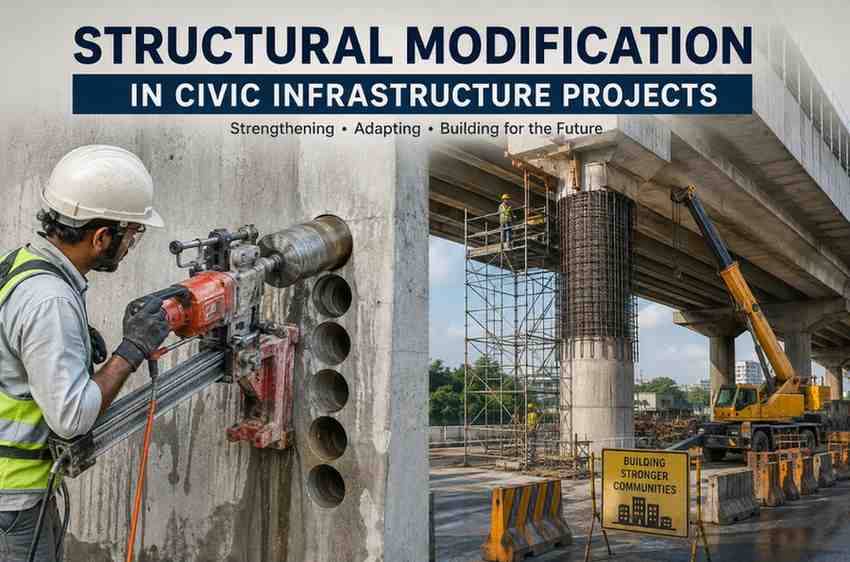
Civic infrastructure is the backbone of every growing city. Roads, bridges, drainage systems, water supply networks, metro corridors, and public buildings all need to evolve as cities expand, populations grow, and technology advances. This evolution rarely happens through demolition and rebuilding alone. More often, it happens through structural modification — the precise, engineered alteration of existing concrete and structural elements to accommodate new requirements without compromising safety or integrity.
At Core Cutting India ([email protected]), we specialize in exactly this kind of precision work. From diamond core drilling to controlled concrete cutting, our teams support civic bodies, contractors, and infrastructure developers across India in modifying structures safely, efficiently, and in compliance with engineering standards. In this blog, we take a deep dive into what structural modification really means in the context of civic infrastructure, why it matters, the techniques involved, and how the right partner can make all the difference.
What Is Structural Modification in Civic Infrastructure?
Structural modification refers to any planned change made to an existing structural element — a wall, slab, column, beam, or foundation — to alter its function, capacity, or configuration. In civic infrastructure projects, this could mean:
- Cutting openings into concrete slabs for new utility lines
- Widening roads by modifying existing culverts or retaining walls
- Creating access points in bridges or flyovers for inspection and maintenance
- Installing new drainage or sewage connections through existing structures
- Modifying government buildings to add elevators, ramps, or additional floors
- Retrofitting old structures to meet updated seismic or safety codes
Unlike new construction, structural modification works within the constraints of an existing structure. This means every cut, drill, or alteration has to be planned around the load-bearing capacity of the structure, the presence of reinforcement (rebar), and the impact on surrounding elements. A single miscalculation can compromise structural integrity, which is why this work demands specialized expertise, not generic demolition.
Why Structural Modification Matters for Civic Projects
Cities are living systems. Infrastructure built decades ago often cannot meet the demands of modern traffic, population density, or technology. Rather than tearing down and rebuilding — which is expensive, disruptive, and resource-intensive — structural modification allows civic bodies to:
1. Extend the Lifespan of Existing Assets Bridges, flyovers, and public buildings represent enormous public investment. Structural modification allows these assets to be upgraded and reused instead of replaced, saving both money and construction time.
2. Adapt to Changing Urban Needs As cities grow, infrastructure must accommodate new utility lines, additional traffic lanes, accessibility features, and updated safety systems. Structural modification makes this adaptation possible without disrupting the entire structure.
3. Improve Safety and Compliance Older structures were often built under outdated codes. Structural modification, including retrofitting, helps bring these structures up to current seismic, fire, and load-bearing standards.
4. Minimize Public Disruption Civic infrastructure — roads, bridges, water systems — cannot simply be shut down for months at a time. Targeted structural modification allows engineers to make precise changes with minimal disruption to public life, unlike full-scale demolition and reconstruction.
5. Support Sustainable Development Reusing and modifying existing structures reduces construction waste and the carbon footprint associated with producing new concrete and steel, aligning with sustainable urban development goals.
Common Techniques Used in Structural Modification
Structural modification in civic infrastructure relies on a combination of precision cutting, drilling, and reinforcement techniques. Some of the most widely used methods include:
1. Diamond Core Drilling
Diamond core drilling is used to create clean, precise circular holes through concrete, brick, or stone for utility penetrations, pipe installations, cable routing, or inspection access. Because diamond-tipped bits generate minimal vibration, this method is ideal for working near sensitive structural elements without causing micro-cracks or stress fractures.
2. Wall and Slab Sawing
Wall sawing and slab sawing use diamond-bladed saws to cut straight, controlled lines through vertical and horizontal concrete surfaces. This technique is commonly used to create doorways, windows, expansion joints, or access openings in walls and floors during civic building modifications.
3. Wire Sawing
For thicker or more complex structural elements — such as bridge piers, large columns, or foundations — wire sawing offers a flexible, high-precision cutting method. A diamond-embedded wire loop cuts through even heavily reinforced concrete with controlled accuracy, making it valuable for bridge and flyover modification projects.
4. Controlled Demolition and Selective Cutting
Rather than demolishing an entire structure, selective cutting allows specific sections to be removed while preserving the rest. This is essential in occupied buildings, active roads, and operational public utilities where full demolition isn't feasible.
5. Structural Strengthening and Retrofitting
Once modifications are made, structural strengthening techniques — such as carbon fiber reinforcement, jacketing, or steel plate bonding — are often applied to restore or enhance the load-bearing capacity of the modified structure.
6. Non-Destructive Testing (NDT)
Before any cutting or drilling begins, non-destructive testing methods like ground-penetrating radar (GPR) and rebar scanning are used to map the internal reinforcement and utilities within a structure. This step is critical in civic projects, where cutting through a live electrical conduit or a primary structural rebar could have serious consequences.
The Process: How Structural Modification Projects Are Executed
A well-managed structural modification project in civic infrastructure typically follows these stages:
1. Site Assessment and Structural Survey Engineers assess the existing structure, review original construction drawings if available, and identify load-bearing elements that must be preserved.
2. Scanning and Mapping Using GPR and rebar detection tools, the team maps out reinforcement, embedded utilities, and potential hazards before any cutting begins.
3. Engineering Approval For civic infrastructure, modifications typically require sign-off from structural engineers and, in many cases, approval from municipal or government authorities to ensure compliance with safety codes.
4. Precision Cutting or Drilling Using the appropriate technique — core drilling, wall sawing, or wire sawing — the modification is executed with minimal vibration and dust, especially important in occupied or public spaces.
5. Reinforcement and Finishing If required, the modified area is reinforced using strengthening techniques to restore structural capacity, followed by finishing work to integrate the modification seamlessly.
6. Quality Checks and Handover A final inspection confirms that the modification meets structural and safety standards before the site is handed back for use.
Challenges Unique to Civic Infrastructure Modification
Civic infrastructure projects come with challenges that differ significantly from private construction:
- Public Safety: Roads, bridges, and public buildings often remain in use during modification work, requiring extremely careful planning to avoid accidents.
- Regulatory Compliance: Government infrastructure is subject to strict codes, approvals, and inspections at multiple stages.
- Minimal Downtime: Civic services like water supply and drainage cannot be disrupted for long periods, demanding fast, efficient execution.
- Aging Structures: Many civic structures are decades old, with undocumented modifications or deteriorated materials that require extra caution.
- Coordination with Multiple Stakeholders: Civic projects often involve municipal bodies, contractors, utility companies, and the public, requiring careful coordination.
This is precisely where an experienced structural modification partner becomes invaluable — not just for technical execution, but for navigating the complexity of working within live public infrastructure.
Why Choose Core Cutting India for Structural Modification
At Core Cutting India, we bring specialized expertise in diamond core drilling, concrete cutting, and structural modification services tailored specifically for civic and infrastructure projects. Our approach combines:
- Advanced diamond cutting and drilling equipment for precision and minimal disruption
- Non-destructive scanning to protect existing reinforcement and utilities
- Experienced engineers who understand the regulatory landscape of civic projects
- Dust and vibration control methods suited for occupied public spaces
- A strong safety-first approach aligned with civic infrastructure standards
Whether it's creating utility access points in a municipal building, modifying a bridge for maintenance access, or retrofitting an aging public structure, our team is equipped to handle the technical and logistical demands of civic infrastructure work.
Frequently Asked Questions
What is structural modification in civil engineering? Structural modification refers to the planned alteration of an existing structural element — such as a wall, slab, beam, or column — to change its function, capacity, or configuration while preserving overall structural integrity.
Why is structural modification important in civic infrastructure? It allows aging or outdated infrastructure to be adapted to modern needs — such as new utilities, accessibility features, or safety upgrades — without the cost and disruption of full demolition and reconstruction.
What techniques are used for structural modification? Common techniques include diamond core drilling, wall and slab sawing, wire sawing, selective demolition, and structural strengthening methods such as jacketing and carbon fiber reinforcement.
Is core cutting safe for load-bearing structures? Yes, when performed by trained professionals using proper scanning and engineering assessment. Identifying reinforcement and load paths beforehand is essential to ensure the structure's integrity is preserved.
How much does structural modification cost in India? Costs vary widely depending on the scale, technique, structural complexity, and location of the project. It's best to request a site assessment for an accurate estimate.
What is the difference between retrofitting and structural modification? Retrofitting specifically refers to strengthening an existing structure to meet updated safety or seismic standards, while structural modification is a broader term that includes any alteration to a structure's form or function, including retrofitting.
Who approves structural modification in government infrastructure projects? Approvals typically come from municipal engineering departments, structural consultants, and relevant government authorities, depending on the scale and nature of the civic project.
Conclusion
Structural modification is quietly shaping the future of our cities — enabling infrastructure to grow, adapt, and stay safe without the enormous cost of complete reconstruction. From bridges and roads to municipal buildings and utility networks, precision cutting and drilling techniques are making it possible to modernize civic assets while keeping them in service.
For civic bodies, contractors, and infrastructure developers looking for a reliable partner in structural modification, Core Cutting India offers the technical expertise, equipment, and safety standards needed to execute these projects successfully. Reach out to us at [email protected] to discuss your next civic infrastructure modification project.