
Introduction
Smart homes are no longer a futuristic concept — they are becoming the standard for modern residential and commercial construction across India. From automated lighting and climate control to integrated security systems, voice-activated assistants, and centralized energy management, today's homes are wired for intelligence. But behind every seamless smart home installation lies a less glamorous, highly technical process: the creation of precise structural openings in walls, floors, and ceilings.
At Core Cutting India ([email protected]), we specialize in exactly this — providing accurate, safe, and non-disruptive structural openings that make smart home integration possible. In this blog, we'll explore what structural openings are, why they matter for smart home installations, the methods used to create them, and how professional core cutting services ensure your automation project goes off without a hitch.
What Are Structural Openings?
A structural opening refers to a precisely cut hole, channel, or cavity made in a building's structural elements — such as concrete walls, RCC slabs, brick masonry, or flooring — to allow the passage of cables, conduits, pipes, or equipment. Unlike random drilling, structural openings are planned with engineering precision to avoid compromising the load-bearing capacity of the structure.
For smart home installations, structural openings serve as the physical pathways through which electrical wiring, low-voltage cabling, fiber optics, HVAC ducts, and sensor wiring travel from one point of the house to another. Without well-executed openings, even the most advanced smart home technology cannot be properly installed or concealed.
Why Structural Openings Matter for Smart Home Installations
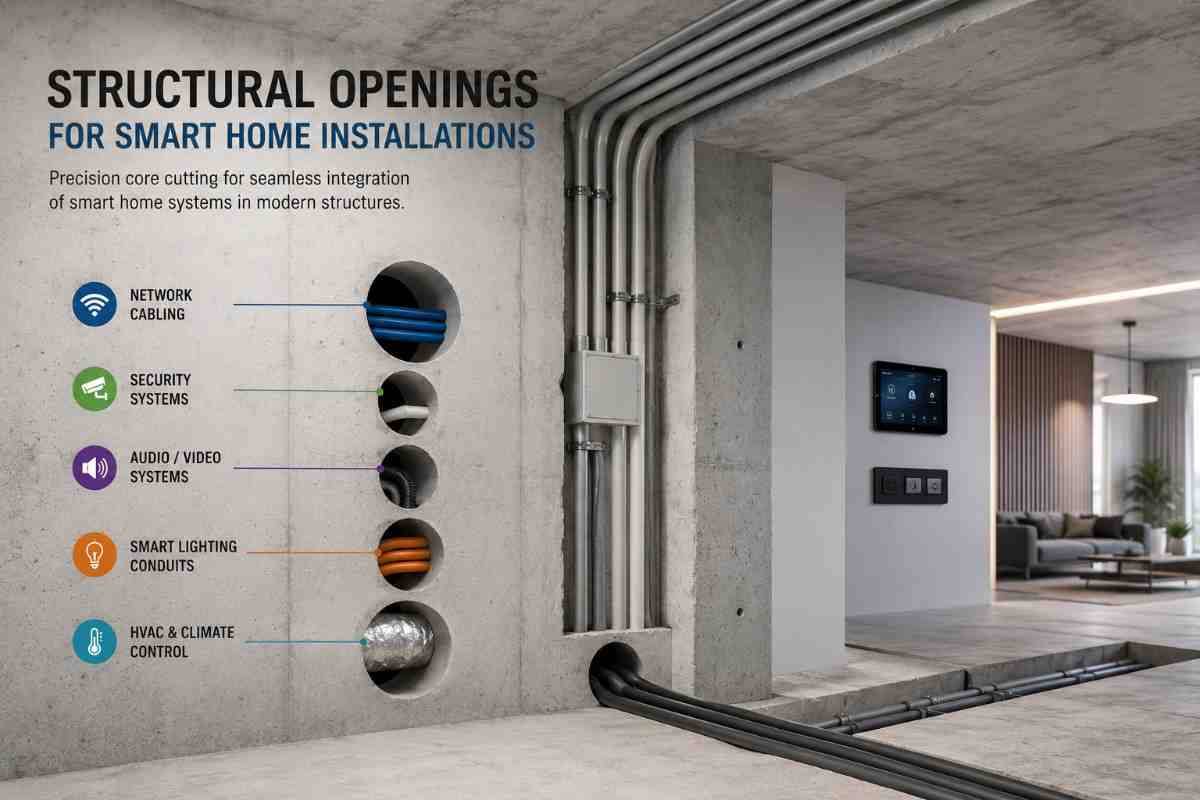
Smart homes rely on an extensive, often invisible, network of cabling and conduits. Every smart thermostat, security camera, motion sensor, smart lock, and centralized hub needs a dedicated wiring path. Here's why getting the structural opening process right is so critical:
1. Seamless Aesthetic Integration
Homeowners want their smart devices to blend into the architecture — not dangle from exposed wires or unsightly trunking. Precisely placed structural openings allow cables to run invisibly through walls and floors, keeping the finished look clean and professional.
2. Structural Safety
Cutting into concrete or masonry without proper planning can weaken load-bearing walls, slabs, or beams. Professional core cutting services use non-destructive techniques and structural assessments to ensure openings do not compromise the building's integrity.
3. Efficient Cable Management
Smart homes often require multiple types of cabling — CAT6 for networking, coaxial for entertainment systems, low-voltage wiring for sensors, and power cables for smart panels. Well-planned structural openings create organized pathways that prevent future maintenance headaches.
4. Retrofit Compatibility
Not every smart home project starts from scratch. Many homeowners retrofit existing properties with automation systems. In these cases, structural openings must be created with minimal disruption to existing finishes, plumbing, and electrical systems — a task that demands specialized core cutting expertise.
5. Future-Proofing
As smart home ecosystems expand, additional openings may be required for new devices. Professionally executed structural openings, done with scalability in mind, make future upgrades far easier.
Common Methods Used to Create Structural Openings
Professional contractors like Core Cutting India use a range of specialized techniques depending on the material, location, and purpose of the opening.
Diamond Core Drilling
Core drilling uses a diamond-tipped hollow bit to bore precise, clean, circular holes through concrete, brick, or stone. This method is ideal for creating openings for conduit pipes, cable bundles, HVAC lines, and plumbing runs in smart home projects. It produces minimal dust, reduced vibration, and highly accurate results — essential when working around existing structural reinforcement.
Wall Sawing
For larger rectangular or linear openings — such as those needed for centralized smart panels, home automation control boxes, or larger equipment housings — wall sawing is used. This technique employs a diamond blade to cut straight, controlled lines through concrete or masonry walls.
Wall Chasing (Channeling)
Wall chasing involves cutting narrow grooves into walls to embed electrical conduits and low-voltage cabling flush with the surface. This is particularly useful for smart lighting circuits, sensor wiring, and networking cables that need to be hidden before plastering or finishing.
Floor Coring
For multi-story smart homes, floor coring allows cabling to pass vertically between levels — connecting ground-floor control hubs to upper-floor devices, or linking rooftop solar and security systems to indoor panels.
Non-Destructive Scanning Before Cutting
Before any cutting begins, professional teams use tools like ground-penetrating radar (GPR) or rebar scanners to detect embedded steel reinforcement, electrical lines, and plumbing. This step is crucial to avoid damaging critical infrastructure and to ensure the structural opening is placed safely.
The Structural Opening Process for a Smart Home Project
- Site Assessment and Planning – Engineers review architectural drawings and smart home wiring diagrams to identify optimal opening locations.
- Scanning for Embedded Utilities – Concrete scanning tools detect rebar, conduits, and pipes to avoid structural or utility damage.
- Marking and Layout – Precise measurements are marked on walls, floors, or ceilings based on the automation system's cabling requirements.
- Core Drilling or Sawing – Using diamond-tipped equipment, openings are cut to the exact diameter or dimension required.
- Debris and Dust Management – Wet-cutting techniques and vacuum extraction systems minimize mess and airborne dust, keeping the work area clean.
- Quality Inspection – Each opening is inspected for accuracy, smooth edges, and structural safety before handover to electricians or automation installers.
- Sealing and Finishing – Post-installation, openings are sealed, fire-stopped where required, and finished to match the surrounding surface.
Applications of Structural Openings in Smart Home Systems
- Smart Lighting Circuits – Chased wall channels for dimmable and app-controlled lighting wiring.
- Home Security and CCTV – Core-drilled openings for camera cabling through exterior and interior walls.
- Smart HVAC and Climate Control – Openings for sensor wiring connected to centralized thermostats.
- Networking Infrastructure – Core-cut pathways for CAT6/fiber cabling supporting Wi-Fi mesh systems and smart hubs.
- Access Control Systems – Precision openings for smart locks, video doorbells, and intercom wiring.
- Home Theater and Entertainment – Wall openings for concealed speaker wiring and AV cabling.
- Solar and Energy Management – Floor and roof openings for cabling between solar panels, inverters, and smart energy meters.
Why Choose Professional Core Cutting Services
Attempting structural openings without professional expertise can lead to serious risks: cracked walls, severed electrical lines, weakened load-bearing structures, and costly repairs. Professional core cutting companies bring several advantages to smart home projects:
- Precision Equipment – Diamond core drills and saws deliver clean, accurate cuts with minimal vibration.
- Structural Expertise – Trained technicians understand load-bearing considerations and building codes.
- Utility Scanning – Advanced detection tools prevent accidental damage to embedded wiring or pipes.
- Dust and Debris Control – Wet-cutting and vacuum systems keep job sites clean, especially important in occupied homes.
- Time Efficiency – Experienced teams complete openings faster, reducing overall project timelines for automation installers and electricians.
- Safety Compliance – Professional teams follow safety protocols to protect both workers and residents during the cutting process.
Choosing the Right Partner for Your Smart Home Project
When planning a smart home installation — whether new construction or a retrofit — coordinating with a specialized core cutting contractor early in the process saves time, money, and stress. At Core Cutting India, our team works closely with architects, electricians, and smart home integrators to plan and execute structural openings that align perfectly with automation blueprints.
We offer:
- Diamond core drilling for conduit and cable pathways
- Wall sawing for control panels and equipment recesses
- Wall chasing for concealed wiring
- Floor and slab coring for multi-level cabling
- Non-destructive scanning to protect existing structures
- Clean, dust-controlled execution suitable for occupied residences
Whether you're building a new smart home from the ground up or upgrading an existing property with automation technology, precise structural openings are the foundation of a successful, clutter-free installation.
Conclusion
Structural openings may not be the most visible part of a smart home, but they are among the most important. They determine how cleanly your automation system integrates into your living space, how safely your building's structure is preserved, and how easily your system can be expanded in the future. Partnering with an experienced core cutting company ensures that every hole, channel, or cavity is cut with precision, safety, and your smart home's long-term functionality in mind.
For expert structural opening services tailored to smart home installations, reach out to Core Cutting India at [email protected]. Let our precision cutting expertise lay the groundwork for your smarter, more connected home.