
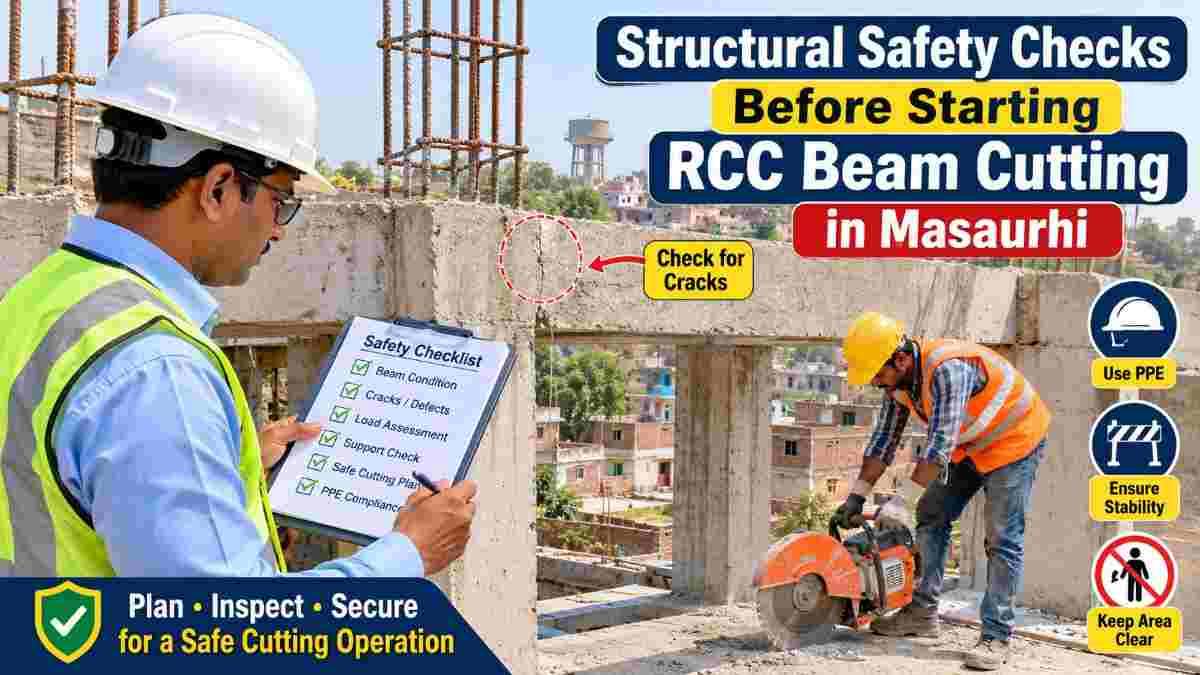
RCC (Reinforced Cement Concrete) beams form the primary skeletal matrix of any modern building. They endure immense compressive forces through high-grade concrete and handle tensile stresses using embedded steel rebar networks. Whether executing commercial structural modifications, installing retrofitted HVAC ductwork, or expanding residential layouts in Masaurhi, cutting an RCC beam is never a simple demolition task. It is a precise surgical operation on a load-bearing member.
Cutting into an RCC structural element without conducting preliminary diagnostic checks risks local cracking, progressive structural deflection, and catastrophic failure. Executing safe concrete alteration requires strict adherence to engineering standards, structural scanning, temporary shoring, and advanced diamond-edge cutting tools.
To plan your structural alteration safely or consult with field engineers, contact Core Cutting India directly at +91 70096 79903 or visit https://corecuttingindia.com/.
1. Understanding the Structural Role of RCC Beams
Before making a single cut into a concrete beam, field technicians and site supervisors must understand the load paths running through the building. Beams absorb dead loads (weight of slabs, masonry walls, and structural elements) and live loads (occupants, furniture, and environmental forces), transferring them horizontally into vertical columns and down to the foundations.
       [ Dead & Live Slabs Loads ]
                  │
                  ▼
         ┌──────────────────┐
         │     RCC BEAM     │  ◄── (Compressive Zone Top / Tensile Zone Bottom)
         └────────┬─────────┘
                  │
                  ▼
        ┌───────────────────┐
        │ Vertical Columns  │
        └─────────┬─────────┘
                  │
                  ▼
         ┌─────────────────┐
         │   Foundations   │
         └─────────────────┘
An RCC beam features two distinct zones under standard bending moments:
-
Compressive Zone (Top Portion): Concrete handles the down-force loads squeezing the upper section.
-
Tensile Zone (Bottom Portion): High-tensile steel rebars absorb forces pulling the lower section apart.
-
Shear Stress Zones (Near Supports): Diagonal tension builds near beam-column joints, where stirrups (shear ties) prevent diagonal cracking.
Cutting steel rebar in the tensile zone or severing shear stirrups near a support joint drastically alters the structural mechanics of the building. In places like Masaurhi—where buildings host mixed-use residential and commercial loads—cutting an RCC member without proper safety checks degrades structural integrity across connected spans.
2. Pre-Cutting Pre-requisites & Engineering Approvals
Modifying structural concrete requires methodical preparation. Proceeding without written structural verification creates severe liability and site hazards.
Structural Audit & Original Blueprint Analysis
-
Blueprints Verification: Review original structural drawings to determine the design intent, rebar diameter, stirrup spacing, concrete grade (e.g., M20, M25, M30), and clear span distance.
-
Structural Engineer Sign-off: A licensed structural engineer must evaluate whether the proposed cut or core penetration is permissible, specify alternative load paths, and stamp the site execution strategy.
-
Field Visual Inspection: Inspect the target beam for pre-existing micro-cracks, spalling, concrete carbonation, or visible rebar corrosion before placing heavy machinery on site.
3. Sub-Surface Scanning and Mapping Technologies
Never cut blindly into reinforced concrete. Visual inspection cannot reveal internal rebar layout, post-tensioned cables, embedded electrical conduits, or plumbing lines.
| Scanning Technology | Detection Capabilities | Maximum Depth | Primary Application |
| Ground Penetrating Radar (GPR) | Rebar layers, post-tension cables, PVC/metal conduits, air voids | Up to 18–24 inches (450–600 mm) | High-resolution 3D mapping of dense rebar matrix |
| Covermeter / Ferroscan | Ferromagnetic metals, precise concrete cover depth, rebar diameter | Up to 4–6 inches (100–150 mm) | Quick rebar localization and concrete cover measurement |
| X-Ray Radiography | High-density internal imaging showing rebar overlaps and flaws | Full thickness dependent on source | High-security nuclear or heavy industrial applications |
Using high-frequency GPR scanning allows technicians to map out clear zones for diamond core drilling or wire saw tracking, ensuring critical primary steel is not inadvertently severed unless explicitly directed by structural calculations.
4. Temporary Shoring and Load Re-Routing Protocols
When an RCC beam is designated for partial sectioning or total removal, the load carried by that member must be transferred elsewhere before cutting begins.
 ┌─────────────────────────────────────────────────────────┐
 │                   OVERHEAD RCC SLAB                     │
 └──────┬──────────────────────┬────────────────────┬──────┘
        │                      │                    │
   ┌────┴────┐            ┌────┴────┐          ┌────┴────┐
   │ Heavy   │            │  Heavy  │          │ Heavy   │
   │ Duty    │            │  Duty   │          │ Duty    │
   │ Prop    │            │  Prop   │          │ Prop    │
   └────┬────┘            └────┬────┘          └────┬────┘
        │                      │                    │
 ───────┴──────────────────────┴────────────────────┴───────
                    TEMPORARY LOAD DISTRIBUTOR
Temporary Support Installation Steps
-
Calculate Tributary Loads: Determine the exact weight of the overhead slab and incoming joists acting on the target section.
-
Erect Heavy-Duty Steel Props: Install adjustable hydraulic or mechanical steel props (acrow props) directly under adjacent slab bays on both sides of the cut line.
-
Sole Plates and Head Plates: Place thick timber or steel spreader beams under the prop bases to distribute point loads across sub-floors, avoiding floor-slab punch-through.
-
Pre-loading Props: Tighten props to engage load transfer active before cutting starts, minimizing sag or deflection in adjacent spans during concrete sectioning.
5. Modern RCC Beam Cutting Methodologies
Using destructive manual hammers or jackhammers to remove RCC structural members introduces intense micro-vibrations. These shocks induce micro-fractures in surrounding structural bays, break concrete-to-rebar bonds, and create noise and dust. Modern structural alterations demand non-destructive, diamond-based tools.
A. Diamond Wall Sawing
-
Mechanism: Uses a track-mounted diamond blade driven by high-torque hydraulic or electric motors.
-
Advantages: Produces straight, clean cuts up to 730 mm deep with zero vibration. Leaves clean edges that require no patching.
-
Ideal Usage: Sectioning deep RCC beams into manageable blocks for crane removal.
B. Diamond Wire Sawing
-
Mechanism: A flexible steel cable impregnated with industrial diamond beads loops around large concrete structures and pulls continuously under tension.
-
Advantages: Unlimited cutting depth; can slice through complex, heavily reinforced structural concrete members, bridge piers, and thick foundation beams.
-
Ideal Usage: Heavy industrial RCC beam sectioning where blade diameter is insufficient.
C. Stitch Core Drilling
-
Mechanism: Series of overlapping diamond core drill bits drilled along a perimeter line.
-
Advantages: Useful in tight access spaces where mounting large saw tracks is restricted.
6. Environmental, Dust, and Hazard Mitigation Safety
RCC beam cutting produces concrete slurry, fine respirable crystalline silica dust, and elevated sound levels. Managing environmental hazards protects workers and site infrastructure in urban zones like Masaurhi.
Dust and Slurry Management
-
Wet Cutting Systems: High-volume water supplies must lubricate diamond segments continuously. This cools the cutting edge and traps 99% of airborne silica dust at the source.
-
Slurry Extraction Vacuum Units: Industrial wet-vacuum systems must collect slurry directly from the blade housing, preventing runoff into adjacent utility shafts or public drainage systems.
Worker Personal Protective Equipment (PPE)
-
Respiratory Protection: N95/FFP3 rated respirators to prevent silica inhalation.
-
Hearing Protection: Industrial earmuffs rated for noise levels above 85 dB(A).
-
Impact Protection: Steel-toe boots, hard hats with chin straps, and cut-resistant safety gloves.
-
Fall Arrest Systems: Full-body safety harnesses connected to rated lifelines when operating wall saws on scaffolding at elevated heights.
7. Post-Cut Inspection and Debris Handling Plan
Once the beam is sectioned, removing heavy concrete segments safely requires pre-planned rigging procedures.
Step 1: Secure Heavy Concrete Block with Rigging Chains / Hoists
                        │
                        ▼
Step 2: Complete Final Penetration Cut with Diamond Saw
                        │
                        ▼
Step 3: Controlled Lowering to Floor Level via Gantry / Crane
                        │
                        ▼
Step 4: Ultrasonic Non-Destructive Testing of Remaining Frame
Safety Steps During Block Removal:
-
Rigging Anchor Points: Core drill hoist anchor points through the sectioned block before completing the final cut. Connect overhead gantries, cranes, or chain pulley blocks.
-
Controlled Lowering: Never drop cut concrete blocks onto lower slabs; dynamic shock loads can trigger floor collapses. Lower blocks under controlled mechanical tension.
-
Non-Destructive Post-Cut Testing (NDT): Inspect remaining concrete surfaces around the cut zone using Ultrasonic Pulse Velocity (UPV) or rebound hammer testing to verify structural soundness.
Target-Related Searches
-
RCC beam diamond cutting in Masaurhi Patna
-
Non-destructive concrete cutting services Bihar
-
Heavy duty wall sawing and wire sawing Masaurhi
-
Concrete slab shoring and temporary support installation
-
Ground Penetrating Radar rebar scanning services
-
Core Cutting India structural alteration services
-
Reinforced concrete modification safety standards
People Also Ask (PAA)
Q1: Does cutting an RCC beam weaken the entire building structure?
Cutting an RCC beam alters the load paths of connected slabs and columns. If executed without a structural engineer's assessment, load re-routing, and proper shoring, it can weaken surrounding structural bays. However, when paired with professional scanning, shoring, and diamond sawing techniques, alterations can be completed safely.
Q2: What is the safest technique for cutting deep RCC beams?
Track-mounted diamond wall sawing and diamond wire sawing are the safest, most precise techniques. Unlike jackhammers, diamond sawing generates zero structural vibration, preventing micro-fractures in remaining concrete while delivering precise cut edges.
Q3: Why is sub-surface GPR scanning necessary before cutting concrete?
Ground Penetrating Radar (GPR) maps embedded steel rebar, post-tensioned tendons, electrical conduits, and water lines inside the beam. Scanning prevents accidental severing of critical structural reinforcement or utility lines during cutting operations.
Q4: How is heavy concrete dust controlled during beam cutting?
Professional contractors use wet cutting systems combined with industrial slurry extraction vacuums. Water suppresses airborne silica dust at the point of contact, keeping the workplace safe and preventing dust propagation into occupied spaces.
Q5: Who should I contact for professional structural beam cutting in Masaurhi?
For technical structural modifications, diamond wall sawing, wire sawing, and RCC beam alterations across Masaurhi and surrounding regions, contact Core Cutting India at +91 70096 79903 or visit https://corecuttingindia.com/.