
Introduction
Surat has quietly transformed from a textile and diamond trading hub into one of western India's fastest-growing commercial destinations. New IT parks, corporate towers, shopping malls, multiplexes, hospitals, hotels, and mixed-use complexes are rising across the city at a pace few other tier-2 cities can match. Areas like Vesu, Adajan, Pal, City Light, Dumas Road, and the Ring Road corridor have gone from residential pockets to buzzing commercial districts within a decade.
But behind every glass façade and every air-conditioned office floor lies a less visible but equally critical layer of infrastructure: Mechanical, Electrical, and Plumbing (MEP) systems. These systems don't just sit inside a building — they need to physically pass through slabs, beams, and walls to connect one floor to another, one utility room to the next. Every time a duct, pipe, or cable needs to cross a concrete structure, it needs a precisely engineered opening called an MEP penetration.
As Surat's commercial footprint expands, the scale, complexity, and precision required for these penetrations are growing just as fast. This blog explores why Surat's construction boom is directly driving demand for professional core cutting and core drilling services, and what building owners, contractors, and MEP consultants need to know to keep projects safe, compliant, and on schedule.
Understanding MEP Penetrations in Commercial Buildings
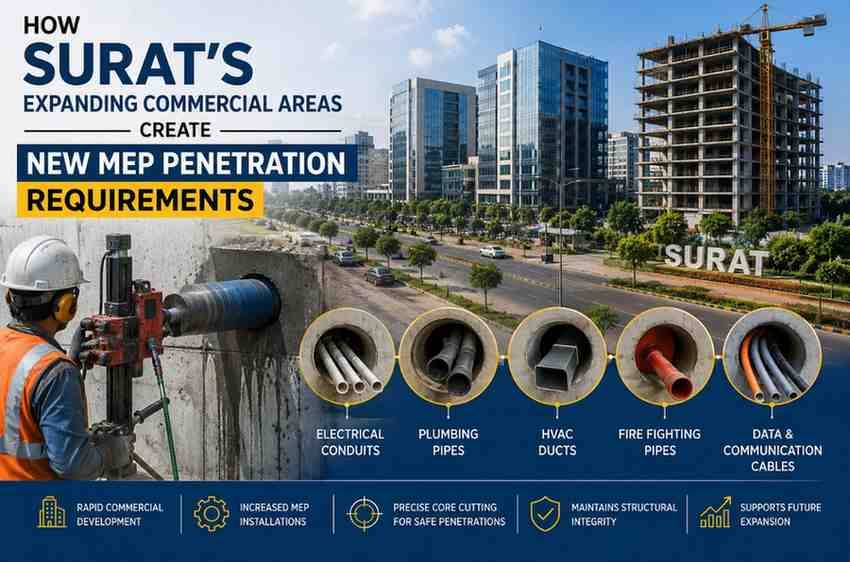
MEP penetrations are the openings created in concrete slabs, beams, shear walls, and foundations to allow HVAC ducts, electrical conduits, plumbing pipes, fire sprinkler lines, and data cabling to pass through a structure. In a typical commercial high-rise, hundreds — sometimes thousands — of such penetrations are required across the building's lifecycle.
Unlike residential construction, where MEP requirements are relatively simple, commercial buildings such as office towers, malls, and hospitals have layered, high-density service networks. A single floor might need penetrations for centralized air conditioning ducts, chilled water piping, fire-fighting risers, electrical bus ducts, structured cabling, and drainage lines — all coexisting within tightly packed concrete slabs, many of which are post-tensioned or heavily reinforced for structural strength.
This is where core cutting and core drilling come in. Instead of leaving these openings unformed during the pour (which limits design flexibility) or breaking concrete with impact tools (which risks structural damage), professional core cutting uses diamond-tipped drilling and wall-saw equipment to create clean, precise, vibration-free openings exactly where and when they're needed.
Why Surat's Commercial Boom Is Changing the MEP Penetration Landscape
1. Vertical Growth Means More Floors, More Penetrations
Surat's skyline is rising. Commercial developments that were once limited to three or four floors are now routinely stretching to 10, 15, or even 20+ storeys. Every additional floor multiplies the number of vertical MEP shafts, riser penetrations, and duct crossings needed to keep utilities running from the basement to the rooftop. A taller building isn't just a bigger version of a shorter one — it's an exponentially more complex network of service pathways, each requiring accurately located and sized penetrations.
2. Retrofit and Renovation Work Is Rising Alongside New Construction
Not all of Surat's commercial growth is happening on greenfield sites. A significant share involves retrofitting older commercial buildings — converting them into modern offices, showrooms, restaurants, or co-working spaces. Retrofit work is far more demanding from a core cutting perspective because it involves cutting into existing, already-loaded structures. Contractors need to identify rebar and post-tensioned cables using scanning equipment before drilling, something that simply isn't a concern during fresh construction.
3. Mixed-Use Developments Demand More Coordinated MEP Planning
Surat's newer commercial projects increasingly combine retail, office, hospitality, and entertainment under one roof. Mixed-use buildings have far more diverse MEP requirements than single-purpose structures — a mall with an attached multiplex and food court, for instance, needs separate ventilation zones, dedicated fire suppression systems, and independent electrical distribution for each use type. This diversity translates directly into a higher volume and greater variety of penetration requirements, from small-diameter cable openings to large rectangular duct cutouts.
4. Modern Buildings Use Denser, Stronger Concrete
To meet seismic codes and support taller structures, many of Surat's newer commercial buildings use high-strength concrete and post-tensioned slabs. These materials are excellent for structural performance but far more difficult to cut through safely using conventional methods. Post-tensioned slabs, in particular, contain steel cables under high tension; cutting into them without proper scanning and technique can cause serious structural failure. This has made professional, technology-assisted core cutting not just preferable but essential.
5. IT Parks and Corporate Offices Require Extensive Data and Electrical Infrastructure
Surat's growing IT and BPO sector has brought a new category of commercial construction: technology-driven office spaces with extensive structured cabling, server rooms, UPS systems, and redundant power distribution. These spaces require dense networks of small-diameter core-drilled openings for data cabling and electrical conduits, often installed after the main structure is complete, when tenants finalize their specific fit-out requirements.
6. Healthcare and Hospitality Sectors Add Specialized Requirements
Surat's expanding hospital and hotel sectors bring their own MEP complexity. Hospitals need precisely sealed penetrations for medical gas lines, specialized ventilation for isolation areas, and fire-rated openings that meet strict life-safety codes. Hotels require extensive plumbing penetrations across repetitive floor plans for guest rooms, along with kitchen exhaust and laundry ventilation systems. Both sectors demand a level of precision and documentation that only professional core cutting teams can consistently deliver.
The Technical Challenges Behind Modern MEP Penetrations
As Surat's commercial buildings become more sophisticated, the technical demands on core cutting contractors have grown considerably.
Structural Scanning Before Cutting: Before any core is drilled in an existing structure, ground-penetrating radar or rebar scanning is used to map embedded steel and post-tensioned cables. This step is non-negotiable in dense commercial construction, where a single miscalculated cut can compromise a slab's load-bearing capacity.
Precision Sizing and Placement: MEP consultants issue detailed shop drawings specifying the exact diameter, shape, and location of each penetration. Core cutting teams must work to millimeter-level accuracy, particularly in areas where multiple services run close together, to avoid clashes between ducts, pipes, and cables.
Dust and Vibration Control: In occupied or partially occupied commercial buildings — increasingly common as Surat developers phase-hand over floors while others are still under fit-out — dust suppression and low-vibration cutting techniques are essential to avoid disrupting tenants and to comply with environmental and safety norms.
Fire and Acoustic Sealing: Once penetrations are cut, they must be properly sealed with fire-rated materials to maintain the building's compartmentalization and acoustic performance. This is especially critical in mixed-use and healthcare buildings where fire codes are stringent.
Coordination Across Trades: With HVAC, electrical, plumbing, and fire-fighting contractors often working on overlapping schedules, core cutting teams must coordinate closely to avoid rework, sequencing delays, or conflicting penetration locations.
What This Means for Developers, Contractors, and MEP Consultants in Surat
For anyone involved in Surat's commercial construction pipeline, the growing complexity of MEP penetrations carries a few practical implications:
- Early planning pays off. Coordinating MEP layouts and penetration locations during the design stage, rather than improvising on-site, reduces costly rework and structural risk.
- Specialized expertise matters more than ever. As buildings grow taller and use more advanced structural systems, generic breaking and chiseling methods are no longer adequate. Diamond core drilling and wall sawing, performed by trained technicians using calibrated equipment, have become the industry standard for commercial-grade work.
- Compliance and documentation are increasingly scrutinized. With more commercial buildings undergoing fire safety audits and structural certifications, having a documented, professionally executed core cutting process is becoming a practical necessity, not just a best practice.
- Retrofit demand will keep climbing. As Surat's older commercial stock is upgraded to meet modern tenant expectations, the need for precise, structurally safe cutting into existing buildings will only increase.
Why Professional Core Cutting Services Are the Right Choice
Given the stakes involved — structural safety, tenant disruption, project timelines, and regulatory compliance — commercial developers and contractors in Surat are increasingly turning to specialized core cutting companies rather than relying on general labor for these tasks.
A professional core cutting partner brings scanning technology to detect rebar and post-tensioned cables, calibrated diamond drilling and wall-sawing equipment for clean and accurate cuts, trained technicians who understand load-bearing considerations, dust and vibration control suited to occupied buildings, and the ability to coordinate schedules across multiple MEP trades on fast-moving commercial sites.
This combination of precision, safety, and reliability is exactly what Surat's expanding commercial landscape now demands.
Looking Ahead: Surat's Infrastructure Growth Will Keep Raising the Bar
Surat's commercial real estate story isn't slowing down. With continued investment in office space, retail, hospitality, and mixed-use development — supported by the city's broader infrastructure push, including improved connectivity and planned metro rail links — the pace of commercial construction is expected to remain strong in the coming years.
As buildings get taller, systems get denser, and tenant expectations get higher, MEP penetration work will only become more technical and more central to how commercial projects are planned and executed. Developers and contractors who invest in professional core cutting expertise early will be better positioned to deliver safe, compliant, and efficiently built commercial spaces.
Conclusion
Surat's rapid commercial expansion is reshaping the city's skyline — and, less visibly, reshaping how MEP systems are installed within it. Taller buildings, denser service networks, high-strength concrete, and a growing mix of office, retail, healthcare, and hospitality developments are all driving demand for precise, safe, and professionally executed core cutting and core drilling.
For developers, contractors, and MEP consultants working across Surat's commercial corridors, partnering with an experienced core cutting team isn't just about getting an opening cut — it's about protecting structural integrity, meeting compliance requirements, and keeping fast-moving commercial projects on track.
Core Cutting India specializes in precision core cutting, core drilling, and wall sawing services for commercial, industrial, and residential projects across Surat and beyond. To discuss your project's MEP penetration requirements, reach out at [email protected].
Target-Related Searches
- MEP penetration Surat
- core cutting services Surat
- core drilling company Surat
- commercial construction Surat
- concrete core cutting for HVAC ducts
- wall cutting services for electrical conduits
- post-tension slab core drilling
- fire-rated penetration sealing
- RCC core cutting contractor
- diamond core drilling Gujarat
People Also Ask
1. What is MEP penetration in construction? MEP penetration refers to the openings made in concrete slabs, beams, or walls to allow mechanical (HVAC), electrical, and plumbing systems to pass from one area or floor of a building to another.
2. Why is core cutting preferred over conventional concrete breaking? Core cutting uses diamond-tipped drilling and sawing equipment to create clean, precise openings without the vibration, cracking, or structural stress caused by hammering or breaking methods.
3. Is core cutting safe for post-tensioned slabs? Yes, when performed by trained professionals who first scan the slab to locate tensioned cables and reinforcement before cutting, minimizing the risk of structural damage.
4. How does commercial building growth affect MEP planning? Larger and taller commercial buildings require significantly more MEP penetrations across multiple floors, along with more complex coordination between HVAC, electrical, plumbing, and fire safety systems.
5. Can core cutting be done in occupied commercial buildings? Yes, professional core cutting teams use dust suppression and low-vibration techniques designed to minimize disruption in buildings that are partially or fully occupied.
6. What sealing is required after MEP penetrations are cut? Penetrations typically need fire-rated and acoustic sealing to maintain the building's fire compartmentalization and sound insulation standards.