
Look around any modern city, and you are surrounded by concrete: flyovers, metro viaducts, high-rise towers, dams, airport runways and the floor beneath your feet. After water, concrete is the most widely used material on Earth. Yet few people realise how much chemistry, physics and engineering sits inside that grey mass.
Understanding the science behind modern concrete structures explains why some buildings last a century while others crack within a few years. It also explains why work on existing concrete, such as core cutting, wall sawing and drilling, needs careful planning. In this guide from Core Cutting India, we break down how concrete works, why it is so strong, and how modern engineering keeps it performing.
What Is Concrete? A Man-Made Rock
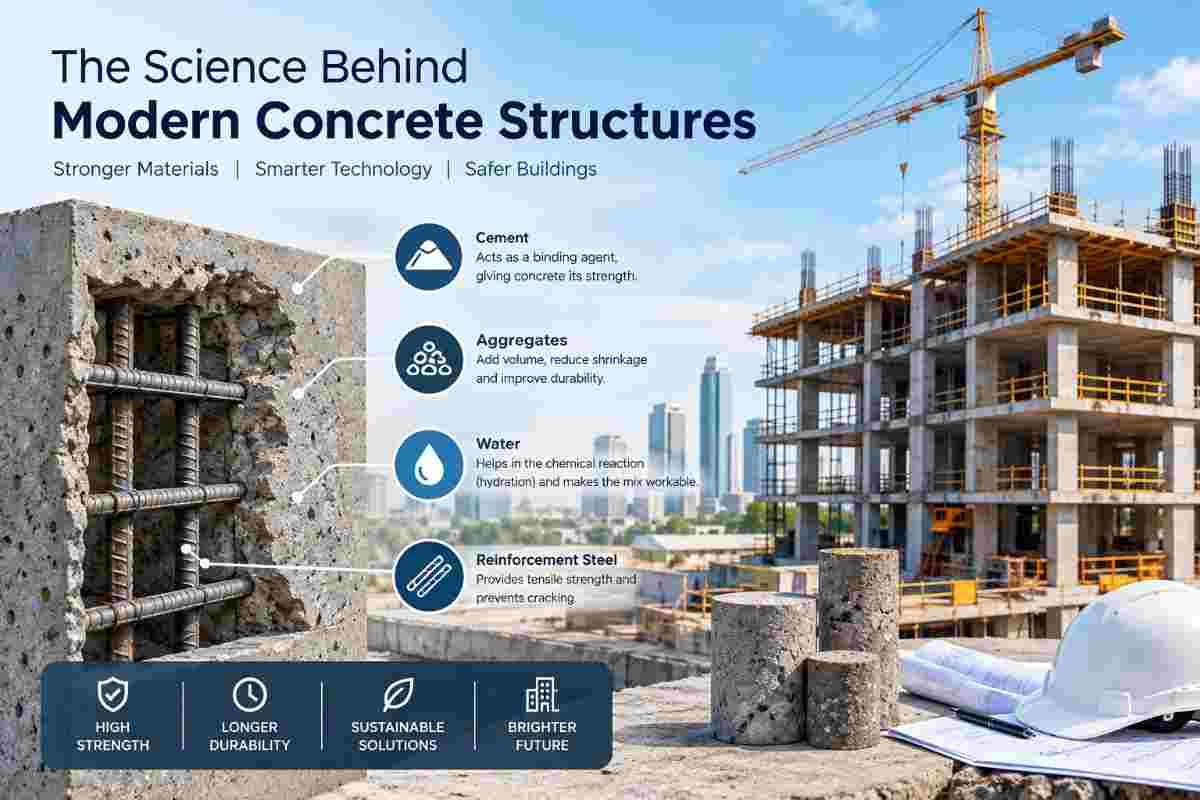
Concrete is a composite material made of four basic ingredients:
- Cement, the reactive binder
- Water, which triggers the chemical reaction
- Fine aggregate, usually sand
- Coarse aggregate, such as crushed stone or gravel
Aggregates typically make up 60 to 75 percent of the volume. They act as the skeleton of the material, while cement paste is the glue that bonds everything into a solid mass. A useful comparison is a dense stone wall in which the stones are the aggregates and the mortar is the cement paste.
The result behaves like an artificial rock. It can be poured while fluid, shaped into almost any form, and left to harden into a load-bearing material. That combination of plasticity and strength is why concrete dominates modern construction.
Cement Hydration: The Chemistry That Creates Strength
Concrete does not "dry" the way paint does. It hardens through a chemical reaction called hydration, and the distinction matters. A concrete slab kept moist gains strength far better than one that dries out quickly.
Ordinary Portland cement is made by heating limestone and clay to around 1,450°C, producing a material called clinker, which is then ground into a fine powder. The clinker contains four main compounds:
- Tricalcium silicate (C₃S): reacts quickly and drives early strength
- Dicalcium silicate (C₂S): reacts slowly and contributes to long-term strength
- Tricalcium aluminate (C₃A): reacts rapidly and influences setting time
- Tetracalcium aluminoferrite (C₄AF): contributes to colour and has a minor effect on strength
When water touches cement, these compounds dissolve and recombine into new products. The most important is calcium silicate hydrate (C-S-H) gel, a nanoscale, glue-like structure that binds aggregates together and gives concrete most of its strength. The reaction also produces calcium hydroxide, which keeps concrete highly alkaline. That alkalinity has an important role in protecting steel reinforcement, as we will see shortly.
Hydration begins within minutes but continues for months, even years, as long as moisture is available. This is why concrete strength is conventionally tested at 28 days, a practical benchmark rather than the point at which hardening stops.
Water-Cement Ratio and Mix Design: Where Strength Is Decided
If one number defines concrete quality, it is the water-cement ratio (w/c), the weight of water divided by the weight of cement. The principle, known as Abrams' law, is simple: lower w/c ratio, higher strength and lower permeability.
Cement needs only about 0.25 to 0.30 parts of water by weight to hydrate fully. Extra water is usually added so the concrete flows and can be placed easily. But surplus water evaporates and leaves behind microscopic pores, which weaken the material and give harmful substances a path to travel through it. A dense, low-porosity mix is therefore both stronger and more durable.
Engineers design mixes through a process called mix design. In India this is guided by standards such as IS 10262 for proportioning, IS 456 for plain and reinforced concrete, and IS 383 for aggregates. Concrete is specified by grade, such as M20, M25, M30 or M40, where the number is the characteristic compressive strength in megapascals at 28 days.
A good mix design balances competing needs:
- Strength: the required grade for structural loads
- Workability: how easily the concrete can be mixed, pumped, placed and compacted
- Durability: resistance to the exposure environment
- Economy: cement is the costliest ingredient, so it is not over-used
Aggregates and Admixtures: The Unsung Performers
Aggregates are far more than filler. Their shape, size distribution, strength and cleanliness affect workability, density and final strength. Well-graded aggregates, with a smooth range of particle sizes, pack tightly so that less cement paste is needed to fill the gaps. Dirty, weak or reactive aggregates can quietly undermine an otherwise well-designed mix.
Chemical admixtures are the second quiet revolution in modern concrete. Added in small doses, they change fresh and hardened properties:
- Superplasticizers let concrete flow easily at a very low w/c ratio, giving high strength without sacrificing workability.
- Retarders slow setting in hot weather or during long transport.
- Accelerators speed up early strength gain for fast-track work.
- Air-entraining agents create tiny stable bubbles that relieve pressure from freezing and thawing.
- Waterproofing and corrosion-inhibiting admixtures improve long-term durability.
Alongside these are supplementary cementitious materials (SCMs) such as fly ash, ground granulated blast-furnace slag (GGBS) and silica fume. They react with calcium hydroxide in a pozzolanic reaction, producing additional C-S-H gel. Silica fume particles are roughly one hundred times smaller than cement grains, so they fill microscopic voids and produce exceptionally dense concrete. SCMs also cut the cement content, which lowers heat of hydration and the carbon footprint.
Why Concrete Needs Steel: The Science of Reinforced and Prestressed Concrete
Concrete has a fundamental weakness. It is very strong in compression but weak in tension, with tensile strength only around 8 to 15 percent of its compressive strength. A concrete beam left unreinforced would crack and fail under bending loads.
Steel reinforcement (rebar) solves this. Steel handles tension while concrete handles compression, and the two work together as reinforced concrete (RCC). Three natural coincidences make the partnership work:
- Similar thermal expansion. Concrete and steel expand and contract at nearly the same rate, roughly 10 to 12 millionths per degree Celsius, so temperature changes do not tear them apart.
- Strong bond. Ribbed bars grip the surrounding concrete, transferring load between the two.
- Chemical protection. The highly alkaline pore solution, with a pH of about 12.5 to 13.5, forms a thin passive film on the steel that resists corrosion.
Prestressed concrete takes the idea further. High-strength steel tendons are tensioned before or after the concrete cures, squeezing the concrete into compression. When service loads arrive, they must first overcome that built-in compression before any tension develops. Prestressing allows longer spans, slimmer sections and fewer cracks, which is why it is used in bridges, flyovers, metro viaducts and large-span floors.
Durability: Why Concrete Structures Deteriorate
Concrete is durable, but it is not immortal. Most premature deterioration traces back to a few well-understood mechanisms:
- Carbonation: Carbon dioxide from the air slowly reacts with calcium hydroxide, lowering the concrete's pH. When carbonation reaches the steel, the passive film breaks down and corrosion can begin.
- Chloride attack: Chlorides from sea water, de-icing salts or contaminated materials destroy the passive film even in alkaline concrete. This is a major risk in coastal regions.
- Corrosion expansion: Rust occupies several times the volume of the original steel, generating internal pressure that cracks and spalls the cover concrete.
- Sulphate attack: Sulphates in soil or groundwater react with cement compounds and cause expansion and disintegration.
- Alkali-silica reaction: Certain reactive aggregates form a gel that swells and cracks the concrete from within.
- Freeze-thaw cycles: Water in pores expands as it freezes, damaging poorly protected concrete in cold climates.
- Shrinkage and thermal cracking: Poor curing or large temperature differences in massive pours create early-age cracks.
The defences follow directly from the science: low w/c ratio, adequate cover over the reinforcement, proper compaction, good curing and the right exposure-specific mix. Curing is the most neglected of these. Keeping concrete moist and at a suitable temperature during early days allows hydration to continue and produces a denser, less permeable surface.
Modern Innovations Reshaping Concrete
Concrete technology is evolving quickly. Several developments stand out:
High-performance concrete (HPC) and ultra-high-performance concrete (UHPC) use very low w/c ratios, silica fume, fine powders and often steel or synthetic fibres. They reach compressive strengths well beyond conventional grades, with excellent durability and improved ductility.
Self-compacting concrete (SCC) flows under its own weight into congested reinforcement without vibration, giving better finishes and safer, quieter placement.
Fibre-reinforced concrete adds steel, glass, polypropylene or other fibres to control cracking and improve toughness, and it is common in industrial floors, tunnel linings and shotcrete.
Self-healing concrete is an emerging field. Some systems embed bacteria or capsules that produce calcium carbonate when cracks open and water enters, sealing them autonomously.
Low-carbon concrete addresses sustainability directly. Cement manufacturing accounts for roughly 7 to 8 percent of global CO₂ emissions, so the industry is increasing use of SCMs, blended cements, recycled aggregates and carbon-capture approaches to shrink the footprint.
Where Science Meets Precision: Working on Existing Concrete
Once concrete has cured and reached full strength, it is a hard, dense and often heavily reinforced material. Buildings are modified, services are added, openings are created and structures are strengthened or demolished in a controlled way. All of this must be done without damaging the structure that remains.
That is where diamond concrete cutting comes in. Techniques such as core cutting, wall sawing, slab sawing and wire sawing rely on the same material science we have discussed. Industrial diamond, the hardest known natural material, is embedded in a metal matrix on cutting tools. As the tool rotates, exposed diamond particles grind through the cement paste, aggregates and even steel rebar, while water cools the tool and flushes out slurry. The result is clean, accurate cuts with minimal vibration and cracking compared with impact methods like hammering.
Understanding the concrete matters at every stage:
- Reinforcement and embedded services. Cutting through unknown rebar, post-tensioned tendons, electrical conduits or pipes can be dangerous and expensive. Ground-penetrating radar (GPR) scanning maps what lies inside the slab or wall before any cut is made.
- Structural behaviour. Removing concrete changes how loads travel through the structure. Openings in slabs, beams and walls must be planned so that strength and stability are not compromised. Post-tensioned members in particular need extreme caution, and cutting decisions should involve the structural engineer.
- Material variation. Hard granite aggregates, dense high-strength grades and heavy reinforcement all affect tool selection, cutting speed and technique.
For projects such as door and window openings, HVAC and plumbing penetrations, lift shafts, staircase openings, slab modifications and controlled demolition, working with an experienced concrete cutting team keeps the process safe, precise and low-disturbance. You can learn more about professional concrete cutting services at Core Cutting India.
Frequently Asked Questions (People Also Ask)
What is the science behind concrete?
Concrete works through hydration. When water reacts with cement, it forms calcium silicate hydrate (C-S-H) gel, which binds sand and aggregates into a solid mass. The strength, density and durability of the result depend on the water-cement ratio, the quality of the ingredients and how well the concrete is compacted and cured.
Why is concrete so strong?
Concrete is strong in compression because its hardened cement paste and tightly packed aggregates resist crushing forces effectively. Its weakness is tension, which is why steel reinforcement is added in most structural applications.
How does concrete harden?
Concrete hardens by a chemical reaction, not by drying. Cement compounds react with water to form hydration products. The process is fastest in the first few days and continues slowly for months, provided moisture is present.
What is the ideal water-cement ratio?
It depends on the grade and exposure, but structural concrete commonly uses ratios of roughly 0.40 to 0.55. Lower ratios give higher strength and durability but need admixtures such as superplasticizers to keep the concrete workable.
Why is steel used in concrete?
Steel supplies the tensile strength that concrete lacks. The two materials bond well, expand at similar rates with temperature, and the alkaline environment of concrete protects the steel from corrosion.
How long does a concrete structure last?
A well-designed, well-built and properly maintained structure can last 50 to 100 years or more. Service life depends on mix quality, cover to reinforcement, curing, exposure conditions and maintenance.
What causes concrete to crack?
Common causes include plastic and drying shrinkage, thermal stress, overloading, corrosion of reinforcement, poor curing, foundation settlement and chemical attack. Some hairline cracking is normal, but wide or growing cracks should be assessed by an engineer.
Can existing concrete be cut safely?
Yes. Diamond cutting methods such as core cutting, wall sawing and slab sawing can create precise openings in reinforced concrete with minimal vibration and damage. Pre-cut scanning with GPR and prior structural assessment are best practice.
Conclusion
The science behind modern concrete structures is a story of chemistry, materials engineering and careful workmanship. Hydration creates the binding gel, the water-cement ratio governs density, aggregates form the skeleton, admixtures fine-tune performance, and steel compensates for concrete's weakness in tension. Durability then depends on protecting that system from carbonation, chlorides and moisture over decades.
From the first pour to later renovation and modification, respecting the science leads to safer, longer-lasting and more sustainable structures. If your project involves precise openings, drilling or controlled removal in existing concrete, visit Core Cutting India to learn how professional diamond cutting can help you get the job done accurately and safely.