
Introduction
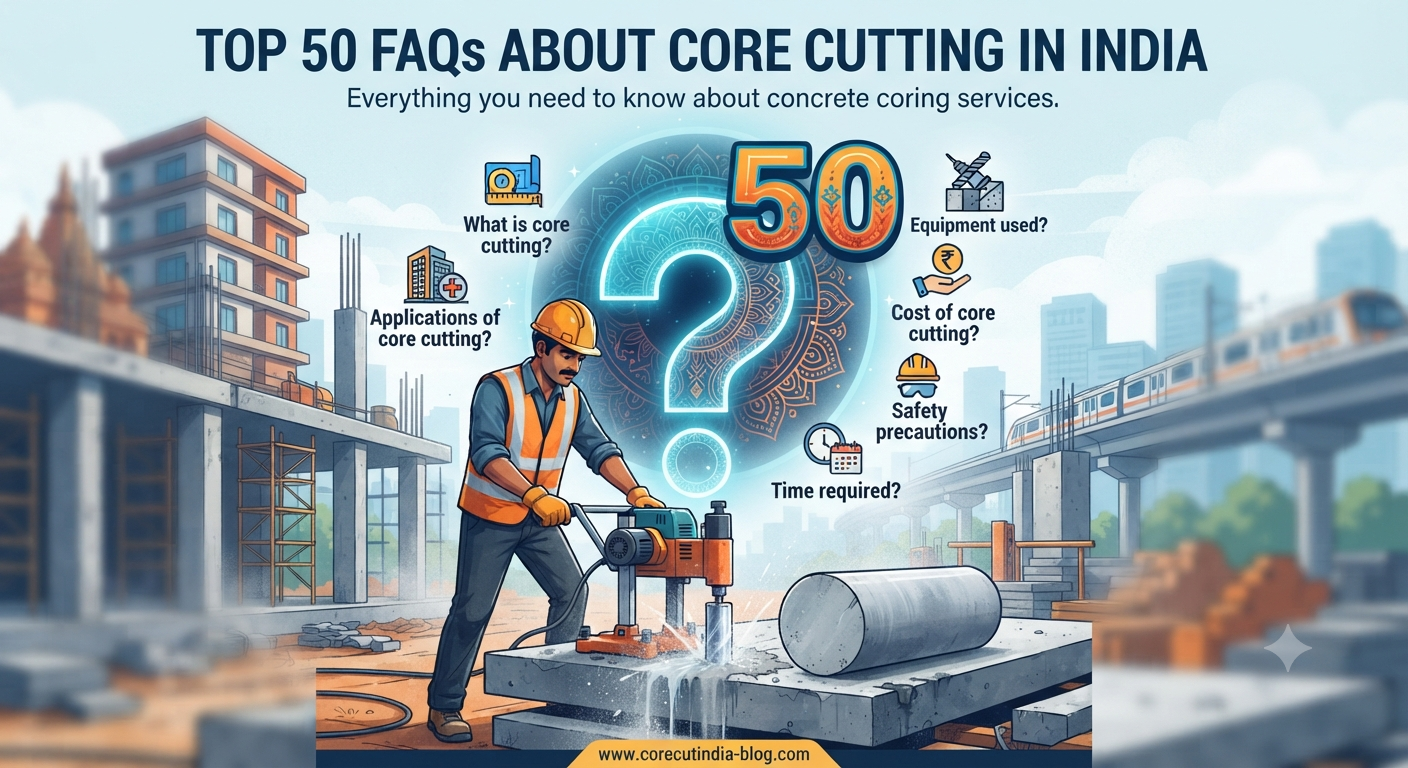
Core cutting is a sophisticated construction technology that has revolutionized how we handle structural modifications in India [1.1.1, 1.1.2]. Whether you are a homeowner planning a renovation or a contractor managing a commercial site, understanding the intricacies of core cutting is essential for structural integrity and project efficiency [1.3.1]. At [email protected], we prioritize precision, safety, and professional excellence. This guide serves as your ultimate resource for everything you need to know about core cutting.
Part 1: Fundamentals of Core Cutting
-
What is core cutting? It is a process of drilling precise, cylindrical holes in hard materials like concrete, marble, or asphalt using specialized machines [1.1.1, 1.1.2].
-
How does it differ from traditional breaking? Unlike traditional hammering, which causes vibrations and cracks, core cutting is a non-destructive method [1.1.2, 1.3.1].
-
What surfaces can be cut? Reinforced Cement Concrete (RCC), brickwork, stone, granite, and asphalt [1.1.2, 1.3.1].
-
What is a core drill? A powerful machine equipped with a diamond-tipped bit designed to cut through tough materials [1.1.2, 1.3.1].
-
Why is it called "diamond" core cutting? Because the bits are embedded with industrial-grade diamond segments for extreme durability [1.1.2, 1.3.1].
-
Can core cutting be done on ceilings? Yes, it is effective on walls, floors, and ceilings [1.3.2].
-
Does it cause structural damage? No, when done correctly, it preserves the integrity of the remaining structure [1.3.1].
-
Is it loud? It produces significantly less noise compared to pneumatic breakers [1.3.2].
-
Is it dust-free? Most modern systems use water cooling, which keeps dust to a minimum [1.3.1].
-
How deep can it cut? Modern equipment can handle significant depths depending on the project requirements [1.3.2].
Part 2: Applications & Utilities
-
Why is it used for plumbing? It allows for the neat passage of pipes through thick concrete slabs [1.1.2, 1.3.1].
-
Is it useful for electrical wiring? Yes, it creates dedicated channels for conduit paths [1.1.2, 1.3.1].
-
Can it be used for HVAC installation? Absolutely, it creates precise openings for ventilation ducts [1.1.2, 1.3.1].
-
What are "anchor holes"? Holes drilled specifically to secure heavy industrial machinery or supports [1.3.1].
-
How is it used in testing? Core samples are removed to test the compressive strength and quality of concrete [1.2.1, 1.2.2].
-
Can it create door openings? Yes, by using a sequence of overlapping cuts [1.1.2, 1.3.1].
-
Is it used in bridge construction? Yes, for structural modifications and drainage [1.3.1].
-
Can it be used for retrofitting? It is the preferred method for retrofitting older buildings with new utility lines [1.3.1].
-
Does it work for fiber cement sheets? Yes, specific bits are available for various materials [1.5.1].
-
Can I use it for home renovations? Yes, it is ideal for modernizing electrical and plumbing setups in homes [1.3.2].
Part 3: Cost and Pricing in India
-
How is the cost calculated? Usually per hole, per inch of diameter, or per meter of depth [1.2.1, 1.3.2, 1.5.1].
-
What is the average price range? Prices vary widely based on location and depth, typically ranging from ₹500 to ₹4,000+ per cut [1.2.1, 1.5.1].
-
Do diameter sizes affect the price? Yes, larger diameters require more resources and time [1.2.1].
-
Are there extra charges for deep cuts? Yes, increased depth increases machine wear and labor time [1.2.1].
-
Is there a minimum charge? Many providers have a "minimum visit" fee [1.5.2].
-
What factors influence the final quote? Material hardness, reinforcement density, and project site accessibility [1.3.1, 1.4.2].
-
Do I pay for the bits? Generally, the service provider supplies the equipment; you pay for the completed hole [1.5.1].
-
Is GST extra? Yes, most formal registered companies will charge GST on top of the base price [1.5.2].
-
Can I get a discount for bulk work? Many contractors offer discounted rates for high-volume residential or commercial projects [1.5.1].
-
Should I get a written estimate? Always, to avoid hidden costs [1.5.2].
Part 4: Safety and Best Practices
-
What is the first step in safety? Scanning the area to locate rebars and hidden conduits [1.4.1, 1.4.2].
-
Why is concrete scanning important? It prevents hitting critical infrastructure like power lines or structural steel [1.4.1, 1.4.2].
-
What PPE is required? Helmet, goggles, ear protection, gloves, and safety boots [1.4.1, 1.4.2].
-
How do we handle rebar interference? By using high-quality diamond bits capable of cutting through steel [1.2.2].
-
What happens if a water line is hit? Proper pre-scanning prevents this; if it happens, the water main must be shut off immediately [1.4.1].
-
Is wet cutting always better? Yes, it cools the bit and suppresses dust [1.4.1, 1.4.2].
-
How to manage the mess? Use slurry vacuums or dams to catch water and debris [1.4.1, 1.4.2].
-
Should the site be cleared? Yes, isolate the work area to prevent unauthorized access [1.2.1, 1.4.1].
-
Is ventilation necessary? Essential, especially in confined spaces [1.4.1].
-
Are there permits required? For major commercial structural changes, check with local authorities [1.4.1].
Part 5: Technical Maintenance and Expertise
-
How long does a cut take? It depends on the diameter and thickness; small holes may take minutes [1.3.1].
-
What if the concrete is very hard? Specialized bits with varying diamond bond hardness are used [1.1.2].
-
Can I DIY core cutting? It is highly discouraged due to the risk of structural damage and injury; hire a professional [1.3.1, 1.4.1].
-
What is a "Core Test"? A test where a cylinder of concrete is removed and sent to a lab to verify strength [1.2.1, 1.2.2].
-
How old should concrete be before testing? Ideally 28 days [1.2.2].
-
How is the core sample capped? Using high-quality mortar to ensure a flat surface for testing [1.2.2].
-
What is the L/D ratio? The Length-to-Diameter ratio, which is critical for accurate compressive strength testing [1.2.2].
-
Does vibration affect the core sample? Yes, which is why professionals use rigid stands [1.2.2].
-
What if my core hits reinforcement? Correction factors are applied to the test results [1.2.2].
-
How do I choose the right service? Look for experience, safety records, and modern equipment [1.3.2, 1.5.2].
Conclusion
Core cutting is an indispensable part of modern construction in India, providing the precision necessary for complex structural and utility work [1.3.1, 1.3.2]. By following safety protocols and hiring experienced professionals, you can ensure your project is completed flawlessly.
For expert advice and professional core cutting services, reach out to us at [email protected].
Disclaimer: This blog is for informational purposes. Always consult with a structural engineer before performing any modifications to load-bearing elements.