
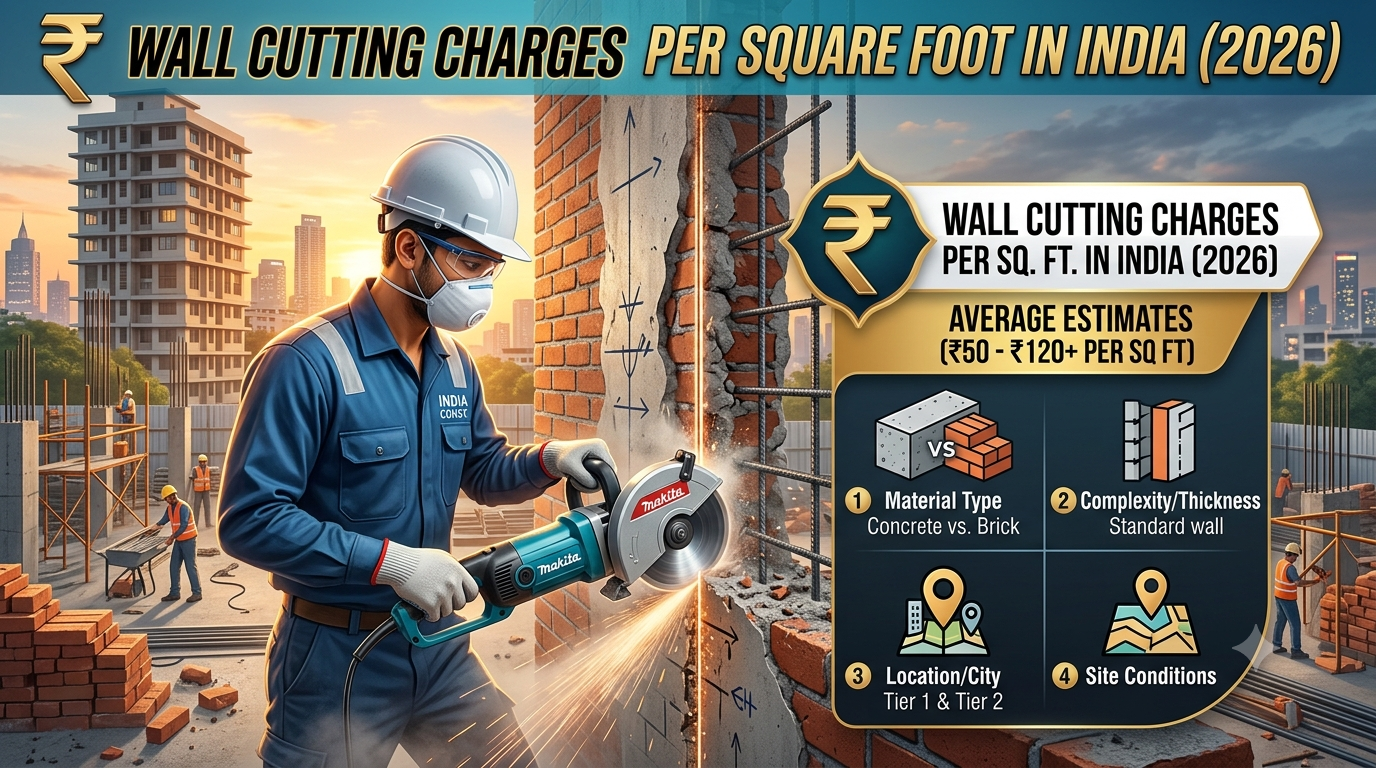
Whether you're renovating a flat in Mumbai, adding a new door in your Bangalore villa, or laying fresh plumbing lines in a Delhi office, at some point you'll need a professional to cut into a wall. This isn't a job for a hammer and chisel anymore — modern wall cutting uses diamond-tipped saws and core drills that give clean, dust-controlled, structurally safe cuts. But the moment you start calling contractors, you'll notice something: everyone quotes a different price.
That's because wall cutting charges in India aren't a single fixed number. They shift based on the wall material, thickness, cutting method, city, and the purpose of the cut. In this guide, we break down wall cutting charges per square foot in India for 2026, with real Indian examples, city comparisons, and the hidden factors that push your bill up or down. This guide is brought to you by Core Cutting India (corecuttingindia.com) — India's platform for verified wall, RCC, and core cutting contractors across 500+ cities. For quotes or queries, reach us at [email protected].
Why Wall Cutting Isn't a "One Rate Fits All" Job
Before jumping into numbers, it helps to understand what "wall cutting" actually covers. The term is used loosely, but it includes several distinct services:
- Wall sawing/cutting — using a diamond wall saw to cut straight lines through a wall, typically to remove a section for a door, window, or ventilation opening.
- Core cutting/core drilling — drilling circular holes through walls or slabs for pipes, cables, AC ducts, or exhaust vents.
- Wall chasing/grooving — cutting shallow channels into a wall surface to embed electrical conduits or plumbing lines.
- RCC (Reinforced Cement Concrete) cutting — cutting through load-bearing concrete walls, which requires more powerful machinery and structural caution.
Each of these is priced differently, and a contractor's quote depends entirely on which one you actually need.
Average Wall Cutting Charges Per Square Foot in India (2026)
Based on current market rates from verified contractors across major Indian cities, here's a realistic pricing range for 2026:
| Type of Wall Cutting | Average Rate (2026) |
|---|---|
| Brick wall cutting (4–9 inch thick) | ₹100 – ₹200 per sq ft |
| RCC/concrete wall cutting | ₹150 – ₹350 per sq ft |
| Wall chasing (for wiring/plumbing) | ₹40 – ₹90 per running ft |
| Core drilling (per hole, 2"–8" diameter) | ₹300 – ₹1,500 per hole |
| Diamond wall saw cutting (structural) | ₹200 – ₹450 per sq ft |
| Door/window opening cutting (full job) | ₹3,000 – ₹15,000 per opening |
These figures are indicative averages compiled from contractor listings and service providers across India; always request a site-specific quote, since thickness, reinforcement, and access difficulty change the final number.
A useful way to think about it: a standard door-sized opening (about 21 sq ft in a 9-inch brick wall) at ₹150 per sq ft would cost roughly ₹3,000–₹4,000 in labour and machine charges alone, before you add debris removal or finishing work.
City-Wise Wall Cutting Charges in India
Labour rates, machine availability, and cost of living all influence pricing city to city. Here's a broad comparison:
Delhi NCR: Being a hub for core cutting and structural service providers, Delhi NCR often has some of the most competitive rates — brick wall cutting can start around ₹100–₹150 per sq ft, while RCC cutting for commercial projects touches ₹250–₹300 per sq ft in high-rise or metro-adjacent projects.
Mumbai and Pune: Due to higher labour costs and dense construction (older buildings with thicker RCC walls), expect rates on the higher end — ₹180–₹350 per sq ft for RCC cutting, and slightly more for high-rise access or shaft cutting.
Bangalore and Chennai: With a strong base of specialized concrete cutting firms, rates are competitive and hover around ₹125–₹300 per sq ft depending on wall type, with core drilling for AC and exhaust holes commonly billed separately per hole.
Hyderabad and Ahmedabad: Tier-1 but slightly more budget-friendly than Mumbai/Bangalore — expect ₹100–₹250 per sq ft for standard residential wall cutting.
Tier-2 Cities (Jaipur, Lucknow, Indore, Nagpur, Coimbatore): Lower labour overheads bring average rates down to ₹80–₹180 per sq ft for brick and light RCC work.
Real Indian Examples
Example 1 — Residential flat in Pune: A homeowner wanted to convert a window into a full-height door in a 6-inch brick partition wall. The opening measured roughly 21 sq ft. At a quoted rate of ₹125 per sq ft, the wall cutting portion cost approximately ₹2,625, with an additional ₹1,500 for debris clearance and edge finishing — a total of around ₹4,000–₹4,500.
Example 2 — Commercial office in Gurugram: A company needed core drilling for six AC duct holes (6-inch diameter each) through an RCC wall. At roughly ₹700–₹900 per hole for RCC core drilling, the total job came to approximately ₹4,500–₹5,500, including mobilization charges.
Example 3 — Independent house in Chennai: A plumbing retrofit required wall chasing across 40 running feet for concealed pipeline work. At ₹60 per running foot, the chasing cost was about ₹2,400, separate from re-plastering.
Example 4 — Apartment renovation in Bangalore: Cutting a new ventilation opening (2 sq ft) through a 9-inch RCC wall using a diamond wall saw was quoted at ₹300 per sq ft, bringing the job to roughly ₹600–₹900 including machine setup charges, which are often higher for small, isolated jobs due to fixed mobilization costs.
These examples reflect typical market patterns; actual costs will vary by contractor, floor level, and site accessibility.
Factors That Affect Wall Cutting Charges
Several variables explain why two nearly identical jobs can be quoted very differently:
1. Wall material and thickness. Brick walls are softer and faster to cut than reinforced concrete. A 4-inch partition wall costs far less to cut than a 9-inch or 12-inch load-bearing RCC wall, since thicker walls need more blade passes, more time, and often more powerful (and expensive) machinery.
2. Presence of steel reinforcement. RCC walls contain embedded steel rebar. Cutting through rebar requires diamond blades rated for combined concrete-and-metal cutting, which wear out faster and cost more to operate — this is usually reflected in a higher per-sq-ft rate compared to plain brick or block walls.
3. Cutting method. Hand-held diamond cutters are cheaper to deploy than track-mounted wall saws or wire saws, which are reserved for large structural cuts, thick walls, or precision jobs where minimal vibration is essential.
4. Location and floor level. Ground-floor jobs with easy vehicle and equipment access cost less than cutting on the 15th floor of a high-rise, where equipment has to be carried up, water supply for dust suppression needs arranging, and safety measures add time.
5. Dust and debris management. Slurry-free or dust-free cutting technology, increasingly required in occupied residential and hospital buildings, adds a premium over traditional wet-cutting methods.
6. Job size and mobilization. Small, isolated jobs (like one small vent hole) often carry a minimum service charge, since the contractor's travel, machine setup, and safety prep cost roughly the same whether the cut is 1 sq ft or 10 sq ft.
7. Structural safety requirements. Cutting into a load-bearing wall may require a structural engineer's assessment and temporary support (shoring) before cutting begins, which adds to the overall project cost even though it isn't strictly a "cutting" charge.
8. Finishing work. Plastering, waterproofing, or reinforcing the cut edges with lintels (for door/window openings) is usually quoted separately and can equal or exceed the cutting charge itself.
Wall Cutting vs Core Cutting vs Wall Chasing — Which Do You Need?
It's worth clarifying these terms since they're often used interchangeably by homeowners but priced very differently by contractors:
- If you need a rectangular opening (a new door, window, or ventilation gap), you need wall cutting/wall sawing, typically priced per square foot.
- If you need a round hole for a pipe, cable, or exhaust duct, you need core cutting/core drilling, typically priced per hole or per inch of diameter.
- If you need a shallow groove for hiding wires or pipes inside the wall surface, you need wall chasing, typically priced per running foot.
Getting the terminology right when requesting quotes helps you compare contractor pricing accurately and avoid confusion.
Tips to Get a Fair Price on Wall Cutting
- Always specify wall type and thickness when requesting a quote — a vague description leads to vague, often inflated, pricing.
- Ask whether the quote includes debris removal. Some contractors bill this separately, which can add 15–20% to the total.
- Compare per-sq-ft and per-job quotes. For small cuts, a flat job rate may work out cheaper than a per-sq-ft calculation with a hidden minimum charge.
- Check for dust-free/slurry-free technology if you're cutting in an occupied home — it may cost slightly more but saves cleanup time and protects furnishings.
- Verify if structural clearance is needed before cutting a load-bearing wall — this protects you from safety risks and potential legal issues with your housing society or municipal authority.
- Get at least two to three quotes from verified contractors rather than accepting the first number offered.
Why Work With Verified Contractors
Wall and RCC cutting is precision structural work — a poorly executed cut on a load-bearing wall can compromise the safety of an entire building. Unlicensed or inexperienced operators may quote lower rates but often lack the right diamond blades, dust control equipment, or structural knowledge to do the job safely.
Core Cutting India (corecuttingindia.com) connects homeowners, contractors, and businesses with verified wall cutting, RCC cutting, and core drilling professionals across 500+ Indian cities. Every listed contractor is vetted for equipment quality and workmanship, so you get transparent, competitive pricing without compromising on safety.
Final Thoughts
Wall cutting charges per square foot in India for 2026 typically range from ₹100 to ₹350 depending on wall material, thickness, method, and city, with core drilling and chasing priced separately by hole or running foot. The best way to avoid overpaying — or underpaying for shoddy work — is to clearly define the job, get multiple quotes, and hire verified professionals who understand structural safety.
If you're planning a wall cutting, core cutting, or RCC cutting project anywhere in India, get instant quotes from verified contractors through Core Cutting India. Reach out at [email protected] or visit corecuttingindia.com to compare rates in your city before you start your project.