
Delhi’s commercial spaces are always changing. A showroom in Lajpat Nagar needs a wider entrance, a startup office in Nehru Place wants an open-plan layout, and a retail shop in Karol Bagh needs a new shutter opening or a staircase cut-out. In each case, someone has to remove or modify a wall without damaging the rest of the building.
That is where professional wall cutting comes in. Done well, it is fast, clean and precise. Done badly, it can mean cracked plaster, structural damage, noise complaints and weeks of delay. This guide covers how wall cutting works for commercial shops and office renovations in Delhi, what to expect, and how to choose the right service. For expert help, you can visit Core Cutting India.
What Is Wall Cutting?
Wall cutting is the controlled removal of a section of wall using specialised diamond-tipped machinery. Instead of breaking a wall with hammers and chisels, technicians cut precise lines through brick, concrete, RCC (reinforced cement concrete) or stone. The cut section is then removed in manageable pieces.
The result is a clean, straight-edged opening with minimal vibration. This matters in commercial buildings, where neighbouring shops, tenants and floors above and below can all be affected by careless demolition.
Why Delhi’s Commercial Spaces Need Wall Cutting
Delhi has a mix of old and new construction. Market complexes in Chandni Chowk, Sadar Bazaar and Lajpat Nagar often sit in decades-old buildings with thick load-bearing walls. Newer office towers in Connaught Place, Saket, Okhla and the NCR corridor use RCC frames with partition walls.
Commercial owners and tenants usually need wall cutting for these reasons:
- Creating new entrances or exits: Widening a shop front or adding a second access point increases footfall and improves safety.
- Open-plan office layouts: Removing partition walls creates collaborative workspaces and improves light and airflow.
- Installing windows and ventilation: Many older commercial units lack adequate natural light or ventilation.
- Staircase and lift openings: Adding a mezzanine or connecting floors needs openings in slabs and walls.
- Utility passages: Ducts for HVAC, plumbing, electrical conduits and fire-safety systems often need openings through walls and slabs.
- Merging adjacent units: Business owners who take over a neighbouring shop often need a connecting doorway.
Traditional Demolition vs. Professional Wall Cutting
Many shop owners still hire local labourers to break walls manually. It looks cheaper on paper, but the hidden costs add up quickly.
Manual demolition:
- Creates heavy vibration that can crack adjoining walls and ceilings
- Produces large amounts of dust and debris
- Leaves rough, uneven edges that need extra finishing
- Is very noisy and disturbs neighbouring businesses
- Can weaken structural elements if cuts are not controlled
Professional wall cutting:
- Delivers clean, precise openings
- Reduces vibration, protecting adjacent structures
- Controls dust, especially with wet-cutting methods
- Is faster and more predictable
- Saves time on finishing and repairs
For a working shop or an occupied office building, these differences decide whether you can keep trading during renovation.
Common Wall Cutting Methods Used in Commercial Renovation
1. Wall Saw Cutting
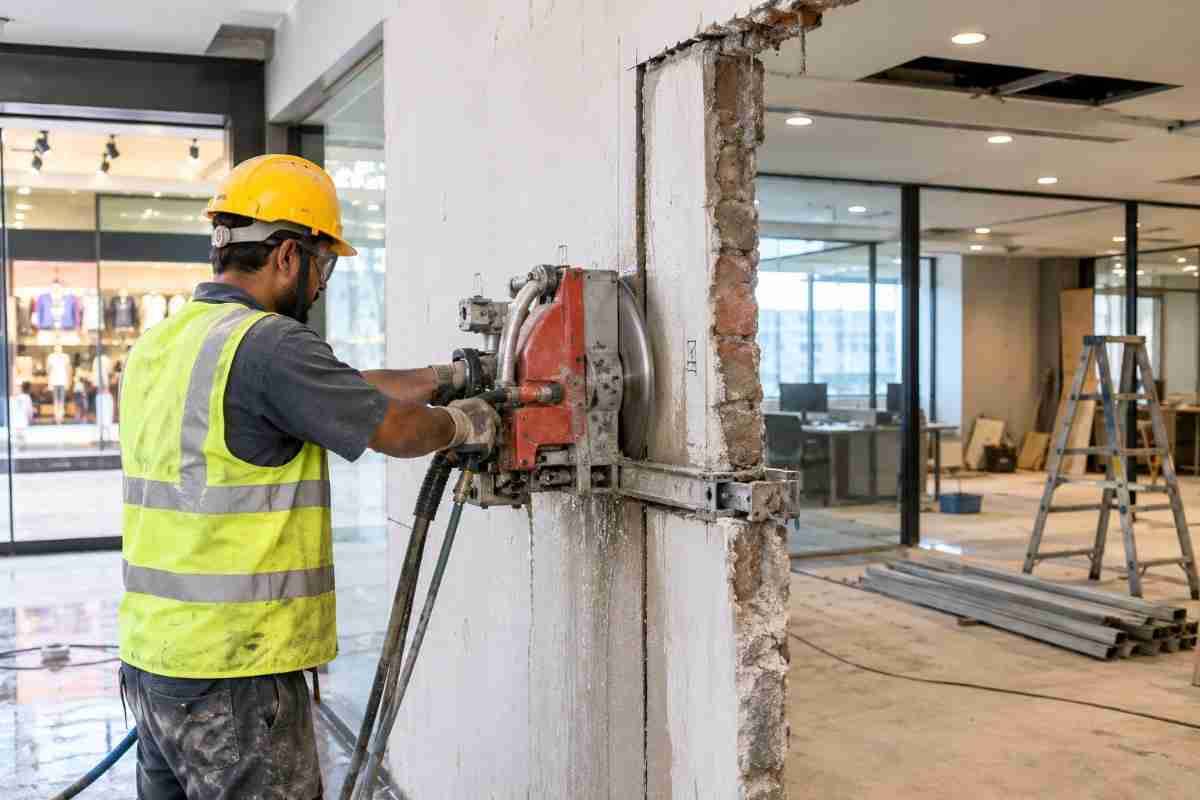
A wall saw is a track-mounted machine with a large circular diamond blade. It makes long, straight cuts through thick concrete walls and slabs. It suits large openings such as shop fronts, wide doorways and lift shafts. The track keeps the cut accurate, and the work is quieter than conventional breaking.
2. Wire Saw Cutting
A diamond wire saw uses a flexible, diamond-embedded cable looped around the section to be removed. It works well for very thick walls, awkward shapes and places where a standard saw cannot reach. It is common in heavy industrial and large commercial jobs.
3. Hand Saw Cutting
Handheld diamond saws suit smaller or confined jobs, such as cutting a window in a brick wall or trimming a doorway. They are flexible but depend on the operator’s skill.
4. Core Cutting
Core cutting uses hollow cylindrical diamond drill bits to make round holes of different diameters in walls and slabs. It is ideal for pipes, cables, AC ducts, drainage lines and anchor points, which are common in office fit-outs where electrical, plumbing and air-conditioning work all need passages.
5. Wet vs. Dry Cutting
Wet cutting uses water to cool the blade and suppress dust, making it ideal for occupied spaces. Dry cutting is used where water could damage interiors or equipment, usually with dust-extraction systems. A good contractor will recommend the right method for your site.
Wall Cutting for Commercial Shops: What to Know
Retail and service shops have particular needs. You usually can’t afford long closures, and the shopfront affects your brand and your customers.
Shopfront widening: A wider entrance lets in more light and makes the shop more inviting. Because the front wall may carry load, it may need support from beams or lintels before cutting.
Adding shutters or glass facades: Modern retail often relies on glass frontage. Precise cutting keeps the opening true to the frame, which affects how well the glazing fits.
Connecting shops: When you expand into the unit next door, a clean connecting opening avoids a patchy, unprofessional look.
Mezzanine floors and staircases: Cutting a slab for a staircase needs careful planning for the opening’s position and size, and often structural reinforcement.
Many Delhi markets have narrow lanes, limited access and tight working hours. Compact equipment and flexible scheduling, including after-hours work, are valuable here.
Wall Cutting for Office Renovation in Delhi
Office renovation is about adapting space to how people actually work. Wall cutting helps in several ways.
Open-plan conversion: Removing non-structural partitions can transform a cramped floor into a bright, flexible workspace.
Meeting rooms and cabins: Sometimes the answer is cutting openings for glass partitions, sliding doors or pass-throughs.
Server rooms and technical infrastructure: Cable routes, cooling ducts and conduits need accurate holes. Core cutting prevents damage to existing reinforcement and services.
HVAC and fire-safety retrofits: Modern codes may require sprinkler lines, exhaust ducts and fire-rated passages. Precise cutting keeps these installations tidy and compliant.
Occupied-building work: Many Delhi offices are in multi-tenant buildings where other businesses are still operating. Low-vibration, low-noise, dust-controlled cutting is essential to avoid complaints and keep everyone productive.
Structural Safety: The Most Important Consideration
Before any wall is cut, you must know whether it is load-bearing. Cutting a structural wall or beam without proper analysis can seriously compromise a building.
Key safety steps include:
- Structural assessment: A qualified structural engineer should review the building’s drawings and the specific wall.
- Scanning for reinforcement and services: Concrete scanners can detect rebar, post-tension cables, electrical conduits and pipes inside the wall.
- Temporary support: Props and shoring may be needed to hold up the load while an opening is created.
- Proper lintels and reinforcement: New openings in load-bearing walls need appropriate beams or frames.
- Compliance and permissions: Depending on the property, you may need approval from the building owner, society or relevant civic authorities. Check the requirements for your specific location, particularly for older buildings and heritage zones.
Never let a contractor start cutting without addressing these points. Cheap, careless work can cost far more later.
Benefits of Professional Wall Cutting
Precision: Cuts follow exact measurements, so frames, glass and fittings fit properly.
Speed: Professional equipment completes in hours what manual breaking might take days to do.
Safety: Controlled cutting lowers the risk of accidental damage and injuries.
Less disruption: Reduced noise, vibration and dust help neighbours and staff.
Cleaner finish: Straight edges mean less plastering and repair work.
Cost-effectiveness: Although the hourly rate may look higher, fewer repairs, faster completion and lower risk usually make it better value.
Factors That Affect Wall Cutting Costs in Delhi
There is no single price, as every job differs. Typical factors include:
- Wall thickness and material: Reinforced concrete costs more to cut than brick.
- Size and number of openings: Larger or more numerous cuts take more time.
- Cutting method: Wire saws and specialised setups can cost more than hand saws.
- Site access: Upper floors, narrow lanes and limited access raise logistics costs.
- Working hours: Night or weekend work may carry a premium.
- Reinforcement density: Heavily reinforced concrete wears blades faster.
- Debris removal and disposal: Some quotes include this, others don’t, so clarify it upfront.
Always ask for a written quote that lists the scope, method, timeline and what’s included. Compare quotes on value and not only on price.
How to Choose the Right Wall Cutting Contractor in Delhi
A cutting job is only as good as the team doing it. Look for:
- Experience with commercial projects: Shops and offices have different constraints from homes.
- Modern, well-maintained equipment: Quality machinery gives cleaner, safer results.
- Trained operators: Skilled technicians read the structure and adapt to surprises.
- Safety practices: Ask about protective equipment, site protection and risk assessment.
- Clear communication: A reliable contractor explains the plan, timeline and cost without vague answers.
- Dust and noise control: Ask how they’ll protect your premises and neighbours.
- Reputation: Check reviews, past projects and references.
Companies like Core Cutting India specialise in concrete cutting services, including wall cutting, core drilling and related work, and understand the demands of Delhi’s commercial renovation market.
Step-by-Step: How a Typical Wall Cutting Project Works
Step 1: Site visit and consultation. The contractor inspects the wall, understands your goals and notes access issues.
Step 2: Assessment and planning. The team scans the wall, checks for hidden services and confirms the structural approach with an engineer where needed.
Step 3: Quotation and scheduling. You receive a clear quote and agree on timing that minimises business disruption.
Step 4: Site preparation. Floors, furniture and equipment are protected, and the work area is cordoned off.
Step 5: Marking and setup. Cut lines are marked exactly, and machines and tracks are installed.
Step 6: Cutting. The wall is cut in sections using the chosen method, with dust and slurry controlled.
Step 7: Removal and cleanup. Sections are safely lifted out, and debris is cleared.
Step 8: Finishing support. The clean edges are ready for framing, plastering, glazing or cladding.
Tips to Minimise Disruption to Your Business
- Plan around trading hours. Schedule noisy work for evenings or closed days.
- Inform neighbours and building management early. This avoids complaints and delays.
- Remove or cover valuables and stock. Even low-dust methods benefit from protection.
- Coordinate trades. Align carpenters, electricians and glaziers so the opening is finished promptly.
- Keep paperwork in order. Have approvals and permissions ready before work starts.
Common Mistakes to Avoid
- Cutting before confirming whether a wall is load-bearing
- Choosing a contractor purely on the lowest price
- Skipping reinforcement and services scanning
- Ignoring dust, noise and neighbour concerns
- Not agreeing in advance on debris removal
- Failing to plan finishing work, leaving the opening unprotected
Frequently Asked Questions
Is wall cutting better than breaking a wall?
For most commercial projects, yes. It is more precise, causes less vibration and dust, and leaves cleaner edges, which reduces repair work and disruption.
Can a load-bearing wall be cut?
Sometimes, but only after a structural engineer’s assessment, with proper temporary support and reinforcement such as new beams or lintels. It should never be done casually.
How long does wall cutting take?
It depends on wall thickness, material and size of the opening. A simple opening may take a few hours, while larger or more complex jobs can take several days.
Is wall cutting noisy or dusty?
It is generally quieter and cleaner than manual breaking, especially with wet-cutting methods. Some noise is unavoidable, so scheduling matters.
Can wall cutting be done while my shop or office is operating?
Often yes, particularly with low-vibration, dust-controlled methods and after-hours scheduling. Discuss your constraints with the contractor beforehand.
What is the difference between wall cutting and core cutting?
Wall cutting removes larger sections or makes straight-edged openings. Core cutting drills round holes for pipes, ducts and cables.
How much does wall cutting cost in Delhi?
Costs vary with wall material, thickness, size of the opening, method and site access. Request a site-specific written quote for an accurate figure.
Do I need permission to cut a wall in a commercial property?
Usually you need the owner’s or building management’s approval, and some buildings require additional permissions. Check the rules for your property and location.
Conclusion
Wall cutting is one of the most useful tools in commercial renovation. It lets Delhi’s shop owners and office managers reshape their spaces quickly, safely and cleanly, whether they’re widening a shopfront, opening up a floor plan or running new services through a building.
The keys to a good result are simple. Understand the structure, choose the right cutting method, plan around your business, and work with an experienced team. Cutting corners on any of these can lead to cost overruns, damage and delays.
If you’re planning a renovation in Delhi, consider speaking with the specialists at Core Cutting India. A site visit and a clear plan are the best first steps toward a smooth, professional result.