
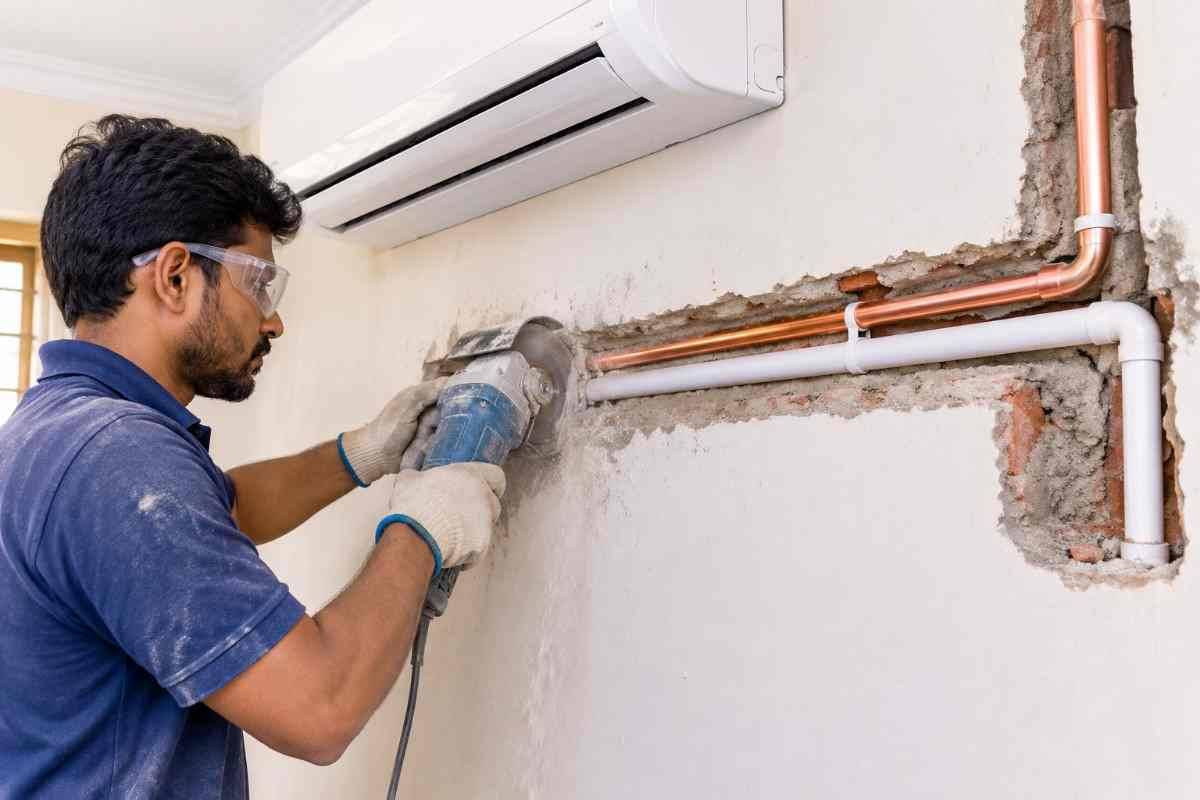
Installing a split air conditioner looks simple until you have to get the copper piping and drain line through a solid wall. Most homes and offices in India have reinforced concrete or thick brick walls, and a badly made opening can lead to cracks, leaks, noise, weak cooling, and an expensive repair. That is why professional wall cutting for AC copper pipe and drainage installation has become the standard approach for anyone who wants a clean, durable and safe result.
In this guide from Core Cutting India (https://corecuttingindia.com/), we explain how wall cutting works, which methods suit different walls, how to plan the pipe route, and what mistakes to avoid. Whether you are a homeowner, contractor, interior designer or facility manager, this will help you make better decisions before the first hole is made.
What Is Wall Cutting for AC Copper Pipe and Drainage Installation?
A split AC has an indoor unit and an outdoor unit. Between them run several lines:
- Two copper pipes: a thinner liquid line and a thicker suction line, each wrapped in insulation.
- A drain pipe: carries condensate (water removed from indoor air) outside.
- An electrical cable: powers and connects the two units.
All of these must pass through the wall, usually bundled together. Wall cutting is the process of making a precise, clean opening that lets them through without damaging the structure. The opening may be a round hole made by a diamond core drill, or a narrow channel (a chase) cut into the wall surface so the pipes can run concealed.
Why You Should Not Use a Hammer and Chisel
Many people still ask a local mason to break a hole with a hammer and chisel or an ordinary impact drill. It is cheap and fast, but the risks are significant:
- Cracks spread beyond the intended opening because of vibration and impact force.
- Rough, uneven edges make it hard to seal the opening and fit a sleeve properly.
- Rebar and conduits can be hit accidentally, weakening the wall or damaging wiring.
- Heavy dust and debris spoil flooring, furniture and paint.
- Poor alignment can disturb the pipe slope and hurt drainage.
Professional cutting uses diamond tools and controlled water cooling, so the opening is smooth, accurate and neat. The surrounding wall stays intact.
Main Methods of Wall Cutting for AC Pipe Installation
The right method depends on wall thickness, material, access and the layout of your AC lines.
1. Diamond Core Cutting (Core Drilling)
Core cutting is the most common method for AC pipe holes. A hollow cylindrical bit with diamond segments is rotated against the wall. It cuts a perfectly round hole and removes a solid “core” of concrete or brick.
Best for: RCC walls, brick walls, block walls and columns where a single round opening will carry the pipe bundle.
Advantages:
- Clean, circular opening with smooth walls
- Minimal vibration, so less risk of cracking
- Reduced dust when water-cooled
- Accurate angle control for drainage slope
- Works through thick, heavily reinforced concrete
Typical hole diameters for a standard split AC are often in the range of 50 mm to 75 mm. Multi-AC or VRF installations may need larger or multiple holes. Your installer or the AC manufacturer’s guidelines should confirm the exact size.
2. Wall Chasing (Groove Cutting)
If you want the copper pipe and drain line hidden inside the wall for a cleaner interior look, a wall chaser or groove cutter is used. It makes straight, parallel cuts to a controlled depth, and the material between the cuts is removed to form a channel.
Best for: New constructions, renovations and premium interiors where exposed piping is not acceptable.
Advantages:
- Concealed piping for a neat finish
- Straight, uniform channels
- Much less dust than manual chiselling when a vacuum attachment is used
3. Wall Saw Cutting
For larger openings, such as a service shaft, a wide duct opening for ducted or cassette AC systems, or removal of a wall section, a track-mounted wall saw is used. It follows precise lines and can cut very thick concrete.
Best for: Commercial buildings, large openings and heavy structural cutting.
4. Hand-Held Wall Cutting
Hand-held diamond cutters can be used for small adjustments, corner work and tight spaces where larger machines cannot fit.
How to Plan the Pipe Route Before Cutting
A good cut starts with good planning. Skipping this step is the most common reason installations go wrong.
1. Decide the indoor and outdoor unit positions. Keep the pipe run as short as possible. Longer runs reduce cooling efficiency and add cost. Check the manufacturer’s maximum pipe length and height difference.
2. Choose the hole location. The hole should sit behind or near the indoor unit, at a height that allows a gentle downward slope for the drain line toward the outside.
3. Plan the drain slope. Condensate drains by gravity, so the drain pipe must slope downward from the indoor unit to the outlet. A slope of roughly 1:50 to 1:100 is commonly recommended, but follow the guidance from your AC brand and installer. Too little slope causes water to pool and leak indoors; too much can cause noisy flow.
4. Check what is inside the wall. Electrical conduits, plumbing lines and steel reinforcement can sit exactly where you want to cut. Use building plans, a cable detector or a rebar scanner where possible. Never assume a wall is empty.
5. Mark the exact point and angle. The hole is usually drilled with a slight outward-downward tilt so water cannot run back into the room and the drain flows naturally.
6. Think about the outside. Make sure the opening leads to a safe drainage point and does not discharge on a neighbour’s wall, a walkway or a balcony below.
Step-by-Step Process: How Professionals Cut Walls for AC Pipes
Here is how a professional team typically works:
- Site inspection: Wall type, thickness, access and possible hidden services are assessed.
- Marking: The centre point and the diameter are marked precisely. Chase lines are marked for concealed piping.
- Protection: Floors, furniture and fittings are covered. A water-collection or vacuum system is set up to control slurry and dust.
- Machine anchoring: The core drill is fixed securely using an anchor or vacuum base so it cannot move during cutting.
- Cutting: The diamond bit is run at the right speed with water cooling. The operator watches progress and adjusts if reinforcement is met.
- Core removal: The concrete or brick core is removed carefully from the opening.
- Cleaning: The area is wiped and slurry removed.
- Sleeve fitting and sealing: A PVC sleeve is often placed in the opening. After the pipes pass through, the gap is sealed with suitable sealant or filler to prevent water ingress, insects and air leakage.
Benefits of Professional Wall Cutting for AC Installation
Structural safety. Controlled cutting avoids unnecessary vibration and protects the integrity of walls and columns.
Precise drainage slope. An accurately angled hole supports proper condensate flow, which reduces the risk of leaks and damp patches.
Clean finish. Smooth edges make sleeves and sealing neat and long-lasting.
Less dust and noise. Water-cooled diamond cutting is much more comfortable to live with than hammer breaking, which matters in homes, offices, hospitals and shops that remain occupied.
Speed. An experienced team can often complete a standard AC pipe hole quickly, so your installation can proceed the same day.
Lower long-term cost. Avoiding cracks, leakage and rework usually saves more than the small premium over a rough DIY approach.
Safety Precautions During Wall Cutting
Wall cutting is not a casual DIY task. Professionals follow these precautions:
- Power isolation: Electricity to the area is switched off where wiring may be present.
- Rebar awareness: Cutting through steel reinforcement in structural members like columns and beams should only be done with proper approval and guidance. Not every wall can be cut at every point.
- PPE: Operators use eye protection, hearing protection, gloves and masks where needed.
- Water and electrical separation: Equipment is used with proper grounding and safe water handling.
- Working at height: Higher openings need stable scaffolding or ladders and safe positioning.
- Structural check: On load-bearing walls and older buildings, an engineer’s view may be needed before cutting.
Common Mistakes to Avoid
- Cutting without checking for conduits or pipes inside the wall
- Making the hole too small, forcing the insulation to be crushed and reducing efficiency
- Making the hole too large, which leaves big gaps that are hard to seal
- Wrong drainage angle, causing water to flow back or collect
- Poor sealing, which allows rainwater, insects and hot air inside
- Kinking or bending the copper pipe while pushing it through a tight or misaligned hole
- Cutting a beam or column without structural approval
- Ignoring the outdoor discharge point, so water drips on neighbours or walkways
Tips for Copper Pipe and Drain Line Installation After Cutting
Once the opening is ready, the quality of the pipe work matters just as much:
- Use good-quality insulated copper pipes of the correct gauge as recommended by the AC manufacturer.
- Avoid sharp bends; use gentle curves to protect refrigerant flow.
- Pass the pipes through a protective sleeve so the insulation does not tear against the wall edge.
- Tape the bundle neatly and keep the drain pipe lowest in the bundle so it keeps its downward slope.
- Make a small drip loop in the electrical cable outside, so rainwater does not run along it into the wall.
- Seal both inner and outer gaps properly with sealant, and finish with paint or a cover trim if desired.
- Test the drain by pouring a little water into the indoor unit’s tray and checking flow before final finishing.
What Affects the Cost of Wall Cutting for AC Installation?
Pricing is not one-size-fits-all. These are the main factors:
- Wall thickness and material: RCC costs more to cut than a plain brick wall.
- Hole diameter: Larger holes need bigger bits and more time.
- Number of holes or chase length
- Reinforcement density
- Height and accessibility of the working point
- Site conditions, such as occupied homes needing extra dust protection
- Location and travel
The best way to get an accurate figure is a quick site discussion or a clear description of your wall and requirement.
Where Is Wall Cutting for AC Pipes Commonly Needed?
- Residential flats, villas and independent houses
- Offices, banks and co-working spaces
- Hospitals and clinics
- Restaurants, cafés and retail showrooms
- Hotels and guest houses
- Factories, warehouses and server rooms
- Schools and training centres
Multi-split, VRF and ducted systems in commercial projects may require several precise openings and chases, which makes professional equipment even more important.
Why Choose Core Cutting India?
At Core Cutting India (https://corecuttingindia.com/), we focus on concrete and wall cutting work that is accurate, safe and tidy. When you hire us for AC pipe and drainage openings, you can expect:
- Diamond core cutting and wall cutting equipment suited to different wall types
- Clean, low-dust working methods to protect your interiors
- Accurate slope and alignment to support proper drainage
- Experienced operators who check for hidden risks before cutting
- Prompt scheduling so your AC installer is not kept waiting
- Transparent communication about scope and requirements
Whether you need one opening for a bedroom AC or multiple cuts for a full commercial project, we can plan the work with you.
Frequently Asked Questions (People Also Ask)
1. How do you make a hole in a wall for an AC pipe?
The cleanest method is diamond core drilling. A water-cooled hollow diamond bit cuts a round hole at a slight downward angle toward the outside, then a sleeve is fitted for the pipes.
2. What size hole is needed for a split AC pipe?
It commonly ranges from about 50 mm to 75 mm depending on the pipe bundle and insulation, but always confirm with your AC model’s installation guide and installer.
3. Can I drill a hole for an AC pipe myself?
You can attempt it with a hammer drill, but it risks cracks, rebar damage and hitting concealed wires or pipes. For concrete walls, professional core cutting is much safer and neater.
4. What is the correct slope for an AC drain pipe?
The drain must slope continuously downward away from the indoor unit. A gentle slope in the region of 1:50 to 1:100 is often recommended, though your installer should follow the manufacturer’s instructions.
5. How do you seal the hole after AC pipe installation?
Use a PVC sleeve around the pipes, then seal the gaps with weatherproof sealant or suitable filler on both sides to block water, dust, insects and air.
6. Is wall cutting safe for load-bearing walls?
Small core holes are often acceptable, but cutting structural elements such as beams, columns and load-bearing walls should only be done after proper assessment, and sometimes engineer approval.
7. Is core cutting dusty?
Water-cooled diamond core cutting produces far less dust than hammer breaking, though some slurry is created, which is controlled with proper setup.
8. Can AC pipes be hidden inside the wall?
Yes. Wall chasing creates channels for concealed pipes. The plan must be made before plastering or finishing, and proper access for service and leak checking should be considered.
9. How long does an AC pipe hole take to cut?
A standard hole can often be done relatively quickly, depending on wall thickness, reinforcement and access.
10. Who can do wall cutting for AC installation near me?
Look for a company with diamond core cutting experience and good reviews. You can contact Core Cutting India at +91 70096 79903 or visit https://corecuttingindia.com/.
Final Thoughts
Good AC performance does not depend only on the unit you buy. It also depends on how well the copper pipes and drain line are installed, and that starts with the cut in the wall. A precise, properly angled and neatly finished opening protects your structure, keeps drainage working, and gives your interiors a clean look for years.
If you are planning an AC installation or relocation and need safe, accurate wall cutting, talk to professionals who do it every day.
Book Wall Cutting for Your AC Installation
Core Cutting India
🌐 Website: https://corecuttingindia.com/
📞 Call or WhatsApp: +91 70096 79903
Tell us your wall type, hole size and location, and our team will guide you on the best cutting method for your AC copper pipe and drainage installation.