
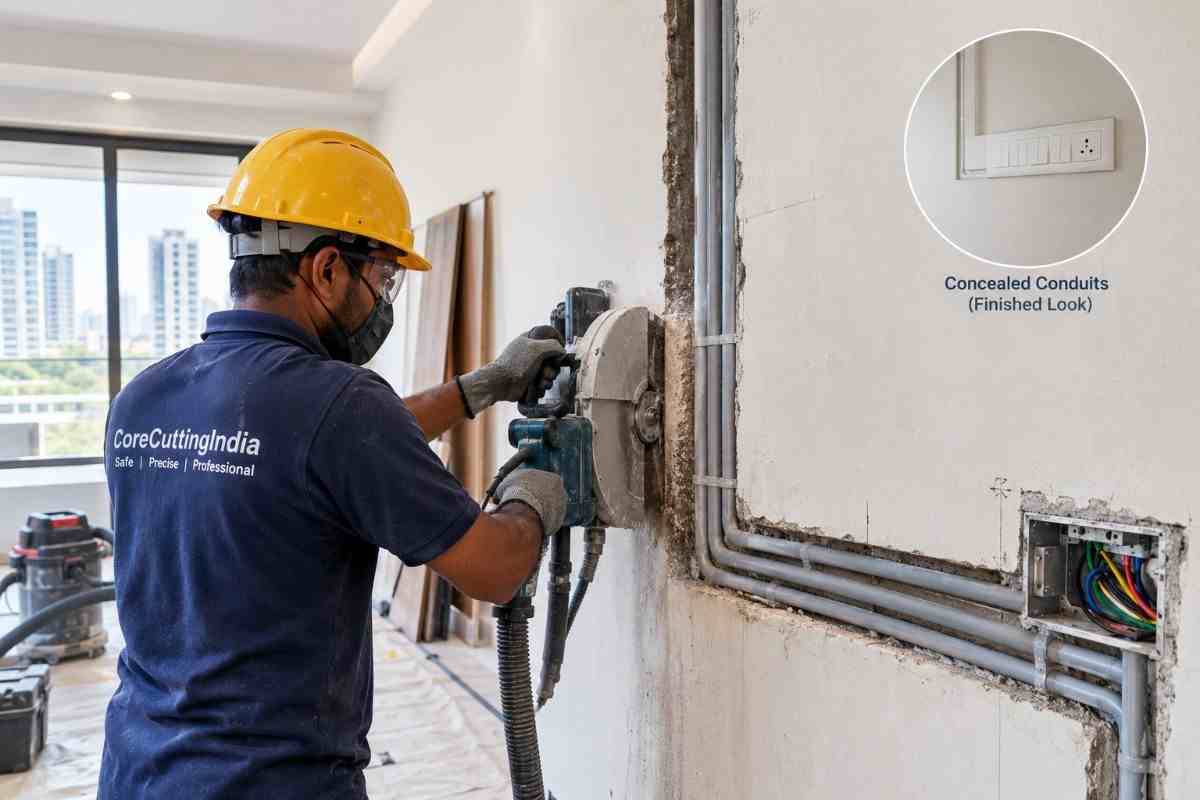
Walk into any newly finished apartment in Dwarka, Greater Kailash, Rohini, or Vasant Kunj and you’ll notice something: clean walls. No tangled wires, no surface-mounted pipes, no exposed junction boxes. Everything is tucked neatly inside the wall.
That finish comes from concealed electrical conduit wiring. Behind every concealed wiring job is a precise, skilled operation called wall cutting, also known as wall chasing. Done well, it protects your home’s structure, keeps dust to a minimum, and gives you a safe, long-lasting electrical system. Done badly, it leaves cracked plaster, weakened walls, and costly repairs.
This guide explains how wall cutting for concealed conduits works, why it matters in Delhi’s homes, and how to get it right. It draws on the kind of practical knowledge the team at Core Cutting India applies on residential and commercial sites across the capital.
What Is Wall Cutting for Concealed Conduits?
Wall chasing is the process of cutting narrow, straight channels (called chases or grooves) into a wall surface. These channels hold electrical conduits, which are protective pipes through which wires run. After the conduit and wiring are fitted, the channel is filled with cement mortar or plaster and finished to match the wall.
The result is a wall that looks untouched, with switches, sockets, and fixtures connected to wiring hidden underneath.
Concealed conduit wiring replaced older surface wiring for several reasons:
- Aesthetics: Modern interiors with false ceilings, textured paint, wallpaper, and modular kitchens look better without visible cables.
- Safety: Conduits shield wires from moisture, rodents, impact, and accidental contact.
- Durability: Wiring inside walls is less exposed to wear, heat, and dust.
- Property value: Buyers and tenants in Delhi expect concealed wiring in a quality home.
Why Wall Cutting Matters So Much in Delhi
Delhi has particular conditions that make professional wall cutting more important than it might be elsewhere.
1. A mix of building types
Delhi’s housing stock is varied. You’ll find:
- Older load-bearing brick homes in areas like Karol Bagh, Old Rajinder Nagar, and parts of South Delhi
- RCC (reinforced cement concrete) framed independent floors and builder floors
- High-rise apartments with concrete shear walls and AAC block partitions
- Heritage and semi-heritage structures
Each behaves differently when cut. A chase in an AAC block wall is easy but needs care to avoid cracking. A chase in a concrete wall needs diamond-based cutting equipment. In a load-bearing wall, every cut affects structural capacity.
2. Seismic considerations
Delhi lies in a high seismic zone. Structural integrity matters more here, and uncontrolled cutting, such as hammering a chase with a hammer and chisel, can weaken walls and cut through reinforcement. Controlled machine cutting reduces that risk considerably.
3. Dust, noise, and neighbours
Delhi homes are close together, and air quality is already a serious concern. Traditional manual chiselling produces heavy dust, loud noise, and vibration that annoys neighbours and can damage nearby finishes. Modern wall chasing machines with dust extraction have made renovation far more tolerable for families living in or next to the work area.
4. Renovation boom
Many Delhi homeowners are upgrading old wiring, adding air conditioners, installing modular kitchens, or converting spaces. Most of these projects require new conduit runs in walls that are already plastered and painted, which calls for precise, minimally invasive cutting.
Traditional Chiselling vs. Machine Wall Chasing
For decades, electricians created wall grooves with a hammer and chisel. It still happens, but the drawbacks are well known.
| Factor | Manual Chiselling | Machine Wall Chasing |
|---|---|---|
| Accuracy | Uneven, wandering lines | Straight, uniform depth and width |
| Wall damage | High risk of cracks and spalling | Minimal, with clean edges |
| Dust | Heavy and uncontrolled | Greatly reduced with extraction |
| Noise and vibration | High | Lower and more controlled |
| Speed | Slow | Much faster |
| Finishing effort | Extra patching required | Less plaster repair |
A wall chasing machine uses twin diamond blades set at a fixed distance apart. It cuts two parallel lines at a controlled depth. The material between the cuts is then removed cleanly, leaving a neat groove. Many machines connect to a vacuum or dust extractor, so most of the dust never enters the room.
For modern Delhi homes with finished interiors, expensive flooring, and sensitive residents, machine chasing is the clear choice.
Step-by-Step: How Professional Wall Cutting for Conduits Works
Here is how a well-run project usually unfolds.
Step 1: Planning and layout
Before any cutting, the electrical layout is finalised. This includes the position of switchboards, sockets, lights, fans, ACs, geysers, and the distribution board. The routes for conduits are marked on the wall with a chalk line or laser level.
Good planning avoids unnecessary cuts. Vertical and horizontal runs should be kept as straight and short as practical.
Step 2: Checking the wall
The team identifies the wall type (brick, AAC, concrete, or hollow block) and checks for existing hidden services such as water pipes, old conduits, or gas lines. This step prevents expensive accidents. Where there’s doubt, a detector or careful test cut is used.
Step 3: Marking and masking
The marked lines are double-checked. Floors, furniture, and nearby finishes are covered, since protecting the surroundings makes cleanup far easier.
Step 4: Cutting the chase
The machine is set to the required depth and width. The operator makes parallel cuts along the marked line, then removes the material between them. Dust extraction runs throughout.
Depth is chosen to suit the conduit size, usually just enough to seat the conduit with a layer of mortar over it.
Step 5: Fixing conduits and boxes
PVC or metal conduits are laid in the chase and clamped. Switch boxes and junction boxes are fixed in recesses cut at marked positions. Bends are kept smooth so wires can be drawn through easily later.
Step 6: Wiring and testing
Wires are pulled through the conduits, connected, and tested before the walls are closed.
Step 7: Filling and finishing
The chase is filled with cement mortar, often with a bonding agent or mesh strip across the joint for better crack resistance. After curing, the surface is plastered, sanded, and painted.
How Deep and Wide Should a Wall Chase Be?
This is one of the most common questions homeowners ask, and it is where careless cutting causes the most harm.
As a general principle:
- Keep chases as shallow as the conduit allows. Deeper cuts weaken the wall, especially in thin partitions.
- Prefer vertical chases to horizontal ones, particularly in load-bearing masonry. Long horizontal chases can reduce a wall’s ability to carry load and resist lateral forces.
- Avoid cutting through reinforcing steel. In RCC walls, columns, and beams, never cut into the reinforcement. If a chase must pass through such an element, it needs structural advice first.
- Avoid chasing in columns and beams altogether unless an engineer approves it.
- Don’t cut chases on both faces of a thin wall directly opposite each other, which can badly reduce its thickness at that point.
Exact limits depend on wall thickness, material, and structural design, so the safest approach is to confirm with your structural engineer or architect, especially for load-bearing and RCC walls. Indian building and electrical codes also provide guidance on conduit installation and wiring practice, and a licensed electrician should follow them.
Different Walls, Different Approaches
Brick walls
Brick is the most forgiving material for chasing. Diamond-blade machines cut cleanly, and the chase is easy to fill and finish.
AAC and lightweight block walls
Popular in new Delhi-NCR apartments, AAC blocks are soft and cut easily, but they are also more prone to crumbling and cracking if cut carelessly. Shallow, controlled cuts and proper mesh reinforcement at the joint help prevent later cracks.
Concrete and RCC walls
These need heavy-duty diamond cutting equipment and, importantly, awareness of embedded reinforcement. This is where professional tools and experience matter most.
Hollow block and partition walls
Thin walls leave little room for error. Surface conduits or alternate routing are sometimes better than deep chasing.
Common Mistakes to Avoid
1. Hiring only on price. The cheapest option is often manual chiselling by untrained labour, and the cost of repairing cracks and broken plaster usually exceeds the saving.
2. Skipping the plan. Changing your mind after cutting means more chases, more patching, and weaker walls.
3. Cutting too deep. Extra depth does not make wiring safer. It only weakens the wall.
4. Ignoring hidden pipes. Cutting into a water line behind the wall can mean leaks, damp patches, and tearing up fresh work.
5. Poor finishing. If the chase is not filled and cured properly, hairline cracks follow the line of the cut. Using mesh or a bonding agent helps.
6. No dust control. Dust ruins flooring and furniture and affects family health, a real concern in Delhi’s air.
7. Using the wrong conduit. Low-quality conduit can crush or deform inside the plaster. Use good-quality conduit from reputable manufacturers.
Wall Cutting in Existing Homes: Renovation Tips
Not every Delhi homeowner is building from scratch. If you’re adding concealed wiring to a lived-in home, a few practical tips help:
- Plan the entire job in one go. Repeated rounds of cutting are disruptive and costly.
- Move or cover valuables. Even with extraction, fine dust can spread.
- Schedule around the family. Machine chasing is quick, but you may prefer to be out for the day.
- Budget for repainting. Even clean chases need patching, and fresh paint on affected walls makes the repair invisible.
- Test everything before closing the walls. Opening a wall again later defeats the purpose.
How Much Does Wall Cutting Cost in Delhi?
There’s no single price, because cost depends on several factors:
- Wall material and hardness (brick, AAC, concrete)
- Total running length of chases
- Depth and width required
- Site access, such as floor level and lift availability
- Dust control requirements
- Whether the work is new construction or renovation
Rather than quoting a number that may not fit your project, the sensible approach is to have a site visit or share your layout and request a quote based on the actual running length and wall type. Compare quotes on what is included (cutting, extraction, cleanup) and not just the headline rate.
Why Professional Wall Cutting Services Are Worth It
You might wonder whether it’s worth hiring a specialist rather than letting the electrician handle everything. For anything beyond a small job, specialist wall cutting offers real advantages:
- Precision: Straight, uniform chases make conduit fixing and plastering easier.
- Structural care: Experienced operators know which cuts are risky.
- Speed: Machines finish in hours what chiselling takes days to do.
- Cleaner sites: Dust extraction protects your home and health.
- Less rework: Clean cuts mean fewer cracks and less plaster repair.
Core Cutting India works with diamond cutting techniques for walls, slabs, and concrete elements, so homeowners, builders, interior contractors, and electricians in Delhi NCR can get clean, controlled results without damaging the surrounding structure. You can learn more about the services at https://corecuttingindia.com/.
Safety and Compliance: What Homeowners Should Know
Concealed wiring is only as safe as the work behind it. Keep these points in mind:
- Use a licensed electrician for all wiring and connections.
- Choose ISI-marked or equivalent quality conduits, wires, and accessories.
- Make sure earthing is properly provided throughout.
- Keep separate conduits for power and low-voltage lines (internet, TV, CCTV) where practical, to reduce interference.
- Leave spare conduit capacity or draw wires for future upgrades.
- Keep a marked drawing of conduit routes before the walls are plastered. It will save you from drilling into a live conduit years later.
That last point is often overlooked. A simple photo record of the open chases before closing them can be extremely valuable.
Frequently Asked Questions (People Also Ask)
What is wall chasing?
Wall chasing is cutting a narrow groove into a wall so electrical conduits or pipes can be laid inside it. After installation, the groove is filled and finished so the services are hidden.
Is wall chasing safe for the building?
When done correctly, with controlled depth, proper locations, and care around reinforcement, wall chasing is safe for typical residential walls. Problems arise from excessively deep, long horizontal, or uncontrolled cuts, especially in load-bearing walls. For structural elements, consult an engineer first.
Can I do concealed wiring in an existing house?
Yes. Concealed wiring can be added to an existing home by cutting new chases, laying conduits, and repairing the walls. Machine chasing with dust control makes this far cleaner than before, though you should expect some patching and repainting.
How deep should a wall chase be?
It should be only as deep as needed to hold the conduit with a protective mortar cover. Deeper cuts weaken the wall, so keep them shallow and avoid cutting reinforcement. Confirm exact limits with your structural engineer, especially for load-bearing walls.
Is machine wall chasing better than manual chiselling?
For most modern homes, yes. Machine chasing produces cleaner lines, less vibration and cracking, less dust (with extraction), and faster results.
Can wall cutting be done without making a mess?
It cannot be completely mess-free, but dust-extraction wall chasers reduce airborne dust dramatically. Covering floors and furniture reduces cleanup further.
How much does wall cutting cost in Delhi?
The cost depends on wall type, chase length, depth, and site conditions. The most reliable way to know is to request a quote based on your layout or a site inspection.
Can you cut chases in RCC walls and columns?
RCC walls can be cut with proper diamond equipment, but you should never cut through reinforcement or chase into columns and beams without structural approval.
Final Thoughts
Concealed electrical conduits are now the standard in modern Delhi homes, and for good reason. They deliver cleaner interiors, better protection for wiring, and higher property value. But the quality of a concealed wiring job begins with the cut. Planned, precise, structure-aware wall cutting sets the foundation for everything that follows, from conduit fixing to plastering and paint.
Whether you’re building a new home, renovating an older flat, or upgrading the wiring in an independent floor, use the right method, plan the layout carefully, and choose professionals who respect both your walls and your living space.
If you’re planning a project in Delhi NCR and want clean, accurate, low-dust wall cutting, get in touch with the team at Core Cutting India to discuss your requirements and get a quote based on your site.