
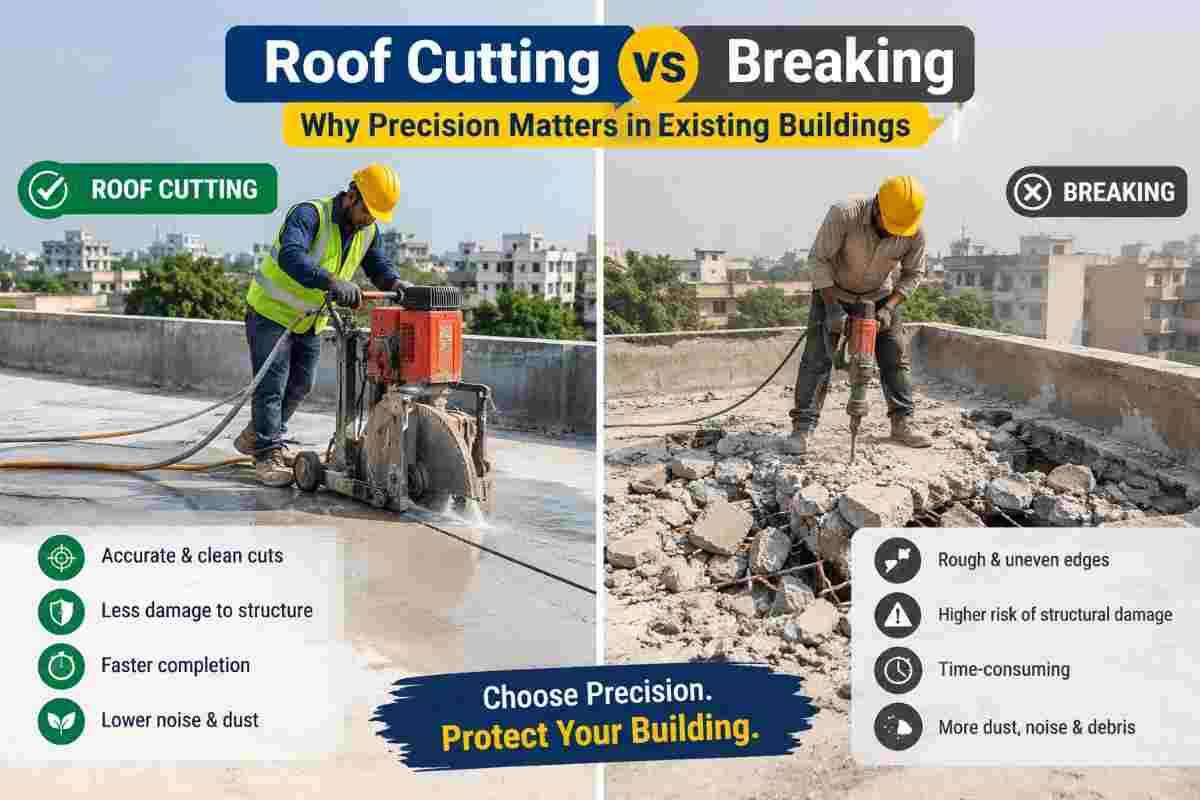
Renovating a home, office or shop in Delhi almost always means altering a wall. You might widen a doorway, open up a kitchen, add a window, or remove a partition to create a larger hall. Sooner or later, a contractor will ask whether you want the wall cut or broken.
The two methods sound similar, but they differ a great deal in noise, dust, precision, structural safety, speed and long-term finish. In a dense city like Delhi, with its apartment societies, shared walls, older buildings and strict neighbours, the choice matters even more.
This guide from Core Cutting India explains how each method works, where it fits, and how to decide for your project.
What Is Wall Breaking?
Wall breaking is the traditional demolition method. Workers use sledgehammers, chisels, jackhammers or electric breakers to smash through a wall and remove the debris. It has been used in Indian construction for decades because the tools are cheap and the technique is familiar to almost every mason and labour contractor.
How it works:
- The area to be removed is marked.
- Workers strike or hammer the wall until it cracks and falls apart.
- The rubble is cleared, and the edges are usually patched and plastered afterwards.
Where it still makes sense:
- Non-structural brick partition walls
- Complete demolition of a structure or room
- Projects where the edges will be fully rebuilt anyway
- Very tight budgets where finish quality is not a concern
The method is simple, but the process is violent. The vibration from hammering travels through the structure and can damage areas you never meant to touch.
What Is Wall Cutting?
Wall cutting, also called concrete cutting or diamond cutting, uses specialised machines fitted with diamond-embedded blades or wires. Instead of smashing the wall, the equipment slices through it along a pre-marked line, leaving clean, straight edges.
Common wall cutting techniques include:
- Wall saw cutting: A track-mounted diamond blade cuts straight lines through thick RCC walls and slabs.
- Wire saw cutting: A diamond-coated wire cuts very thick or awkwardly shaped sections.
- Hand saw / ring saw cutting: Used for smaller cuts, corners and tight spaces.
- Core cutting (drilling): Circular holes are drilled for pipes, ducts, cables and ventilation.
Because the machine removes a controlled section, the rest of the wall stays intact and undisturbed. That is why wall cutting has become the preferred method for modern renovation work in Delhi, especially in apartments, offices, hospitals and commercial buildings. You can see the range of services available at Core Cutting India.
Wall Cutting vs Wall Breaking: A Detailed Comparison
1. Precision and Finish
This is the biggest difference between the two.
Wall cutting produces clean, straight edges with accuracy to a few millimetres. A door frame or window fits neatly, and little plaster repair is needed. Wall breaking produces rough, uneven edges that need to be patched, levelled and re-plastered. A badly broken opening can end up larger than planned, which adds rework cost.
Winner: Wall cutting.
2. Noise Levels
Delhi apartments and housing societies are often strict about renovation noise. Breaking a wall with a hammer or jackhammer is extremely loud, and the sound carries through floors and walls. Neighbours complain, and societies may stop work or fine residents.
Diamond cutting is significantly quieter and smoother. It isn’t silent, but it is far more tolerable, and it usually produces fewer complaints.
Winner: Wall cutting.
3. Dust and Debris
Breaking generates a large amount of dust and loose debris, which spreads through the home and into neighbouring flats. Most cutting methods use water cooling, which suppresses dust. The removed section also comes out in manageable blocks rather than shattered fragments, so cleanup is simpler.
If you have children, elderly family members, or anyone with asthma or allergies, this matters. Delhi’s air quality is already a concern, and adding construction dust indoors is something most families want to avoid.
Winner: Wall cutting.
4. Structural Safety
This is the most serious factor. Hammering sends shock waves through the structure. In reinforced concrete buildings, this can cause micro-cracks in adjacent walls, beams and slabs, and can loosen plaster or tiles far from the work area. In older Delhi buildings, such as those in Karol Bagh, Lajpat Nagar or parts of Old Delhi, the risk is higher.
Cutting avoids most of that vibration and affects only the targeted section. Neither method should be used on a load-bearing wall without an engineer’s assessment, because removing any structural element changes how loads are carried.
Winner: Wall cutting.
5. Speed
For small non-structural walls, breaking can be fast. For thick RCC walls, slabs or precise openings, cutting is usually faster overall once you count the time saved on repairs, cleanup and rework. A job that looks quicker on day one can take longer by the time the finishing is complete.
Winner: Depends on the job. Wall breaking for simple brick walls, wall cutting for concrete and precision work.
6. Cost
Wall breaking usually has a lower upfront cost because the equipment and labour are cheaper. But it often creates hidden expenses:
- Repair and plastering of rough edges
- Fixing cracks or damage to nearby surfaces
- Extra cleaning and debris removal
- Possible disputes or fines from the society
Wall cutting costs more per job, but finishing costs are lower and the risk of costly mistakes drops. For small, simple tasks, breaking may be cheaper overall. For concrete work or anything requiring a neat result, cutting often turns out more economical in the long run. Pricing depends on wall thickness, material, access and location, so a site inspection is the only way to get an accurate quote.
Winner: Breaking for upfront cost, cutting for total value.
7. Suitability for Concrete and RCC
Modern Delhi construction relies heavily on reinforced concrete. Breaking through steel-reinforced concrete with hammers is slow, exhausting and messy, and cutting through the rebar is difficult. Diamond blades cut through both concrete and reinforcement cleanly.
Winner: Wall cutting.
Quick Comparison Table
| Factor | Wall Cutting | Wall Breaking |
|---|---|---|
| Precision | Very high | Low |
| Noise | Lower | Very high |
| Dust | Controlled | Heavy |
| Vibration / structural risk | Minimal | Significant |
| RCC suitability | Excellent | Poor |
| Upfront cost | Higher | Lower |
| Finishing work needed | Minimal | Extensive |
| Best for | Doors, windows, RCC, offices, flats | Simple brick walls, full demolition |
Which Is Better for Delhi Renovation Projects?
For most renovation work in Delhi, wall cutting is the better choice. The city’s housing conditions make the case on their own:
- Apartment living: Shared walls and societies with noise rules make low-vibration, low-noise work much more practical.
- RCC buildings: Most modern construction uses reinforced concrete, which cutting handles far better.
- Older structures: Heritage and ageing buildings can’t afford the shock of heavy breaking.
- Commercial spaces: Offices, showrooms, clinics and restaurants need clean finishes and minimal downtime.
- Air quality concerns: Controlling dust is a real health priority in Delhi.
Wall breaking still has a role. If you are demolishing a non-structural brick partition inside your own independent house, or tearing down a whole structure, breaking can be a practical, budget-friendly option. Just be realistic about the mess and the finishing work that follows.
Common Renovation Projects and the Best Method
Opening a new door in a wall: Wall cutting. You get a clean frame-ready opening with minimal repair.
Adding a window in a concrete wall: Wall cutting. Precision matters for fitting frames and keeping the wall sound.
Removing a brick partition between rooms: Either works, but cutting gives a neater result if you want a clean connection to existing walls.
Creating openings for AC, ducts or pipes: Core cutting. Round holes of exact diameter are drilled without damaging the surroundings.
Cutting a staircase or lift opening in a slab: Slab cutting with diamond saws, not breaking.
Demolishing an entire room or building: Breaking or mechanical demolition, sometimes combined with cutting for controlled sections.
Important Things to Check Before You Start
Whichever method you choose, these steps protect you from expensive mistakes.
- Identify whether the wall is load-bearing. Never remove a structural wall without a qualified structural engineer’s approval. Getting this wrong can compromise the whole building.
- Get permissions. In many Delhi housing societies and cooperative groups, you need approval from the resident welfare association or society before any structural alteration. Local authority rules, such as those of the MCD or DDA, may also apply depending on the property and the change. Check requirements for your specific building.
- Inform your neighbours. A short heads-up avoids conflict, especially for apartments.
- Check for hidden utilities. Electrical conduits, water pipes and gas lines often run inside walls. A professional scan before cutting prevents dangerous surprises.
- Plan debris disposal. Construction waste has to be removed responsibly, and rules about disposal apply in Delhi.
- Hire experienced professionals. Equipment is only as good as the operator. Skilled technicians know the right blade, speed and cutting sequence for each material.
Why Professional Wall Cutting Matters
Wall cutting isn’t something to improvise. Professional teams bring calibrated machinery, trained operators, safety practices and experience across different materials, including concrete, brick, stone and reinforced slabs. They also plan the cutting sequence so heavy sections are supported and removed safely.
When you work with a specialist like Core Cutting India, you benefit from:
- Precision equipment that delivers clean, accurate openings
- Methods designed to reduce noise, dust and vibration
- Experience with Delhi’s building types, from modern high-rises to older constructions
- Safer work practices that protect your property and neighbours
- Reduced finishing cost thanks to neat edges
Frequently Asked Questions
Is wall cutting better than wall breaking?
For most renovation jobs, yes. Wall cutting gives cleaner edges, less noise and dust, and much lower risk of structural damage. Wall breaking can work for simple brick partitions or full demolition, but it leaves more mess and finishing work.
Is wall cutting more expensive than wall breaking?
Cutting usually costs more upfront because it uses specialised equipment. But once you add the cost of repairs, plastering, cleanup and potential damage from breaking, the gap often narrows or reverses, especially for concrete walls.
Can you cut a load-bearing wall?
Technically it can be done, but only after a structural engineer assesses the building and designs proper support, such as beams or columns. Never cut or remove a load-bearing wall without professional approval.
Does wall cutting create a lot of noise and dust?
Compared with breaking, no. Water-cooled diamond cutting greatly reduces dust, and the noise is lower and steadier than hammering. It isn’t completely silent, but it is far less disruptive.
How long does wall cutting take?
It depends on wall thickness, material and the size of the opening. A standard door opening in a wall can often be completed within a few hours to a day, though thicker RCC sections take longer. A site visit will give you a reliable estimate.
Do I need permission to cut a wall in my Delhi flat?
In most cases you should inform and get approval from your housing society or RWA, and structural changes may need approval from the relevant authorities. Rules vary by property type and location, so confirm before starting.
What is core cutting?
Core cutting uses a hollow diamond drill bit to make precise round holes in concrete, brick or stone. It’s commonly used for pipes, drainage, ventilation, cabling and AC installations.
Can wall cutting be done in an occupied house or office?
Yes. Because it creates less vibration, dust and noise, cutting is well suited to occupied spaces. Protect furniture and belongings, and plan the timing around your routine.
Final Verdict
If you want a clean, safe and efficient result, wall cutting is the smarter choice for most Delhi renovation projects. It protects your building’s structure, respects your neighbours, keeps dust under control and gives you openings that are ready for finishing with minimal rework. Wall breaking still has its place for simple, non-structural jobs and full demolition, but it comes with more noise, mess and risk.
Whatever you choose, the key is professional assessment and skilled execution. Before any wall is touched, confirm whether it is structural, secure the necessary permissions and hire a team that knows what it is doing.
Planning a renovation in Delhi NCR? Visit Core Cutting India to discuss your project and get expert guidance on the right cutting method for your walls.