
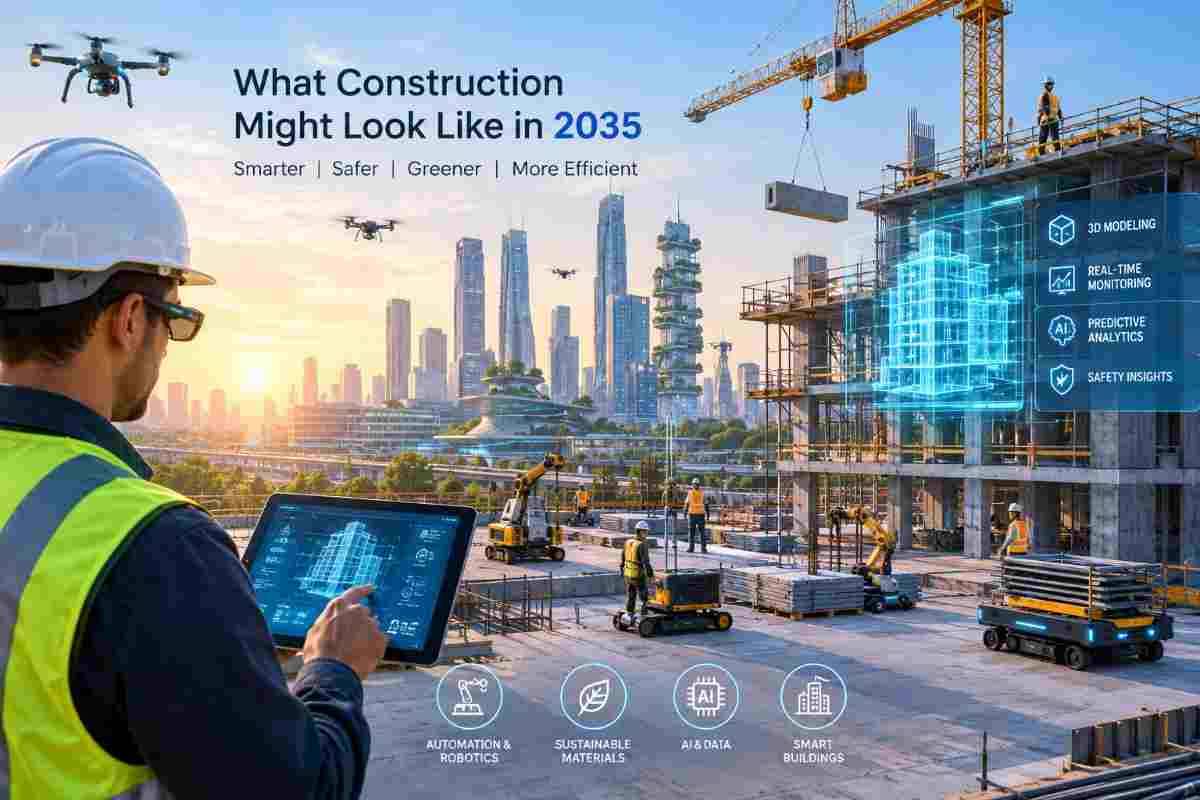
Walk onto a construction site today, and you'll see much of what you'd have seen twenty years ago — cranes, concrete mixers, scaffolding, and crews working with hand tools and heavy machinery. But beneath the surface, change is accelerating. Robotics, artificial intelligence, sustainable materials, and digital design tools are quietly reshaping how buildings get planned, built, and maintained. By 2035, the construction industry could look fundamentally different from the one we know today.
At Core Cutting India, we work at the intersection of precision construction techniques and evolving industry standards, which gives us a front-row seat to how quickly things are shifting. In this article, we explore what construction might realistically look like a decade from now — the technologies, materials, workforce changes, and challenges that will define the next era of building.
1. Automation and Robotics on Site
One of the clearest trends already underway is the rise of construction robotics. Bricklaying robots, autonomous excavators, and robotic arms for welding and rebar tying are no longer experimental — they're being piloted on real projects. By 2035, it's likely that many repetitive, physically demanding tasks will be handled by machines, while human workers shift toward supervising, programming, and troubleshooting automated systems.
This doesn't necessarily mean fewer jobs — it means different jobs. Site workers may need to develop new skills around robotics maintenance, drone operation, and digital site management. Construction firms that invest early in automation could gain a significant edge in speed, cost control, and worker safety, since machines can take over the most hazardous tasks like working at height or handling heavy loads.
Autonomous vehicles are also expected to play a bigger role, particularly for material transport within large sites. Self-driving dump trucks and delivery bots could reduce the need for constant manual coordination, cutting delays and improving logistics on sprawling infrastructure projects.
2. 3D Printing and Prefabrication
3D-printed construction has moved from novelty to real-world application in the last few years, with printed homes, walls, and even small bridges already completed in various countries. By 2035, large-scale 3D printing could become a mainstream method for building affordable housing, disaster relief shelters, and even mid-rise structures.
Alongside 3D printing, prefabrication and modular construction are expected to grow substantially. Instead of assembling every component on-site, entire rooms, wall panels, or structural modules could be manufactured in controlled factory environments and then transported for rapid on-site assembly. This approach reduces waste, shortens project timelines, and improves quality control since factory conditions are far more consistent than an open-air job site.
For a country like India, where housing demand continues to outpace supply, these methods could be transformative — enabling faster, more affordable construction without compromising structural quality.
3. Smarter, More Sustainable Materials
Material science is advancing quickly, and the materials used in 2035 may look quite different from today's standard concrete, steel, and brick. Expect wider adoption of low-carbon concrete alternatives, self-healing concrete that repairs its own cracks, and engineered timber products like cross-laminated timber (CLT) that offer strength comparable to steel with a much smaller carbon footprint.
Recycled and upcycled materials will likely play a bigger role too, as regulatory pressure and corporate sustainability goals push the industry toward circular construction practices — where materials from demolished buildings are reused rather than sent to landfill. Insulation, cladding, and glazing technologies will also continue improving, helping buildings regulate temperature more efficiently and reduce dependence on energy-intensive heating and cooling systems.
Sustainability won't just be a marketing point by 2035 — in many regions, it will be a regulatory requirement, with stricter building codes mandating lower embodied carbon and higher energy performance.
4. Digital Twins and AI-Driven Project Management
The construction industry has historically lagged behind other sectors in digital adoption, but that's changing fast. Building Information Modeling (BIM) is already widely used for design and coordination, and by 2035 it's likely to be paired with digital twin technology — a continuously updated virtual replica of a physical building that tracks everything from structural performance to energy usage in real time.
Artificial intelligence will likely play a growing role in project management as well. AI tools can already help forecast project delays, optimize resource allocation, and flag safety risks by analyzing site photos and sensor data. In the coming decade, expect AI to move from a supporting tool to a core part of daily project decision-making — helping managers predict cost overruns before they happen, schedule crews more efficiently, and even simulate how design changes will affect a building's long-term performance.
This shift toward data-driven construction should also improve accountability and transparency, since stakeholders will have access to real-time dashboards showing exactly where a project stands at any given moment.
5. Drones, Wearables, and Site Safety
Safety has always been a top priority in construction, and by 2035 it's likely to be supported by a much more connected job site. Drones are already used for site surveys and progress monitoring, and their role is expected to expand into real-time hazard detection, inventory tracking, and even automated quality inspections of hard-to-reach structural elements.
Wearable technology could also become standard issue for site workers. Smart helmets and vests equipped with sensors may track vital signs, detect falls, monitor air quality, and alert supervisors to potential hazards before accidents happen. Combined with AI-powered video analytics, these tools could significantly reduce workplace injuries — one of the construction industry's most persistent challenges.
Exoskeletons, still relatively niche today, may also become more common for workers handling heavy materials, reducing physical strain and long-term injury risk.
6. Green Buildings and Net-Zero Construction
Climate goals are pushing the construction industry toward net-zero buildings — structures that produce as much energy as they consume over the course of a year. By 2035, solar integration, energy-efficient HVAC systems, and smart building management systems are likely to be standard features rather than premium upgrades.
Expect more buildings designed with passive cooling and heating principles, especially in regions with hot climates, reducing reliance on energy-intensive air conditioning. Rainwater harvesting, greywater recycling, and green roofs may also become more common as cities look for ways to manage water scarcity and urban heat.
Governments around the world are already tightening building codes to reduce carbon emissions from the construction sector, which accounts for a significant share of global emissions. This regulatory pressure, combined with rising energy costs, is likely to make sustainable construction the default rather than the exception by 2035.
7. A Changing Workforce
Perhaps the most significant shift by 2035 won't be technological at all — it will be human. As automation takes over more repetitive tasks, the construction workforce will likely need to become more technically skilled. Roles like drone operators, BIM coordinators, robotics technicians, and data analysts could become as common on-site as traditional trades like carpentry and masonry.
This shift presents both a challenge and an opportunity. Training programs and vocational education will need to evolve to prepare workers for these new roles, particularly in regions like India where construction remains a major source of employment. Companies that invest in upskilling their workforce now are likely to be better positioned to adapt as automation and digital tools become more deeply embedded in everyday operations.
At the same time, human expertise in areas like structural judgment, on-site problem-solving, and craftsmanship isn't going away. The most successful construction firms in 2035 will likely be the ones that combine technology with skilled human oversight, rather than replacing one with the other.
8. Challenges on the Road to 2035
None of this transformation will happen without friction. High upfront costs for robotics and automation remain a barrier, particularly for small and mid-sized construction firms. Regulatory frameworks in many countries haven't caught up with new construction methods like 3D printing, which can slow adoption even when the technology is ready.
There are also legitimate concerns about job displacement, data security for connected job sites, and the need for standardized safety regulations around autonomous equipment. The construction industry will need to navigate these challenges carefully, balancing innovation with practical, on-the-ground realities — including cost, workforce readiness, and local building codes.
Final Thoughts
Construction in 2035 probably won't look like a science fiction movie set, but it will likely be faster, safer, more sustainable, and significantly more data-driven than it is today. Robotics and automation will handle more repetitive tasks, AI will support smarter decision-making, and sustainable materials will become the norm rather than the exception. At the same time, skilled human expertise will remain essential — the industry of 2035 will be defined by collaboration between people and technology, not one replacing the other.
For companies in the construction and cutting industry, staying ahead of these trends isn't optional — it's a competitive necessity. At Core Cutting India, we're committed to keeping pace with evolving construction technology and techniques, so our clients benefit from precision, efficiency, and reliability today and in the years ahead.
Want to learn more about modern construction techniques and precision cutting solutions? Visit Core Cutting India to explore our services.