
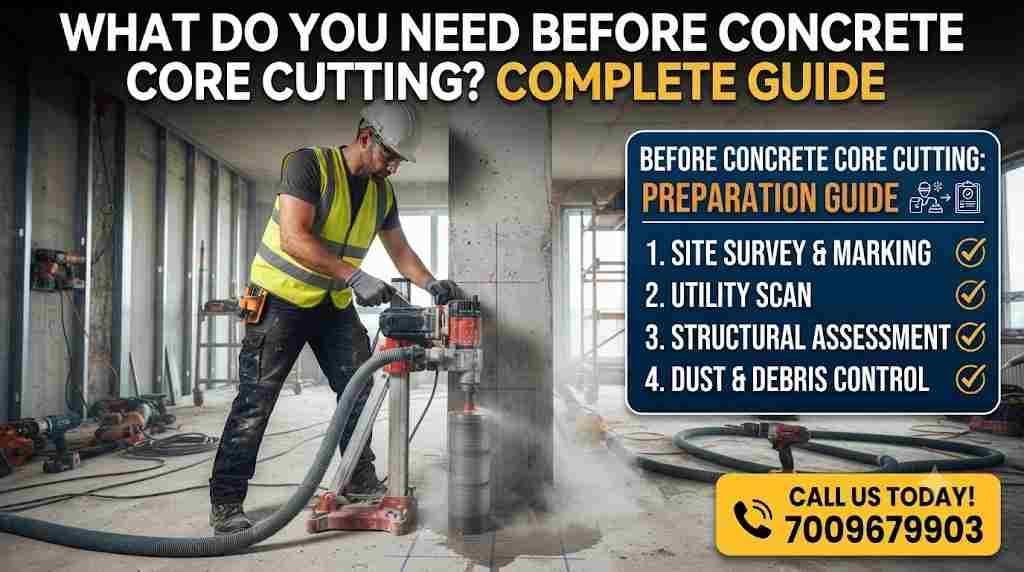
Concrete looks simple from the outside: grey, solid, uniform. Inside, it is anything but. Steel bars, embedded pipes, cables and sometimes tensioned cables all sit hidden in there. A hole drilled without knowing what's inside can mean a damaged pipe, a snapped bar, or in the worst case a weakened structure.
So before you ask "how much will it cost?", ask a better question: what does my contractor need to know about this concrete, and what do I need to know about my contractor?
This guide answers both. It is organised around questions people actually ask us, so you can jump straight to the one that matches your situation.
Have a concrete wall or slab to cut? 📞 Call: 7009679903 | 💬 WhatsApp: Send photos and hole sizes | ✉️ info@corecuttingindia.com
What Is Concrete Core Cutting?
Concrete core cutting uses a hollow, diamond-edged drill bit and water to cut a clean cylindrical hole through concrete. The solid piece removed is called the core. The method avoids the vibration and cracking that hammer drilling can cause, which is why it is preferred for pipes, ducts, cables and structural openings. See our core cutting service page for a fuller explanation.
Question 1: What Kind of Concrete Am I Dealing With?
Not all concrete behaves the same. Tell your contractor which of these applies.
Plain concrete (PCC)
Contains no steel. Easier and faster to cut. Usually found in flooring bases and footings.
Reinforced concrete (RCC)
Contains steel bars. Common in slabs, beams, columns and most modern walls. Cutting is slower because the bit meets steel.
Pre-stressed or post-tensioned concrete
Contains steel cables held under high tension. This is the one that matters most. Cutting a tensioned cable can be dangerous and can seriously damage the structure. If your building might have post-tensioned slabs (some commercial buildings, parking decks and large-span floors do), say so clearly and confirm with the structural engineer or building records before any drilling starts.
Brick or block walls with concrete elements
Many Punjab homes use RCC frames with brick infill. The wall type changes the bit choice and the time required.
Practical tip: If you don't know your concrete type, share photos and the building's age. A good contractor will ask follow-up questions rather than guess.
Question 2: What Is Inside the Concrete?
This is the most important preparation question. Before cutting, you or your contractor should check for:
- Rebar (reinforcement bars). Hitting a bar slows cutting, wears the bit and may require shifting the hole
- Electrical conduits. Live wiring and drilling is a serious hazard
- Water, drain or gas pipes embedded in the slab or wall
- Post-tensioned cables, as discussed above
- Old patches or voids from earlier repairs
How it is checked
- Drawings. Structural, electrical and plumbing drawings are the best source, if you have them
- Scanning. Professional detection equipment such as ground-penetrating radar or rebar scanners can map what's inside
- Inspection. Looking at the opposite face or the room below sometimes reveals pipe routes
Don't be shy about asking, "How will you check before drilling?" It is a normal professional question.
Question 3: Is It Safe and Allowed to Cut Here?
Structural elements
Beams, columns and shear walls carry the building's load. Cutting them without engineering approval is unsafe. Read our note on beam cutting before planning anything near them.
Spacing and edge rules
Holes placed too close to each other, or too close to the edge of a slab or a beam, can weaken the concrete. Exact limits depend on the structure, so ask an engineer, not a guess.
Permissions
- Society or colony approval for apartments
- Landlord's consent for rented property
- Building manager approval for commercial spaces
Treat this as a checkpoint, not paperwork. A job stopped halfway is worse than a job delayed by a day.
Question 4: What Size, Depth and Position Do I Need?
Give your contractor exact numbers.
| Detail to share | Why it matters |
|---|---|
| Hole diameter | Decides the bit and machine used |
| Wall or slab thickness | Affects time and price |
| Position on wall | Must be clear and marked |
| Angle or slope | Needed for AC pipes and drainage |
| Number of holes | Helps with batch pricing |
| Height from floor | May need a ladder or scaffold |
A simple marking method
- Mark the centre point with chalk or tape
- Write the diameter beside it
- Draw an arrow for slope direction
- Check what is on the other side of the wall
- Photograph and send it before cutting day
Question 5: What Do I Need to Arrange on Site?
Concrete cutting is a wet process and uses a powered machine, so a few basics must be ready.
- Power point near the work area
- Water source and a plan for slurry
- Clear access for the crew and equipment
- Protected floors and furniture
- Someone on site to approve work
For the full list, see our guide on what to arrange before core cutting. If this is part of a larger project, our interior renovation checklist shows where cutting fits in the schedule.
Question 6: Is the Concrete Mature Enough to Cut?
Fresh concrete gains strength over time. Cutting very young concrete can cause edge damage or spalling. If your slab or wall was cast recently, tell the contractor the casting date and ask whether it should wait. For most renovation work on older buildings this isn't an issue, but it matters on new construction.
Question 7: What Will It Cost?
Pricing depends on:
- Hole diameter and depth
- Concrete strength and reinforcement density
- Working height and access
- Number of holes
- Your city and urgency
Use the Core Cutting Rate Calculator for a quick estimate, then confirm your exact price after sharing photos and measurements. Our platform's general guide suggests about ₹150 to ₹800 per hole, though larger or more complex openings can fall outside that range.
Ask what the quote includes, such as machine, bits, labour and cleanup, and whether anything is charged extra.
Question 8: How Do I Choose the Right Contractor?
Look for:
- Use of wet diamond core drilling equipment
- A clear method for checking reinforcement and services
- Experience with your concrete type
- A written or WhatsApp-confirmed quote
- Reviews or photos of past work
- Clear answers about safety and cleanup
On Core Cutting India, each contractor profile shows ratings and reviews, which helps you compare before you call. Start from the homepage and select your city.
Myth vs Fact
Myth: Any drill can cut concrete cleanly. Fact: Hammer drills can crack edges and are unsuitable for larger holes. Core drilling gives cleaner results.
Myth: If there's no visible steel, the wall has none. Fact: Steel is hidden inside. Always check before cutting.
Myth: Cutting a small hole can't hurt the structure. Fact: Hole position, spacing and nearby structural elements matter, even for small holes.
Myth: Cheapest quote is the best quote. Fact: Check what's included and how the contractor handles hidden services and cleanup.
Quick Glossary
- Core: the cylindrical piece of concrete removed by the bit
- Diamond bit: the hollow cutting tool with diamond segments
- Slurry: the wet mixture of water and concrete dust
- Rebar: steel reinforcement bars inside concrete
- Post-tensioned slab: a slab with tensioned steel cables inside
- GPR: ground-penetrating radar, used to scan concrete
Your Pre-Cutting Checklist
- [ ] Concrete type identified or photos shared
- [ ] Hidden services checked
- [ ] Post-tensioning ruled out or confirmed with an engineer
- [ ] Structural approval for any beam, column or wall work
- [ ] Permissions confirmed
- [ ] Hole sizes, depth and positions marked
- [ ] Power, water and access arranged
- [ ] Quote and inclusions confirmed
- [ ] Post-cutting inspection planned
Local Note for Punjab Customers
Punjab buildings range from older brick-and-RCC family homes to newer apartments and commercial complexes. Many older houses have been extended and repaired over time, so the wall can contain surprises. Sharing photos, the building's age and any past alteration details helps the crew plan. In dense markets of cities like Ludhiana, Amritsar and Jalandhar, tell the contractor about access and parking, too.
Compare contractors, ratings and reviews on our Punjab core cutting service page. In Jalandhar, our guides on chimney hole cutting and exhaust fan hole cutting show typical household jobs.
Frequently Asked Questions
What do I need before concrete core cutting?
Know your concrete type, check for hidden steel and services, get any structural approvals, mark the hole position and size, arrange power and water, and confirm permissions and the quote with your contractor.
Can core cutting damage reinforcement?
It can if the position isn't checked first. Professionals scan or inspect before drilling and may adjust the hole location to avoid cutting steel unnecessarily.
Is it safe to core cut a post-tensioned slab?
Only with expert confirmation. Cutting a tensioned cable can be dangerous, so always verify with a structural engineer or building records first.
Can I cut through a beam or column?
Not without approval from a qualified structural engineer, because these elements carry the building's load.
How much does concrete core cutting cost?
It depends on diameter, thickness, reinforcement, access and city. Our general range is about ₹150 to ₹800 per hole. Use the Rate Calculator and confirm with your contractor.
Is water necessary for concrete core cutting?
Yes. Wet cutting cools the diamond bit and flushes cuttings, giving cleaner holes and longer bit life.
How do I book concrete core cutting?
Call or WhatsApp 7009679903 with your city, hole sizes, wall or slab thickness and photos for guidance and a quote.
Get Your Concrete Cut Right the First Time
Not sure what's inside your wall or slab? Send us photos and your hole details, and we'll guide you to the right verified contractor.
📞 Call or 💬 WhatsApp: 7009679903
✉️ Email: info@corecuttingindia.com 🌐 Website: corecuttingindia.com 🧮 Instant estimate: Rate Calculator