
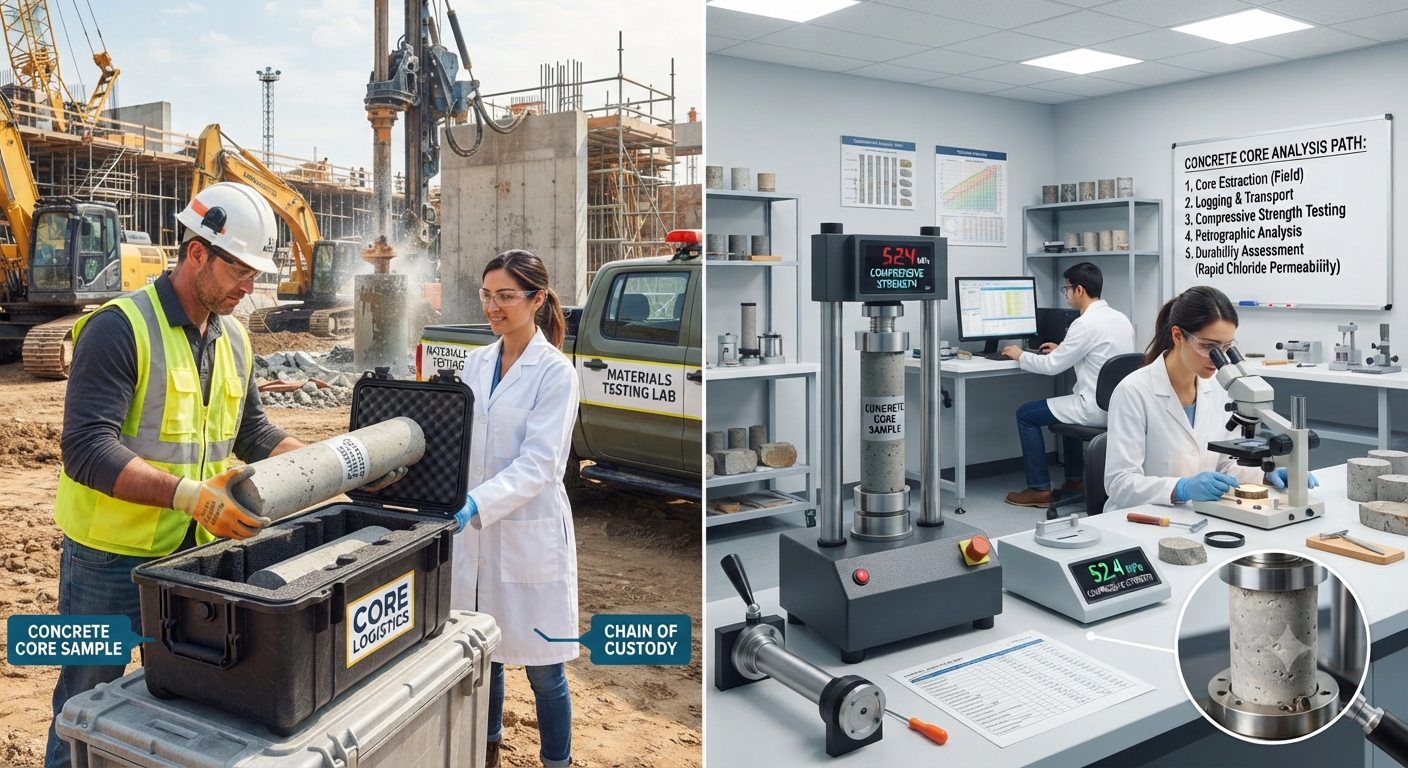
When a specialized diamond-tipped drill bit bores through a reinforced concrete wall, column, or slab to extract a cylindrical specimen, most onlookers assume the job is done. The heavy machinery is packed up, the site is cleared, and the core cylinder is handed over to engineers. However, the extraction of a concrete core is merely the opening chapter of a rigorous, highly technical scientific process.
What happens to that cylindrical plug of hardened cement, aggregate, and steel once it leaves the job site? How does it transform from a raw piece of debris into a definitive verdict on a multi-crore real estate project's safety?
This comprehensive guide dives deep into the post-extraction lifecycle of a concrete core, tracking its journey from the field to the testing laboratory, and exploring how the resulting data dictates structural interventions across India.
1. The Immediate Field Phase: Care, Labeling, and Chain of Custody
The moment a core cylinder is dislodged from a structure, its integrity becomes paramount. A compromised sample yields distorted laboratory results, leading to catastrophic miscalculations in structural assessments.
Immediate Inspection and Measurement
-
Visual Evaluation: Engineers immediately inspect the core for honeycombing, segregation of aggregates, visible voids, or major internal cracking.
-
Dimensional Verification: The length-to-diameter ratio (l/d) is measured on-site. Standard testing protocols (such as IS 516 or ASTM C42) require specific ratios to ensure accurate compressive strength conversion factors.
Labeling and Sealing
Every extracted core is meticulously labeled with a waterproof marker, detailing:
-
Specific location coordinates (e.g., Column C-14, Basement 2).
-
Orientation (vertical extraction from a slab versus horizontal extraction from a beam).
-
Date, time, and project name.
To prevent moisture loss—which drastically alters internal strength dynamics—cores are immediately wrapped in plastic membranes or placed in airtight cylindrical containers before being transported to an NABL-accredited testing facility.
2. Laboratory Preparation: Conditioning Before Testing
Upon arrival at the testing laboratory, the core undergoes a precise preparation phase. You cannot simply place a raw, rough-cut cylinder into a heavy-duty compression testing machine.
Trimming and Capping
-
End Preparation: Diamond saws trim the uneven ends left by the core cutting drill. Smooth, parallel, and flat surfaces are mandatory to ensure even load distribution during testing.
-
Capping or Grinding: Sulfur capping or high-strength grinding is applied to the end surfaces to eliminate microscopic surface irregularities.
Moisture Conditioning
Depending on whether the structure is typically wet (like a water treatment plant in Chennai) or dry (like a commercial office high-rise in Gurgaon), the laboratory may condition the core to a specific moisture state. Standard testing often requires air-drying or saturation, followed by precise weighing to calculate the density of the hardened concrete.
3. Analytical Phase: What Tests Are Performed on the Core?
A concrete core is a treasure trove of physical and chemical data. Depending on the structural audit requirements, laboratories subject the core to several diagnostic procedures:
A. Compressive Strength Test (IS 516 / ASTM C42)
This is the primary reason cores are extracted. The specimen is placed in a hydraulic compression testing machine where axial load is applied continuously until structural failure occurs.
-
The Indian Context: In many older residential buildings across South Mumbai or Kolkata, original cube test records are missing or disputed during redevelopment. Core testing provides the true in-situ compressive strength (fcu), helping structural consultants determine if the building can safely support additional vertical floors under the latest National Building Code (NBC) guidelines.
B. Petrographic Examination
When a structure shows signs of premature distress—such as alkali-silica reaction (ASR), sulfate attack, or thermal cracking—a microscopic petrographic analysis is carried out.
-
Thin sections of the core are sliced, mounted on glass slides, and examined under polarized light microscopes. This reveals mineral compositions, cement-to-aggregate bonding, micro-cracking networks, and the presence of harmful chemical agents.
C. Carbonation Depth Measurement
Exposing a freshly cut cross-section of the core to a phenolphthalein indicator solution reveals the depth of carbonation. If the chemical spray remains clear instead of turning pink, it indicates that carbon dioxide has penetrated the concrete and neutralized its alkaline environment, leaving internal reinforcement vulnerable to rust.
4. Remedial Phase: Restoring the Core Hole
Extracting a core creates a cylindrical void in a load-bearing element. Leaving this hole unfilled would weaken the structural member, invite moisture ingress, and accelerate corrosion of internal steel reinforcement bars (rebars). Therefore, core hole restoration is a mandatory final step.
Step-by-Step Core Restoration Process
5. Real-World Indian Examples of Core Extraction and Its Aftermath
To understand the practical implications of core extraction, let us examine two typical scenarios across urban India:
Case Study 1: High-Rise Retrofitting in Noida
-
The Situation: A 15-year-old commercial complex in Sector 18, Noida, planned to install heavy chiller units on its rooftop. The original structural drawings were unavailable, and authorities mandated a structural stability certificate.
-
The Extraction & Lab Process: Engineers extracted 12 concrete cores from key columns across different floors. Laboratory crushing revealed an average compressive strength of M25 grade concrete, which was 15% higher than originally estimated.
-
The Outcome: Armed with certified core test data, the structural consultant approved the rooftop load addition with minimal carbon-fiber wrapping reinforcements, saving the developer millions in unnecessary wholesale rebuilding.
Case Study 2: Infrastructure Audit of Coastal Structures in Mumbai
-
The Situation: Bridges and residential societies situated along Mumbai’s coastal belt (such as Bandra and Worli) frequently suffer from severe chloride ingress due to marine environments.
-
The Extraction & Lab Process: Cores extracted from bridge piers underwent rapid chloride permeability testing (RCPT) and petrographic analysis alongside compressive strength tests.
-
The Outcome: The tests uncovered deep chloride contamination and internal micro-cracking. This prompted the municipal corporation to initiate massive cathodic protection and anti-corrosion retrofitting rather than waiting for structural failure.
6. The Broader Ecosystem: Combining Cores with Non-Destructive Testing (NDT)
Core extraction is classified as a semi-destructive testing method. While it yields the most accurate strength data, it cannot be performed infinitely across a structure without causing localized damage.
Therefore, engineering firms in India use core extraction to calibrate Non-Destructive Testing (NDT) methods:
-
Rebound Hammer Test: Provides a quick surface hardness profile across hundreds of points.
-
Ultrasonic Pulse Velocity (UPV) Test: Evaluates internal homogeneity and detects hidden voids.
-
Core Extraction: Performed selectively at representative locations (good, average, and poor zones identified by NDT) to establish a direct correlation curve, maximizing accuracy while minimizing structural intrusion.
Conclusion
The journey of a concrete core does not end when the diamond drill bit finishes its rotation. From rigorous laboratory crushing and microscopic petrographic analysis to meticulous structural report generation and high-strength core hole grouting, the post-extraction phase bridges the gap between raw construction material and certified structural safety.
For property owners, builders, and structural engineers across India, understanding this lifecycle ensures that core extraction is viewed not merely as a destructive cutting job, but as a vital diagnostic procedure safeguarding human lives and multi-crore assets.
Need Professional Core Cutting and Testing Support? If you are managing a construction, renovation, or structural audit project in India and require precision diamond core drilling, controlled cutting, or post-extraction restoration, partner with certified industry experts. Reach out to [email protected] for professional consultation and site execution services tailored to modern engineering standards.
Target-Related Searches
-
concrete core testing procedure IS 516
-
cost of core cutting and testing in India
-
how to fill core holes in concrete walls
-
core cutter machine rental India
-
NABL accredited concrete testing labs near me
People Also Ask (PAA)
-
Why is a concrete core test performed?
-
Does core cutting weaken a concrete structure?
-
How many concrete cores should be extracted for testing?
-
What is the difference between cube test and core test?
-
How are core holes repaired after extraction?